Tag: Al Jazeera

  • US midterm elections 2026 in maps and charts

    US midterm elections 2026 in maps and charts

    On November 3, about 210 million registered voters will decide how much power Donald Trump has for the rest of his US presidency.

    Trump is not on the ballot, but control of the United States Congress is. Made up of the House of Representatives and the Senate, Congress writes the country’s laws and controls federal spending.

    Recommended Stories

    list of 4 itemsend of list

    In this visual explainer, Al Jazeera breaks down how the elections work, which races matter and what the results could mean for either party.

    What happens in the midterm elections?

    Held halfway through a US president’s four-year term, midterm elections decide the makeup of Congress.

    All 435 seats in the House of Representatives and 35 of the Senate’s 100 seats are being contested, including special elections in the states of Florida and Ohio to fill the seats vacated by US Secretary of State Marco Rubio and Vice President JD Vance. Voters in 36 states will also elect governors.

    House members represent one congressional district each and serve two-year terms, while senators serve six-year terms.

    INTERACTIVE_US MIDTERMS_GFX 2026_OVERALL

    Midterm elections are also widely considered a referendum on the sitting president’s performance.

    Since 1946, the president’s party has lost an average of 26.5 seats in the House and a handful in the Senate in midterm elections, according to Todd Belt, a professor of political management at George Washington University.

    Beyond Congress and governors, voters will also elect state legislators and local officials.

    Nadia Brown, a professor of government at Georgetown University, said that while national elections get most of the attention, “It is important to remember that local politics is where most Americans interact with government.”

    She added that “It is the local propositions or referendums on ballots [that] will impact the everyday lives of people.”

    What is at stake in the House and Senate?

    Republicans hold majorities in both chambers. Losing either would give Democrats the power to block legislation and launch investigations into Trump’s administration.

    Democrats need to gain three seats in the House and four in the Senate to take control. A 50-50 split in the Senate would leave Republicans in control, because Vance can cast tie-breaking votes.

    Belt said a Democratic victory could significantly limit Trump’s ability to pursue his domestic agenda.

    “If Democrats take one chamber, all non-government funding legislation will grind to a halt,” he told Al Jazeera.

    How do House elections work?

    The House of Representatives is the lower house of the US Congress.

    Its 435 members each represent one local district and serve two-year terms, so every seat is contested every two years.

    Seats are divided among the states by population, based on the US Census conducted every 10 years. California, the most populous state, has 52 seats, while the least populous, such as Wyoming and Vermont, have one each.

    A party needs 218 seats for a majority.

    Republicans currently control the House, with 218 seats to the Democrats’ 214, and one independent sits with the Republicans. Two seats are vacant, one last held by each party.

    The new House will be sworn in on January 3, 2027.

    INTERACTIVE_US MIDTERMS_GFX 2026_HOUSE ELECTION

    The House races to watch

    Each district elects its own representative, and the party that wins 218 seats takes control, so a few narrow wins in close districts can decide the majority.

    Belt estimates that about 35 House races could decide the majority. He predicts Democrats could gain about 15 seats, despite Republican redistricting that he says has given the party an advantage in nine additional districts.

    “People generally vote straight ticket, meaning they will vote for all the candidates of one party, so this is likely to affect down-ballot races [as well],” he said.

    A battleground district is a seat either party could realistically win. The graphic below highlights 12 of these key races to watch.

    INTERACTIVE_US MIDTERMS_GFX 2026_HOUSE RACES

    How do Senate elections work?

    The Senate is the upper house of the US Congress.

    Its 100 members, two from each state regardless of population, are elected statewide and serve six-year terms, with about a third of seats contested every two years.

    This year, 33 seats are being contested in regular elections, alongside special elections in Florida and Ohio. Those two contests will fill the remaining two years of terms previously held by Marco Rubio and JD Vance.

    Of the 35 seats being contested, Republicans hold 22, and Democrats hold 13.

    Republicans currently have 53 senators. Democrats have 45, and two independents sit with them, giving the Democratic bloc 47 seats.

    Democrats need a net gain of four seats to reach 51 and take control. Republicans can keep control with 50 because Vice President Vance can break tied votes.

    The new Senate will be sworn in on January 3, 2027.

    INTERACTIVE_US MIDTERMS_GFX 2026_SENATE

    The Senate races to watch

    To win the Senate, Democrats must hold the 13 seats they are defending and flip Republican-held ones.

    In Georgia, Democratic Senator Jon Ossoff faces Republican Mike Collins. Michigan’s open seat pits Democrat Abdul El-Sayed against Republican Mike Rogers, while Democrat Chris Pappas faces Republican John Sununu for an open seat in New Hampshire.

    Republican-held seats offer Democrats opportunities elsewhere. In Maine, Senator Susan Collins faces Democrat Troy Jackson, who replaced primary winner Graham Platner after he withdrew in July. North Carolina’s open seat pits Democrat Roy Cooper against Republican Michael Whatley.

    Ohio, Alaska and Iowa are also competitive, while Texas and Kansas have drawn growing attention as Democrats look for more routes to a majority.

    Although Democrats face a more difficult path to a Senate majority than to control of the House, the growing number of competitive races has increased their chances of winning the chamber, according to election analysts.

    INTERACTIVE_US MIDTERMS_GFX 2026_SENATE RACES

    What are the key election issues?

    The cost of living tops voters’ concerns, with rising petrol prices, housing costs and healthcare coverage squeezing household budgets.

    Reproductive rights remain a major issue, while immigration and the state of US democracy are also on the ballot.

    The US-Israel war on Iran and the rapid growth of artificial intelligence (AI)` and data centres have raised further questions about security, jobs and energy costs.

    INTERACTIVE_US MIDTERMS_GFX 2026_ELECTION ISSUES

    Who votes in the midterms?

    About 210 million Americans are registered to vote, nearly eight in 10 US residents aged 18 or older, according to USAFacts, a nonpartisan organisation that compiles government data.

    California has the most registered voters, with 23.2 million, followed by Texas (17.4 million) and Florida (13.6 million). Together, they account for about 26 percent of all registered voters.

    Wyoming (278,468), Vermont (459,455) and Alaska (603,310) have the fewest.

    INTERACTIVE_US MIDTERMS_GFX 2026_REGISTERED VOTERS

    How different groups plan to vote

    A Pew Research Center survey conducted from September 28 to October 4 found that 44 percent of registered voters backed the Democratic candidate in their district, compared with 36 percent for the Republican. Five percent support another candidate, and 15 percent are unsure.

    Men are evenly split, with 42 percent backing each party, while women favour Democrats by 45 percent to 31 percent.

    The graphic below shows how voting preferences differ by gender, race, age, education and party affiliation.

    INTERACTIVE_US MIDTERMS_GFX 2026_DEMOGRAPHICS

    US election voter turnout

    Fewer Americans vote in midterms than in presidential elections. Since 1944, average turnout has been about 42 percent in midterms, compared with 58 percent in presidential races.

    INTERACTIVE_US MIDTERMS_GFX 2026_VOTER_TURNOUT

    What happens if Republicans lose the House?

    A Democratic House could block Republican legislation and use its committees to investigate the Trump administration. It would also hold the power to impeach the president, which only the House can do.

    Control would also give Democrats leverage over government funding. Every bill needs approval from both chambers, so a Republican Senate could not pass laws on its own.

    Belt expects a Democratic-controlled House to lead to more confrontations over federal spending, including the 12 annual bills needed to fund federal agencies. That raises the possibility of further government shutdowns, when funding lapses and many federal services stop.

    Belt also believes that Trump could turn increasingly to foreign policy if his domestic agenda faces opposition in Congress.

    “Traditionally, presidents facing divided government in their last two years pivot to foreign policy almost exclusively. I think the same will be true for Trump,” he said.

    What happens if Republicans lose the Senate?

    A Democratic Senate could block legislation and reject presidential nominees, including federal judges, Supreme Court justices, cabinet officials and ambassadors.

    That makes Senate control consequential beyond the next two years. Federal judges serve for life, shaping rulings long after a presidency ends.

    The Senate also holds the trial if the House impeaches a president. Removing a president from office requires a two-thirds majority, a threshold neither party is likely to reach.

    Would winning both chambers give Democrats full control?

    No. Trump would remain president and could veto legislation, and overriding a veto requires a two-thirds vote in each chamber.

    Senate rules also require 60 votes to end debate on most legislation, though some budget bills can pass with a simple majority. A narrow majority therefore does not guarantee a party can pass its programme.

    A Democratic House could open impeachment proceedings against Trump, who has already been impeached twice. However, removing a president from office requires a two-thirds majority in the Senate.

    Belt considers another impeachment unlikely.

    “There will definitely be investigations,” he told Al Jazeera, but added, “There will not likely be another impeachment because Democrats tried that twice and Republicans rallied behind Trump.”

    When will we know the results?

    Results will begin emerging after the first polls close at 6pm Eastern time (23:00 GMT) on November 3, but some close races could take days to resolve.

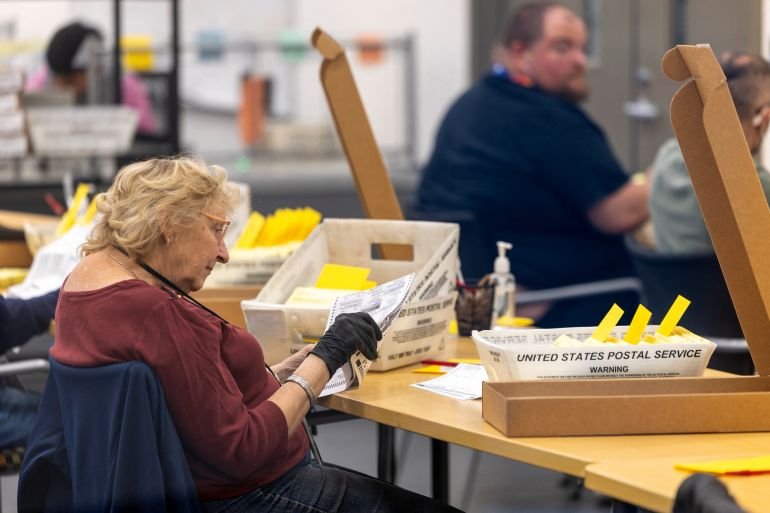
    Election night results are preliminary. Final tallies can take days or sometimes weeks as officials count mail-in, provisional and other outstanding ballots before certifying the results, and the pace varies by state.

    “In some states, it may take up to a week or more,” Belt said.

    Some contests may go further. In Georgia, if no Senate candidate wins a majority, the race goes to a run-off election on December 1.

    Belt warned that early results could give a misleading picture of the outcome. Because Republicans have historically been less likely than Democrats to vote by mail, some states could initially appear to favour Republican candidates before later-counted ballots narrow or reverse their leads. This is known as the “red mirage”. In states that count mail ballots first, the reverse can happen.

    A delay in counting or a change in which candidate is leading does not, by itself, indicate electoral fraud.

    The vote will decide who writes legislation, scrutinises the administration and controls federal spending, setting the balance of power for the rest of Trump’s term.

  • California’s billionaire tax faces a precarious road from rich opposition

    California’s billionaire tax faces a precarious road from rich opposition

    San Francisco, United States – University of California at Berkeley economics professor Brian Galle recently found a flyer in his mailbox about the proposed billionaire tax he helped write. But as he read it, Galle found things he hadn’t written, including that the tax can be on anyone and even on their retirement savings.

    Californians have been getting such flyers and watching similar ads as they prepare to vote in the November 3 election on whether to impose the one-time tax of 5 percent on the assets of the state’s billionaires.

    Recommended Stories

    list of 4 itemsend of list

    Spending by the billionaires to oppose the tax has made this the most expensive ballot measure ever and among the most expensive campaigns of this midterm, says David McCuan, professor of political science at Sonoma State University, who tracks state and local elections.

    California’s celebrated tech billionaires, including Google co-founder Sergey Brin, Doordash founder Tony Xu, Stripe co-founder Patrick Collison, Ripple co-executive chairman Chris Larsen and venture capitalists John Doerr, Michael Moritz and Vinod Khosla, are among those who have donated more than $300m to block the additional tax on their assets.

    While Meta founder Mark Zuckerberg has not donated money to oppose the tax, Meta’s SEC filings revealed that he told the company’s board, which includes Xu and Collison, that he would buy a home outside California to avoid paying the tax. This could have affected Meta stock prices and the board created a new class of shares that Zuckerberg could use to pay the tax.

    The billionaire fundraising has far outstripped that of the supporters, who only raised $32m. This has led to the ubiquitous ad campaign as well as outreach to voters.

    “I feel like I am in an Alice in Wonderland alternate reality,” said Ashley Craig, a volunteer for Patriotic Millionaires, a group that supports the tax.

    Craig has spent months door knocking and making calls to voters to campaign for the tax and often hears misinformation about it.

    “They often tell me it has secret provisions allowing everyone to be taxed, which is not entirely true,” she said.

    Any change in the tax would require a two-thirds majority in the assembly and would need to stay true to the spirit of the tax. But the prevalence of the ads has meant that voters often tell Craig the tax would soon include her – and them.

    Making democracy more equal

    “The irony is that Prop 40 [the billionaire tax proposal] is meant to make democracy more equal, but the billionaires are using their money to avoid that,” says Galle, the proposal’s coauthor.

    The US Supreme Court’s judgement in the Citizens United v FEC case gave companies and special groups the freedom to spend freely in elections, he said.

    “This has led to this situation where Sergey Brin has a lot more of a political voice,” says Francesco Trebbi, the BT Rocca professor of Business and Public Policy at the University of California at Berkeley’s Haas School of Business. “It’s Sergey Brin v millions of Californians. This leads people to lose trust in the system ” .

    Apart from the ad buys, Craig says she has also felt alone in the campaign arena. While the state Democratic party has endorsed the tax proposal, Craig says she hasn’t had ground support from the party. “We don’t have resources like social media, door knocking, phone banking and I would place the blame at the feet of the Democratic party.”

    Sonoma State’s McCuan attributes this to the Democratic party’s internal rift between the progressives and moderates, with the former in favour of such a policy and the latter resisting it.

    “This is a broader proxy test between the party’s progressives and moderates. If this works, progressive candidates could try such ideas in the 2028 presidential elections,” McCuan says, which the billionaires and moderates want to avert.

    So while the party has endorsed the measure, California Governor Gavin Newsom has opposed it, as has Xavier Becerra, the Democratic candidate for governor in the election and Katie Porter, a former congresswoman who also ran for governor.

    Newsom, who is eyeing a 2028 presidential run, has opposed the tax, saying it is “poorly written. It would harm the state if its billionaires, who have an estimated wealth of 2.3 trillion according to the measure’s authors, move, as Zuckerberg has planned,” Newsom has said.

    The tax’s opponents have also backed a ballot measure that prohibits any new state taxes based on personal property or imposed retroactively. Another asks state auditors to review any proposed tax measures for their financial impact before they are voted on. If these pass and get more votes than the billionaire tax, they could negate the billionaire tax, even if it is passed.

    Sen. Bernie Sanders, I-Vt., speaks during a campaign rally in support of California Proposition 40, known as the billionaire tax, in Los Angeles, USA
    Senator Bernie Sanders at a campaign rally in LA in support of California Proposition 40, known as the billionaire tax [File: Jae C Hong/AP Photo]

    Only a third of citizen initiatives pass

    The strong campaign opposing the billionaire tax may have impacted support for it. Voters support the tax by a small margin, but also the two measures that oppose it, according to a recent poll by the Public Policy Institute of California (PPIC).

    “Only about a third of such citizen initiatives pass. So the burden is on the yes side,” says Mark Baldassare, statewide survey director and Miller chair in public policy at PPIC. “Support can decline if people don’t feel completely sure.”

    But Suzane Jiminez, chief of staff at the SEIU health workers union, which has sponsored the billionaire tax measure, said, “We are feeling confident that we will have the votes. When voters see that billionaires are funding the ads, they see through them.”

    Senator Bernie Sanders of Vermont and Congressman Ro Khanna of California rallied across the state to drum up support for the measure. Jiminez said that in the last few weeks, 3,000 volunteers have spread out to knock on doors and distributed flyers explaining the tax across the state. “The democratic figureheads do not represent the rank and file on this. They are supporting us,” Jiminez said.

    It is unclear whether this will be enough, as the shortfall in funding means support for the measure remains precarious. Baldassare said he plans to do his poll again as voters read and receive the state’s voter guides explaining the ballot measures and make up their minds.

    Sonoma University’s McCuan said that just the historic amount of money being spent on defeating the measure is a win in itself for the tax backers.

    “Progressives can win by losing. They can say moderates sank us, use it as a morality play. They will attack big tech – as a bad bogeyman of US politics.”

  • US appeals court sceptical of Trump’s lawsuit over California voter rolls

    US appeals court sceptical of Trump’s lawsuit over California voter rolls

    Judge questions the Trump administration’s efforts to exert greater influence over elections process ahead of the upcoming midterm vote.

    A United States appeals court has expressed doubt over the Department of Justice’s lawsuit against California, which seeks to force the state to throw out mail-in ballots it has deemed likely to go to noncitizens.

    Circuit Judge Mark Bennett said on Sunday the three-judge panel would issue a decision as soon as possible, following a rare weekend oral argument.

    Recommended Stories

    list of 3 itemsend of list

    But Bennett, an appointee of Republican President Donald Trump, voiced concern that the lawsuit would not hold up to scrutiny.

    He pointed to the Elections Clause in the US Constitution, which allows states — not the federal government — to administer elections.

    “It seems to me that you want us to issue an injunction that is entirely inconsistent with the law that the California legislature has adopted pursuant to the Elections Clause,” Bennett told Justice Department lawyer Matthew Donnelly. “How can we do that?”

    The case is part of a larger effort under the right-wing Trump administration to crack down on alleged noncitizen voting ahead of the crucial November 3 midterm elections.

    On October 15, less than three weeks before the midterm races, the Justice Department issued a complaint targeting California, a left-wing stronghold.

    It asked the federal court system to set aside thousands of mail-in ballots that the government says were sent to “likely noncitizens”.

    The lawsuit indicates the Trump administration sent California officials a list of 20,000 names it believes are not eligible to vote, based on citizenship.

    Trump has often pushed the discredited claim that the Democratic Party is benefitting from widespread voting by noncitizens.

    California has long been one of the targets of his election misinformation.

    Earlier this year, Trump denounced the state’s primaries after right-wing candidates like Los Angeles mayoral hopeful Spencer Pratt felt short of his expectations.

    “There’s BIG cheating by the Dumocrats in California,” he wrote on social media at the time.

    He then announced that the state would be under investigation by the US Attorneys’ Office.

    Trump’s efforts have caused alarm, with critics accusing him of seeking to dampen voter turnout through intimidation and confusion.

    The midterms will decide which party controls the US Congress, as well as key state and local positions.

    Polls, however, predict steep odds for Republican candidates, given Trump’s souring approval ratings and dissatisfaction with issues like the cost of living and the US-Israel war on Iran.

    Voting rights advocates have warned that the Trump administration has not publicly revealed how it has compiled its list of noncitizen voters, and whistleblower reports have cast doubt on the accuracy of such lists.

    In response to the October 15 lawsuit, California has countered that it has strong safeguards to prevent noncitizens from voting.

    It also said the Justice Department’s claims are based on dubious data.

    “This is a sad, desperate attempt by Trump to use his politicized Justice Department to try to suppress California voters just three weeks before Election Day,” California Governor Gavin Newsom said in a statement earlier this month.

    “We will continue to carry out free and fair elections in the Golden State — and call out this authoritarian as he tries every play in the dictator’s playbook.”

  • Kimi Antonelli wins US Grand Prix, closes in on F1 championship

    Kimi Antonelli wins US Grand Prix, closes in on F1 championship

    Italian wunderkind Kimi Antonelli took another step toward his first Formula One championship by claiming his ninth race of the year at the United States Grand Prix in Austin, Texas.

    Antonelli, 20, capitalised on his pole position and sailed to a time of 1:35:16.650 at the Circuit of the Americas on Sunday, beating Charles Leclerc of Monaco by a comfortable 13.078 seconds.

    Recommended Stories

    list of 4 itemsend of list

    With five races to go, Antonelli does not have the championship wrapped up quite yet, but his lead over Mercedes teammate George Russell of Great Britain expanded to 123 points.

    Russell must win the next race in Mexico City to remain in contention for the championship; otherwise, it will go to Antonelli, who has come to dominate the sport in his second F1 campaign.

    “I’m aware [securing the championship] is close, but the mindset doesn’t change,” Antonelli said post-race. “I want to finish the season on a high, to go into 2027 with high hopes.”

    The strategy for Antonelli and Mercedes paid off. While others chose to pit twice during the 56-lap race, Antonelli held on until Lap 25 to pit and did not visit the pit lane again.

    “It was a perfect way to end the weekend; it was an incredible team effort, especially from strategy to believe in me and go for one stop,” Antonelli said.

    Antonelli won five Grands Prix in a row early this season, one of which was the Miami Grand Prix. He is now 2-for-2 in the United States this season, with the Las Vegas Grand Prix still to come in November.

    Max Verstappen, the four-time F1 champion for Red Bull Racing, rounded out the podium 17.485 seconds behind Antonelli. After rattling off every championship from 2021 to 2024, Verstappen has been mathematically eliminated from this year’s chase and will go two years without a world title.

    “Our overall pace was not good enough, and the tyres we had available were not the right ones,” Verstappen said. “We still managed to get on the podium, maybe a bit lucky with the [Virtual Safety Car] at the end.”

    A Virtual Safety Car was deployed after Valtteri Bottas’s Cadillac stopped on the track on Lap 52. It lasted until the penultimate lap, by which time nobody would be catching up to Antonelli.

    Mercedes grew its lead in the constructors’ standings to 133 points over Ferrari — 607 points to Ferrari’s 474.

    October 25, 2026; Austin, Texas, U.S.; Mercedes' Andrea Kimi Antonelli in action during the race. Mandatory Credit: Michael Johnson-Imagn Images
    Antonelli’s lead over Russell expanded to 123 points [Michael Johnson/Imagn Images/Reuters]

    Wolff hails Antonelli’s best race yet

    “On Kimi’s side, the main headline is that for me [that’s] the best race that he’s delivered so far,” Mercedes team boss Toto Wolff said.

    “Getting off the start with the inferior tyre and then controlling it [the race] at all times. The race of a champion who isn’t the champion yet, but exceptional.

    “I think he’s outperformed the car. His driving style just glues with the car.”

    Wolff, reminded that Antonelli has had some special wins already this season, including at his home Italian Grand Prix from the back of the grid as well as Monaco and Spa, accepted that sometimes he struggled to remember past races.

    “Both of them were pretty good,” he said in reference to Monza. “But the headline, this is the best, we can keep.”

    Antonelli was happy to agree with the boss.

    “I think it was one of the best, because of how we built up during the weekend,” he told reporters.

    “And, you know, it was a great team effort as well today, especially with the strategy, believing in the one-stop. And, yeah, it was a really great team effort, and they all deserve this result today.

    “Monza, we clearly had the fastest car. We were just super quick, so of course it was incredibly special coming from the back,” he added.

    “But it was also a track where it was relatively easy to overtake, and we were so quick. But definitely, Monza was a super special one, and one that I will remember forever. But, you know, this one probably, in terms of execution, was better … the way we built the performance throughout the weekend was very good.”

  • Lula’s victory may be a turning point for Latin America

    Lula’s victory may be a turning point for Latin America

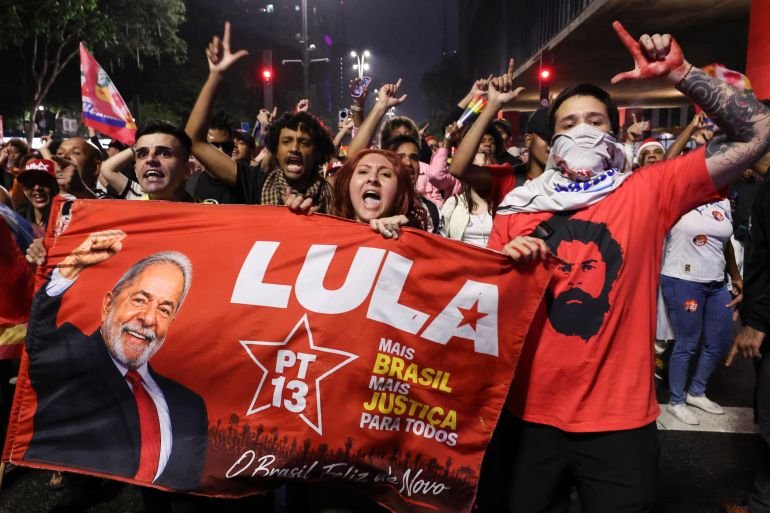
    At 80, President Luiz Inacio Lula da Silva has pulled off an extraordinary political victory. After losing the first round to Flavio Bolsonaro, son of former President Jair Bolsonaro, by 47 percent to 45 percent, Lula defied the odds to secure a stunning second-round victory, with 51.8 percent of the vote against Bolsonaro’s 48.2 percent.

    His triumph confounded every pre-election poll and crowned a dramatic campaign revival that few had anticipated.

    Lula’s victory in Latin America’s largest country does more than halt the far right’s return to power in Brazil. It breaks a succession of right-wing electoral victories across the region and deals a major blow to United States President Donald Trump’s increasingly interventionist agenda in the Western Hemisphere.

    When Bolsonaro unexpectedly defeated Lula in the first round, the result sent shockwaves across Brazil and beyond. For the government, the defeat was particularly startling given its strong socioeconomic record. What followed was an extraordinary three-week political mobilisation that transformed the sluggish first-round campaign of Lula’s Workers’ Party into an existential confrontation over the future of democracy and sovereignty in Brazil.

    The economic record was hardly that of a government heading for defeat. Brazil’s economy grew by a cumulative 9.2 percent between 2023 and 2025, compared with an average of just 5.6 percent among its South American neighbours. Unemployment fell from 9.3 percent in 2022 to a historic low of 5.4 percent in 2026.

    Brazil also exited the United Nations Hunger Map in 2025, after having returned to it under the Bolsonaro senior administration. In the Amazon, deforestation fell to its lowest level in decades, a sharp reversal of the trend under his predecessor.

    Not everything has been rosy under the Lula administration. Millions of Brazilians have remained trapped in credit-card debt, struggling with extremely high interest rates, while an explosion of online gambling has devastated the livelihoods of families. The run-off result sent a clear signal that there was social discontent.

    Lula responded with unusually bold measures: a sweeping debt-relief initiative and restrictions on online betting, as well as expanded social benefits, fuel subsidies, and the transition from a six-day to a five-day working week. These policies sought to reconnect the government’s macroeconomic achievements with the everyday economic anxieties of Brazilian voters.

    Bolsonaro offered a radically different vision for Brazil: sweeping spending cuts, privatisations, lower taxes and, above all, an iron-fisted response to crime and insecurity. His proposals included building five maximum-security prisons modelled on El Salvador’s notorious penitentiary system and authorising lethal force against heavily armed criminals.

    Bolsonaro also pledged to pardon his father, sentenced to 27 years for plotting to overturn the 2022 election, and to grant clemency to those convicted over the January 8, 2023 assault on Brazil’s democratic institutions. For his supporters, this represented an opportunity to reverse what they considered judicial persecution. For his opponents, it threatened to rehabilitate the attempted coup and undermine judicial independence.

    Lula’s campaign came back re-energised, with many young Brazilians mobilising at the grassroots level. The campaign was able to overcome even algorithmic bias by social media giants like Meta, which favoured Bolsonaro.

    Ultimately, the election became a battle not only over Brazil’s democracy but also its sovereignty. Trump’s administration has intervened conspicuously in Brazilian politics throughout Lula’s term, imposing punitive tariffs, sanctioning a Supreme Court justice involved in Jair Bolsonaro’s prosecution and openly embracing his son’s candidacy.

    In May, Trump received Flavio Bolsonaro in the Oval Office. Two days later, Secretary of State Marco Rubio designated Brazil’s two largest crime organisations as foreign terrorist organisations, a measure Flavio had publicly requested.

    These designations carry implications extending far beyond electoral politics. They potentially open the door to US military operations on Brazilian territory under Washington’s expanding war on so-called “narcoterrorism”. The world saw how one such foreign terrorist designation enabled the US to intervene militarily in Venezuela and abduct its sitting president.

    Whereas Trump seeks to draw Latin America’s largest country into Washington’s expanding system of hemispheric military dominance, Lula has defended Brazil’s strategic autonomy, insisting that cooperation against organised crime must respect national sovereignty.

    He framed the election as a choice between a sovereign Brazil charting its own course and one subordinated to Washington’s geopolitical agenda. Sunday’s election result shows that the Brazilian people have made their choice.

    Importantly, Lula’s victory may mark a turning point in Latin America’s rightward shift. Since Trump’s return to the White House, the right has scored a string of electoral victories in Honduras, Chile, and Bolivia, among others. But Lula’s re-election suggests that its momentum may be faltering.

    The result comes just ahead of the US midterms and could deliver a significant setback to the strength of Trump’s leadership in the Americas. In Argentina, President Javier Milei — who regularly attacks Lula and threw all his weight behind Bolsonaro — has been sliding in the polls ahead of next year’s presidential election. In Chile, President Jose Antonio Kast has suffered an even more precipitous collapse in public support.

    Mexico’s Claudia Sheinbaum, for her part, has likely breathed a sigh of relief. A Lula defeat would have left her increasingly isolated in a region gravitating towards Mexico’s northern neighbour. Instead, Latin America’s two most populous countries and largest economies will remain firmly on the left for the foreseeable future.

    It is too early to declare the region’s rightward turn over. But Lula’s victory raises the possibility that the wave has already crested. Brazil will not be joining Trump’s Shield of the Americas, and while the “Donroe Doctrine” remains a threat, its moment of greatest ascendancy may already be behind it.

    Lula’s victory is a vindication of a lifetime spent fighting for society’s most marginalised and disenfranchised. And its significance extends far beyond Brazil’s borders. For defenders of democracy, multilateralism, international law, environmental protection and the sovereignty of the Global South, it sends a powerful message: the far right’s advance is neither inevitable nor irreversible. Not in Brazil. Not anywhere.

    The views expressed in this article are the author’s own and do not necessarily reflect Al Jazeera’s editorial stance.

  • Elena Rybakina retains Ningbo title, wins first trophy as world number one

    Elena Rybakina retains Ningbo title, wins first trophy as world number one

    The victory helped the Kazakh take a big step towards securing the year-end number one ranking.

    Elena Rybakina blazed past unseeded Canadian Leylah Fernandez 6-2 6-2 in the Ningbo Open final to retain her title and lift her first trophy as the world number one ahead of the WTA Finals next month.

    The victory on Sunday also helped the Kazakh take a big step towards securing the year-end number one ranking, further burnishing a spectacular season in which she won the Australian Open title before adding the US Open crown to reach the summit.

    Top seed Rybakina made the breakthrough with her trademark power in the fifth game and then unleashed a searing crosscourt backhand winner to go 4-2 up, before the 27-year-old wrapped up the opening set in only 38 minutes.

    World number 30 Fernandez made a bright start to the next set but Rybakina absorbed the pressure and raised her level to force an error and break for 2-1, with the three-time Grand Slam champion breezing to victory from there.

    Rybakina’s latest triumph is a timely lift after setbacks in Beijing and Wuhan, as she turns her attention to the Pan Pacific Open in Tokyo this week before launching her title defence at the season finale in Indian Wells from November 8.

  • Trump’s tariff pause angers some US ranchers, boosts Brazilian beef imports

    Trump’s tariff pause angers some US ranchers, boosts Brazilian beef imports

    In late August, United States President Donald Trump announced a 90-day pause on certain beef tariffs, making beef cheaper to import, particularly from Brazil.

    That decision was framed as a way to bring down prices for consumers, but it landed as a betrayal for many US ranchers, who were getting ready to take their cattle to market.

    Recommended Stories

    list of 4 itemsend of list

    It is too soon to tell how the decision will ultimately affect grocery prices, but the impact on ranchers was immediate: prices at cattle auctions plummeted, temporarily lowering ranchers’ profits. The United States Cattlemen’s Association, the National Cattlemen’s Beef Association and the Farm Bureau, all member organisations that represent ranchers, opposed the decision.

    Rural Republican members of Congress also distanced themselves, but it is not yet clear how ranchers will vote in the midterms — or whether those votes will decide races.

    Chad Basinger, a rancher in Pretty Prairie, Kansas, is sceptical that the imports will have a significant impact.

    “I know there’s people that have said, ‘Well I’m just gonna vote for the other party’ or ‘I’m not gonna vote’ or ‘This administration’s really let me down’. So yes, there will be people that swing the other way in the midterms. But overall I don’t think it’ll be that much,” Basinger said.

    Ranchers will also be weighing the administration’s other actions, Basinger said, such as the $8bn in farm relief announced in Kansas on October 19.

    Basinger’s House of Representatives district in Kansas is expected to remain safely Republican in the midterms. But Kansas faces an unexpectedly tight Senate race and ranchers in House districts elsewhere may find themselves closer to the political fray: potential swing districts in Montana, Iowa, Texas and Colorado are all in cattle country.

    Still, it is unlikely that ranchers alone will decide elections: ranchers — along with farmers more broadly — represent a shrinking percentage of rural voters and a smaller voting bloc in practice than in the public imagination.

    America’s cattle herd is near its smallest size since 1951 and the number of ranchers has declined alongside the number of livestock. Observers worry that ongoing uncertainty fuelled by tariffs, fuel prices and drought may cause the ranching population to shrink further.

    David Anderson, an agricultural economist at Texas A&M University who advises ranchers, said that high prices this year should have given ranchers the confidence to invest in the future and expand their herds. Making imports cheaper, however, may have helped nudge ranchers in the opposite direction.

    “It really works against the market signal to expand and produce more domestically,” Anderson said. “That got a lot of people pretty angry.”

    Tariff changes add volatility

    This is not the first time that Trump’s tariffs have impacted cattle supplies. Last year, the president added a 50 percent tariff on Brazil, a key trade partner for beef, raising the cost of importing Brazilian lean beef, which is often mixed with fatty US beef to make hamburger patties, a staple in most homes.

    In February, Trump allowed more tariff-free beef imports from Argentina. In August, he did the same for Brazil and Paraguay.

    Both tariff changes led to swift price swings in cattle futures markets, which are often volatile in response to the news cycle.

    Cattle prices also moved this year in response to more fundamental drivers of supply and demand: plant closures by meatpackers, labour shortages late last month related to ICE actions at Kansas packing plants, the second-largest in the country, and the reopening of the southern border after a closure due to New World screwworm disease.

    Big picture, the shrinking US cattle herd has less to do with short-term price changes and more to do with drought cycles, which are growing more intense as warming temperatures increase evaporation.

    Still, tariff changes add uncertainty. “This has been a hot topic for the last six weeks,” said Anderson. “It just adds a little more uncertainty or volatility — or worries or stress.”

    This year, extra price volatility as many ranchers prepared to sell meant ranchers faced lower profits and more risk.

    Basinger says that for many established ranchers, the tariff announcement was frustrating, but not existential.

    “People are upset. They have a right to be upset. But they’re not going to change their strategy,” he said. For most ranchers, Basinger said, the imports would not be the biggest factor shaping decisions about their herds this year.

    Where price volatility may matter more, Basinger said, is for the next generation. Most of today’s ranchers are eyeing retirement. Their heirs must decide whether to make a go of ranching or sell their family’s land. Other aspiring ranchers are also watching the industry.

    “If you’re seeing your dad not make money, or somebody else not make money…it’s not easy work!” Basinger said. “It has to be very enticing for somebody to want to jump in and be like, ‘I’m gonna be a rancher and go break ice in the middle of winter when it’s cold and I could be inside’.”

    Record revenue and record costs

    This year, low US cattle supplies meant that ranchers commanded record-high cattle prices, despite added imports and other market shifts.

    But high revenue doesn’t always mean huge profits: Many ranchers operate at a loss for years in a row. Then, they rely on a few good years to pay down debts or expand their herds.

    This year, profits were lower than hoped, because ranchers also faced high costs.

    Interest rates on loans are high and the war with Iran meant ranchers paid extra for fuel and fertiliser. A drought across much of America’s ranchland meant they paid more for feed.

    In states such as Kansas and Nebraska, ranchers also faced destructive wildfires and aid groups like Farm Rescue coordinated hay donations.

    Still, Basinger said, ranchers who raise cows and calves generally did well this year. In Kansas, he is seeing ranchers use profits to make repairs and upgrades. He said this year’s high cattle prices have been helping. “But it needs to help for a little longer to give them more of an edge,” he said.

    More of an edge might mean, for example, enough money for bigger purchases, like buying land from a neighbouring ranch to make room for a growing herd.

    Rangeland, however, is increasingly expensive. When it is up for sale, outside investors can often pay more than ranchers, which can mean less land for cattle. That’s just one more pressure shrinking the US herd decade after decade.

    Ranchers had hoped that 2026 would be a turnaround year. So far, however, “we really don’t have much evidence of herd expansion,” Anderson said.

  • US Attorney General Todd Blanche defends Alaska Senate election lawsuit

    US Attorney General Todd Blanche defends Alaska Senate election lawsuit

    United States Attorney General Todd Blanche has defended the Department of Justice’s decision to sue to prevent the certification of a Republican loss in Alaska’s tight Senate race.

    On Sunday, Blanche did a tour of the morning political shows in the US, making stops at CNN’s State of the Union TV programme and CBS’s Face the Nation.

    Recommended Stories

    list of 3 itemsend of list

    In each appearance, he faced pointed questions about the legality of the Justice Department’s efforts, responding, in some cases, with open frustration.

    “ Why is this controversial?” Blanche asked CNN host Dana Bash at one point. He proceeded to accuse one of the candidates in the Senate race of intentionally trying to confuse voters.

    “We’re going to try to create a situation where that can be remedied,” he said. “That shouldn’t be something that is causing this shock and horror.”

    But the Justice Department’s lawsuit, filed on October 22, has been the subject of bipartisan criticism.

    Many have accused the administration of President Donald Trump of laying the groundwork to block a Democratic win in the race. Trump himself claimed to have authorised the lawsuit.

    “I’m the one who said do it,” he told reporters on Friday.

    Inside the Alaska Senate race

    During the midterm elections on November 3, citizens in Alaska will vote in one of the closest Senate races in the country, which will help decide whether Republicans maintain their majority in the chamber.

    Senator Dan S Sullivan, the Republican incumbent, is seeking to defend his seat in the US Senate. But he faces fierce competition from former US Representative Mary Peltola, a Democrat.

    Also in the running is another candidate named Dan J Sullivan, a former Forest Service employee.

    The second Sullivan’s decision to run has raised concerns that he is a spoiler candidate, whose presence on the ballot is designed to draw votes away from the incumbent.

    But the Forest Service worker has denied any such intent. Such allegations, he said, are “entirely false”.

    “I am not a registered Democrat, and I have had no conversations whatsoever with the Peltola campaign about my candidacy,” the second Sullivan wrote in a letter to Alaska’s lieutenant governor before the state’s primaries.

    “I have considered running for political office for over a decade. I made the decision to formally run for the United States Senate in the upcoming primary election because Senator Sullivan has routinely failed the people of Alaska, and they deserve a better representative. It is my right to do so.”

    Four candidates advanced to the final round of voting after Alaska’s August primaries. They included Peltola and both Sullivans. The two men are running as Republicans.

    A controversial lawsuit

    The Justice Department has argued that its lawsuit – filed less than two weeks before the midterm elections – is necessary “to protect the integrity” of the election.

    Any result in the Senate race, it argues, would be “tainted by the inclusion on the ballot of Daniel J Sullivan”.

    The department has therefore called on the US District Court in Alaska to issue an order declaring the race’s certification “unlawful” and barring the state from “allowing such a certification to occur”.

    Under the US Constitution, only states have the power to administer elections, though Congress has the right to pass regulations concerning federal votes.

    It is highly unusual for a presidential administration to inject itself into issues of state election certification, and experts say such a move is likely to be deemed illegal.

    Already, in June, Alaska’s Supreme Court ruled that both Sullivans could compete in the Senate race. The state’s Division of Elections has also taken steps to reduce voter confusion.

    The November 3 ballot, for instance, will list Dan S Sullivan as the incumbent and as a “registered Republican”.

    Dan J Sullivan, meanwhile, will have the suffix “Jr” added to his name, and his party affiliation will be left blank, despite the candidate identifying as Republican.

    But in Sunday’s television appearances, Blanche — who leads the Department of Justice and formerly served as Trump’s personal lawyer — argued that merely having two Sullivans on the ballot is a recipe for confusion.

    “It is wrong,” Blanche told CNN. “Putting aside whether we’re going to win or lose in the courts, putting aside what the Alaskan Supreme Court has done, in our system, we should not have a candidate who has to worry about another candidate being on the ballot for no other reason than to confuse voters.”

    Blanche also denied any impropriety in Trump saying he ordered the lawsuit.

    “He’s supposed to make sure that everything in this country is running right, including elections,” Blanche said.

    The race for the Senate

    Historically, the Justice Department has embraced a norm of judicial independence, though critics have accused the Trump administration of wielding its prosecutorial powers for political gain.

    Bash, the CNN host, raised some of those concerns, pointing to Trump’s comments accusing Democrats of cheating, as well as his history of election denialism.

    The president has long denied his loss in the 2020 presidential race, and his supporters sought to block the certification of that election, notably by storming the US Capitol on January 6, 2021.

    When Bash pointed to that incident, Blanche chided her: “Oh, you’ve got to stop it with that.”

    “Why are you yelling at me?” Bash responded as the two talked over each other.

    “You are not being a real person. Come on, man,” Blanche continued. “That is crazy.”

    He also denied that Trump was setting the stage for a contested election if the Democrat Peltola were to win. Instead, he framed the lawsuit as setting the stage for further investigations into any eventual results.

    “The relief that we’re seeking – which, again, isn’t to determine who the senator is, it’s not to try to overturn something the state is going to do – it’s just to make sure that the ballots that come in are kept in a way that may allow a court to investigate further,” Blanche said.

    Speaking to CBS, Blanche also dodged a question about whether Trump personally asked him to file the lawsuit.

    “I will never, ever, ever talk about communications that I have with the president of the United States. I never have, and I never will,” Blanche said.

    The race to control the US Senate is expected to be a nail-biter, with Republicans holding a slim majority at present: They have 53 seats in the 100-member chamber.

    Only a third of the Senate’s seats – 35 in total – will be up for grabs in the midterm races, as terms in the chamber last six years and are staggered across different election years.

    Trump’s Republican Party is projected to face an uphill battle to protect its congressional majorities, amid backlash against the rising cost of living and Trump’s own withering poll numbers.

    Roughly seven Senate elections are considered toss-ups, including the Alaska race.

    In early October, The New York Times and Siena College released a poll finding Peltola leading the incumbent Sullivan by nearly 7 percentage points, one of the widest margins of any of the toss-up states.

  • How have Democrats’ policies shifted since the last major US election?

    How have Democrats’ policies shifted since the last major US election?

    Two years after United States voters delivered a stunning rebuke of the country’s Democratic Party by electing Republican President Donald Trump to a second nonconsecutive term, some of the party’s midterm candidates are reassessing stances on a host of hot-button issues.

    Whether they have dialled it back on issues like transgender rights or ramped up efforts to oppose Israel’s genocidal war on Gaza, Democrats in some of the toughest midterm battleground races are responding to voter concerns – or even breaking outright with party leadership.

    Those shifts have resonated with some voters, while others have been alienated as the party tries to find its footing in Trump’s second term and wrestle away control of both houses of Congress from Republicans.

    But in the time since Trump defeated former Vice President Kamala Harris in 2024, Democratic divisions have only grown deeper. Establishment and self-described moderates within the party have struggled to hold back a rising tide of progressive populism as voters increasingly demand stronger, bolder policies.

    That movement, powered by groups like the Democratic Socialists of America, has forced a reckoning over what it means to be a Democrat in Trump’s second term, leading to significant differences among candidates on policies that often depend on where they are running.

    Here’s how – and why – the party has shifted:

    Democrats’ shifting views on Israel

    The most notable shift among Democrats has, arguably, been on Israel.

    Three years after Israel launched its genocidal war in Gaza and killed more than 74,000 Palestinians following Hamas’s October 7, 2023, attacks, polls have suggested that Americans hold increasingly negative views on Israeli military actions.

    A Pew Research Center survey conducted earlier this year suggested that 60 percent of US adults had an unfavourable opinion of Israel. That number is significantly higher – 80 percent – among US Democrats.

    In response, some longtime Democratic supporters of Israel – including Senator Chris Coons, who is likely to chair the Senate Foreign Relations Committee if Democrats retake control of the Senate next month – have shifted, as voters, especially younger ones, demand greater accountability from the US ally.

    US Democratic Senator Chris Coons of Delaware speaks at the COP26 UN Climate Summit in Glasgow, Scotland
    US Democratic Senator Chris Coons of Delaware speaks at the COP26 UN Climate Summit in Glasgow, Scotland [Alastair Grant/AP Photo]

    The moderate Delaware Democrat told Politico in an interview this month that he wants a “thorough reexamination” of the US-Israeli relationship and is even willing to impose sanctions on Israel’s prime minister, Benjamin Netanyahu.

    It is a marked change in tone after Harris rejected calls to feature a Palestinian American speaker at the 2024 Democratic National Convention in Chicago.

    Earlier this year, 40 Democratic senators voted in support of a motion that disapproved proposed military sales to Israel. Only seven Democratic senators voted with Republicans to block it.

    But as a new Congress may include even more progressive voices demanding the US rethink its relationship with Israel, those calls would likely be met with stiff resistance from some in the Democratic leadership, including Senate Minority Leader Chuck Schumer.

    The New York Democrat, who would likely become majority leader if Democrats retake the Senate, has said that the US “commitment to Israel’s security and defense must be ironclad”.

    Have Democrats changed their positions on transgender rights?

    Following years of attacks from Republicans, Democrats in tightly contested US House or Senate races have downplayed – or outright dismissed – support for the transgender community, mostly when it comes to the participation of transgender students in school sports.

    In Ohio, Democratic Representative Marcy Kaptur ran an advertisement featuring her saying, “Boys should not play in girls’ sports”. And in North Carolina, Representative Don Davis released a television commercial in which the Democrat says there “should always be a safe and fair space for women and girls in sports”.

    Next door in South Carolina, Democratic Senate candidate Annie Andrews, a doctor, said in a newly released advertisement that she opposes “biological men playing in women’s sports”.

    Trump’s return to the White House was fuelled, in part, by a now-famous advertisement in the 2024 campaign that highlighted Harris’s support for transgender Americans.

    “Kamala is for they/them,” a narrator said in the advertisement, referring to gender neutral pronouns used by some in the transgender and nonbinary community. “President Trump is for you.”

    But the reassessment of transgender rights after the commercial’s airing is not taking place in every part of the party.

    On Thursday at a “Students vs Billionaires” town hall in Portland, Maine, Representative Alexandria Ocasio-Cortez addressed concerns from a transgender college student who told the New York progressive that they felt “abandoned” by Democrats.

    “They’re wrong”, Ocasio-Cortez said about some members of her party. “First and foremost, I want to just let you know how shameful and sorry I am that there are people out there that scare so easily after an election”.

    The congresswoman added, “The moment you compromise the rights of a trans person in America, you compromise the rights of every citizen.”

    What has changed on immigration and border security?

    During former US President Joe Biden’s term, Democrats encountered near-daily attacks from Republicans on the country’s immigration system.

    US Customs and Border Protection (CBP) recorded more than 8 million encounters at the US-Mexico border between 2021 and 2025, fuelling concerns among some voters that the Biden administration had ignored the issue.

    In Texas’s closely watched Senate race, candidate James Talarico has positioned himself as a “border security Democrat”, advocating for stronger border enforcement and comprehensive immigration reform.

    Third Way, a US-based organisation that pushes for moderate policies, said stances like Talarico’s resonate better with voters because they have taken a proactive, rather than a reactionary approach.

    Democratic US Senate candidate James Talarico speaks at a campaign rally during his "Clear Eyes, Full Hearts Tour" at the Galveston Railroad Museum in Galveston, Texas, on October 22, 2026. (Photo by Mark Felix / AFP)
    Democratic US Senate candidate James Talarico speaks at a campaign rally in Galveston, Texas, on Thursday [Mark Felix/AFP]

    “I remember very clearly when Harris came out and spoke at the DNC in 2024; she… said we need order at the border and to have a strong immigration system”, Third Way’s senior political adviser, Lucas Holtz, told Al Jazeera.

    “The problem is, after that, the Harris campaign really did not stick with that line in the sand… They stopped taking a stand on these issues, and more voters thought that she was too far to the left.”

    “[Talarico] is making the case in a lot of his ads that the Biden administration failed on securing the border… It’s putting Republicans on their back foot in some of these races.”

    But among progressives, Trump’s response to the nation’s immigration issue has also prompted a strong swing to the left.

    After several high-profile incidents earlier this year – including federal immigration agents in Minneapolis, Minnesota, shooting dead US citizens Renee Good and Alex Pretti  – calls to abolish, or drastically overhaul, US Immigration and Customs Enforcement (ICE) have gained momentum.

    Left-leaning political groups and politicians have united behind a message of “abolish ICE”, which would dismantle the federal agency and end its enforcement authority.

    Do Democrats support Medicare for All?

    As cost-of-living issues remain paramount for voters, Democrats of all stripes have coalesced behind the need for more government intervention in the country’s healthcare system.

    But how exactly the party addresses rising medical costs remains up for debate.

    Some progressives, including Michigan Democratic Senate candidate Abdul El-Sayed, have championed policies like Medicare for All, which would expand the nation’s federal health insurance programme for seniors so all US citizens would be guaranteed healthcare.

    US Senate Democratic candidate Abdul El-Sayed gestures to supporters during a campaign rally in Dearborn, Michigan
    US Senate Democratic candidate Abdul El-Sayed gestures to supporters during a campaign rally in Dearborn, Michigan [Rebecca Cook/Reuters]

    Others running in more conservative states, like Andrews, have called for the return of Affordable Care Act subsidies that lapsed during Trump’s second term, as well as limits on health insurance companies’ profits.

    Polling released by the independent health organisation KFF suggested that 66 percent of US adults now support Medicare for All, a 13-point increase from October 2020.

    “Everybody’s going to have their own approach to this, but by and large, all Democrats want to move to a universal healthcare system in the best way possible”, Holtz said.

    “We’re in agreement that we need to do better than what the Trump administration has done.”

  • CENTCOM reportedly has plans for Iran strikes: Will Trump approve them?

    CENTCOM reportedly has plans for Iran strikes: Will Trump approve them?

    The US military has drawn up options for renewed attacks on Iran, according to the Washington-based website The Hill, raising the prospect of another round of major fighting in a war approaching its eighth month.

    Central Command (CENTCOM), which oversees US forces in the Middle East, has plans ready for follow-up strikes if authorised by the White House, the outlet reported. It also said military planners had prepared several options for Defense Secretary Pete Hegseth.

    Recommended Stories

    list of 4 itemsend of list

    The report focused on possible attacks after the November 3 US midterm elections. But President Donald Trump suggested on Saturday that the United States could strike as soon as “tomorrow”, while also holding out the possibility of a “big, beautiful” agreement with Tehran.

    Iranian President Masoud Pezeshkian, meanwhile, accused Washington of derailing negotiations but said efforts to reach an agreement should continue. With both sides warning of further attacks, could the conflict tip back into full-scale war? Here is what we know.

    Oil tankers have increasingly come under attack from Iran. October has become the worst month for attacks on ships near the Strait of Hormuz since the US-Israel war was launched in February
    Oil tankers have increasingly come under attack from Iran. October has become the worst month for attacks on ships near the Strait of Hormuz since the US-Israel war was launched in February [File: Fatemeh Bahrami/Anadolu Agency]

    What are the plans?

    The latest reporting suggests military preparations are advancing, although it remains unclear which options Trump might approve or when. Earlier this month, Axios reported that the Pentagon had instructed CENTCOM to complete preparations for a possible resumption of major combat operations. Its sources said a renewed campaign could target Iranian energy facilities, infrastructure and nuclear sites.

    Those preparations do not amount to an order to attack. The decision ultimately rests with Trump, whose public statements continue to leave room for both military action and negotiations.

    Meanwhile, on Wednesday, The New York Times reported that the US and Israel have drawn up joint plans for an attack on Iran after the midterm elections. The reports come alongside US warnings about alleged Iranian threats to American personnel overseas. An intelligence memo sent on Friday by Director of National Intelligence Jay Clayton to Secretary of State Marco Rubio said Iran had “substantially increased efforts to target US personnel”, with lethal plots reaching “advanced stages” in the Middle East and elsewhere.

    The Department of State has ordered staffing reductions at several regional embassies amid the warnings. The publicly reported memo did not identify specific targets or establish when any alleged attacks might occur.

    Trump has added to the uncertainty. At a rally on Friday, he said Washington “may do another little Epic Fury”, referring to the codename of the US-Israeli military operation against Iran that began on February 28. On Saturday, he declined to disclose the timing of any possible attack while suggesting one could come as early as Sunday.

    Julie Norman, associate fellow at Chatham House, told Al Jazeera the preparations served both as short-term posturing and a possible longer-term military objective next month. “With Trump, I think he is always keeping options on the table, but I think this particular drawing up of plans is an immediate posturing deterrent, but also a very real option after the midterms,” she said.

    It comes as the US is deploying a third aircraft carrier strike group, the USS Theodore Roosevelt, along with roughly 10,000 additional soldiers and the 13th Marine Expeditionary Unit to the Middle East by the end of November.

    How has Iran responded?

    Tehran has combined calls for further negotiations with warnings that renewed US attacks would bring a wider response. “We were having negotiations, the cowards [Americans] messed everything up,” Pezeshkian said in remarks broadcast on Saturday, before adding that efforts to conclude the agreement should continue.

    Iran’s parliament speaker and chief negotiator Mohammad Bagher Ghalibaf will also miss the 12th BRICS Parliamentary Forum in New Delhi, according to the Iranian Embassy in India. The embassy cited “unforeseen circumstances” without elaborating.

    On Sunday, Iran’s army also said it had shot down a US-developed LUCAS drone over the southern port city of Bandar Abbas, according to the semi-official Tasnim news agency.

    The Reuters news agency has reported, quoting Iranian security officials, that Tehran has drawn up plans to target undersea communications cables in the Gulf in the event of a resumption of US and Israeli attacks.

    INTERACTIVE - The world fibre optic undersea cables map-1791883069
    (Al Jazeera)

    The incident followed Iranian claims that seven oil tankers had caught fire or sustained damage in and around the Strait of Hormuz earlier this week, while on Wednesday, Iran also announced what it describes as a shift towards an “offensive” military doctrine, warning that countries hosting bases used in US attacks could become targets.

    “Our defence doctrine was previously defensive; we used to say that if a country attacks us, we will respond. Now we say that if a country attacks us, we will both respond and launch an offensive,” Islamic Revolutionary Guard Corps spokesman Hossein Mohebi said.

    The warning raises the prospect of a confrontation spreading further across the region, with energy infrastructure and countries aligned with Washington potentially exposed. “Iran is also drawing up its own target lists to include energy infrastructure and US-aligned states,” Norman said.

    “So I would say both parties are certainly very prepared for another round of escalation and projecting preparedness to each other.”

    “In the meantime, there is a very high risk of miscalculation by either side, a very high risk of rapid escalation.”

    October has become the worst month for attacks on ships since the war began in February, with more than 120 attacks reported so far.

    Would another attack serve Trump’s interests?

    The timing is politically sensitive, with Trump facing pressure to avoid renewed escalation before the US midterm elections, while Israeli Prime Minister Benjamin Netanyahu has been pushing for an attack as his support dwindles in the polls ahead of Tuesday’s election.

    It comes after Netanyahu said overthrowing Iran’s government remains Israel’s “primary objective”.

    Mohamad Elmasry, a professor at the Doha Institute for Graduate Studies in Qatar, said recent developments pointed towards renewed fighting rather than a diplomatic breakthrough. “There is a lot of signalling, a lot of posturing suggesting that we are headed for another round of fighting,” he told Al Jazeera.

    He pointed to Hegseth’s recent visit to Israel, and Washington’s reported withdrawal of personnel from regional diplomatic and military sites. “All of that would suggest that the US and Israel are planning [another round of attacks] on Iran, either soon or very soon,” he said.

    “One of the fears is this next round of fighting could actually be more dangerous, more catastrophic than the previous round.”

    Norman added that while the US president may be eyeing up a strike on Iran after the midterms, “the big question for Trump from military advisers is – what would a further round of escalation bring that the other rounds didn’t?”

    “What would these strategies do to force Iran to the negotiating table? And I don’t think there has been a clear answer to that.”

    [Al Jazeera]
    [Al Jazeera]