An FCC proposal that could help SpaceX access more spectrum and better compete as a mobile carrier is facing pushback from T-Mobile over concerns it’ll degrade the carrier’s 5G network.
T-Mobile, which holds licenses in the affected radio bands, raised the issue during meetings with the FCC this week, according to a regulatory filing spotted by Ookla analyst Mike Dano.
The company is concerned about the FCC’s push to open an additional 482 megahertz of radio spectrum for satellite-to-phone services. This includes freeing up a slice of radio waves between the 2496-2690MHz bands as a “secondary” mobile-satellite service, requiring stricter interference and co-existence protections.
The FCC’s proposal acknowledges that T-Mobile “holds long-term de facto leases and licenses for most of the 2.5 GHz spectrum.” The carrier is now urging the FCC to remove the bands from its draft proposal before the agency’s Oct. 29 meeting, where commissioners will vote on whether to proceed with exploring the spectrum’s opening. “T-Mobile uses the 2.5 GHz band as the core foundation of its Ultra Capacity 5G network,” the company wrote in a 10-page filing.

(Credit: T-Mobile)
The carrier points out that the 2.5GHz band is deployed terrestrially in a Time Division Duplexing (TDD) scheme, meaning both “towers and handsets share a single frequency band for both sending and receiving data, alternating use across time rather than dividing the spectrum into separate channels.”
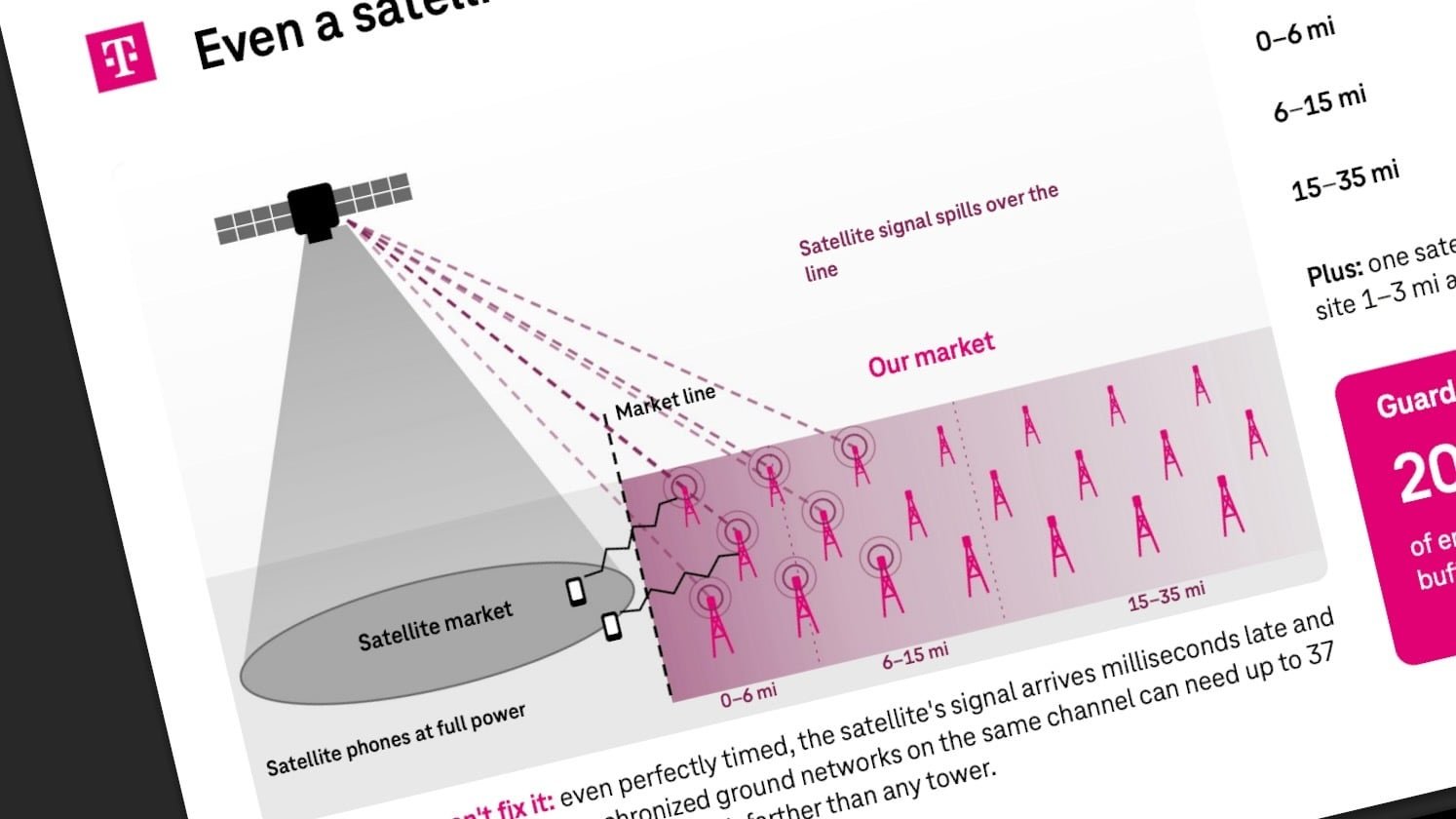
According to T-Mobile, allowing a satellite service to use the same radio frequencies is bound to cause interference. “In a terrestrial TDD scheme, every tower can and does keep the same rhythm—they switch between synchronized talking and listening so that signals never collide. A satellite, however, cannot keep that same rhythm. That is because a satellite’s signal must travel hundreds of kilometers from space before it is received on Earth, resulting in an inherent delay which renders synchronization with terrestrial signals extremely complex,” the carrier says.

(Credit: T-Mobile)
“The end result is that a satellite signal can land on top of a tower and collide with terrestrial signals, leading to dropped and incomplete calls (including calls to emergency 911 services),” T-Mobile added. The filing includes a presentation that claims “up to 96% of a cell site’s uplink coverage area lost where the satellite covers the same area.”
Even if “perfect alignment between satellite and terrestrial signals” is achieved, the uplink coverage could still degrade by as much as 35% to 65% due to the satellite transmissions,” the company argues.

(Credit: T-Mobile)
The filing never names SpaceX or any other satellite providers. Still, T-Mobile executives have been downplaying satellite connectivity and even taking some shots at SpaceX’s cellular ambitions. It’s a bit surprising considering T-Mobile is the exclusive provider of the first-gen Starlink Mobile system in the US.
Recommended by Our Editors
But it looks like the two are now on a collision course. Earlier this month, SpaceX officially announced plans to become the fourth major mobile carrier in the US, using a combination of next-gen satellites, cell towers, and smaller femtocells to provide nationwide coverage. T-Mobile’s CTO and the carrier’s parent company have since fired back, casting doubt on Starlink Mobile’s ability to offer robust coverage.
This Tweet is currently unavailable. It might be loading or has been removed.
Still, the FCC has been developing a regulatory path for SpaceX to spur competition in the carrier market, which promises to benefit consumers. This includes auctioning off more spectrum.
The FCC’s proposal to use the 2.5GHz spectrum acknowledges the interference risks. But T-Mobile’s filing shoots down any potential of coexistence, saying that implementing mitigation “measures would ultimately result in a substantial reduction in the utility of the 2.5 GHz band and approximately 20 to 25% of the spectrum laying fallow in a 100-megahertz block.”
About Our Expert

Michael Kan
Principal Reporter
Experience
I’ve been a journalist for over 15 years. I got my start as a schools and cities reporter in Kansas City and joined PCMag in 2017, where I cover satellite internet services, cybersecurity, PC hardware, and more. I’m currently based in San Francisco, but previously spent over five years in China, covering the country’s technology sector.
Since 2020, I’ve covered the launch and explosive growth of SpaceX’s Starlink satellite internet service, writing 600+ stories on availability and feature launches, but also the regulatory battles over the expansion of satellite constellations, fights with rival providers like AST SpaceMobile and Amazon, and the effort to expand into satellite-based mobile service. I’ve combed through FCC filings for the latest news and driven to remote corners of California to test Starlink’s cellular service.
I also cover cyber threats, from ransomware gangs to the emergence of AI-based malware. In 2024 and 2025, the FTC forced Avast to pay consumers $16.5 million for secretly harvesting and selling their personal information to third-party clients, as revealed in my joint investigation with Motherboard.
I also cover the PC graphics card market. Pandemic-era shortages led me to camp out in front of a Best Buy to get an RTX 3000. I’m now following how the AI-driven memory shortage is impacting the entire consumer electronics market. I’m always eager to learn more, so please jump in the comments with feedback and send me tips.
Leave a Reply