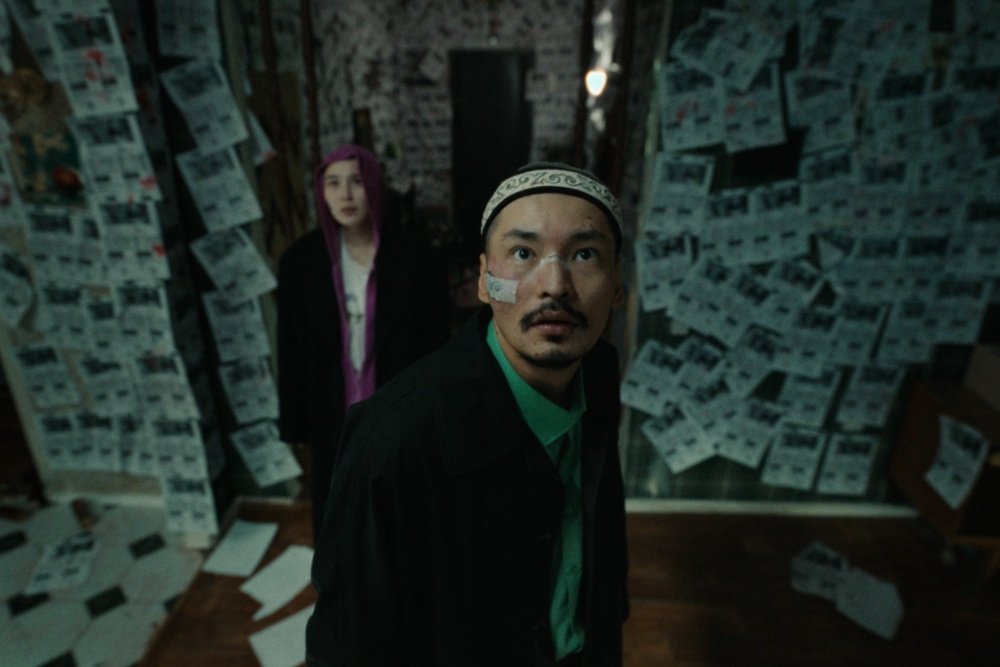
There will be blood — and lots of it — in Kazakh director Aitore Zholdaskali’s solo debut, “Sicko,” a hard-boiled crime thriller about an internet scam gone wrong that plays this week at the Transilvania Intl. Film Festival.
Written by Zholdaskali, Kazybek Orazbek and Aldiyar Zhaparkhanov, “Sicko” follows a cash-strapped couple who hatch a get-rich-quick scheme to pay off their mounting debts. With the help of a crooked lab assistant, they fake a terminal illness and start a crowdfunder for “lifesaving” treatment that swiftly goes viral.
Their rapid ascent to fame and fortune at first seems like a dream come true, but soon their celebrity attracts attention from Almaty’s criminal underworld, and their scheme spins dangerously out of control.
“Sicko” stars Ayan Utepbergen and Dilnaz Kurmangali as the conniving couple and is produced by Kuanysh Beisekov, Anna Kachko, Ashkat Shmanov and Almas Zhali. The film had its international premiere in the Bright Future Competition section of the Intl. Film Festival Rotterdam following a blockbuster theatrical release in Kazakhstan. Loco Films is handling world sales.
By Zholdaskali’s own admission, “Sicko” “started as a joke,” fueled by the growing number of stories he and his co-writers were encountering about internet scams in Kazakhstan. The trio conceived a bloody, black comedy that explored how far a desperate man might go to survive at the crossroads of late-stage capitalism and the attention economy, where viral fame and fortune are just a few clicks away.
“It was important to understand why this is happening to a normal person,” he says. “There are many people we see every day in the news who are ready to kill a friend, to do a robbery, to commit a moral crime, to do evil things. For us, it was important for us to understand where it comes from.”
“Sicko” serves up blood and gore by the bucket, and it’s that — along with a steady helping of social satire — that have earned it comparisons to South Korean genre films. (Zholdaskali, who confesses a weakness for “ultra-violent” movies, counts Korean cinema among his many influences.)
Yet whether you consider “Sicko” a sort of Kazakh “Parasite,” Zholdaskali insists the film is in fact a toned-down version of the world it depicts. “In my opinion, this film is not as violent as life is,” the director says, noting that even the most gruesome and absurd plot twists in “Sicko” were drawn from actual news stories. “Life has much more to be afraid of.”
Zholdaskali did not follow a straightforward path to filmmaking. Raised in a strict household by a father for whom a college degree for his son was paramount, he found himself out in the cold when he copped to his cinematic ambitions. His father kicked him out of the house — “It was winter. I left home in my flip-flops,” the director says — and Zholdaskali was forced to fend for himself, armed with a camera he bought with savings from a part-time job and “shooting anything I could.”

“Sicko” stars Ayan Utepbergen and Dilnaz Kurmangali
Courtesy Transilvania Film Festival
Before long, he gained recognition making music videos and posting shortform content on social media, trying to build an identity “as a visual filmmaker, as a creative artist,” he says. His big break came at 23, when a producer reached out on Instagram to offer him the reins of an upcoming TV show. The series would be shot on a shoestring budget — so much so that most of his colleagues, he eventually learned, had passed on the show — but for Zholdaskali, “it was a huge opportunity.”
“Sheker,” about a desperate college student who turns to drug running to pay his tuition, would go on to become a massive hit in Kazakhstan and draw some 200 million viewers from across the CIS region, winning a prize for shortform drama at Busan and screening at Canneseries in 2022. That was followed by “Shulamah,” which he co-directed with Igor Tsay, about three friends from the sticks who try to make it big as rappers in Almaty.
Now making his solo debut, “Sicko” marks Zholdaskali’s biggest swing yet. The film screened at Rotterdam following a rapturous response back home, where it grossed more than $2 million last fall despite being slapped with a 21+ rating — a move that effectively restricted screenings to between 10 p.m. and 6 a.m.
The release marked the latest example of a domestic industry that continues to capture an increasing share of the local box office while winning accolades abroad. Zholdaskali is among a generation of promising young Kazakh filmmakers — including Berlinale prizewinner Askar Uzabayev (“Happiness”), Askhat Kuchinchirekov (“Adoption”) and Aisultan Seitov (“Hunger”) — who have stirred echoes of the Kazakh New Wave, a movement of independent, post-Soviet cinema that emerged 40 years ago in the dying days of the Soviet Union.
Does Zholdaskali think his country could be on the cusp of a New Kazakh New Wave?
“I don’t believe so much in a ‘wave,’ but I think there are so many opportunities that we as filmmakers have,” he says. “There are new AI technologies that give much more freedom. There are many options for how you can implement them, and it gives you real freedom and a real opportunity to step up into the international market right away on a different level that was not possible before.”
Partnering with AI startup Higgsfield, Zholdaskali recently directed the action-fantasy “Hell Grind,” which he co-wrote with Adilkhan Yerzhanov, and which Higgsfield says was created entirely on its platform for $500,000 — and completed in just two weeks.
Zholdaskali cites the film as an example of “a big democratization of the filmmaking process [that’s created more] opportunities” in Kazakhstan. “I don’t like to talk about a wave, because at the moment, it’s about dreams — about dreaming big,” he adds. “I think there’s so much to do to be called a ‘wave.’ But we’re already making it happen.”
The Transilvania Intl. Film Festival runs June 12 – 21.
Leave a Reply