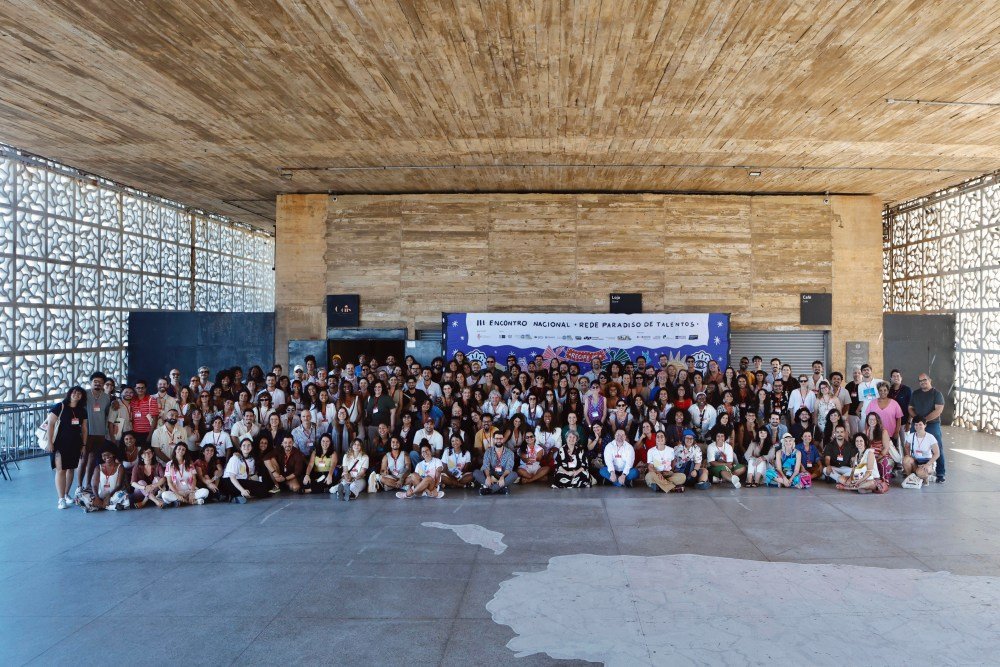
One very rarely gets the chance to be in a room with almost two hundred filmmakers from one single country, gathered not to pitch against one another for scarce grants, but to discuss ways of collaborating and understand where their national cinema is headed. This is precisely the offer on the table with the Projeto Paradiso National Talent gathering, which just wrapped a successful third edition, held in the burgeoning film capital of Recife.
The biannual gathering celebrates the work of the renowned philanthropic initiative, led by the Olga Rabinovich Institute and supporting the Brazilian film sector through talent development, bursary programs, seminars and mentorship. This year’s meeting took place over April 16-18 and saw curated networking sessions, roundtables, and in-conversation events with Kleber Mendonça Filho, producer Emilie Lesclaux and British-Nigerian filmmaker Akinola Davies Jr. Attendees included Anita Rocha da Silveira (“Medusa”), Nara Normande (“Heartless”), Grace Passô (“Our Secret”), Vitrine Filmes’s Letícia Friedriech and Amazon Studios’ Jaqueline Souza, plus lauded Projeto Paradiso council members Marcelo Gomes (“Dolores”) and Gullane director Debora Ivanov.
Variety was present at the event and spoke with several attendees to take the temperature of the national industry following two banner years of international success with the country’s first-ever Oscar for Walter Salles’s “I’m Still Here” and four Oscar nominations for Recife’s very own Mendonça Filho’s “The Secret Agent.” From a strong Northeast momentum to a meagre Cannes presence in 2026, read our five takeaways below:

“The Secret Agent,” courtesy of Neon
Courtesy of Neon
The Northeast is the moment
Despite the Northeast of Brazil having a strong cinema tradition, with exponents from Glauber Rocha to Marcelo Gomes and Guel Arraes, for decades, much of the money-churning industry was concentrated in the Southeast — specifically Rio de Janeiro and São Paulo. Filmmakers from other corners of the country have long voiced frustrations with a lack of access to resources and a certain feeling of segregation regarding available networking initiatives and opportunities.
The last three years, however, have further solidified the Northeast as a prime talent exporter and a rich creative hub. While renowned regional filmmakers such as Gabriel Mascaro (“The Blue Trail”), Kleber Mendonça Filho (“The Secret Agent”), and Karim Aïnouz (“Motel Destino”) continued their well-established trajectories with successful titles at major festivals, a burgeoning new generation of filmmakers signalled a much-needed sense of continuation and renewal in the region. Names like Allan Deberton, Rafhael Barbosa, Tiago Melo and Nara Normande have launched festival darlings and have exciting new projects in the pipeline.
During the Projeto Paradiso National Talent Meeting, many young filmmakers have voiced their desires to bring untold stories to the big screen and continue to expand a plural idea of Brazilianness through cinema internationally. With more and more film commissions popping up in the Northeast and renewed regional incentives as well as savvy producers with a wealth of co-producing experience, we are about to see many more interesting films coming out of the region.
Cannes disappointment = new European opportunities
Last year, Kleber Mendonça Filho brought the frevo from Recife to the Cannes Film Festival red carpet for the world premiere of his competition title “The Secret Agent.” Brazil was also the country of honor at the Marché du Film and brought a record-breaking number of industry attendees to the Croisette. With no Brazilian films announced at the festival this year, the feeling of surprise and disappointment was palpable at the gathering whenever the French fete popped up in conversation. So far, Brazil is only present through co-productions (“Elephants in the Fog” in Un Certain Regard, “Six Months in the Pink Building” in Critics’ Week and “La Perra” in Directors’ Fortnight) with no Brazilian directors scheduled to appear at the event in the official selection or sidebars.
While the lack of Brazilian titles at Cannes bringing a bitter taste to the start of summer festival season, many producers and directors have emphasized a desire to look beyond the big European triad of Berlin, Cannes and Venice as launching pads. Rotterdam, which has a historic connection to Brazilian cinema, is a long-time darling and favorite, but more and more local talent is shifting their attention to festivals like San Sebastián, Karlovy Vary and Locarno as top choices to launch their films.
Courtesy of Juana Carvalho
Looking beyond Europe
Europe still remains the goal for many Brazilian filmmakers when it comes to first sharing their films with audiences, but, more and more, producers are looking outside of Europe and the U.S. when setting up co-productions. Several producers attending the Projeto Paradiso gathering have shown a keen interest in better understanding financing systems in neighboring South American countries, with Chile in particular seen as a strong partner.
British-Nigerian Akinola Davies Jr., who attended the gathering for a lengthy in-conversation event and a screening of “My Father’s Shadow” at the imposing Cinema São Luiz, opened a local appetite for collaborations with African countries. Black Brazilian filmmakers spoke at length about the opportunities that lie in working within the diaspora, and how African countries offer not only similar cultures but also a felt kinship when it comes to understanding the post-colonial wounds permeating Brazilian society. Currently, there are very few co-productions set up between Brazil and the African continent, so there are still some logistical and bureaucratic hurdles on the way to making it a more common collaboration, but the desire is very much there in the South American country.
Collaboration over competition
Towards the end of the weekend, many attendees could be heard saying, “I wish we worked like this in São Paulo/Rio de Janeiro.” This sentiment often punctuated conversations with filmmakers from the Northeast, who have built a thriving industry based on collaboration over competition. While, of course, there is still high competition in the region, makers had to band together in the mid-2000s to figure out how to sustain an industry before incentives, and then again a few years later, once public funds became available and people needed to help one another to understand how to best access what was on the table.
Projeto Paradiso has also adopted a similar ethos, structuring their talent network meeting around collaboration and knowledge sharing instead of creating a more traditional market event structured around competitive sections. “We want everyone to feel good,” Projeto Paradiso program director Rachel do Valle told Variety. “What other markets would call a pitching session, we call a connection session. It’s a space for talking, but also for listening. We want it to be enjoyable and fun.”
Courtesy of Juana Carvalho
Consistent public funds: key to the future
You can’t attend an industry event in Brazil without clusters gathering to talk about the country’s public policies and incentives. While filmmakers acknowledge the historic momentum of their national cinema on the international stage, many have voiced concern that the sense of victory might obscure the very real issues still permeating the industry. Key issues include the long-awaited regulation of streaming services, the need for a centralized national film commission, and, perhaps most pressingly, better-structured funding calendars.
“10 years ago, the Ministry of Culture had specific open calls for debut filmmakers with a regional focus; we no longer have that,” said veteran producer João Vieira Jr. of Carnaval Filmes. “We need to have differentiated open calls: for first or second-time directors, established production companies, rural production companies… It is not a privilege, it is an intelligent way of managing public policies that ensures sustainability.”
Producer Thais Vidal echoed that thought: “We have a consolidated state fund in Pernambuco, qualified crews and the structure to produce and post-produce in Recife, but we face the same issue that plagues the rest of the country, which is the lack of a fixed national financing calendar. This is needed so we can effectively plan ahead.”
Leave a Reply