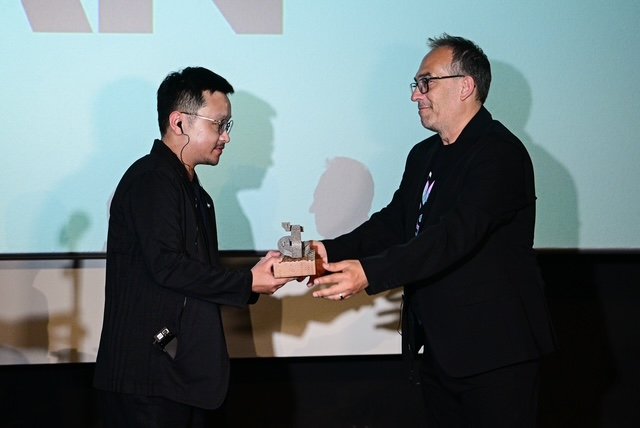
Chinese auteur Bi Gan has completed the story of his fourth feature film, which will “focus on human existence itself,” following “Resurrection,” the Cannes prize winner that drew international attention.
“After ‘Resurrection,’ I discovered that people around me are filled with both eagerness and anxiety toward AI. People are no longer trapped in the illusions of the past, but instead find themselves caught in the mirrored reflections of new ones,” says Bi. Such an “abnormality,” as he describes it, creates a kind of “neurosis” that exists globally and has shaped the direction of his next work in relation to his filmography over the past decade. “From now on, I want to look into the human condition from a more minor perspective.”
The comments come as Bi was set to be presented with an Honorary Golden Lady Harimaguada at Spain’s Las Palmas de Gran Canaria International Film Festival at its 25th edition on Wednesday. The festival will also feature Bi Gan Blues from April 29 to May 3 — a retrospective program comprising six of his works. Reflecting on his creative process, Bi describes it as “picking stones of different shapes by the riverbank and throwing them casually into the current.”
Bi made his first short film “The Poet and the Singer” as a graduation project in 2012, a black-and-white work referencing the Buddhist canon Diamond Sutra. His debut feature “Kaili Blues” came out three years later, telling the story of a rural doctor searching for his nephew in Kaili, a county-level city in Guizhou Province where he was born. The film received multiple international awards, including at the Locarno Film Festival, the Golden Horse Awards, and the Three Continents Festival in Nantes.
“Kali Blues” was followed by his short film “Secret Goldfish” in 2016, part of the advertising campaign for the 53rd Golden Horse Film Festival, alongside works by Anthony Chen and Midi Z. Bi then moved on to his second feature “Long Day’s Journey Into Night,” a romantic crime drama selected for Un Certain Regard at the 2018 Cannes Film Festival. In 2022, he made another short, “A Short Story,” a fantasy production centred on a black cat, which premiered in the Cannes short film competition. His latest feature “Resurrection” premiered on the Criosette last year, winning the Cannes Festival’s Special Jury Prize.
Across nearly 15 years of filmmaking, Bi says he directs more through instinct than retrospection. Before entering the film industry, he experienced uncertainty about his future, and he remains surprised by how his creative work has connected him with wider audiences. When asked what advice he would give his younger self, he gives a simple answer: “Stay humorous.”
Bi has been aware of his own creative voice from an early stage, including recurring elements such as dreams and the treatment of time and space. He adds these elements as “perpetual,” noting they will continue to be woven into his future works. The retrospective, in a way, serves as a confirmation of these instincts and encourages the director to move forward. “For me, this is a new start.”
As part of the festival, Bi has also curated a carte blanche selection, choosing “Spring in a Small Town” and “The World,” two “great works of art” produced in different periods but rooted in the same cultural landscape. The program brings Feimu and Jia Zhangke together – two iconic Chinese filmmakers across generations – suggesting an ongoing dialogue between their works and his own.
“These two films offered me two different perspectives: inside and outside. ‘Spring in a Small Town’ introduced me to a way of looking inward, while ‘The World’ gave me perhaps the most complete representation of the external world that I have encountered.”
The relationship between Jia and Bi further echoes the history of the festival, which awarded Jia the same honour 15 years ago. Reflecting on this continuity, Bi explains it as something akin to cinema itself. “As a creator, it is sometimes difficult to see my own position clearly. But the echoes within the festival, at Las Palmas, allow me to feel the ripples of history within my own river-like creativity, in silence and persistence.”
Leave a Reply