A new Paris-based production company dedicated to independent and auteur Indian cinema has entered the market.
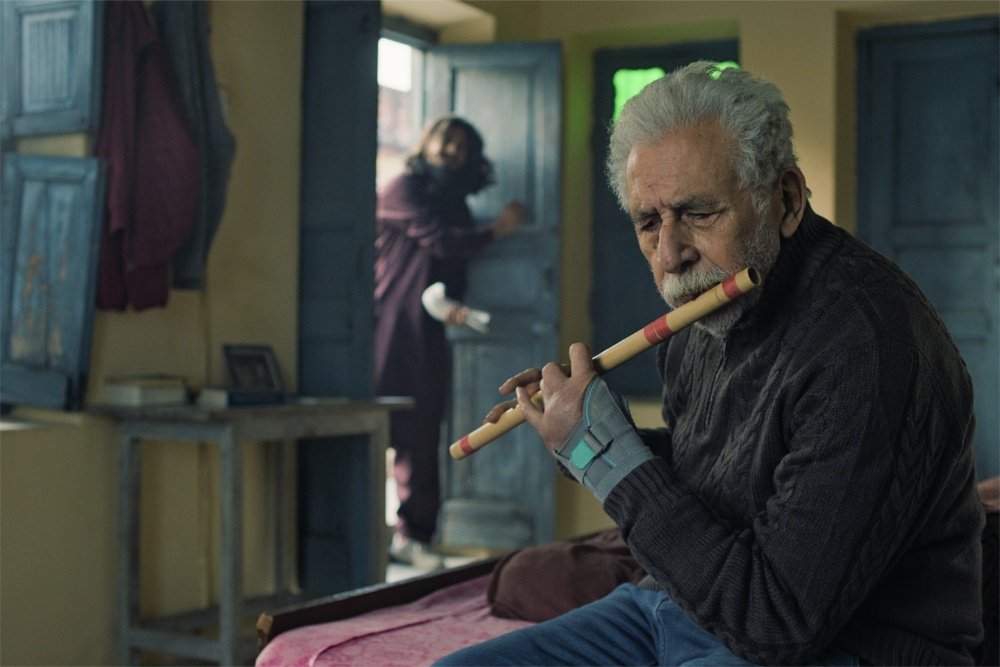
Pavo Films, co-founded in by Cosmin Illes and Némésis Srour, announced its formation at the Cannes Film Market, with Gurvinder Singh’s “Rehmat” – starring Naseeruddin Shah – as its debut co-production.
The two co-founders bring complementary backgrounds in streaming and South Asian cinema scholarship. Illes spent over six years at Spideo, working with international streaming platforms including Canal+ and Globo, before serving as head of marketing at LaCinetek, the French filmmaker-curated streaming platform. Srour is the author of “Bollywood Film Traffic” (Palgrave Macmillan, 2024), a history of Hindi-language cinema’s reach across the Arab world, and has more than a decade of experience distributing and curating Indian and South Asian cinema in France.
For its debut, Pavo Films has come aboard as French co-producer on “Rehmat,” a Punjabi-language feature from Singh, whose previous credits include “Anhey Ghorhey Da Daan” (Venice Horizons, 2011) and “Chauthi Koot” (Un Certain Regard, Cannes 2015). The film, produced by Vahao Studio in India, is currently in post-production.
Set in present-day Punjab, “Rehmat” unfolds across three interconnected stories: a young woman who secretly nurses a wounded stranger while concealing him from police; a family living in the long shadow of a disappearance, with children adrift without a father and an aging grandfather pulled back into the role of household head; and an elderly man who arrives in a village claiming to be God. Shah plays the latter figure, Rashid Ali – a man whose family departed Punjab just before Partition redrew the region along religious lines in 1947, and who returns, after a lifetime spent in England, to the place of his birth.
The screenplay is adapted from short stories by Ajeet Cour, an influential and pioneering feminist voice in modern Punjabi literature. Singh reached the material through painter Arpana Caur, the writer’s daughter, who shared her mother’s books with him over several years and later came aboard as a producer on the film.
Shah, a defining figure of India’s parallel cinema movement whose screen career spans more than five decades, is making his first appearance in a Singh film. Trained at the Film and Television Institute of India in Pune, he emerged in the 1970s through collaborations with directors including Shyam Benegal, Mrinal Sen and Govind Nihalani, producing foundational works of Indian film culture: “Nishant” (1975), “Aakrosh” (1980), “Sparsh” (1980) and “Ardh Satya” (1982), among others. He received the Volpi Cup for Best Actor at Venice in 1984 for “Paar.” In theatre, he co-founded Motley Productions in 1974 and has remained one of India’s most active stage practitioners throughout his screen career.
“When I approached him, he agreed without even asking about the role (…) In the end, the screen character is a complex mix of what I imagined and how Naseer inhabited it,” Singh said.
The ensemble cast also includes Suvinder Vicky, Mita Vashisht, Diya Kamboj and Navjot Randhawa. Celebrated Punjabi poet Jaswant Zafar, 60, makes his screen debut in the role of Harjap, the aging patriarch at the center of the second story.
“‘Rehmat’ portrays how people in a culturally and religiously diverse land navigate life, dealing with divisive political forces, yet retaining hope and compassion,” Singh said.
The film’s title carries a specific resonance for the director. A cross-cultural word with roots in Arabic that traveled into Persian, then Urdu and Punjabi, rehmat means compassion – but Singh has described it as evoking something larger: a flow of ideas and cultural patterns that define the region’s identity, shaped over centuries by wandering Sufis and mystics as much as by conflict and displacement.
Singh has consistently returned to Punjab and its history across his filmography, a preoccupation rooted in his own family’s experience of Partition. “Rehmat” extends that inquiry into the present, with the director describing the region today as marked by a drug crisis, cultural drift among younger generations, and the unresolved wound of a divided Punjab whose communities remain separated by a border that splits a shared language, history and customs.
Cinematically, Singh has foregrounded long takes and diegetic sound design over conventional scoring, with the film’s visual and sonic approach developed in close dialogue with its setting – including three houses in the actual village where shooting took place, each chosen to evoke a different period in Punjab’s history.
Leave a Reply