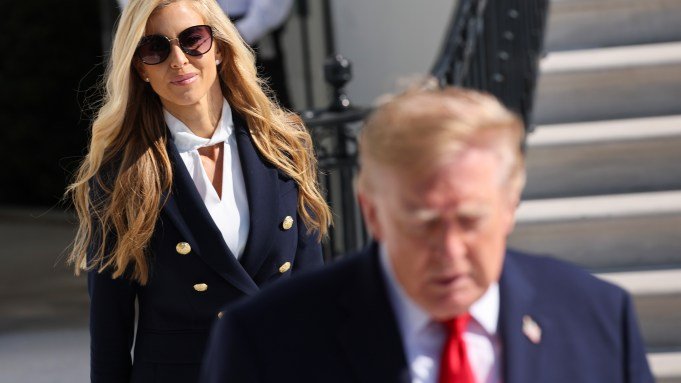
White House Press Secretary Katie Zacharia defended calling herself a lawyer even though she is not licensed to be an attorney at law.
The Wall Street Journal reported that after graduating from Pepperdine Law School in 2011, Zacharia took the California bar exam but did not pass.
In an appearance on Jack Posobiec’s show on Real America’s Voice, Zacharia said that “a lot of the misinformation, miscommunication” is “around the fact that I labeled myself a lawyer, and I consulted for a very long time many people in the field. ‘Is it okay and acceptable if I label myself lawyer, not attorney at law, not Katie Zacharia esquire, but lawyer, and provide legal analysis, not legal advice. And they said absolutely, across the board. You can call yourself a lawyer.’”
Since Zacharia took the post, there have been questions raised of her legal credentials, as she has talked of being a lawyer in numerous media appearances. Trump referred to her as an “attorney” in a Truth Social post announcing her selection. She also was general counsel of the advocacy group Fix California, founded by Ric Grenell.
On Tuesday, shortly after giving her first press briefing, Zacharia appeared with Donald Trump as he embarked on a three-day campaign swing. When a reporter asked Trump where she passed the bar exam, he turned to her and she said, “When I moved to China.” She told The New York Times that she misunderstood the question and thought it was asking for information of where she was after law school.
In the interview with Posobiec, Zacharia said that she got a job in the international practice division of a Chinese law firm. “There’s no Chinese bar,” she said. “I had enough credentials, which was my law degree, to be able to do this practice. And these were multi-million dollar agreements and transactions that were cross border, and there I had all the necessary requirements to do that.”
The Campaign for Accountability filed a complaint with the State Bar of California on Wednesday, challenging her description of herself as a lawyer and as a general counsel.
In her Real America’s Voice interview, Zacharia also described the scramble to prepare for Tuesday’s briefing. After calling on three reporters, she called an end of the briefing, which lasted just 14 minutes. Zacharia said that she received the briefing materials only the night before and woke up at 3 a.m. to prepare. It wasn’t until about 8 a.m., she said, that the materials were finalized. “I never had a full briefing beforehand,” she said.
She also was asked about the inevitability of a Saturday Night Live skit, and said that she would like a “Scarlett Johansson type character.” But she said that she is not watching “anything right now except what he’s doing and focusing on what the president is up to and trying to amplify that.” “I do not want to see any of the other X or Instagram or TV right now.” She will get a short reprieve, as new episodes of SNL are not scheduled for the next two weeks.
Early voting in the U.S. midterm elections is underway. Voters are deciding which party will control Congress, as well as numerous state legislatures and governors’ offices. Snopes’ fact-checkers are flagging rumors surrounding the election, debunking false statements by candidates and suspicious voter fraud claims with nonpartisan research and expert sources. Join our effort to keep this election fact-focused by becoming a Snopes member.
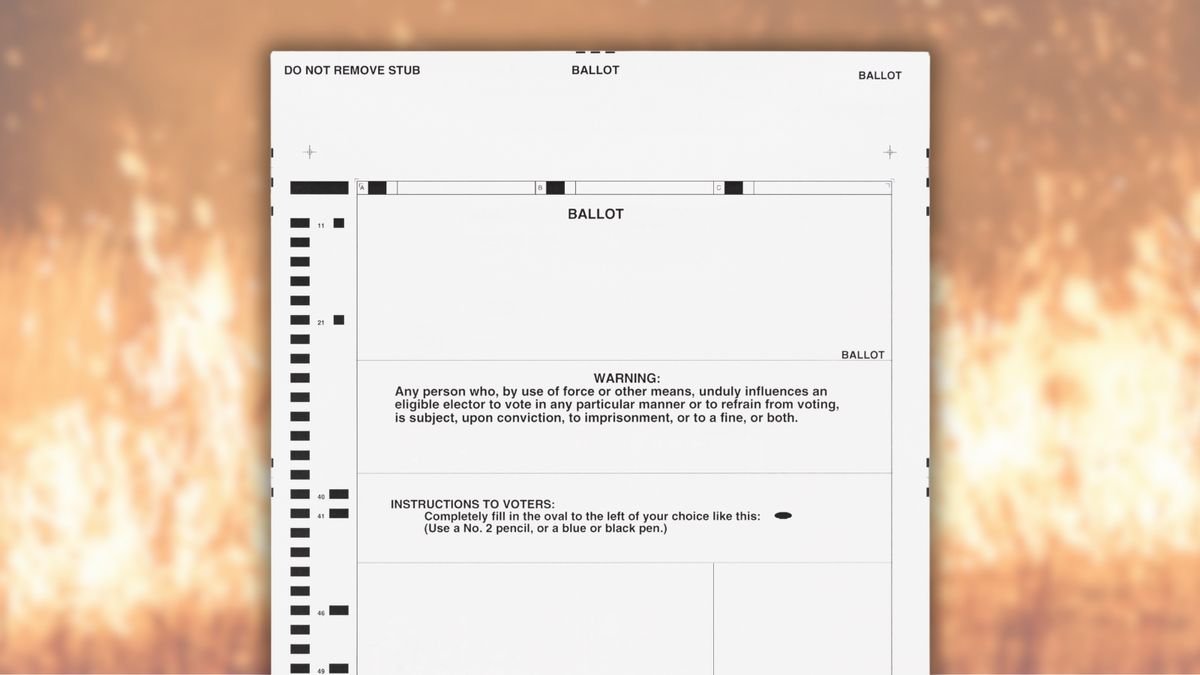
Persistent claims of ballots being lost in fires have surfaced during election cycles in recent years.
For example, in 2020 and 2021, Snopes investigated what turned out to be false rumors of intentional ballot burnings in Virginia and Arizona. In 2024, the FBI said hundreds of midterm election ballots burned overnight in ballot drop boxes in Oregon and Washington. In 2026, a county clerk’s office in Los Angeles reported that a small number of mail-in ballots had burned in a ballot drop box.
Our analysis of claims about ballot fires found that legitimate, verified events in recent years were all fires in ballot drop boxes, suggesting that was the most likely way a ballot could be damaged in a fire. Such fires are rare but difficult to prevent. It can be challenging for elections officials to locate voters whose ballots are damaged beyond recognition.
However, our analysis also found elections officials are preparing for the challenge as best they can by updating ballot drop box security measures. Voters can also help by tracking the status of their ballots so they can get a replacement if theirs is damaged in a fire.
Readers should treat reports of ballot burning that are not ballot drop box fires with suspicion. We will attempt to investigate such rumors as they surface during the 2026 election cycle.
In 2024, hundreds of midterm election ballots burned overnight in ballot boxes overnight in Oregon and Washington. According to the FBI, someone placed improvised incendiary devices two ballot drop boxes in Vancouver, Washington, between 3:30 and 4 a.m. Oct. 8 and one drop box in Portland, Oregon, between 2 and 4 a.m. Oct. 28.
The incidents appeared to materialize fears about a form of election tampering that had played on the public consciousness prior to 2024 and even inspired an episode of the TV drama “Succession” in 2023.
During summer 2026, a county clerk’s office in Los Angeles also reported that a small number of mail-in ballots had been fire-damaged inside a ballot drop box days before the state’s June primary elections.
Though actual, verified instances of ballot burning are rare, voter fears about legitimate votes going uncounted this way will undoubtedly resurface during the 2026 midterm elections. Incidents like the ones in Oregon, Washington and California raise legitimate questions about what happens when criminals attempt to tamper with democratic elections and how both voters and officials can ensure that every vote is counted.
Real instances of ballot burnings can also stoke existing fears of election tampering and encourage the spread of misinformation. For example, in 2020 and 2021, Snopes debunked rumors about ballot-burning in Virginia and Arizona. These incidents were not ballot box fires and turned out to be either refuted or unproven, but spoke to real voter concerns. In our research, Snopes has not encountered a reported and verified incident of ballot burning that was not a ballot box fire, suggesting that ballot drop box fires are the most likely way a ballot can burn.
Drop boxes most-common source of ballot fires
The legitimate incidents of ballot burning that Snopes encountered from previous election cycles all happened in ballot drop boxes. A ballot drop box is a container where voters can drop mail-in or absentee ballots after filling them out.
According to the National Conference of State Legislatures, 29 states and Washington, D.C., explicitly allow the use of ballot drop boxes in elections and 11 states explicitly prohibit them. Six states do not have statues explicitly about drop boxes, but some jurisdictions use them. Four states do not have legislation governing ballot drop boxes and do not use them.
While the Cybersecurity and Infrastructure Security Agency provides guidelines for the use of ballot drop boxes, individual states determine how, when and where to use them. The NCSL wrote that “drop boxes may be supervised or unsupervised with security features, such as cameras, locks and fire suppression systems.”
CISA issued special guidelines about ballot drop boxes and incendiary devices after the incidents in Oregon and Washington in 2024. The agency suggested that states consider emptying the boxes more often and installing video surveillance and fire suppression systems.
How officials mitigate drop box fires
Out of the three ballot drop boxes burned in Washington and Oregon in 2024, the one in Portland reportedly already had a fire suppression system installed, meaning only three ballots were damaged.
Elections officials reportedly contacted the voters whose ballots burned to issue replacements.
However, the fires in Vancouver, Washington, destroyed “hundreds” of ballots. At the time, Clark County Auditor Greg Kimsey issued a statement to voters asking them to check whether their ballot had been received if they deposited it at a certain drop box in a certain time frame.
At the time of the fire in the early hours of Oct. 28, it had been more than a day since elections authorities had last emptied one drop box that burned. Because ballots dropped in drop boxes have usually not been processed by elections officials, there is no sure way to know to whom damaged ballots belong (unless identifying details are still legible).
Kimsey told Snopes via email in October 2026 that approximately 500 ballots burned in the 2024 fires in Washington. Of those, Kimsey said, all but 19 voters got replacement ballots and submitted their votes
Kimsey said the elections board duplicated the 19 missing ballots but “due to the damage we were unable to determine the voters’ choices for all offices and issues on the ballots.”
Ultimately, though the ballot drop box fires in Clark County in 2024 were destructive, officials were able to ensure that the vast majority of the affected votes were counted.
In October 2026, CNN reported that Clark County had upgraded its ballot drop boxes following the 2024 attacks. The new boxes, CNN reported, “include technology that sends a text message to officials if the temperature inside the box rises above a certain temperature, if the box receives a forceful blow or if it’s removed from its geo-fenced location.” Kimsey confirmed this information to Snopes.
Aside from better fire suppression technology, CNN reported that elections officials in Pennsylvania, Illinois and California had invested in ballot drop boxes that photographed people dropping off ballots and scanned the ballot return envelope, meaning officials would know which ballots were in a given box at a given time.
Along with fire suppressant technology, the data the updated ballot drop boxes collected would make it possible for officials to contact affected voters directly in the event of a ballot box fire.
In sum, while ballot drop box fires do pose a threat to voters, elections officials have multiple ways to prevent or mitigate their effects. Our analysis suggests that readers should treat reports of ballot burning that is not a ballot drop box fire with suspicion. We will attempt to investigate such rumors as they surface during the 2026 election cycle.
For further reading about common election-related claims, Snopes has previously reported on whether poll workers can mark your ballot or how vote spikes affect elections.
‘Ballot Drop Box ‘. Cybersecurity and Infrastructure Security Agency (CISA) Elections Infrastructure Government Coordinating Council and Sector Coordinating Council’s Joint COVID Working Group, https://www.eac.gov/sites/default/files/electionofficials/vbm/Ballot_Drop_Box.pdf.
Ballot Drop Box Security Best Practices for Incendiary Devices | CISA. 24 Sept. 2026, https://www.cisa.gov/resources-tools/resources/ballot-drop-box-security-best-practices-incendiary-devices.
Herb, Jeremy, and Gabe Cohen. ‘Why Election Officials Are Pushing Voters to “Use the Drop Box Rather than the Mailbox”‘. CNN, 7 Oct. 2026, https://edition.cnn.com/2026/10/07/politics/drop-boxes-mail-ballots-voting.
Logan, Dean C. ‘Registrar-Recorder/County Clerk Reviewing Isolated Ballot Damage Incident; Reminds Public That Election Interference and Vandalism Will Not Be Tolerated’. 31 May 2026, https://content.lavote.gov/docs/rrcc/news-releases/isolated-ballot-damage-incident.pdf.
Lotz, Avery. ‘What to Know about Ballot Box Fires in Washington and Oregon’. Axios, 31 Oct. 2024, https://www.axios.com/2024/10/28/ballot-boxes-fires-oregon-washington-ballots.
Schneider, Kat. ‘Lehigh County Approves Purchase of 5 Ballot Drop Boxes amid Concerns about Timing’. WFMZ.Com, 23 Sept. 2026, https://www.wfmz.com/news/area/lehighvalley/lehigh-county/lehigh-county-approves-measure-for-purchasing-5-ballot-drop-boxes/article_ba0943d3-eb13-4f8b-a787-777d0ba032e6.html.
‘Table 9: Ballot Drop Box Laws’. National Conference of State Legislatures, https://www.ncsl.org/elections-and-campaigns/table-9-ballot-drop-box-laws.
Track Your Ballot or Ballot Application – Vote.Org. https://www.vote.org/ballot-tracker-tools. Accessed 14 Oct. 2026.
Tuquero, Loreben. ‘Fact-Checking “Succession”: What Happens If a Fire Destroys 100,000 Absentee Ballots in Milwaukee?’ Poynter, 23 May 2023, https://www.poynter.org/fact-checking/2023/fact-check-succession-fire-destroys-100000-absentee-ballots-milwaukee/.
UPDATED: Clark County Auditor Statement Regarding Ballots Destroyed in Ballot Box | Clark County. 28 Oct. 2024, https://clark.wa.gov/elections/updated-clark-county-auditor-statement-regarding-ballots-destroyed-ballot-box.
‘Vancouver Police Investigate Suspicious Device beside Ballot Box’. City of Vancouver, Washington, 28 Oct. 2024, https://www.cityofvancouver.us/vancouver-police-investigate-suspicious-device-beside-ballot-box/.
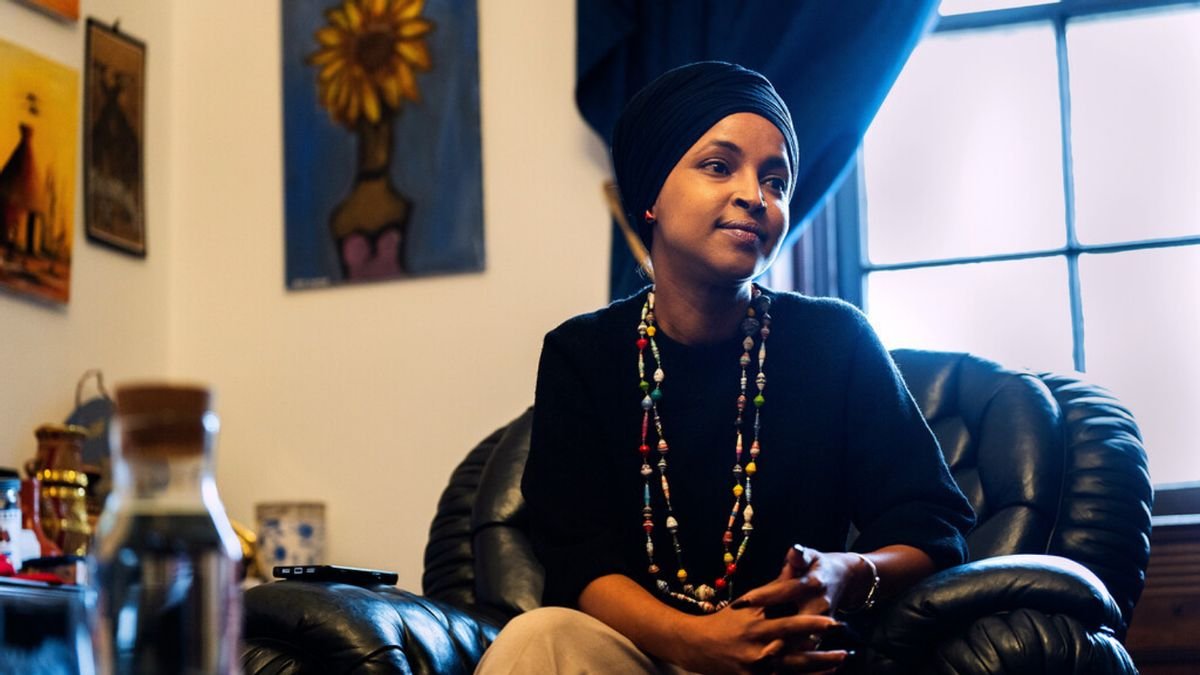
U.S. Rep. Ilhan Omar, D-Minn., altered her birth year in official records from 1981 to 1982.
Rating:
Context
According to The Washington Post, Omar said that requests to change her birth year were due to it being incorrect, not to cover up the truth. We found evidence to support that she was 17 in the year 2000.
As U.S. Rep. Ilhan Omar, D-Minn., entered the final weeks of her reelection bid in October, federal agents searched her home in a criminal investigation reportedly related to claims that she or her father may have lied on immigration paperwork when she sought to secure legal status in the U.S. decades earlier.
In an Oct. 12 statement on X, Omar said called the search “an attempt to target political enemies and weaponize federal law enforcement.” It is unusual for a federal agency to publicly investigate someone running for office so close to Election Day.
Following the search, numeroussocial mediaposts claimed Omar was not a minor in 2000 — the year she reportedly became a U.S. citizen after her father naturalized — saying that official records indicated her birth year was originally listed as 1981 before it was later changed to 1982. Some of the posts said this indicated citizenship fraud.
We looked into the evidence and found that while her birth year was changed in official records, according to The Washington Post, she said this was to fix incorrect information rather than cover up the truth. We found other pieces of evidence indicating she could’ve indeed been a minor in 2000, including her high school yearbook and reports by reputable news outlets in 2018.
Omar has long maintained that she was 17 when she became a citizen in 2000 — receiving citizenship by default, according to U.S. law, after her father was naturalized.
In 2018, two years after she first ran for public office, articles by The Associated Press and The New York Times reported she had become a U.S. citizen in 2000, when she was 17.
In addition to the 2018 news reports, we found a high school yearbook showing Omar was a junior in 2000 and that she was in the graduating class of 2001. While not definitive proof, it supports the claim that Omar was not yet an adult when her family applied for citizenship.
Omar attended Edison High School in Minneapolis. As a member of the class of 2001, she was listed under the “Juniors” section in the 2000 yearbook.
(Classmates.com / Snopes illustration)
Her family fled Somalia in the early 1990s during the country’s civil war, eventually arriving in the U.S. in 1995 before applying for citizenship five years later.
Archived versions of her profile in official records, such as the Minnesota Legislative Reference Library, show that at one time, Omar’s birth year was listed as 1981 — which would have made it unlikely for her to be a minor in 2000.
The circulated posts above took screenshots of an archived version of that website along with the current version (archived), noting that her birth year was changed from 1981 to 1982.
A note on the current version of her profile read:
Her birth year is correct. It is incorrectly reported as 1981 in other sources. As of May 24, 2019, Rep. Omar’s congressional staff are working with Wikipedia and the U.S. House to correct her birth year in those sources.
In a emailed statement to Snopes, David Schmidtke, deputy director of the Minnesota Legislative Reference Library, confirmed that “congressional staff contacted the library regarding her birthdate.”
“However, we do not have supporting documentation, as the information was ‘self-reported,’” he wrote. “The library does not independently verify birthdates before publishing or updating them.”
We contacted Omar’s office seeking comment on the speculation surrounding her birth year and have not yet received a response. We will update this story if we do.
Sources
Chapter 4 – Automatic Acquisition of Citizenship after Birth (INA 320) | USCIS. 26 Sept. 2025, https://www.uscis.gov/policy-manual/volume-12-part-h-chapter-4.
Forliti, Amy. ‘Minnesota House Hopeful Calls Marriage, Fraud Claims “Lies”‘. The Associated Press, 17 Oct. 2018, https://apnews.com/article/cc2ccd70de56405098d2f259bf0e46c5.
Hesson, Ted, and Jeremy Roebuck. ‘U.S. Probe of Rep. Ilhan Omar Focuses on Birth Date, Citizenship Papers, People Familiar Say’. The Washington Post, 13 Oct. 2026, https://www.washingtonpost.com/politics/2026/10/13/rep-omar-investigation-focuses-birthdate-citizenship-papers-people-familiar-say/.
Ilhan Omar – Legislator Record – Minnesota Legislators Past & Present. https://www.lrl.mn.gov/legdb/fulldetail?id=15470. Accessed 15 Oct. 2026.
Izzo, Jack. ‘Still No Evidence Ilhan Omar’s Father Committed War Crimes While Serving in Somali Military’. Snopes, 2 Apr. 2025, https://www.snopes.com//news/2025/04/02/father-ilhan-omar-war-crimes/.
Stolberg, Sheryl Gay. ‘Glorified and Vilified, Representative-Elect Ilhan Omar Tells Critics: “Just Deal”‘. The New York Times, 30 Dec. 2018, https://www.nytimes.com/2018/12/30/us/politics/ilhan-omar-minnesota-congress.html.
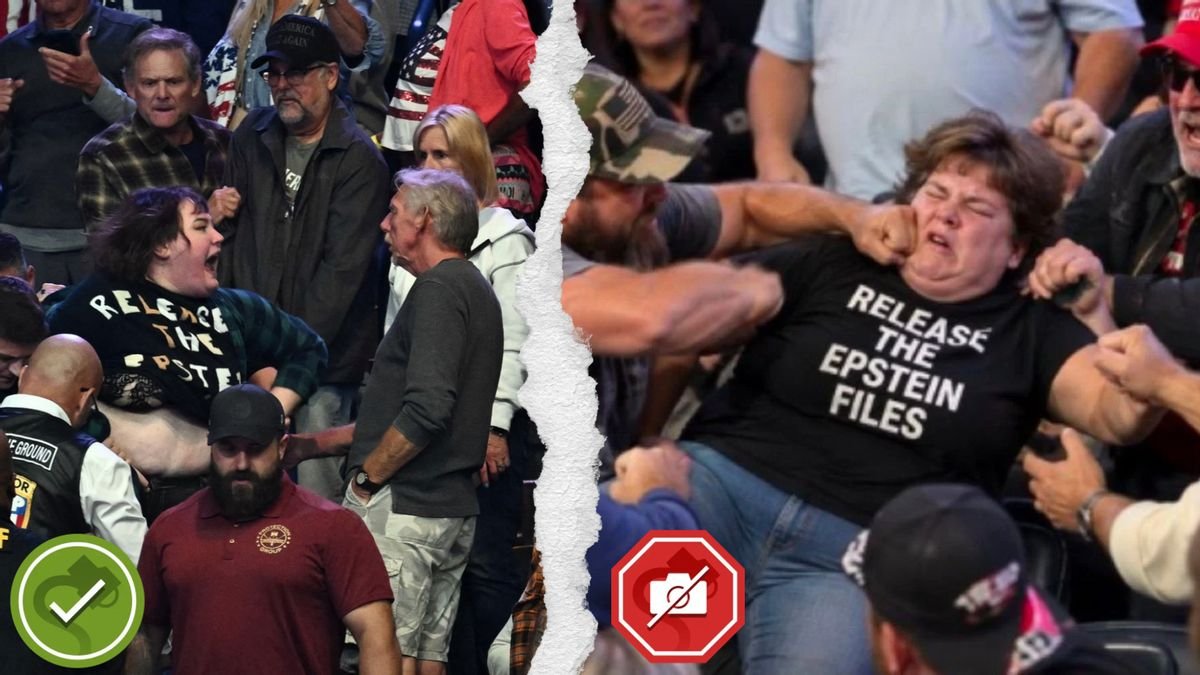
An image authentically shows attendees at one of U.S. President Donald Trump’s rallies punching the face of a protester wearing a shirt that says “RELEASE THE EPSTEIN FILES.”
Rating:
In October 2026, social media users spread an image that claimed to show a woman being punched in the face at one of U.S. President Donald Trump’s rallies.
The person in the picture was wearing a shirt that said “RELEASE THE EPSTEIN FILES.” (The Justice Department has released millions of files related to its investigation of the late sex offender Jeffrey Epstein, but critics allege the agency made redactions to obscure information.)
The image circulated on platforms such as X and Facebook. Many users sharing the image appeared to believe it was authentic.
“If there’s one photo to sum up the Trump era, this is it,” one X post aid.
While a protester wearing a similar shirt was, in fact, attacked at an Oct. 12 Trump rally in Youngstown, Ohio, the image above was created using generative artificial intelligence, according to OpenAI’s detection software. As such, we have rated this image as fake.
OpenAI’s verification tool detected an invisible watermark on the image called SynthID, which the company’s AI tools, like ChatGPT, embed in generated images. (As such, the service can only detect images generated with OpenAI’s software and does not detect AI generation via other large-language models, such as Google’s Gemini.)
(OpenAI)
SynthID detectors are largely accurate but can still be fallible. However, a review of credible footage taken from the Trump rally indicated that the actual protester was wearing slightly different clothing, including an open flannel layered on top of the T-shirt. The T-shirt the real person wore also had variations in the lettering style and coloring, unlike the more uniform version in the AI-generated image.
A reverse-image search could not determine the original creator behind the AI-generated picture.
Numerous reputable news organizations, including NBC News and an ABC affiliate, have published legitimate footage of the event.
NBC News’ video shows rally attendees chanting, “USA, USA, USA” as a man in a gray shirt and a baseball cap appears to push down the protester. Another man in a dark blue or black shirt appears to tackle the protester, hit her and put her in a headlock. Security officials then escort the protester away.
Another clip posted by WKBN, a Youngstown television news station, shows that the same man pulled on the protester’s hair:
Images of the incident are also available via credible photo repositories, including Getty Images and Reuters.
NBC News reported that there were no arrests “because deputies didn’t see the beating and the woman elected not to file a report, Sheriff Jerry Greene said.”
Trump, meanwhile, mocked the protester’s weight while watching the attack unfold. “You know they’re paid protesters,” Trump said, without evidence. “That’s a very low-class protester.”
The protester has not publicly shared their identity with the media as of this writing.
Nineteen people have been injured after a minibus was involved in a collision with a freight train at the Eurotunnel site in Pas-de-Calais, officials have said.
The incident unfolded at around 8pm in Coquelles, sparking a major emergency response with several fire engines, ambulances and a helicopter at the scene.
Those injured were all on the bus, which was carrying HGV drivers towards a Eurotunnel loading platform – the driver of the bus is thought to be one of those hurt in the incident.
Officials have said none of the injuries are life-threatening.
The Pas-de-Calais prefecture said in a statement: “An accident involving a minibus transporting heavy goods vehicle drivers who were about to board a Le Shuttle shuttle occurred this evening, at the loading platform of the Eurotunnel site.
“Significant resources were immediately mobilised by Eurotunnel, then under the authority of the prefect of Pas-de-Calais.
“The initial report indicates 19 people involved, including the driver. No deaths are to be reported at this stage and no lives are in danger.
“The sub-prefect of Calais is currently on site. An initial situation update will be provided during a press briefing scheduled for 10.15pm.”
Local reports claim that two of those who were injured have been assessed as critical and have both been taken to hospital in Lille.
A photograph published by local news outlet La Voix du Nord showed a badly damaged minibus on the platform, with police officers and staff in high-visibility jackets present at the scene.
The image also appeared to show injured people, who had been pixelated, receiving treatment on the platform.
Eurostar said the incident is not expected to impact its service.
It said in a status update: “An incident occurred several kilometres away from the Channel Tunnel.
“This incident does not involve or impact Eurostar trains running from and to London.
“All of Eurostar trains will run as expected.”
The Channel Tunnel opened in 1994 and connects Folkestone in the United Kingdom with Coquelles in northern France.
It’s the only fixed link between Great Britain and the European mainland is the longest underwater section of any tunnel in the world, measuring more than 23 miles.
It runs the Eurostar train service, which carried 20 million passengers in 2025, and freight trains that move tens of millions of tonnes of goods each year.
A woman who was stabbed to death in Manchester in the early hours of this morning has been named, as police arrest a man on suspicion of murder.
Alisha Samuels, 26, was found with serious stab wounds by officers who were responding to reports of a disturbance in Newton Heath at around 2am on Thursday (15 October).
Emergency services rushed to the residential street but despite the best efforts of paramedics, she was pronounced dead at the scene.
Greater Manchester Police have said a 25-year-old man has since been arrested on suspicion of murder.
Another man aged 61 and a woman aged 38 have also been arrested on suspicion of assisting an offender, police said.
All three remain in police custody while police continue with their investigation.
Alisha Samuels died in Manchester on Thursday (GMP/the Press Association)
Detective Inspector Paul Costello, from GMP’s Major Incident Team, said on Thursday: “This was an awful and tragic attack, but I would like to reassure the community that we have three people in our custody, and my team are working tirelessly to identify anyone else who may have been involved.
“There will be a significant police presence in the area, and multiple scenes are in place whilst our investigations continue. I urge anyone who may be able to help with our enquiries to please come forward.”
A local resident said she heard ‘screams’ followed by a ‘car crash’ in the early hours of the morning.
Another told the Manchester Evening News: “I heard shouting and screaming. I went outside and saw all the police.
“They arrested a man, I couldn’t see what he looked like because it was dark.”
A third local resident, who didn’t want to be named, said the horrific incident was a ‘shock’.
“Believe it or not, I was telling my friend the other day that this is a quiet area,” she said.
“So, this has come as a bit of a shock.
“I’ve lived here 30 years and the worst thing we’ve had was a shooting a long time ago. Apart from that, it’s usually quiet.”
Images printed by the MEN showed forensics officers in white suits searching the area outside a property as well as the inside of a white car.
An update from Greater Manchester Police said: “At this time, the family have asked for privacy whilst they deal with the devastating loss of their loved one.”
Detectives are now attempting to determine the circumstance surrounding the incident and have urged witnesses, including anyone with doorbell, phone, or CCTV footage, to get in touch.
The force has called on anyone with relevant information to ‘please come forward to support our investigation and bring justice for Alisha’.
Police can be contacted on 0161 856 5464 or the independent charity Crimestoppers can be contacted anonymously on 0800 555 111.
A Major Incident Public Portal has also been launched, which can be found here.
Ledger has announced Atom, a touchscreen Android device that incorporates a Secure Element running Ledger OS.
Solana Mobile named Ledger as its first hardware expansion partner, with its Seeker app and Solana dApp Store preinstalled on Ledger’s new Atom device.
The launch comes as Ledger investigates hidden implants found in hardware wallets sold through a reseller in Southeast Asia.
Ledger’s new Atom device will ship with Solana’s Seeker app preinstalled, the companiesannounced on stage at Ledger’s Op3n conference in Paris on Thursday.
Billed as a “signer” rather than a hardware wallet, the Atom is an Android-powered touchscreen device equipped with a data-only eSIM and Ledger’s Secure Element, enabling users to send and receive encrypted messages with other Atom users as well as perform crypto transactions in the manner of its range of wallets. To do so, the device switches into a Ledger OS-powered “Secure Mode” for sensitive operations such as signing transactions and authorising AI agent requests.
The Atom sports a 6.77-inch OLED display, rear camera and 4,000mAh battery, and runs on a Qualcomm Dragonwing chip. It also incorporates a hardware privacy switch that physically cuts power to the camera and microphone.
The device also runs third-party apps, and will come preinstalled with Solana’s Seeker app after Solana Mobile named Ledger as its first hardware expansion partner. Seeker combines Solana Mobile’s wallet with its Solana dapp Store, which lists more than 1,500 decentralized apps, and will appear on Atom’s home screen. Until now, the store was available on Solana Mobile’s own Seeker phone.
Your wealth is digital. The device you manage it with should be built for that.
Meet Ledger Atom™: the security of industry leading hardware, the convenience of your everyday apps, plus control over your AI tools, and a rapidly expanding platform of apps, all in one quantum… pic.twitter.com/vHhDNQYipz
Ledger Atom runs on the Android Open Source Project, the free, open version of Google’s mobile operating system, alongside a Secure Element chip running Ledger OS. Its display and touch controls are physically isolated from Android, according to the release, and approvals in the Seeker app happen in a “Secure Mode” backed by the Secure Element.
“Having the Seeker app on Ledger Atom from day one just makes sense, so Ledger users get access to the Solana ecosystem without giving up any of the security,” said Ian Rogers, Ledger’s chief human agency officer.
Solana Mobile began opening its software stack to other Android manufacturers in March. Samsung Wallet also recentlyadded USDC transfers on Solana. Seeker has handled more than $13 billion in transaction volume and 154 million transactions, according to the company, which says it has sold more than 200,000 devices across Seeker and its earlier Saga phone.
Hardware makers that integrate the stack can earn rewards in SKR, the native token of the Solana Mobile ecosystem, which also rewards users and developers, the release said.
Existing Seeker phones will remain fully supported, Solana Mobile said. Reservations for Ledger Atom are open now, though neither company has given a price or shipping date.
The Ledger Atom will include anti-tampering and tamper-evident features from the packaging to the device itself, according to the press release, including ways to help detect whether the enclosure has been opened, and will only be sold through Ledger’s official site.
The announcement of the Atom comes at an awkward time for Ledger, as the firm investigates tampered devices in its reseller network linked to a suspected $87 million wallet drain.
The company this week disclosed that its Donjon security team hadfound an implant in a hardware wallet sold through Southeast Asian reseller CryptoBilis that captures recovery phrases during setup and sends them out over LTE. On Tuesday, itasked resellers in six Southeast Asian countries and Hong Kong to pull its devices from shelves.
Daily Debrief Newsletter
Start every day with the top news stories right now, plus original features, a podcast, videos and more.
Ethereum, XRP, and Solana have all dropped in value on the day, with “outsized drawdowns” compared to Bitcoin.
Experts point to Wednesday’s consumer price index coming in at 3.7% and expectations of an October interest rate hike as major macro pressures.
The slide is also a natural hangover from altcoins’ “strength and momentum” over recent months.
Altcoins have taken a hit over the past 24 hours, with major tokens seeing “outsized drawdowns” compared to Bitcoin. Experts say that this has largely been prompted by macro pressures pushing prices down.
With the market cap of all cryptocurrencies dropping by 2.5% to $2.8 trillion, Ethereum dropped by 5.5% to a $289 billion market cap over the past 24 hours, XRP fell by 5.1% to $82.4 billion, and Solana slipped by 3.8% to $60.6 billion. Meanwhile, industry leader Bitcoin has slipped by 3.1% on the day and 2.6% on the week, sitting at a market cap of $1.6 trillion.
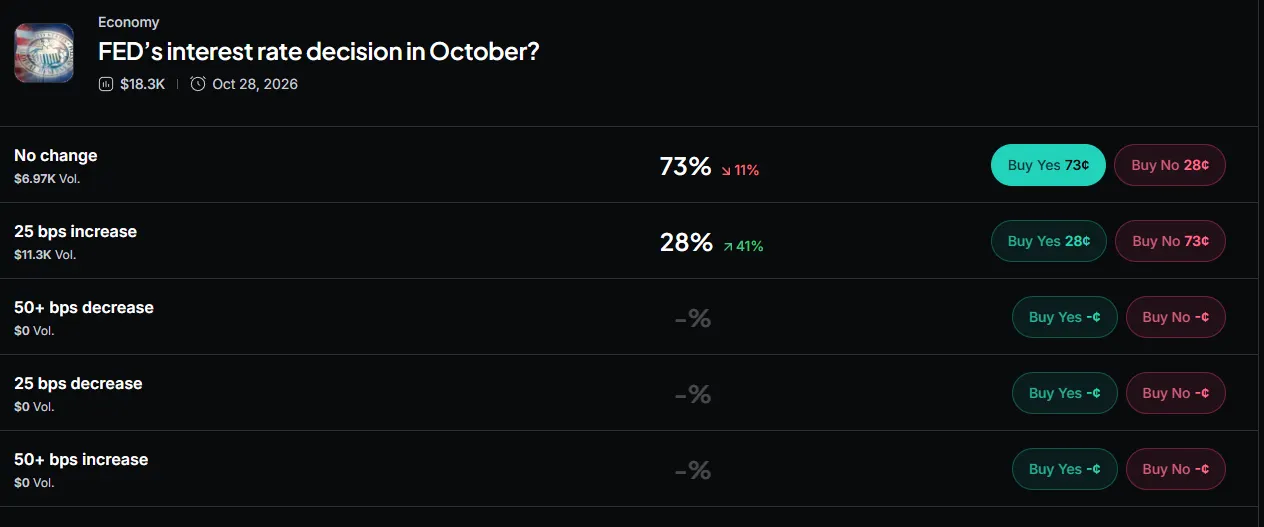
It comes after the consumer price index rose 3.7% in the year to September, as Decrypt reported on Wednesday, with Myriad predictors pointing to a 28% chance of an October interest rate hike (Disclaimer: Myriad is a prediction market operated by Decrypt‘s parent company Dastan).
Nick Forster, founder of options trading exchange Derive.xyz, said in a note shared with Decrypt that this shifted traders into “protection mode” as “hedging activity” on the platform doubled, and whales pulled back on optimistic bets made in spring.
“This immediate pull-back from long-term upside bets alongside aggressive short-term hedging shows a dramatic regime shift,” he said, “with institutional participants rapidly reassessing their macro risk exposure as the path for interest rates turns murky again.”
When markets react like this, Luke Nolan, senior research associate at CoinShares, says that altcoins are impacted the most.
“[It] seems to be high beta assets just got hit harder, similar to in equities as well, where the high flyers have seen outsized drawdowns in recent sessions,” Nolan told Decrypt. “Alts are typically more sensitive to financial conditions, and tightening affects the premise of liquidity expanding.”
Nolan also highlighted the U.S. dollar hitting a near 18-month high as a downward pressure on the entire crypto market. He said that over a medium-term horizon, crypto tends to have an inverse correlation to the US Dollar Index, or DXY. This is partly due to crypto being priced in dollars, Nolan explained, but also because a rising dollar causes a tightening in liquidity and a fall in risk appetite.
Max Shannon, senior associate at Bitwise Europe, told Decrypt that the slide is also a hangover from altcoins’ “strength and momentum” over recent months.
Since the start of October, futures open interest in altcoins (excluding Ethereum) has fallen by $8 billion, Shannon said. To him, that shows traders have “taken chips off the table,” which is a natural reaction after such a strong run.
That pattern is playing out with Ethereum, he added. ETH outperformed Bitcoin for three consecutive months, the first time it’s managed that since March 2021, and investors have been cashing in since. Ethereum ETFs saw 11 straight trading days of net outflows totalling $782.8 million, he said, before a brief inflow on Tuesday. Money has been heading back out since, per CoinGlass data, with $129.5 million in net outflows.
“This price action is more of a consolidation period for altcoins that have already done well,” Shannon told Decrypt. “Altcoins generally tend to exhibit high correlations with BTC in tough times and lower correlations, especially with idiosyncratic catalysts, in better market environments. Hence, for the near term, it is possible that these altcoins trade in lockstep with BTC, albeit more sensitively.”
For prices to recover, Nolan says he wants to see expectations of an interest rate hike in October to fall. Right now, he struggles to call a bottom for altcoins as he sees valid arguments for movements in either direction.
“I could see a situation where Bitcoin loses its support and altcoins likely bleed further,” Nolan told Decrypt. “The opposite could also be true: this could be just a short-term correction, and we could be back into decent market conditions soon, which if Bitcoin was to push back decently above 80k, I could very well see an outsized up move for altcoins.”
Daily Debrief Newsletter
Start every day with the top news stories right now, plus original features, a podcast, videos and more.
Attention, “Fourth Wing” cadets: Amazon Prime Video’s TV adaptation of Rebecca Yarros’ bestselling romantasy series has found your wing leader.
Emilio Sakraya has been cast in the role of Xaden Riorson, Variety has learned. He will star opposite Esther McGregor (“We Were Liars”) as Violet Sorrengail on the Prime Video TV series. Amazon declined comment.
Sakraya has a hefty list of credits in both TV and film from his native Germany as well as in the U.S.; his credits include “Rhinegold,” “Tribes of Europa” and “Warrior Nun.” His other recent projects include “Those About to Die,” and he’s set to appear in Season 3 of “One Piece.”
“Fourth Wing” is set inside the brutal world of Basgiath War College, where there is only one rule: graduate or die. Twenty-year-old Violet Sorrengail was always expected to live a quiet life — but she’s sent on an entirely different path when her mother, a general in the military, orders her to join the hundreds of candidates striving to become dragon riders, the elite of Navarre.
Starting with the release of New York Times bestseller “Fourth Wing” in May 2023, Yarros’ “The Empyrean” book series currently includes sequels “Iron Flame” (November 2023) and “Onyx Storm” (January 2025.) This September, Yarros released the novella “Threshing Day,” which tells 13 stories set in the “The Empyrean” universe. The titles and release dates for the planned fourth and fifth books have yet to be announced.
Ordered to series at Amazon in May, Meredith Averill (“Anne With an E”) is showrunner and executive producer of “Fourth Wing.” The show is also executive produced by Kilter Films (Lisa Joy — who also directs the pilot, Jonathan Nolan and Athena Wickham), Outlier Society (Michael B. Jordan and Elizabeth Raposo) and Premeditated Productions (Liz Pelletier and Sherryl Clark).
The New Orleans gangster establishes a new kingdom in Frisco, Texas, where he discovers a hustler running his business amid the suburban town. Per the series logline, “Recruiting an ambitious protégé, a loyal driver and a growing network of eccentric partners, Lee transforms small hustles into big business. But, every new score raises the stakes, and as his influence grows, so do the risks, forcing Lee to stay one grift ahead. Frisco may not know it yet, but its new king has arrived.”
The series will premiere on Paramount+ Dec. 18 with two episodes, followed by new episodes weekly. Starring alongside Jackson are Asa Germann, Kai Caster, Lilah Pate and Savanna Gann, with a special appearance by Sylvester Stallone.
Written by Sheridan, “Frisco King” is executive produced by Stallone, Jackson, Sheridan, David C. Glasser, Ron Burkle, David Hutkin, Bob Yari, LaTanya Richardson Jackson and Keith Cox. Christina Alexandra Voros and Michael Friedman executive produce in addition to both directing four episodes, with Voros directing the pilot. The series is produced by Paramount Television Studios and 101 Studios,
Watch the teaser for “Frisco King” below.
In other TV roundup news:
Specials
CBS set “The Price is Right at Night: Live Holiday Special” and “The Price is Right: 20 Seasons of Drew Carey” to air in December.
“The Price is Right at Night: Live Holiday Special” will premiere on Dec. 13 at 8 p.m. ET on CBS. The broadcast marks the first time television’s longest-running game show will air in real time. Viewers will also get behind-the-scenes access with host Drew Carey, announcer George Gray, the models and the production team as they race to keep the show on track.
On Dec. 15, CBS will air “The Price is Right: 20 Seasons of Drew Carey.” The special will celebrate two decades of Carey as host, featuring celebrity appearances from previous episodes including Mila Kunis, Jack Black and Snoop Dogg.
The live holiday special is produced by Fremantle, with John Quinn as showrunner and executive producer. The Drew Carey special is produced by Fremantle, with James Davis and Quinn as executive producers. Both specials will be available to stream on Paramount+.
Initiatives
FilAm Creative announced its inaugural TV Creator Lab cohort of 25 writers.
The tuition-free, five-month program is designed to help emerging television creators develop their original scripted series. The selected writers will learn from working television executives, producers, showrunners and industry professionals.
The Lab launched Oct. 8 at Patriot Pictures in Los Angeles. The cohort gathered for a conversation with Lionsgate SVP of Television Richard Rothschild, Greg Coolidge (“The Continental: From the World of John Wick”) and Oren Segal, moderated by television director Francis dela Torre (“Almost Paradise”).
The writers selected are Angel Cielo, Candice Sarangay, Celena Cipriaso, Eileen Cabiling, Ella Espiritu, Eric J. De La Rosa, Eugene Ramos, Faith Christy Soliven, Frances Rubio, Geri Carillo, Hermie Castillo, Jaime Estepa, Jalen Giovanni Jones, Joshua Labata, Joy Regullano, Kim Marcelino, Nicole Wolf, Noël Wiggins, Rebecca Williams Spindler, Roann Enriquez, Rommel Rojas, Stacie Gancayco-Adlao, Teodorico Sajor, Walter Boholst and Yasmine Gomez.
*
The American Film Institute announced the mentors for its 2026 Writers’ Room Ready program.
This year’s mentors are Brad Ingelsby (“Task,” “Mare of Easttown”), Peter Gould (“Better Call Saul,” “Breaking Bad”) Patrik-Ian Polk (“Noah’s Arc,” “P-Valley”), Sev Ohanian (“Sinners,” “Searching”) and Sarah-Violet Bliss (“Scorn,” “Search Party”).
The creatives will be paired with AFI Class of 2025 graduates: Brad Ingelsby with Nathan Bouton — “Black Tide,” one-hour drama Peter Gould with Kirby Saxton — “Holy Water,” half-hour comedy Patrik-Ian Polk with Chri’shawn Julius — “Pop Puss,” half-hour comedy Sev Ohanian with Edward Nenedzhyan — “The Optic,” one-hour drama Sarah-Violet Bliss with Annabel Newland — “Glitter,” half-hour comedy
“Great writing is taught in community, not isolation,” said Susan Ruskin, AFI Conservatory dean and executive vice president of the American Film Institute. “We are deeply grateful to our accomplished mentors, whose wisdom, expertise and generosity empower our Writers’ Room Ready participants to transform their potential into professional practice in the industry.”
The Writers’ Room Ready program recognizes outstanding original television pilot scripts written by AFI Conservatory Screenwriting Fellows.
Partnerships
Elmo and his “Sesame Street” friends are taking on an African safari adventure in a special PBS ‘Nature’ primetime crossover. “Sesame Street and the Great Elephant Adventure” premieres on Wednesday, Oct. 14 at 8 p.m. ET on PBS and PBS Kids and will stream on pbs.org/nature, YouTube,pbskids.org, the PBS KIDS Video app and the PBS app.
Per the release, “The adventure begins at the group’s safari lodge, where they meet the lodge manager and her young daughter, who introduce Elmo and Abby to Kenya’s culture, nature and wildlife. Along the way, Elmo struggles with the idea of leaving his adopted elephant behind but comes to learn that the greatest way to care for his new friend is to let her thrive where she belongs: in the wild.”
“Bringing Elmo and the ‘Sesame Street’ friends into the world of ‘Nature’ allows us to tell a unique story filled with adventure, discovery, and heart,” Sal Perez, executive producer for Sesame Workshop, said. “We hope this special event sparks curiosity in children and encourages them to see themselves as explorers and problem solvers, while reminding viewers of every age that some of life’s greatest lessons come from experiencing nature.”
Programming
Moonbug Entertainment announced that actress and performer Lauren Vaz will join Cashaé Monya in playing Meekah in the global “Blippi” franchise.
“Lauren brings such a natural warmth, confidence and sense of fun to Meekah,” Liz Katz, Associate General Manager of “Blippi” and lead of the Meekah franchise, said. “She really captures the curiosity and big-sister energy that families know and love about Meekah. We’re so excited to welcome her to our ensemble cast alongside Cashaé Monya as we enter an exciting new chapter for Meekah, with more to share in the weeks ahead.”
“Blippi” is a live-action kids’ franchise built around curiosity, exploration and real-world adventures. Meekah is an established character who can be brought to life by different performers. Vaz now joins Monya in sharing the role across the Blippi franchise, as Meekah prepares to enter an exciting new chapter.
“Getting to step into Meekah’s shoes is incredibly special to me,” Vaz said. “I love how she encourages kids to be curious, express themselves and have the confidence to jump in and try something new. Having already been part of the Blippi world on tour, I’m so excited to continue this journey with Meekah and bring my personality, creativity and sense of fun to all the adventures ahead.”
Executive News
Hearst Media Production Group named Amy DeGregorio as executive vice president of sales and revenue.
In the newly created role, DeGregorio will act as a key member of HMPG’s executive team and strategic advisor to the company’s president on revenue growth, commercialization and new business opportunities. She will be responsible for driving revenue strategy and overseeing sales and sponsorship activity.
Prior to her new role, DeGregorio served as senior vice president, managing director of sales for educational/informational programming for HMPG since 2022.
“Amy has done an exceptional job building meaningful brand partnerships and seamlessly integrating sponsors into our E/I programming,” said Bryan Curb, HMPG president. “As HMPG continues to expand, we want to bring that same expertise and strategic approach to our entire portfolio, creating new opportunities for brands to engage with our award-winning content and loyal audiences.”
In 2016, DeGregorio joined Litton Entertainment, which was rebranded to HMPG in 2022, as senior director, integrated marketing. She was promoted to vice president, integrated marketing and, in 2020, senior vice president, client solutions. Before joining Litton, she worked at CBS Television Stations, and has held roles at NBCUniversal, truTV, ABC Television and MTV Networks.