After months of waiting, Nvidia’s RTX Spark has officially landed. We’ve been waiting since the first announcements at Computex, eagerly waiting to see how Nvidia would reshape the laptop field with its “Grace Blackwell” architecture, pumping up the humble Windows laptop with workstation-grade power for AI, packaged into lightweight Windows laptops that can pick up and go. (At least, that’s the promise.)
The first wave of RTX Spark laptops are expensive machines, to be sure, but RTX Spark is a major shift for engineers and AI enthusiasts. This is far more than a modest CPU or NPU refresh. By combining Arm processing, powerful Blackwell RTX graphics, and up to 128GB of coherent unified memory into a single architecture, Nvidia and Microsoft are giving users the power for local AI, and challenging the dominant cloud providers of current AI tools. It’s a new hardware platform, a new category of laptop, and the first of many Windows machines built with agentic AI in mind.
With this hardware, Nvidia and Microsoft are aggressively redefining mobile computing and setting the stage for the next decade of personal technology. I spent a couple of days in San Francisco with Microsoft and Nvidia to get the lowdown on Spark and Windows. So let’s dig into the details of the new platform, the silicon that makes it tick, and the implications RTX Spark has for users and the laptops of tomorrow.

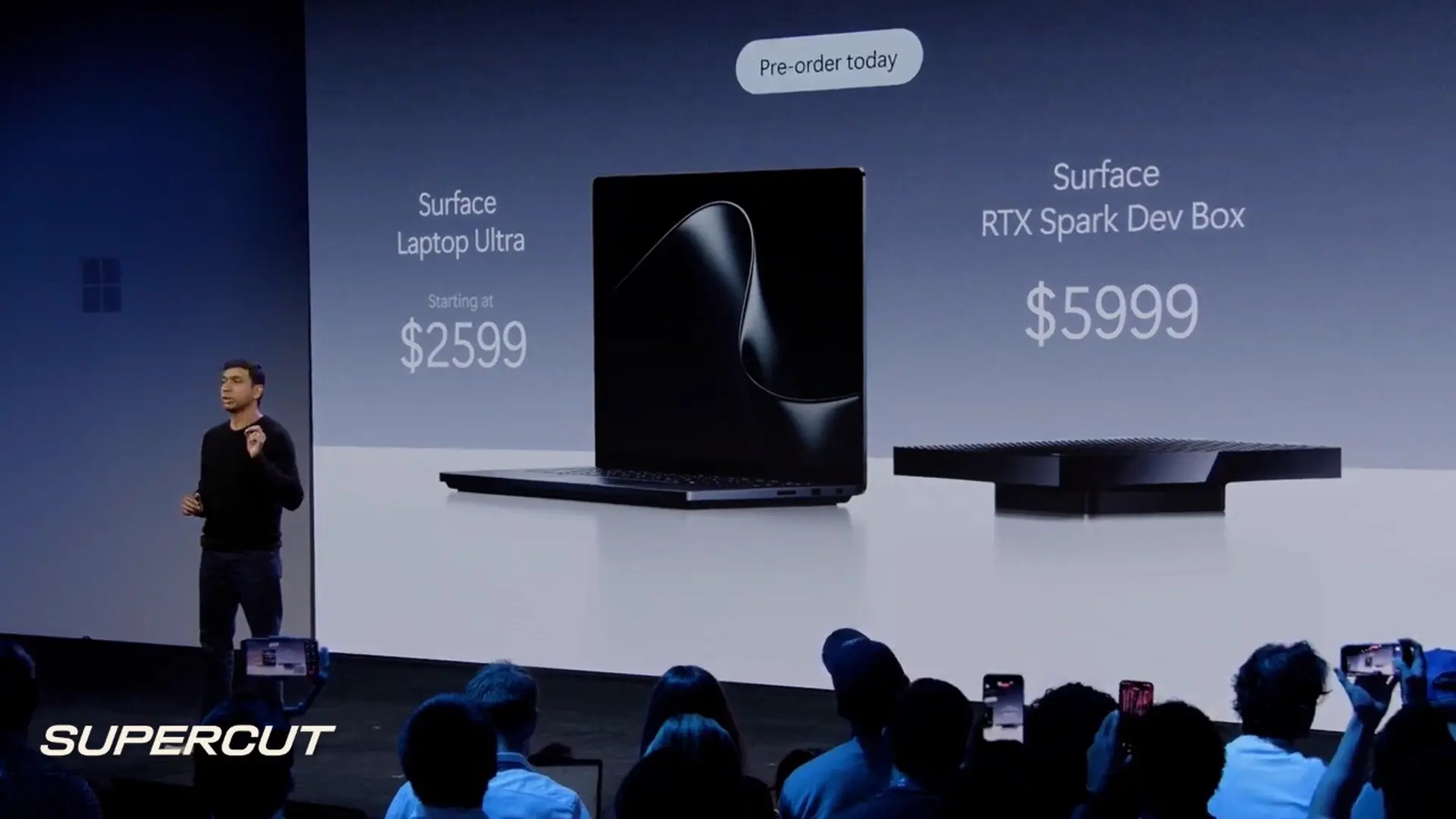
Microsoft Unveils New Surface Laptop Ultra and New AI Agents
Benchmarking and Ecosystem Context: Where RTX Spark Fits
For all their traditional laptop design and rich features, it’s important to remember that RTX Spark laptops are essentially a new platform for Windows machines. It’s built on Arm, and while Windows on Arm is already a thing thanks to the partnership between Microsoft and Qualcomm (the partnership behind the last few generations of Surface devices), Nvidia brings so much more to the equation: powerful graphics, beefier compute, and rich capabilities for local AI and agentic tools. Qualcomm paved the road, but Nvidia is driving a supercomputer down it.
So it’s worth revisiting what an AI PC is and how it has evolved from simple “classic” laptops with an NPU to encompass a range of systems at all levels of power.

(Credit: Brian Westover)
At the basic level, mainstream AI PCs, such as Copilot+ laptops, go beyond the traditional CPU and GPU to add a neural processing unit called the NPU. The NPU offers separate parallelized processing hardware specifically for machine learning and AI functions. Current requirements have mainstream AI PCs producing 40 to 50 trillion operations per second (TOPS), which is sufficient for small models for simple summarization, language translation, captioning, and background processes like webcam image improvements. It’s not enough to power full-scale local inference, and even what can run on those machines runs relatively slowly, bottlenecked by minuscule amounts of RAM and processing power.
(Credit: Brian Westover)
The next level up are traditional x86 gaming systems and mobile workstations. These machines bring dedicated mobile GPU hardware into the equation, which also brings more capable parallel processing and the ability to use VRAM as dedicated memory for loading a model and maintaining context through a conversation or task. The higher wattage and improved thermal management help deliver some legitimate on-device AI capability, but again, we’re still constrained by the amount of local memory and the fact that the hardware is not optimized for AI tasks. So even when you can run AI tools on the machine, they compete for resources anytime you try to multitask AI workloads and the use of another app.
The third category of AI PCs: dedicated AI developer boxes. That’s traditionally meant desktops like the Nvidia DGX Spark, the AMD Ryzen AI Halo, and even larger desktop AI machines like the Nvidia DGX Station, which generally have no consumer market and are purely for enterprise and business users.
RTX Spark straddles the line between gaming and workstation systems and dedicated AI developer machines. They have the form factor of a workstation, the power efficiency of a mainstream AI PC, and the power and unified memory needed for a developer machine. That all translates into an extremely capable, surprisingly portable, and efficient machine, but it also introduces all sorts of new complexities for those of us who test and evaluate laptops.
All About the Nvidia N1X: SoC Architecture and Hardware Specs
Nvidia RTX Spark is an evolution of the same Grace Blackwell architecture in the Nvidia DGX Spark developer desktop, which Nvidia describes as a desktop supercomputer capable of petaflop performance.
(Credit: Nvidia)
The N1X chip is fabricated by TSMC on a 3-nanometer process node, and the SoC can scale between 45 watts and 80 watts TDP. That means that it can deliver power to run high-parameter AI models within the confines of an ultraportable laptop as thin as 0.55 inch and weighing as little as 3 pounds. On top of this, the new architecture also maintains consistent performance, whether powered off a wall outlet or a laptop battery, with Nvidia promising 99% of plugged-in performance on the battery.
On the die, the Grace Blackwell architecture connects a Grace CPU and Blackwell GPU using a dedicated bidirectional interconnect called NVLink-C2C (chip-to-chip). Rated for 600GB-per-second of bandwidth, it enables low-latency, cache-coherent communication across the compute dies, eliminating traditional PCI Express bus bottlenecks and allowing them to address the same unified memory space simultaneously without redundant memory copies. That also gives it a massive advantage over traditional Intel laptop architecture, whether that’s comparing a CPU with integrated graphics or a more powerful system with a dedicated GPU.
The Grace CPU: Arm-Native Multithreading
When you get down to the core silicon, the Grace CPU is built on Arm architecture, with Arm Cortex-X925 performance cores and Arm Cortex-A725 efficiency cores. This architecture has a lot in common with Apple’s M-series chips, which also are built on Arm technology, with a mix of high-performance and energy-efficient cores.
(Credit: Nvidia)
The Nvidia RTX Spark N1X chip is the official name of this first-generation product, but the name actually applies to two different chips: an 18-core version that features nine performance cores and nine efficiency cores, and a 20-core version with 10 performance cores and 10 efficiency cores. It would be a little less confusing if Nvidia didn’t call both of these the “N1X” chip, or added some sort of modifier to the name, but it’s not the first time we’ve encountered this sort of confusing naming scheme for chips. Apple’s M-series chips are guilty of this, too. (Apple makes different versions of the M5 chip, distinguished by core counts on the CPU and GPU.)
The Grace CPU also supports Windows Workload Profile Scheduling (WPS), which distributes multithreaded tasks dynamically across performance and efficiency cores to optimize power scaling.
The Blackwell RTX GPU: Tiered Muscle, Unified Memory
Another part of the SoC equation is the Blackwell RTX GPU, and like the CPU, it comes in two hardware tiers. The flagship model has 6,144 CUDA cores and 192 fifth-generation Tensor Cores. The step-down model has a scaled-down Blackwell chip with 5,120 CUDA cores (and possibly fewer in future configurations). The other major difference is in memory support. The top Blackwell RTX chip supports up to 128GB of LPDDR5X memory, while the step-down model supports 16GB to 64GB of memory.
(Credit: Nvidia)
Ultimately, the split between the two chip variants is confusing, because it also translates into a difference in AI performance that scales proportionally with the core count. At the moment, the version of the chip with 6,144 CUDA cores delivers up to 1 petaflop of FP4 precision, employing 45 to 80 watts of power, which is configurable. The step-down model may not deliver the full processing muscle that the flagship model does.
Here’s the full spec breakdown for the two N1X chips:
The Memory Subsystem: Shattering Mobile VRAM Limits
Beyond the two tiers of the N1X chip, something else will determine RTX Spark’s power potential: the memory allocation.
RTX Spark’s unified memory subsystem operates over a 256-bit, 16-channel memory interface, rated by Nvidia for speeds up to 9,400MBps. That works out to a peak unified memory bandwidth of up to 300GBps.
Compare that with normal gaming and workstation laptops. They’ll use a dedicated GPU and discrete VRAM, and will be generally capped at 24GB of VRAM. (You’d see that in a high-end laptop with an Nvidia GeForce RTX 5090 mobile GPU.) The CPU works in concert with its own system RAM, while the GPU operates hand in hand with this independent, fast pool of VRAM, made up of dedicated GDDR7.
In contrast, on the Nvidia RTX Spark, you are instead working with up to 128GB of unified LPDDR5X in one big pool, directly accessible by the CPU and GPU. For local AI, that gives the RTX Spark an undeniable advantage. Allocation tools let you partition the unified memory dynamically between CPU and GPU, but on the 128GB model, you can devote up to 96GB to GPU access, allowing larger shared page sizes to accelerate big data processing. It also enables you to host massive models locally, which is essential for high-quality performance and agentic tools.
That said, that 128GB configuration is at the extreme high end of RTX Spark systems. Configurations with that amount are currently projected to run about $6,000; smaller RTX Spark memory configurations, like the 32GB and 64GB versions that will be popping up on store shelves at places like Best Buy, are significantly more affordable and can run complex reasoning models at smaller sizes.
The RTX Spark NPU: Copilot+ Compliance and Power Efficiency
One more thing worth mentioning as we discuss the chip architecture in RTX Spark is the inclusion of a dedicated low-power neural processing unit, or NPU.
The RTX Spark’s NPU is a unique offering, not the same as in the equivalent DGX Spark Linux boxes that Nvidia has been selling over the last year and a half. The addition of an NPU is specific to the Windows laptops that RTX Spark is designed for, to meet the 40 TOPS certification threshold for Copilot+ to function.
Now, there has been some confusion about whether or not RTX Spark systems actually qualify as Copilot+ machines themselves, or whether that branding will even continue going forward, now that RTX Spark is redefining what an AI PC can be. However, Microsoft has clarified that RTX Spark laptops are indeed Copilot+ machines. Features like Live Captions, Windows Studio Effects, and other Windows 11 AI-enhanced features like Windows Recall will either be available at launch or rolling out in the coming months. Microsoft says that some of these things will be available this year under the Windows Insider Program, while others will not be deployed until 2027.
The Windows on Arm Factor
Aside from chip architecture, RTX Spark also raises system-level questions around Windows on Arm and system-level integrations. Nvidia and Microsoft pulled the curtain back on some of these at their RTX Spark event, but since then, as I’ve been through technical briefings with Nvidia and various laptop manufacturers, we’ve learned even more. Here’s a quick rundown of some the salient points.
Workload Profile Scheduling
Chief among these is WPS. On a standard PC, the system treats all tasks more or less the same, sending them to different processor cores largely based on what’s open, with some degree of nuance as it handles performance cores versus efficiency cores. But with a complex chip like the RTX Spark, which features an Arm CPU, a dedicated NPU, and a massive number of Blackwell Tensor cores, basic scheduling systems would cause lag and burn through your battery life. WPS solves this with real-time matching of the task and the necessary processing hardware.
Now, some of these things are already in use on other platforms. Intel chips employ Thread Director, which performs hardware-level scheduling on those chips. Microsoft optimized the Windows kernel scheduler for RTX Spark’s Grace CPU layout, dynamically distributing multithreaded compute, background-agent processes, and foreground interactive applications across performance cores and efficiency cores to optimize performance per watt.
Adaptive Unified Memory Addressing and Page Enhancements
Windows memory management also has adaptive unified memory addressing. That removes the traditional fixed boundaries between VRAM and RAM, using an adaptive memory ceiling to dynamically allocate different portions of the up to 128GB of system memory as workloads expand. Both of these technologies are more important than ever when using agentic tools, which run in the background while you work on other tasks on your system. This dynamic distribution and adaptive-processing memory management are part of what makes that background agentic use possible without you suffering a performance hit.
Another kernel-level management tool is around handling shared memory regions. Demanding AI models and complex creative datasets use larger memory pages (that is, the amount of data immediately available in RAM), and enhancements here, according to Nvidia, reduce translation buffering and give developers more granular control over memory traffic on both CPU and GPU. It’s not something you’ll probably ever encounter as an end user. But it does play directly into the seamless experience you’ll have using the system for productivity and content creation while also using AI tools, because it keeps everything running smoothly.
(Credit: Brian Westover)
A Sandbox for AI Agents: Microsoft Execution Containers (MXC)
Perhaps the biggest broad change that Microsoft brings to the table for Nvidia RTX Spark is Microsoft Execution Containers (MXC). This is essentially a set of boundaries, at the OS execution level, that provide process- and section-level isolation for autonomous AI agent workloads.
MXC sets up strict rules around file access and network resources in the runtime without the heavy performance and power overhead of a full virtual machine. This is a really big step forward in enabling agentic tools on consumer systems, with a level of safety that protects your local data and hardware from a misbehaving or improperly set up agentic tool.
Independent Agent Identity Attribution
Microsoft is also adding to Windows something called Independent Agent Identity Attribution. This isolates agent activity from human user sessions, essentially setting up an agent as a separate user on the machine, but with different access permissions. This allows you to use background agents without having to worry that a wayward AI hallucination might turn into a damaging command that gets attributed to you, and it also reins in the agent by not giving it full user or admin access to everything available on the machine. It essentially hands the agent safety scissors to get things done, allowing it to do work without damaging anything in your name.
So Wait, Who Is RTX Spark Actually Meant For?
At this point, you might be asking yourself, “Who are these machines actually made for?” That’s a fair question.
Developers and AI Engineers
First and foremost, these machines are built for AI, specifically developers and AI engineers. Nvidia RTX Spark hardware offers native CUDA runtime locally and puts AI prototyping and agentic work into a laptop form factor. Up until now, these have been confined to Linux systems and clusters, beefy desktop rigs, and servers that offer private compute in the cloud.
That’s great for some use cases, but as AI becomes more common and mainstream, the need for local compute is more important than ever. So first and foremost, this is aimed at developers working on AI tools, and workers and business owners who are leveraging those AI tools and want to keep everything local and secure to protect proprietary information and customer data, or stay on the right side of various data privacy laws.
(Credit: Nvidia)
Content Creators and Digital Artists
Content creators will want to take advantage of accelerated media engines and multi-stream video workflows. The giant unified memory translates into massive unified frame buffers for multi-layer generative creative pipelines and rapid scrubbing through large, high-resolution video files. If you are a visual artist, a YouTuber, or even a game designer, these are machines worth looking at.
Gamers: Windows on Arm Finally Gets Serious
Gaming in particular adds an interesting dimension to this machine. Though Nvidia and Microsoft have both been keen to emphasize that these are not intended to be just gaming machines, they do offer support for the full RTX stack, with GPU power estimated at being equivalent to an RTX 5070 mobile GPU. (We’ll be testing that.)
Plus, you get modern ray tracing, DLSS rendering enhancements, and frame generation, along with optimized Prism emulation of traditional PC titles, finally bringing real gaming support and performance to Windows on Arm.
Gamers will be pleased to know that several game companies are going to be bringing native Arm versions of popular games. One of the hurdles? Anti-cheat technologies. Getting them to run on Arm instead of x86 has been a real stumbling block for Windows gaming outside of Intel and AMD platforms. Nvidia brings a lot of gaming clout to the table, and game companies are already signing up to offer native anti-cheat and in-game support on Arm as a result. This will be a developing area.
(Credit: Brian Westover)
Mainstream Power Users and the Local Agentic Frontier
AI devs and on-the-side gamers are far from the only intended audience for these machines, though. Tech enthusiasts and power users are a major potential market here. These laptops blend power-efficient Arm chips with desktop-class GPU capabilities in thin-and-light designs, providing power that exceeds gaming rigs and workstations in some aspects.
So, perhaps the most important market for these new RTX Spark laptops is mainstream users who are looking to start using local agentic workflows. The promise of an always-on, local-first intelligent assistant with persistent background agents that execute consistently and reliably has massive appeal to those who want to bring AI capabilities more fully into their day-to-day lives. Being able to do this without relying on a cloud API, dealing with online latency, or paying ongoing subscription costs is also a major selling point, particularly for those in the business world who have already embraced AI tools and agents but are quickly finding the per-token subscription costs hard to swallow.
Recommended by Our Editors
(Credit: Brian Westover)
What Local AI and Agentic Computing Look Like in the Age of RTX Spark
By this point, it should be clear: local AI and agentic computing are the primary use cases for RTX Spark. The hardware’s designed for on-device model execution and inference, with the parallelized computing and high-level performance needed to run large-parameter models locally. Get the biggest allocation of unified memory possible here (128GB), and you should be able to run some of the largest local models available.
(Credit: Nvidia)
The Local Model Landscape
Need a research assistant? Want to generate a photo or video? LLM-based AI chatbots are well-suited to these types of tasks, and open-source LLMs you can run on an RTX Spark machine could be a solid alternative to cloud-based household names you might already be familiar with, such as ChatGPT and Grok. Nvidia and Microsoft say that many of the already-popular LLMs will work on RTX systems, including Qwen, Llama, Mistral, Stable Diffusion, and Flux.2. Nvidia also recommends its own Nemotron Bolt, a model specifically optimized for RTX Spark.
None of these will match what you can get from a ChatGPT subscription, but many of them come pretty close. And while all of them can run on existing PCs right now, they’ll likely be faster on an RTX Spark machine.
Autonomous Workflows: Moving Beyond Chatbots
Now, let’s say that in addition to running ideas past a chatbot, you want to automate some of your workflows. You’d use an agentic tool—something like OpenClaw, Hermes, or Perplexity’s Personal Computer—to do that, but you need even greater processing power than you would for an LLM. Here, RTX Spark delivers again.
(Credit: Brian Westover)
A large pool of unified memory, no PCIe bottlenecks, and oodles of CUDA cores mean that one of these machines should be able to let agentic tools easily create professional-grade graphics, render 4K videos, and do other compute-intensive tasks.
Nvidia OpenShell: Lock it Down With an Agentic Security Guard
Great agentic power requires great guardrails. You wouldn’t want an agentic tool to get tricked by a malicious prompt injection and run amok, deleting all your stuff. Nvidia has a solution for that, the aforementioned OpenShell. By default, it blocks everything, intercepting the agent at the operating system’s kernel level. Until you specify otherwise, it can’t open private folders or access unauthorized websites. OpenShell also provides a safety layer that prevents an agent from ever seeing an actual API password or login token.
Accelerating Everyday Creative Workflows
Many prospective RTX Spark system owners might want something simpler than running local LLMs or agentic AI, though. And the platform can still enable AI accelerations of existing software that requires third-party developer support. Here are just a few glimpses of what you can expect on this front, all exclusive to RTX Spark hardware:
Upcoming versions of Adobe Photoshop and Premiere Pro will let you remove unwanted objects from an image, eliminate background humming from an audio track, and adapt a clip’s aspect ratio for multiple social media platforms, among many other tools.
In Blender 5.3, you’ll be able to use AI for denoising, providing real-time lighting and noise-free feedback to help navigate a scene and make editing easier.
(Credit: Brian Westover)
Finally, Nvidia’s Broadcast app, which adds AI effects like noise removal and virtual backgrounds to your livestreams and video calls, will run locally on RTX Spark.
Many of these features are, for the moment, exclusive to RTX Spark laptops and won’t be widely available outside of those systems until other Windows-based AI-agent-ready machines are on the market. Cloud-enabled versions of these features are already out there, but there are many privacy and other benefits to running them locally.
Nvidia PAIR: Distributed Home Mesh Computing
If you’ve got multiple PCs in your home or office, an RTX Spark machine can unite them and harness their computing power to make things run even faster. Using the Nvidia Personal AI Router (PAIR) feature, an RTX Spark PC can distribute AI inference requests across machines.
It essentially turns all your PCs into a network of individual, independent machines that can be coordinated to handle different parts of a larger task. It can’t turn all of your systems into a single, super-powerful virtual GPU, but it can relieve hardware bottlenecks for heavy tasks by putting local GPUs and memory to work. The idea is that it maintains responsive performance by recruiting the unused capacity already in your home and applying that to different workloads.
The RTX Spark can serve as either the central machine in that network or one of several machines working in concert.
Testing RTX Spark: Benchmarking AI as It Changes
At PCMag, we’ve been wrestling with how to properly benchmark the growing ecosystem of AI PCs for months now. We’ve looked at existing benchmarking tools, we’ve looked at complex evaluation protocols for server-grade hardware, and we’ve dabbled in making experiential use cases into repeatable, measurable tests.
And that’s all still a work in progress. But we have developed our own testing protocols for these different classes of machines. We’ve worked with an outside contractor with experience in AI benchmarking and ties to MLCommons, the organization behind the MLPerf testing suite, and they’ve developed preliminary benchmarks for testing NPU performance, measuring discrete GPU performance in AI tasks, and even evaluating these super-SoC machines like the Nvidia DGX Spark and the new RTX Spark laptops.
We’ll be rolling out our first test numbers tomorrow as part of our initial evaluation of RTX Spark. For now, we’re looking at Time to First Token (TTFT), which measures the delay between submitting a prompt and receiving the initial output token of the response. This is the basic measure of performance for local AI, but it’s just that: basic.
Next, we look at tokens per second (TPS), which measures the generation rate of how many subsequent tokens are produced per second during the decode stage, which is generally a process that’s limited by memory bandwidth. We also look at time per output token (TPOT), which is sort of an inverse expression of TPS, reporting token generation speed as average milliseconds per token. Again, this is just a basic rate of token output, which doesn’t really take into account the quality of a response or the accuracy of the response, only the speed of token output.
We’re using specialized runs of MLPerf Client and the LM Studio Qwen benchmark to execute a series of warm-up tasks and preset prompt sequences, doing multiple runs of different prompt sizes, taking advantage of different memory allocations, and averaging the different runs to get a generalized number of measured performance.
We’re doing our best to stack that up against a broad range of hardware across Intel and AMD (both x86 and x64), Apple silicon with M-series Arm processors, and a range of Windows on Arm hardware, including both Qualcomm Snapdragon X and now RTX Spark. And we’re doing this across several operating systems, with a huge range of memory capacities, models we could potentially use, and use cases ranging from text generation to image generation to agentic workflows.
That’s all to say that our AI evaluation is still in its early days. But that’s true for everybody, and the landscape is changing fast. We will share more details about the tests and our results as we evaluate our first batch of systems for RTX Spark. Stay tuned.
About Our Expert

Brian Westover
Principal Writer, Hardware
Experience
From the laptops on your desk to satellites in space and AI that seems to be everywhere, I cover many topics at PCMag. I’ve covered PCs and technology products for over 15 years at PCMag and other publications, among them Tom’s Guide, Laptop Mag, and TWICE. As a hardware reviewer, I’ve handled dozens of MacBooks, 2-in-1 laptops, Chromebooks, and the latest AI PCs. As the resident Starlink expert, I’ve done years of hands-on testing with the satellite service. I also explore the most valuable ways to use the latest AI tools and features in our Try AI column.
Read Full Bio

![Data from the web analytics platform Semrush shows that 80 percent of the website's initial visits originated from Israel. [Semrush]](https://www.aljazeera.com/wp-content/uploads/2026/10/%D9%84%D9%82%D8%B7%D8%A9-%D8%B4%D8%A7%D8%B4%D8%A9-1-%D8%B3%D9%8A%D9%85%D8%B1%D8%B4-1792057535.jpg?w=770&resize=770%2C535&quality=80)
![Semrush analytics reveal that direct links were the primary traffic source for the Israeli counter-film's website in October. [Semrush]](https://www.aljazeera.com/wp-content/uploads/2026/10/%D9%84%D9%82%D8%B7%D8%A9-%D8%B4%D8%A7%D8%B4%D8%A9-2-%D8%B3%D9%8A%D9%85%D8%B1%D8%B4-1792057563.jpg?w=770&resize=770%2C343&quality=80)