Blog

  • Man wires up 400 car batteries in ‘insane’ experiment to see what would happen

    Man wires up 400 car batteries in ‘insane’ experiment to see what would happen

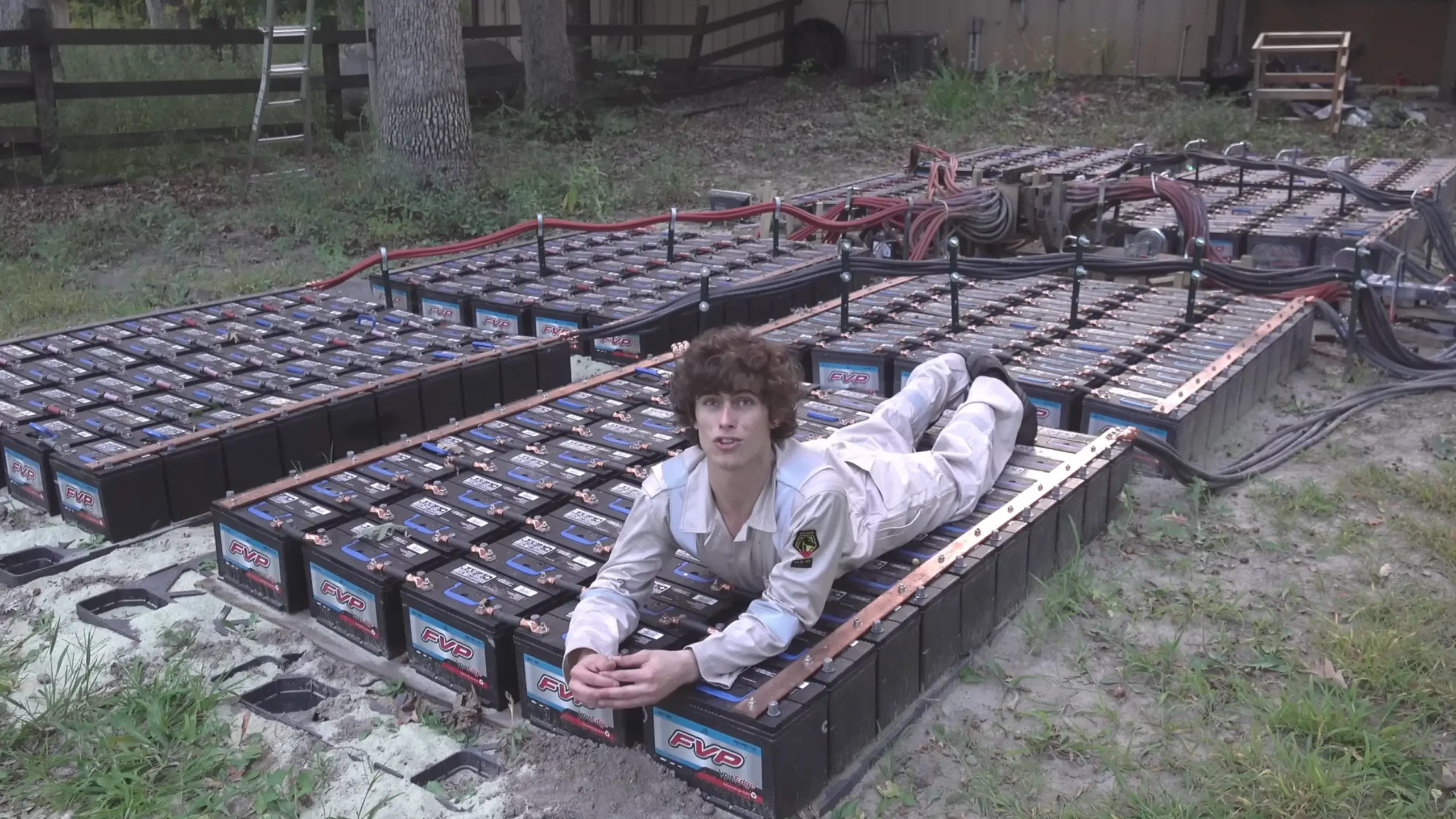
    One man decided to take it upon himself to wire 400 car batteries up in a wild experiment, all in the name of curiosity.

    We live in a world where petrol and diesel-reliant cars are slowly decreasing in numbers, with the rise of electric vehicles (EVs).

    The American content creator is known for his extreme video concepts, as a self-described ‘science maniac’ who ‘loves building huge lasers and playing with electricity and chemicals’.

    Having built some of the biggest lasers ever seen in the social media space, the science-enthusiast has decided to have a go at playing with car batteries and seeing just how much power he can generate.

    A chemist by trade, the YouTuber knwon as ‘styropyro’ likes to push the limits of safe experimenting.
    What about this, doesn't look appealing? (YouTube/Styropyro)

    What about this, doesn’t look appealing? (YouTube/Styropyro)

    Real name Drake Anthony, he wanted to find out how powerful cars can be, when it comes to blowing up a piece of metal.

    Some quick maths reveals that 400 car batteries together will be able to generate over 160,000 amps – the standard international unit for measuring electric current.

    Unsurprisingly, there was no ready-made car switch on the market which could withstand such power, meaning that Drake would have to make it himself, with the use of over 1,000lbs worth of copper.

    You’re probably wondering about the use of car batteries instead of regular old electrical circuits, to which he had a very good explanation.

    “When it comes to making huge currents, most people think of using capacitors,” he said.

    Drake added: “But interestingly, car batteries don’t fall that far behind in terms of max currents. The benefit with car batteries is that they can dump those currents for far longer than a brief pulse.”

    The science nut showed how you can warp a pipe with the sheer power that’s generated, explaining that the energy can be concentrated enough to bend materials.

    He did fail a few times, with the electricity destroying the pipe completely instead of bending it.

    Eventually, with the help of magnetic pulses, he destroyed the pipe.
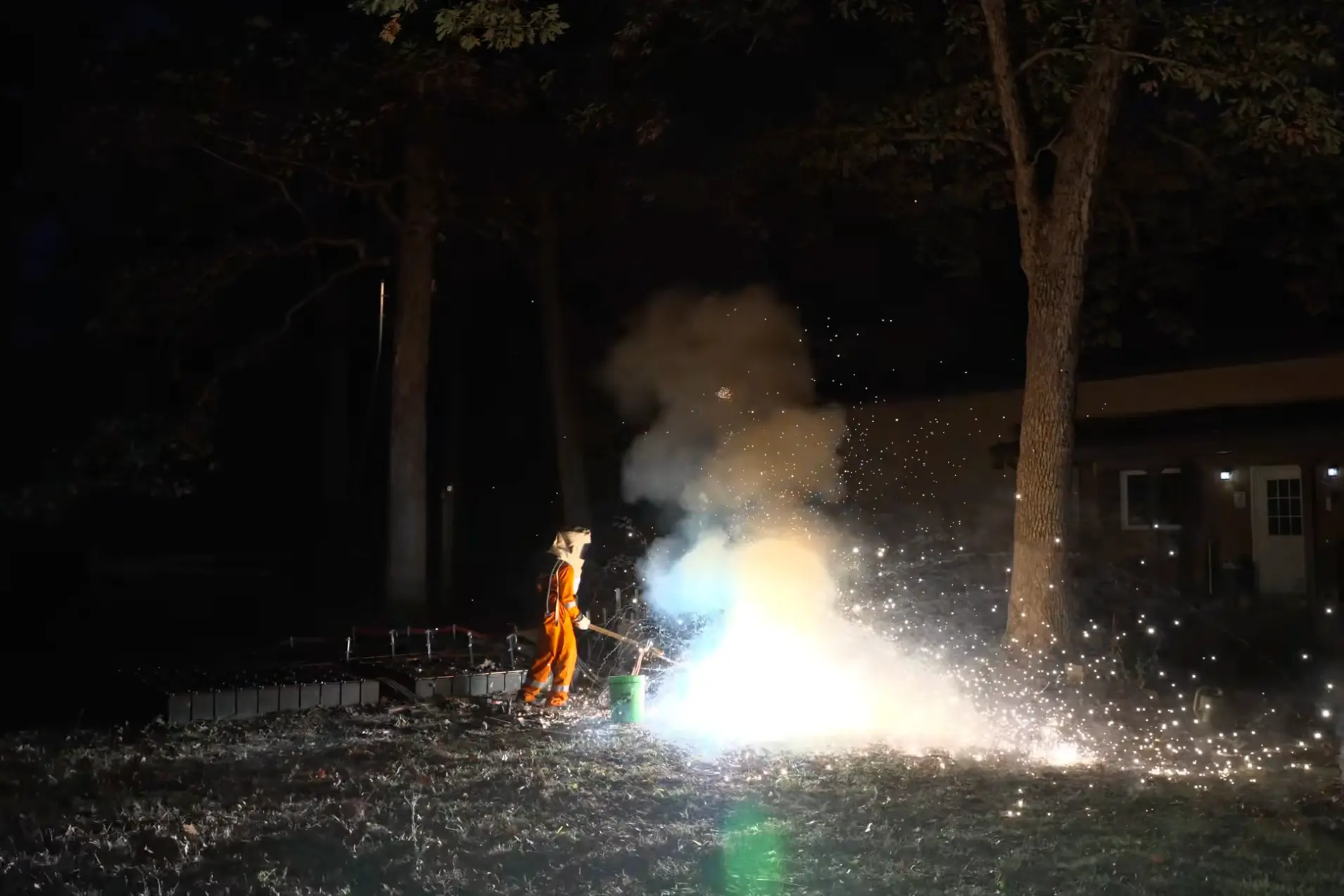
    Drake put the experiment together himself (YouTube/Styropyro)

    Drake put the experiment together himself (YouTube/Styropyro)

    Drake went on to test materials such as bismuth, titanium, and tungsten rod, with satisfying explosions.

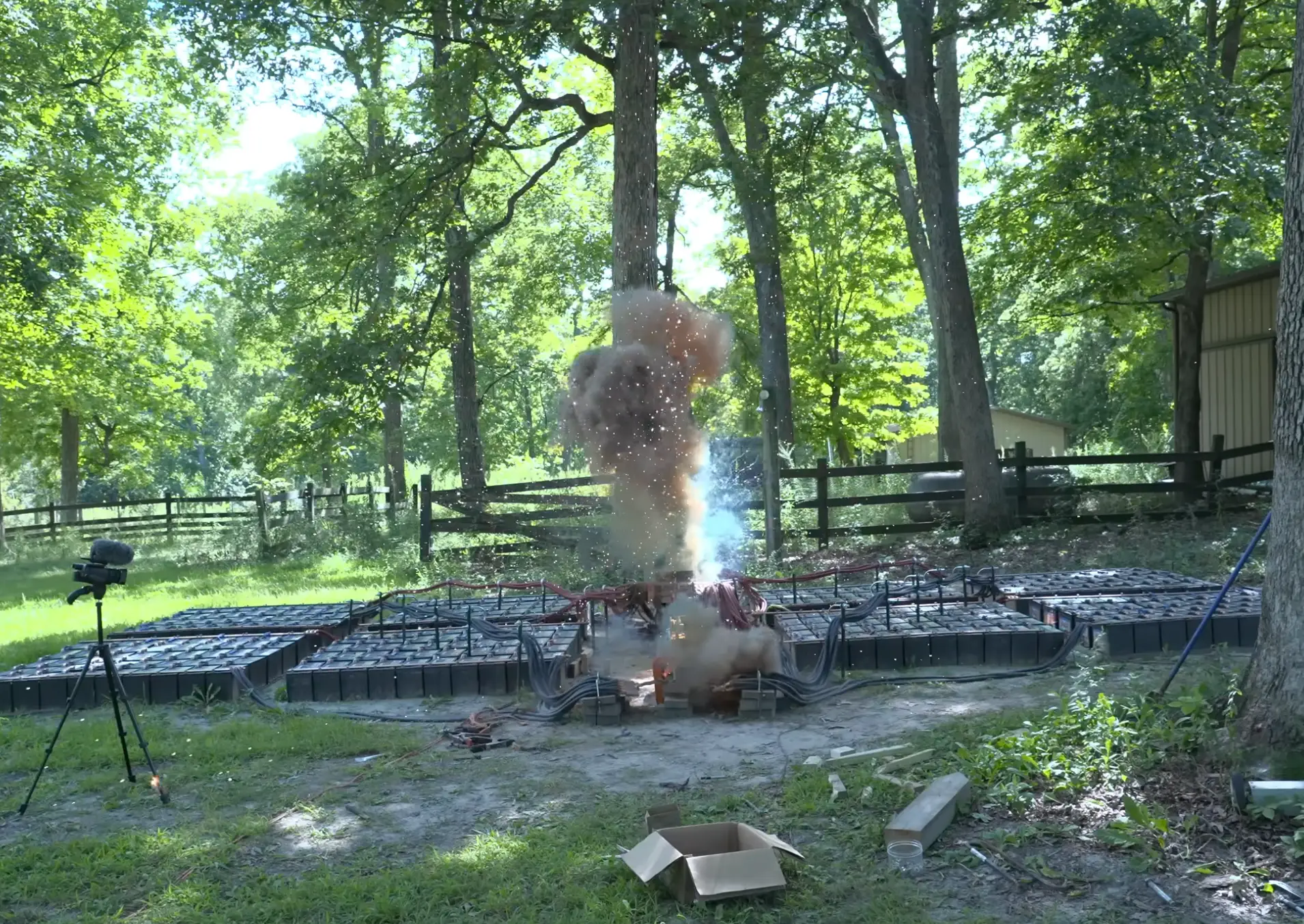
    In the long-awaited finale though, he used Ferrofluid to make a hugely satisfying fireball explosion, because who doesn’t want to see things blown up?

    He admitted that it was ‘the coolest thing I’ve ever filmed in my life’, explaining: “In the span of a 10th of a second, nearly the entirety of the dish of ferrofluid was slammed up against the pipe while the total circuit power rose to over 10 million watts.”

    The final shot looked like something out of Oppenheimer, though on a much smaller scale, and the most amazing thing is that nothing went to waste.

    No, all the car batteries were intact and could be used for other purposes.

    Who said controlled explosions and sustainability couldn’t go hand in hand, eh?

  • ETHZilla Drops Ethereum Treasury Label in Rebrand After Share Price Collapse

    ETHZilla Drops Ethereum Treasury Label in Rebrand After Share Price Collapse

    In brief

    • ETHZilla will rebrand as Forum Markets and trade as FRMM on Nasdaq at the start of March
    • The move follows a week after investors exited as it turned away from an Ethereum balance sheet model.
    • Observers say single-asset treasury strategies depend on sustained equity premiums and strong market conditions.

    Former Ethereum treasury firm ETHZilla said it will rebrand as Forum Markets and adopt a new Nasdaq ticker next month, formalizing a shift away from balance-sheet crypto exposure toward tokenized real-world assets.

    The move marks a departure from the company’s earlier strategy of positioning its shares as a public proxy for Ethereum, an approach that faltered as the stock fell sharply from last year’s highs and the firm reduced its crypto holdings.

    ETHZilla’s shares peaked at $107 on August 13, 2025, shortly after the company announced plans to build a $425 million Ethereum treasury following a pivot from its former biotech business.

    The strategy initially drew investor interest but later unraveled as the share price declined, investors exited, and the company began selling assets to scale back its exposure.

    Shares rose 13.3% on Wednesday to $3.91 following the rebranding announcement, though the stock remains down about 96% from its August peak, according to Google Finance data.

    Under the Forum Markets name, the company said it plans to focus on developing tokenized products backed by real-world assets, using regulated infrastructure rather than holding large crypto positions on its balance sheet.

    The rebrand follows Peter Thiel’s Founders Fund exiting its position in ETHZilla earlier this month. The departure of a prominent early backer came as the stock slid sharply, and the firm’s positioning as a publicly traded proxy for ETH exposure drew increased scrutiny.

    Earlier this month, the company said it would pivot into jet engine leasing and other aviation-related assets to further bolster its business model and equity performance amid a weakening Ethereum price.

    “Single-asset treasury strategies are highly dependent on strong market conditions and sustained equity premiums,” Vincent Liu, chief investment officer at quantitative trading firm Kronos Research, told Decrypt.

    “Treasury-focused firms ultimately need revenue-generating businesses and broader asset exposure to remain relevant long term,” Liu said.

    Such strategies, like Forum’s previous endeavors, could be considered “fragile because its value is tightly linked to network activity,” thereby creating “a correlation trap where purchasing power weakens during ecosystem downturns,” he explained.

    That vulnerability is compounded by fragmentation across Ethereum’s main network and its layer-2 chains, which Liu said dilutes its narrative and premium. This condition, he said, is “further undermined by the absence of a hard supply cap, leaving its long-term scarcity proposition open to question.”

    Forum Markets is expected to begin trading under the ticker symbol “FRMM” on March 2, after previously trading under the ticker “ETHZ” on the Nasdaq Capital Market.

    Daily Debrief Newsletter

    Start every day with the top news stories right now, plus original features, a podcast, videos and more.

  • Bitcoin Exchange Binance Chooses This Country as Headquarters for European Union Operations! Here Are the Details

    Bitcoin Exchange Binance Chooses This Country as Headquarters for European Union Operations! Here Are the Details

    Cryptocurrency exchange Binance has chosen Greece as its regulatory hub for its EU operations ahead of the European Union’s new crypto regulations.

    According to Finance Feeds, Binance co-CEO Richard Teng announced that the exchange applied to the regulatory authority in Greece last month.

    The application aims to obtain an operating license under the European Union’s Markets in Crypto-Assets Regulation (MiCA).

    The MiCA regulation mandates that crypto companies obtain licenses by July 2026. Companies without licenses will not be able to operate within the EU.

    Teng stated that the MiCA license offers a standard framework across Europe, and therefore many factors such as workforce quality, talent pool, and security are considered when selecting an operations center. It was reported that Greece is seen as a suitable base within the EU’s enlargement strategy.

    On the other hand, Teng also touched upon the sharp fluctuations experienced in the crypto market over the past year. Noting that Bitcoin has fallen by approximately 50% from its peak of $126,000 in October last year, Teng stated that individual investor interest has weakened, but institutional participation has remained stable. “Smart money, institutional capital, and long-term funds continue to enter the market,” Teng said, emphasizing that regulatory clarity will strengthen the sector in the long term.

    *This is not investment advice.

  • Akash Opens Homenode Beta Access

    Akash Opens Homenode Beta Access

    Akash, a decentralized marketplace, has launched early access to the open beta of Homenode, a platform that allows owners of consumer-grade GPUs to supply compute power from personal devices to its network. Participants can earn rewards without deploying enterprise infrastructure or managing complex server setups.

    The beta is part of the StarCluster initiative, a distributed AI compute network. During the first phase, the system will focus on high-end GPUs, including $RTX 4090, $RTX 5090 and upcoming 50-series models from NVIDIA. The rollout will also test performance from small colocated setups and repurposed mining equipment before broader expansion.

    Homenode is delivered as a dedicated operating system distributed as an ISO image. Users install it via USB to convert eligible machines into secure provider nodes. The environment is isolated and designed for privacy. Device owners can choose dual-boot or partition options to keep their primary operating system separate from the Homenode setup.

    Image: Freepik

  • TKO May Lose $30 Million on White House UFC Fight: A “Once-In-a-Lifetime” Earned Media Play

    As the UFC continues its planning for its blockbuster UFC bout at the White House in June, parent company TKO is warning investors that it is a one-time event that will likely cost it tens of millions of dollars … and that’s just fine.

    On TKO’s earnings call Wednesday, president and COO Mark Shapiro told Wall Street analysts that the White House event, currently slated for June 14th on the South Lawn, will cost “upwards of $60 million.”

    “I think by the time we get done, all is said and done with the event, and with what we pay the fighters and the fan fest we’re gonna have, that could move north,” Shapiro added. “It’s definitely not moving south.”

    He said that the company is engaging corporate partners and others who he thinks can offset about half the cost of the event, meaning that the company is planning for $30 million in losses, or more if the costs continue to rise.

    That being said, the company is also framing it as a one-time spectacle that could be a huge draw to the mixed martial arts promotion, which is just kicking off its multi-year deal with Paramount global.

    “I wanna be clear about something: We will not profit from the White House event independently. We will not be making money on America’s 250th anniversary,” Shapiro said. “This is an investment for the long term. This is about earned media.

    “This is about sampling, new fans, casual viewers, a spectacle on a stage that will ultimately expand our audience, our viewership, and our success on Paramount+,” he added. “We see this once-in-a-lifetime stage as a strategic investment to drive subscriber acquisition at Paramount+, massive audience sampling for the UFC overall, and Super Bowl-like earned media across the globe.”

    UFC, of course, hosted a one-off event at the Sphere in Las Vegas in 2024, and Shapiro indicated that, while the focus is on the White House fight, TKO will have its eyes open for other one-offs that can drive attention to the sport.

    “We’ll be the first one and maybe the only one ever on the South Lawn of the White House,” he said. “I can’t tell you that we have any events coming up at the Kremlin, but we will definitely be looking for more one-time events.”

  • ‘For All Mankind’ Spinoff ‘Star City’ Unveils First-Look Photos

    ‘For All Mankind’ Spinoff ‘Star City’ Unveils First-Look Photos

    Apple TV has unveiled first-look photos for “Star City,” the new series expanding the world of “For All Mankind.” From creators Ben Nedivi, Matt Wolpert and Ronald D. Moore, the series will debut with two episodes on Apple TV on May 29, running through July 10.  

    The eight-episode series “is a propulsive paranoid thriller that takes us back to the key moment in the alt-history retelling of the space race — when the Soviet Union became the first nation to put a man on the moon,” reads the official logline. “But this time, we explore the story from behind the Iron Curtain, showing the lives of the cosmonauts, the engineers, and the intelligence officers embedded among them in the Soviet space program, and the risks they all took to propel humankind forward.” 

    The series will star Rhys Ifans (“House of the Dragon”), Anna Maxwell Martin (“Motherland”), Agnes O’Casey (“Black Doves”), Alice Englert (“Bad Behaviour”), Solly McLeod (“House of the Dragon”), Adam Nagaitis (“Chernobyl”), Ruby Ashbourne Serkis (“I, Jack Wright”), Josef Davies (“Andor”) and Priya Kansara (“Bridgerton”). 

    Variety first reported that “For All Mankind” would be getting a spinoff back in 2024 when the show was renewed for its fifth season, which will premiere on March 27. The alternate history series first premiered in 2019, and stars Joel Kinnaman, Toby Kebbell, Edi Gathegi, Cynthy Wu, Coral Peña and Wrenn Schmidt, alongside other series regulars. 

    Wolpert and Nedivi serve as showrunners and executive produce alongside Moore and Maril Davis of Tall Ship Productions, as well as Andrew Chambliss and Steve Oster. “Star City” is produced for Apple TV by Sony Pictures Television.

    See first-look images here.

  • A former Solana exec is taking a page out of Wall Street playbook to make global crypto trades faster

    A former Solana exec is taking a page out of Wall Street playbook to make global crypto trades faster

    DoubleZero, a crypto infrastructure startup co-founded by former Solana Foundation executive Austin Federa, is rolling out a major update aimed at spreading Solana’s network more evenly around the world, and making it faster in the process.

    On Mar. 9, the company will launch “Phase II” of its DoubleZero Delegation Program, redirecting 2.4 million $SOL from its 13 million pool to validators operating in underrepresented regions such as São Paulo, Singapore, Hong Kong, and Tokyo. Each region will receive up to 600,000 $SOL in additional delegated stake incentives.

    DoubleZero runs a private, high-speed internet network that helps Solana’s computers talk to each other faster and more reliably. In 2025, the company behind the network raised $28 million at a $400 million valuation.

    DoubleZero’s goal in rolling out the incentive is simple: reduce Solana’s growing geographic concentration in Europe and introduce “multicast functionality,” a data distribution method widely used in traditional finance.

    Geographic cluster

    One of the main goals of Federa is to reduce the geographic concentration of validators.

    “One of the unintended consequences of blockchains getting faster is there’s more incentive to co-locate next to one another,” Federa said in an interview. He compared it to early high-frequency trading wars on Wall Street, when firms scrambled to place servers physically closer to the New York Stock Exchange to shave milliseconds off trades.

    Read more: ‘Crypto’s Flash Boys’: A Q&A With Austin Federa on DoubleZero

    Today, much of Solana’s staked tokens, which secure the network, sit in Central Europe — largely for historical and economic reasons. “There were a lot of really good, really cheap bare-metal data centers in Europe,” Federa said. “Solana was optimized for that kind of hosting early on, and the infrastructure just built up there.”

    But geographic clustering creates trade-offs: If most validators are in Europe, users farther away may be at a disadvantage.

    “If I’m sitting in South America trying to execute a trade on Solana, I can hit send first,” Federa said. “But someone who’s got a computer in Germany might actually win that trade.”

    To address that imbalance, DoubleZero is offering 2.4 million $SOL and aims to make it economically viable for validators to operate outside traditional hubs.

    ‘More dependable’

    The next problem DoubleZero is trying to solve through the new initiative is data transmission latency.

    The main barrier to expanding into those areas isn’t technical, Federa said — it’s economic. “Because you’re further away, everything takes longer to get there. It’s like Amazon Prime — in New York you get it same day. In Montana, it’s four or five days.”

    DoubleZero says its private fiber network helps address connectivity issues, while the new delegation incentives aim to offset the economic penalty of being outside traditional hubs.

    This is why, alongside the geographic push, DoubleZero is introducing the multicast functionality to Solana.

    Federa compared it to watching the Super Bowl via satellite versus streaming. With satellite, “an infinite number of people can be watching that radio wave… and it’s no additional tax.” Streaming, by contrast, requires a separate data stream for each viewer.

    Blockchain networks today largely operate like streaming services — sending duplicate data over and over. Multicast, he said, changes that.

    “In a pre-multicast world, if I’m sending data to 1,000 nodes, I’m handing out 1,000 copies,” he said. “With multicast, I send one copy, and the network hardware replicates it closer to where it needs to go.”

    That reduces bandwidth costs, improves fairness in how quickly participants receive data, and creates more room for future upgrades. It also makes blockchain infrastructure behave more like traditional exchanges, which rely heavily on multicast.

    “Traditional finance isn’t just faster than blockchain — it’s more dependable,” Federa said. “If we can bring more determinism to blockchain networking, it makes it a much more attractive place for market makers and traders.”

    Ultimately, DoubleZero is betting that financial incentives like this will help Solana’s infrastructure spread globally, moving it closer to functioning like a truly real-time market.

    Read more: DoubleZero Mainnet Goes Live With 22% of Staked $SOL on Board

  • ‘Jury Duty’ Season 2 Trailer Gives First Look at New Unbeknownst Star Anthony

    Jury Duty is returning for its highly anticipated second installment, and Prime Video is giving viewers a first look at its latest unbeknownst star, Anthony.

    Entitled Jury Duty Presents: Company Retreat, Prime Video released the first trailer for the docu-comedy on Thursday, introducing the audience to Anthony, the man who has no idea that he’s surrounded by a bunch of actors. Instead, Anthony believes he’s been hired as a temporary worker attending an annual company retreat for hot sauce company Rockin’ Grandma’s.

    The trailer sees Anthony introduced to the new, outlandish group of employees. At part of the center of the season’s drama is the potential sale of Rockin’ Grandma’s, which was originally slated to be taken over by the company head’s son.

    “If they think they can just come in and do whatever they feel like they wanna do, they’re in for a rude awakening,” Anthony says at one point in the trailer when the potential buyers of the hot sauce company are introduced. “I care about y’all. This is a family.”

    Season two of Jury Duty will hit Prime Video on March 20, with a drop of three episodes. Two additional episodes will hit the streamer on March 27, followed by a three-episode finale on April 3.

    Alex Bonifer, Blair Beeken, Emily Pendergast, Erica Hernandez, Jerry Hauck, Jim A. Woods, LaNisa Renee Frederick, Marc-Sully Saint-Fleur, Rachel Kaly, Rob Lathan, Ryan Perez, Stephanie Hodge, Warren Burke and Wendy Braun make up the ensemble cast of Jury Duty Presents: Company Retreat.

    The debut season of Jury Duty was a beloved hit, spotlighting Ronald Gladden as the unbeknownst star, and James Marsden, who joined to play himself. Going off the name of the show, season one depicted a faux jury selection and trial full of actors who knew the case was fake, except for Ronald, who believed he was in the middle of a real scenario.

    A breakout from the series, Gladden landed a two-year overall deal with Amazon MGM Studios in November 2023. The show itself earned four Emmy nominations (including a nod for Marsden), becoming the first title from Amazon’s Freevee to score an Emmy nomination

    It was confirmed that the series was renewed for a second season in February 2025, and that said season had already been filmed.

    Season two is executive produced by David Bernad (The White Lotus, Bad Trip), Lee Eisenberg (Lessons In Chemistry, The Office), Gene Stupnitsky (Hello Ladies, The Office), Todd Schulman (The Chair Company, Who Is America?), Nicholas Hatton (Borat Subsequent Moviefilm, Who Is America?), Jake Szymanski (7 Days in Hell, Mike and Dave Need Wedding Dates), Anthony King (The Afterparty, Silicon Valley), Chris Kula (Wrecked, Community) and Marsden. Eisenberg and Stupnitsky co-created the series, while Szymanski directs. 

  • Scripps CEO Adam Symson Renews Contract Through 2029 Amid Company’s Major Cost-Cutting Plan, Reacquisition of 23 ION Affiliate TV Stations

    Scripps CEO Adam Symson Renews Contract Through 2029 Amid Company’s Major Cost-Cutting Plan, Reacquisition of 23 ION Affiliate TV Stations

    E.W. Scripps Co. has renewed its contract with CEO Adam Symson through 2029.

    Symon’s new contract includes a large one-time $10 million performance-based cash award tied to Scripps’ target of boosting adjusted earnings by between $125-150 million over the next three years.

    The longer-pact announcement came during the company’s quarterly earnings call Thursday, when Symson briefed analysts on Scripps’ plans for major cost-cutting moves, as well as its pending $54 million reacquisition of 23 ION-affiliated TV stations, which it originally divested in 2021 to INYO Broadcast Holdings. Scripps sees that deal, which is subject to regulatory approval, as being “immediately accretive” to its networks segment profit.

    “Several weeks ago, we gathered more than 200 Scripps employees together to begin executing this transformation plan. And in the weeks since, the circle has been steadily expanding,” Symson said. “Our colleagues across the country are engaged in this work and are excited by the opportunity to drive this important company farther, faster and into the future. And so am I. The next few years will be pivotal as we accelerate our momentum. So I’m grateful that the Scripps board has decided to extend my contract until the end of 2029. I have the collective creativity and talent of nearly 5,000 colleagues behind me. I believe deeply in our ability to execute yet another Scripps transformation, and I am committed to seeing it through. And now, operator, we’re ready for questions.”

    During the call Thursday, Symson and other Scripps execs declined to confirm the exact number of layoffs that are expected across the company, but noted that workforce reductions are not the only cost-saving move planned. Leadership reiterated that cost savings and revenue growth initiatives will “leverage technology including AI and automation” and increase revenue yield for its existing businesses.

    “Over the last couple of years, as fragmentation has proliferated and people have turned to more and more platforms for the news and information, we have continued to ask our employees to do more with less, and that has diminished the quality of our product,” Symson aid. “AI opens up the opportunity for us to actually ensure that our reporters, our field journalists, are spending their time doing that which they got into the business to do: actually report. To ensure that they are connecting with the communities that they serve, to ensure that they are speaking directly to our consumer, to ensure that they are actually able to attend the news events and not have to rush off in order to then post something on the web, and then immediately put something on social media, and then do four live shots. And so using AI in order to care for some of those things is already opening up opportunity for our journalists to spend more time doing journalism and less time doing what I would characterize as some of the performative aspects, or the distribution or production aspects of their job.”

    Symson added: “We want them creating the content. That’s where the value is. That’s what differentiates us from the commodity news and information that’s out there. We don’t want them spending their time rewriting broadcast scripts into an AP Style story that can go on the web. There’s technology that can care for that, and we’re already using it.”