Blog

  • How Trump’s 2026 Iran ‘war’ script echoes and twists the 2003 Iraq playbook

    How Trump’s 2026 Iran ‘war’ script echoes and twists the 2003 Iraq playbook

    In January 2003, President George W Bush stood before the United States Congress to warn of a “grave danger” from a “dictator”, a former US client in the Middle East, armed with weapons of mass destruction (WMD).

    Twenty-three years later, in the same chamber, President Donald Trump used his State of the Union address to paint a strikingly similar narrative: A rogue regime, a looming nuclear threat, and a ticking clock.

    Recommended Stories

    list of 4 itemsend of list

    In a dark twist of historical irony, Iraq’s Saddam Hussein, who was armed to the teeth by the US in Iraq’s 1980-1988 war with the fledgling Islamic Republic of Iran, became Washington’s public enemy number one, surpassing Osama bin Laden. Now, that label has been seemingly applied to Iran’s Supreme Leader Ayatollah Ali Khamenei, a key leader during that ruinous war against Iraq that left a million dead.

    But while the “war script” sounds familiar, the geopolitical stage has shifted dramatically.

    As Washington pivots from the neoconservatives’ “preemptive” doctrine of the Bush era to what experts are calling the “preventive maintenance” of the Trump era – following the June 2025 strikes on Iran in tandem with Israel’s attack in the 12-day war – questions are mounting about the intelligence, the endgame, and the alarming lack of checks and balances.

    The semiotics of fear: From clouds to tunnels

    In 2003, the visual language of war was vertical: The fear of a “mushroom cloud” rising over US cities, or a biological weapon seeping into populated areas. Today, the fear has gone in the other direction: Purportedly deep underground.

    “The administration is updating the visual dictionary of fear,” says Osama Abu Irshaid, a Washington-based political analyst. “They are exaggerating the nuclear threat exactly as the Bush administration did with the ‘smoking gun’ metaphor. But there is a key difference: In 2003, US intelligence was manipulated to align with the lie. In 2026, the intelligence assessments actually contradict Trump’s claims.”

    While Trump asserted in his State of the Union address that Iran is “rebuilding” its nuclear programme to strike the US mainland, his own officials offer conflicting narratives. White House spokesperson Karoline Leavitt insisted Tuesday, parroting her boss, that the 2025 “Operation Midnight Hammer” had “obliterated” Iran’s facilities. Yet, days earlier, Trump envoy Steve Witkoff claimed Tehran was “a week away” from the bomb.

    This “information chaos”, analysts argue, serves a specific purpose: Keeping the threat vague enough to justify perpetual military pressure.

    “Bush benefitted from the post-9/11 anger to link Iraq to an existential threat,” Abu Irshaid told Al Jazeera. “Trump doesn’t have that. Iran hasn’t attacked the US homeland. So, he has to fabricate a direct threat, claiming their ballistic missiles can reach America – a claim unsupported by technical realities.”

    The regime change quagmire

    Perhaps the most glaring contrast with 2003 is the internal coherence of the administration.

    The Bush team – Vice President Dick Cheney, Defense Secretary Donald Rumsfeld and his deputy Paul Wolfowitz – moved in ideological lockstep. Cheney famously predicted US troops would be “greeted as liberators”.

    They were anything but. The made-for-television scene of a statue of Saddam Hussein being torn down in central Baghdad quickly gave way to sustained, organised fighting against the US occupation, heavy US troop losses, as well as sectarian bloodletting that forced Iraq onto the cusp of all-out civil war.

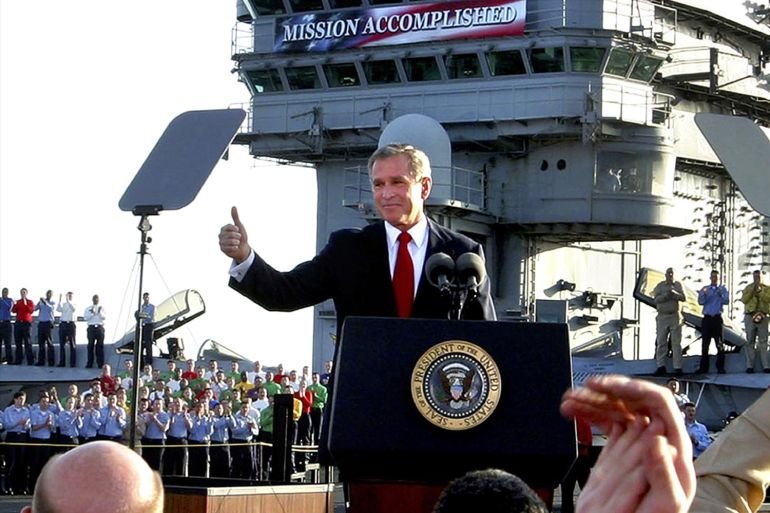
    Bush declaring major combat operations over under a huge “Mission Accomplished” banner in May 2003 came back to haunt his administration and the US for years to come.

    The Trump team of 2026 appears far more fractured, torn between “America First” isolationism and aggressive interventionism.

    • The official line: Vice President JD Vance and Defence Secretary Pete Hegseth have publicly stated the goal is not regime change. “We are not at war with Iran, we’re at war with Iran’s nuclear programme,” Vance said Sunday.
    • The president’s instinct: Trump contradicted them on social media, posting: “If the current Iranian Regime is unable to MAKE IRAN GREAT AGAIN, why wouldn’t there be a Regime change??? MIGA!!!”

    “The Neocons who hijacked policy under Bush have been weakened,” notes Abu Irshaid. “But they have been replaced by figures like Stephen Miller, who holds absolute loyalty to Trump and close ties to the Israeli right. Trump is driven by instinct, not strategy. He seeks the ‘victory’ that eluded his predecessors: The total hollowing out of Iran, whether through zero-enrichment surrender or collapse.”

    The lonely superpower: Coercion over coalition

    In 2003, Bush and United Kingdom Prime Minister Tony Blair worked tirelessly to build a “Coalition of the Willing”. It was a diplomatic veneer, but it existed. Blair remains a much-loathed figure in the Middle East and in some quarters in the West for giving diplomatic cover to the Iraq debacle.

    In 2026, the US is operating in stark isolation.

    “Trump is not building a coalition; he is alienating allies,” Abu Irshaid explains. He points to a pattern of “extortion” extending from tariffs on the European Union to attempts to “buy” Greenland. “The Europeans see the coercion used against Iran and fear it could be turned against them. Unlike 2003, only Israel is fully on board.”

    This isolation was highlighted when the UK reportedly refused to allow the US to use island bases for strikes on Iran, forcing B-2 bombers to fly 18-hour missions directly from the US mainland during the 2025 campaign.

    The collapse of checks and balances

    Following the damning intelligence failures and lies of the Iraq war, promises were made to strengthen congressional oversight. Two decades later, those guardrails appear to have vanished.

    Despite efforts by US Representatives Ro Khanna (a Democrat) and Thomas Massie (a Republican) to invoke a “discharge petition” to block an unauthorised war, the political reality is grim.

    “The concept of checks and balances is facing a severe test,” warns Abu Irshaid. “The Republican Party is now effectively the party of Trump. The Supreme Court leans right. Trump is operating with expanded post-9/11 powers that allow for ‘limited strikes’ – strikes that can easily spiral into the open war he claims to avoid.”

    With the administration citing “32,000” protesters killed by Tehran – a figure significantly higher than independent estimates, and which Iran dismissed as “big lies” on Wednesday – the moral groundwork for escalation is being laid, bypassing the need for United Nations resolutions or congressional approval.

    As US and Iranian negotiators meet in Geneva for make-or-break talks under the shadow of last year’s “Operation Midnight Hammer”, the question remains: Are the two nations with decades of enmity boiling between them on the brink of a new deal, or the prelude to a war that could ignite the entire region in flames?
  • AMC Lands U.K. Crime Drama ‘This City Is Ours’ From ‘The Crown’ Producer Left Bank

    AMC Lands U.K. Crime Drama ‘This City Is Ours’ From ‘The Crown’ Producer Left Bank

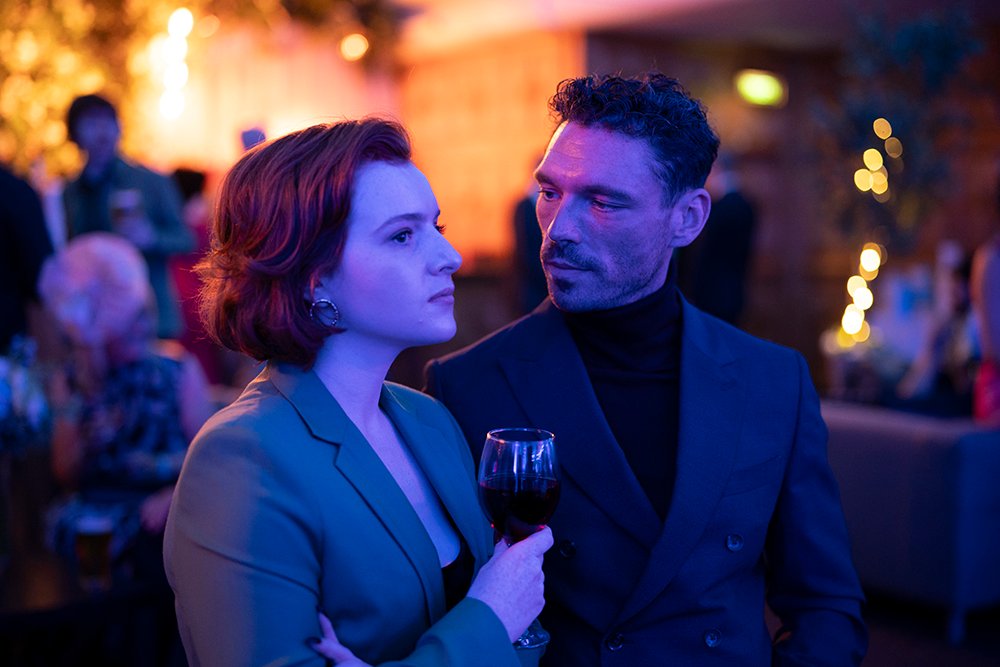
    AMC Networks has acquired U.S. rights to U.K. crime drama “This City Is Ours” ahead of Sony Pictures Television‘s London Showcase.

    The Liverpool-set series — made by SPT-owned Left Bank Pictures (“The Crown,” “Dept. Q”) for the BBC — will launch next month on AMC+.

    The AMC deal caps a number of international sales for the series, which was first unveiled to global buyers at SPT’s London Screenings event in 2025. It has since sold to Stan (Australia), Sky (New Zealand, Germany, Switzerland, Austria), Bell Media (English Canada), Quebecor Content (French Canada), RTE (Ireland), TIM VISION (Italy), Movistar Plus+ (Spain), AXN (Portugal), YLE (Finland), Telia Estonia (Estonia), Telia Play (Lithuania), Tet+ (Latvia), Nova (Greece), Syn (Iceland), Yes (Israel), Videoland (Netherlands), TV2 Norway (Norway), SVT (Sweden), Sony LIV (India), HBO Max (through Central and Eastern Europe, Poland), and beIN (across the Middle East and North Africa, Türkiye).

    In the UK, “This City Is Ours” became the BBC’s most watched new drama launch of 2025, attracting an average of 5.8 million viewers, with more than 7.8 million viewers for the first episode to date, more than tripling its initial overnight figure of 1.9 million. Almost three million people streamed the series finale ahead of its BBC One broadcast. The series was recommissioned for a second season, which is currently in production in Liverpool with filming also in Spain.

    “We’re thrilled that ‘This City Is Ours’ will debut on AMC+ in the US, a testament to the series’ global appeal,” said Jason Spivak, Co-President, Distribution & Networks, SPT. “The show taps into the enduring strength of family-driven crime drama — a powerful saga set inside a criminal empire where power, loyalty, and betrayal collide. Following its breakout launch at last year’s London Screenings, we’re excited to build on that momentum as we head into this year’s event.”

    Season 1 of “This City Is Ours” was commissioned by Lindsay Salt, director of BBC Drama. It was created by Stephen Butchard, who serves as lead writer, with Robbie O’Neill writing further episodes. The directors are Saul Dibb (“The Salisbury Poisonings,” “The Sixth Commandment”) and John Hayes (“Nightsleeper,” “Dublin Murders”). The producer is Simon Maloney (“Peaky Blinders,” “I May Destroy You”). Executive producers are Andy Harries, Rebecca Hodgson and Sian McWilliams for Left Bank Pictures, Stephen Butchard and Saul Dibb, and Jo McClellan and Sami El Hadi for the BBC. Additional funding and support came from the Liverpool Film Office through the Liverpool City Region Combined Authority’s LCR Production Fund.

  • iQiYi Q4 Revenue Rises 3% as Chinese Streaming Giant Narrows Quarterly Deficit; Posts Full-Year Loss

    iQiYi Q4 Revenue Rises 3% as Chinese Streaming Giant Narrows Quarterly Deficit; Posts Full-Year Loss

    Chinese streaming giant iQiYi returned to revenue growth in the fourth quarter of 2025, posting a 3% year-over-year increase and narrowing its quarterly loss, though the company swung to a full-year loss as profitability eroded sharply.

    Total revenues reached RMB6.79 billion ($971.6 million) for the quarter ended Dec. 31, the company said Thursday. The gain marked a marked a return to growth after recent quarterly declines, including an 8% drop in Q3.

    The company narrowed its quarterly net loss attributable to iQiYi to RMB5.8 million ($800,000), compared to a net loss of RMB189.4 million ($27.1 million) in the same period of 2024 and a loss of RMB248.9 million ($35.6 million) in the previous quarter.

    For the full year 2025, however, the company posted a net loss attributable to iQiYi of RMB206.3 million ($29.5 million), compared to net income of RMB764.1 million ($109.3 million) in 2024. On a non-GAAP basis (a measure that excludes certain items not reflective of core operations, unlike GAAP – Generally Accepted Accounting Principles), full-year net income was RMB280.6 million ($40.1 million), compared to RMB1.51 billion ($216 million) in 2024.

    On a non-GAAP basis for the fourth quarter, the company posted net income of RMB109.7 million ($15.7 million), compared to a non-GAAP net loss of RMB58.8 million ($8.4 million) a year earlier.

    “In the fourth quarter, our IP-centric strategy reinforced user engagement and market leadership, and we delivered improved financial performance, with total revenues growing both annually and sequentially,” said Yu Gong, founder, director and CEO of iQiYi. “Heading into 2026, we will fortify our domestic core by advancing content excellence and strengthening our membership and advertising businesses, accelerate breakthroughs across our overseas and experience businesses, and harness AI to cultivate a thriving content ecosystem enriched by AIGC.”

    Interim CFO Ying Zeng highlighted emerging growth drivers. “Our emerging businesses are shaping new growth engines. Notably, our overseas business maintained strong growth momentum, achieving record top-line performance in the fourth quarter,” Zeng said. “We look forward to these emerging businesses contributing to long-term value creation.”

    For the fourth quarter, membership services revenue remained flat year over year at RMB4.11 billion ($587.1 million). Online advertising services revenue declined 6% to RMB1.35 billion ($193.4 million), as some advertisers adjusted their strategies in response to macro pressures.

    Content distribution revenue surged 94% to RMB787.7 million ($112.6 million), primarily driven by an increase in cash transactions. Other revenues fell 18% to RMB547.9 million ($78.3 million), primarily due to altered business cooperation arrangements.

    Cost of revenues increased 8% to RMB5.38 billion ($768.8 million). Content costs rose 11% to RMB3.83 billion ($548.1 million), mainly attributable to a more robust lineup of original dramas during the quarter. Selling, general and administrative expenses increased 7% to RMB946.2 million ($135.3 million), primarily driven by higher marketing spending.

    Operating income was RMB55.4 million ($7.9 million), compared to operating income of RMB285.4 million ($40.8 million) in Q4 2024. Non-GAAP operating income was RMB143.5 million ($20.5 million), compared to RMB405.9 million ($58 million) a year earlier.

    Free cash flow was RMB26.8 million ($3.8 million), compared to RMB498.1 million ($71.2 million) in the same period of 2024.

    For the full year 2025, total revenues declined 7% to RMB27.29 billion ($3.9 billion). Membership services revenue declined 5% to RMB16.81 billion ($2.40 billion), primarily due to a lighter content slate. Online advertising services revenue decreased 9% to RMB5.19 billion ($742.6 million). Content distribution revenue fell 12% to RMB2.50 billion ($357.1 million), primarily due to a decrease in barter transactions.

    As of Dec. 31, iQiYi held cash, cash equivalents, restricted cash, short-term investments and long-term restricted cash of RMB4.69 billion ($671 million). The company had an aggregate loan of $636.6 million to investment firm PAG.

    In October 2025, the company entered into an additional facility agreement with PAG providing a loan facility of $114.1 million at a 4.5% annual interest rate. In connection with this loan, PAG released all remaining restricted cash collateralized by the company under its convertible senior notes.

  • Kraken, CMT Digital, and Fidelity’s arm invest in crypto options platform STS Digital

    Kraken, CMT Digital, and Fidelity’s arm invest in crypto options platform STS Digital

    STS Digital, a Bermuda-regulated digital asset trading firm serving institutional clients, has secured $30 million in a round led by CMT Digital, according to a Thursday announcement.

    Payward, the parent company of exchange operator Kraken, also participated alongside Arrington Capital, BitRock Capital, Strobe Ventures, and Fidelity’s affiliated investment arm, F-Prime.

    Established in 2022, STS Digital offers trading in spot markets, options, and structured products across more than 400 digital assets through multiple access channels.

    The fresh capital will be used to grow the firm’s spot and options infrastructure, enhance its ability to provide liquidity under volatile market conditions, and strengthen its financial position.

    “This investment enables us to meet the explosive demand from institutional investors for our spot, options, and structured product pricing,” said Gideon Hyams, chairman and co-founder of the firm.

    STS Digital supports OTC trading alongside advanced derivatives such as futures and bespoke structured solutions designed for sophisticated investors. The platform aims to deliver continuous market access with low-latency execution and institutional-grade risk management capabilities.

    Sam Hallene, partner at CMT Digital, highlighted the firm’s approach to risk controls and platform design as key factors in the investment decision.

    “They have already built a meaningful liquidity moat in crypto options, and our view is that liquidity is one of the most durable competitive advantages in financial markets,” Hallene said.

    Arjun Sethi, chief executive of Payward, noted that the investment aligns with Kraken’s efforts to broaden its derivatives offerings.

    “Derivatives are among the most powerful tools in crypto, giving market participants more ways to manage risk and navigate volatility,” Sethi said.

    The latest development comes as institutional participants increasingly turn to options for hedging, yield generation, and volatility management rather than purely speculative trades.

    Market observers have noted growing demand for counterparties with strong balance sheets and consistent execution capabilities, particularly following periods of heightened stress in digital asset markets.

  • Telegram Announces New Bitcoin (BTC), Ethereum (ETH), and USDT Feature for Users!

    Telegram Announces New Bitcoin (BTC), Ethereum (ETH), and USDT Feature for Users!

    Wallet in Telegram, a cryptocurrency solution integrated into the Telegram messaging application, has announced Bitcoin, Ethereum, and $USDT for its users.

    According to The Block, Wallet in Telegram has announced that it has begun offering users the opportunity to earn on-chain returns on Bitcoin ($BTC), Ethereum ($ETH), and $USDT assets.

    This feature will be available through the $TON Wallet solution, which is integrated into the Wallet application on Telegram and features self-storage capabilities.

    It was stated that DeFi-focused platforms such as Morpho, TAC, and Re7 also provided technical support during the integration process.

    Users can earn interest by depositing their crypto assets through the newly introduced “Vaults” system.

    Among the current $USDT strategies, the highest yield option is achieved with Re7’s DeFi strategy, which offers a compound annual yield (APY) of up to 18%.

    In addition, $ETH and $BTC vaults have been activated. This means that yield generation has been enabled for both of the market’s largest cryptocurrencies.

    Andrew Rogozov, founder and CEO of The Open Platform and Wallet in Telegram, stated: “With Vaults in $TON Wallet, we are bridging the gap between advanced DeFi protocols and hundreds of millions of users. Direct access to self-custodial vault strategies for $ETH, $BTC, and $USDT within the $TON ecosystem is a major step toward making decentralized finance truly universal.”

    *This is not investment advice.

  • Samsung’s Galaxy S26 Billed as First ‘Agentic AI Phone’—Here’s What That Means

    Samsung’s Galaxy S26 Billed as First ‘Agentic AI Phone’—Here’s What That Means

    In brief

    • Samsung brands the Galaxy S26 as the first “agentic AI phone.”
    • Samsung is layering Gemini, Perplexity, and a revamped Bixby into a multi-agent stack.
    • There is also a toggleable hardware privacy display that blocks shoulder-surfers at the pixel level.

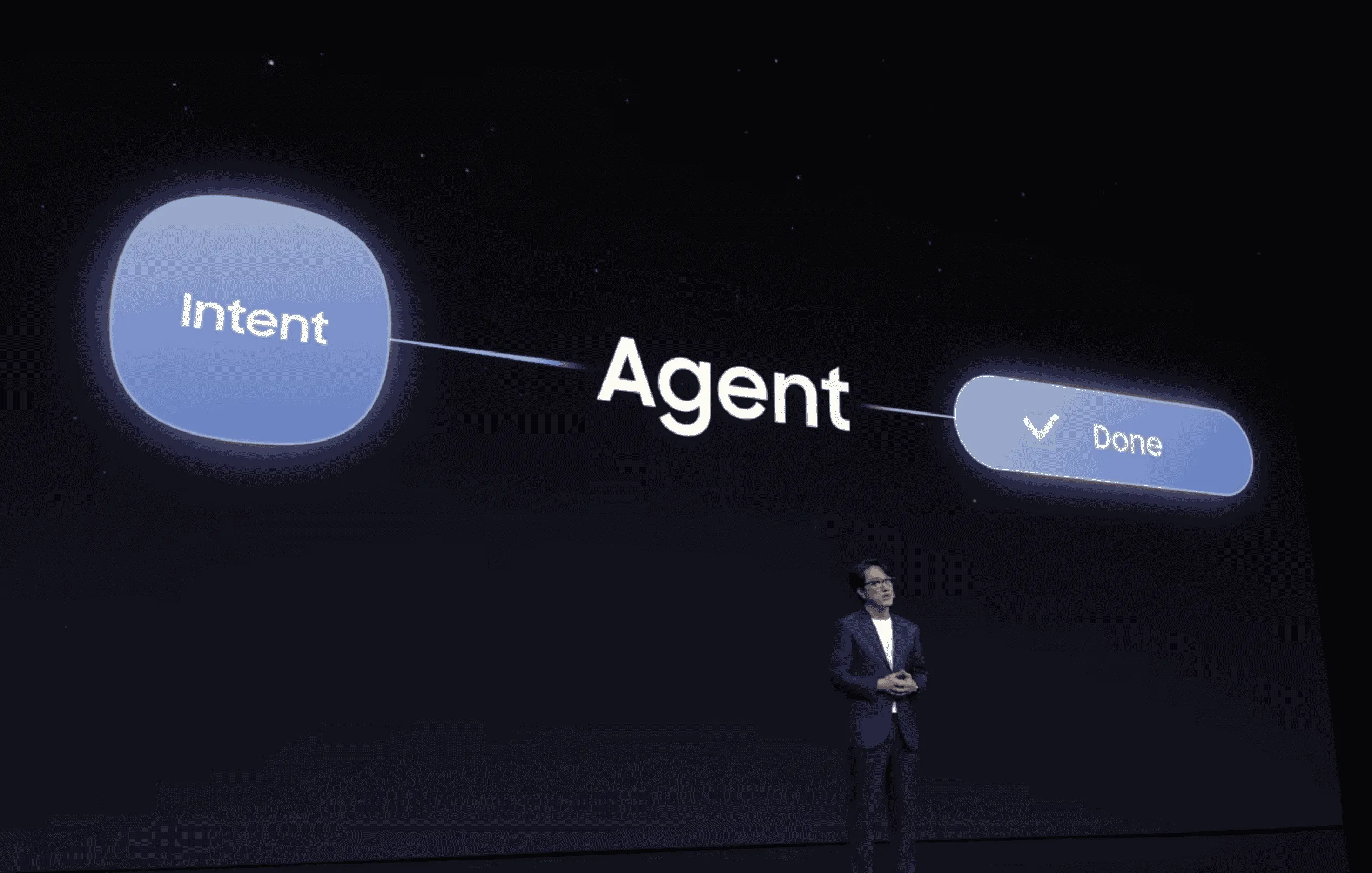
    Samsung CEO TM Roh stepped onto a San Francisco stage Wednesday, introduced the Galaxy S26 line of phones, and said something no phone maker has said before.

    “Imagine a phone that anticipates your needs before you even realize them,” he said. “A phone that learns your habits and adapts in real time. A phone that takes actions on your behalf. This is the agentic AI phone.”

    That sounds interesting, but what does “agentic AI phone” actually mean—and why should anyone care?

    Up until now, AI in phones has been reactive. You ask, it answers. Agentic AI is different. It takes actions on your behalf, across apps, without you doing the tapping or talking. Think of the difference between a search engine and a personal assistant who actually books the restaurant after you mention that you’re hungry.

    That shift feels like the thing every tech company has been chasing since Siri launched on Apple’s iPhone 4S back in 2011—and yes, Siri was arguably the first real attempt at an agentic phone experience. You were supposed to just talk to your phone and have it do stuff. All these years later, we’re not quite there yet, but Samsung and Google are the ones trying to build it.

    This is also what a wave of AI hardware startups spent the last two years trying—and failing—to do. The Humane AI Pin launched in late 2023 for $699 plus a $24 monthly subscription, got destroyed in reviews, sold barely 10,000 units, and ended up acquired by HP for $116 million—a fraction of its $1 billion valuation.

    The Rabbit R1, a $199 pocket AI companion that Microsoft CEO Satya Nadella called the most impressive tech demo since Steve Jobs unveiled the iPhone, shipped to real users and underwhelmed almost everyone. Both devices shared the same core pitch: your phone can’t do agentic AI, so you need a dedicated device. Turns out, the phone just needed better software.

    Samsung now says it’s delivering exactly what those gadgets promised—not with a new piece of hardware you have to carry alongside your phone, but through a software layer baked directly into a device you already own.

    The engine behind the Galaxy S26’s agentic features is Google’s Gemini—specifically a new capability where the AI opens apps in a virtual background window and navigates them while you do something else entirely.

    At the Unpacked event, Google’s Samir Samat showed a demo: The family group chat floods in with pizza requests, Gemini reads the thread, figures out everyone’s order, opens DoorDash, builds the cart, and waits for your manual tap before actually confirming. Your phone stays usable the whole time.

    At launch, that works for DoorDash, GrubHub, Uber, Kroger, Walmart, and other selected apps in a very short list. It’s rolling out first as a limited preview in the U.S. and South Korea, with more apps to come.

    Calling it a beta would be accurate—Google is explicitly collecting feedback from S26 users. The important guardrail: Gemini never hits “confirm” or “pay” without your final tap. You can also watch it work in real time if you don’t trust it to operate unsupervised, which, fair.

    Alongside Gemini, Samsung is bringing in Perplexity as a second system-level agent. Perplexity, which bills itself as an “answer engine” rather than a chatbot, will be accessible via a wake phrase or a side-button shortcut on the S26.

    Inside Samsung’s web browser, Perplexity’s Ask AI feature can sweep across all your open tabs and recent browsing history simultaneously to answer a research question without you jumping between sources. Samsung says nearly 80% of users already rely on more than two AI agents daily—which is the practical justification for offering both instead of picking one.

    There’s also a new Bixby, the AI assistant that Samsung refuses to let die. It has been overhauled to go beyond simple command executions and operate based on context understanding. Bixby now understands natural language well enough that you can say “My eyes hurt after looking at the screen,” and it’ll open the brightness settings automatically. It also pulls live information directly into your conversation without kicking you out to another app. Whether people will actually use Bixby this time is a separate conversation.

    Beyond the agentic stuff, the AI feature list for the S26 is long. “Now Brief” is a personalized daily digest—it proactively surfaces your restaurant reservations pulled from notification history, schedule conflicts, and energy levels, even for events you never manually added to a calendar. “Call Screening” identifies unknown callers and summarizes their intent before you pick up. A new “Nudge” feature detects context in a chat—if someone asks if you’re free this weekend, it brings your calendar to you inside the message thread instead of making you switch apps.

    “Photo Assist” lets you describe something missing from a shot and Galaxy AI adds it in. The front camera also now uses an AI image signal processor for sharper detail on selfies, while night video gets cleaner grain reduction. The S26 Ultra shoots 8K video using the new APV codec, which supports near-lossless quality so footage survives multiple rounds of editing. The whole camera pipeline leans heavily on AI at the hardware level.

    On competition: Apple has been promising a smarter Siri since at least 2024 and still hasn’t delivered the features it announced. Google’s own Pixel 10 will get the same Gemini agentic features—but Samsung ships first, in far larger volumes, to far more countries. No other phone maker is currently using the word “agentic” to describe its product. Samsung grabbed the label. Whether the tech giant earns it long-term depends on how fast the beta expands.

    But the actual standout from Wednesday wasn’t the AI. It was a piece of display hardware that privacy-conscious people will appreciate: a built-in privacy display that lets you control whether onlookers can actually see what you’re doing on your phone.

    It works like this: a “black matrix” layer physically narrows the path of light from each pixel so only the person holding the phone can see what’s on screen. Those watching at an angle get nothing but pitch black, as if the display is off. Someone next to you on the subway sees nothing.

    Unlike the plastic privacy films that have existed for years and make your screen permanently darker and harder to share, this one toggles on and off. You can apply it only to specific apps—banking stays private, for example, but your games don’t—or just to the notification bar, so a person next to you can see most of your screen but not your incoming messages.

    The Samsung Galaxy S26 Ultra, starting at $1,299, is the only phone in the world with this feature built into the display hardware. Pre-orders open today; shipping starts March 11. The standard Galaxy S26 starts at $899, while the larger Galaxy S26 Plus will sell for $1,099.

    Daily Debrief Newsletter

    Start every day with the top news stories right now, plus original features, a podcast, videos and more.

  • Nvidia Earnings Results Steady Markets as AI Spending Debate Intensifies

    Nvidia Earnings Results Steady Markets as AI Spending Debate Intensifies

    In brief

    • Nvidia’s data-center revenue rose 75% to $62.3 billion, reinforcing its dominance at the core of global AI infrastructure spending.
    • U.S. stocks rebounded modestly, with the tech-heavy Nasdaq outperforming.
    • CEO Jensen Huang has argued that AI remains early in a multitrillion-dollar buildout, countering investor concerns that the sector may be overheating.

    U.S. stocks edged higher late Wednesday as investors weighed another blockbuster earnings report from Nvidia against lingering concerns over the scale and sustainability of global AI investment.

    Nvidia reported fourth-quarter revenue of $68.1 billion, up 73% from a year earlier, driven almost entirely by continued demand for data-center infrastructure.

    Sales in that segment rose 75% to $62.3 billion, reinforcing the company’s central role in the artificial-intelligence buildout that has underpinned equity markets over the past year. 

    “Nvidia has sent a clear message to the market with this result that the AI infrastructure buildout is only accelerating,” Josh Gilbert, market analyst at eToro, told Decrypt. “Every quarter, the sceptics line up, and quarter after quarter, Nvidia has managed to prove them wrong.”

    Net income nearly doubled to $43 billion, while gross margins held at about 75%, reflecting strong pricing power.

    The results helped lift semiconductor shares and supported a modest rebound in broader equity benchmarks after a volatile start to the week.

    The Nasdaq outperformed, advancing 1.26% while the S&P 500 closed higher at 0.8% as gains in megacap technology stocks offset weakness in more cyclical sectors. Shares for Nvidia in after-hours trading rose 1.37% to $198.31.

    Crypto also saw major valuation gains in blue-chip assets, including Bitcoin and Ethereum, which jumped 7% and 12.5%, respectively, ahead of the earnings release.

    Treasury yields fell across most maturities, signalling continued caution in rates markets even as equities stabilized.

    Nvidia’s guidance, meanwhile, added to the sense that AI spending remains resilient. 

    The company forecast first-quarter fiscal 2027 revenue of about $78 billion, implying further sequential growth, despite excluding any contribution from China data-centre sales. 

    Management said customers continue to invest aggressively to scale inference and deploy so-called agentic AI systems.

    The earnings echoed comments made last month by Nvidia Chief Executive Jensen Huang at the World Economic Forum in Davos, where he argued that AI is still in the early stages of what he described as the “largest infrastructure buildout in human history.” 

    Huang said trillions of dollars in additional investment would be needed across energy, chips, and data centres to support the technology’s long-term potential, pushing back against fears that the sector is already in a bubble.

    Goldman Sachs has forecast that AI capital expenditure growth will peak in 2026 and then decelerate, which investors see as a mixed signal: growth will remain, but cash-flow visibility could improve only as spending slows.

    Cathie Wood’s Ark Invest, by contrast, has argued that AI infrastructure spending is still in its early stages, framing the current surge in capital outlays by hyperscalers as the start of a multi-year investment cycle rather than a peak.

    “Nvidia has locked in $95.2 billion in inventory and capacity commitments, nearly double the level from a year ago,” Gilbert said. “When the world’s biggest companies are spending at this pace, you’d better be ready to deliver.”

    Editor’s note: Adds comment from eToro analyst Josh Gilbert

    Daily Debrief Newsletter

    Start every day with the top news stories right now, plus original features, a podcast, videos and more.

  • Israeli Film Community Throws Support Behind Tricia Tuttle, Hailing Berlinale as Space for ‘Open Debate’ and ‘Non-Censorship’ (EXCLUSIVE)

    Israeli Film Community Throws Support Behind Tricia Tuttle, Hailing Berlinale as Space for ‘Open Debate’ and ‘Non-Censorship’ (EXCLUSIVE)

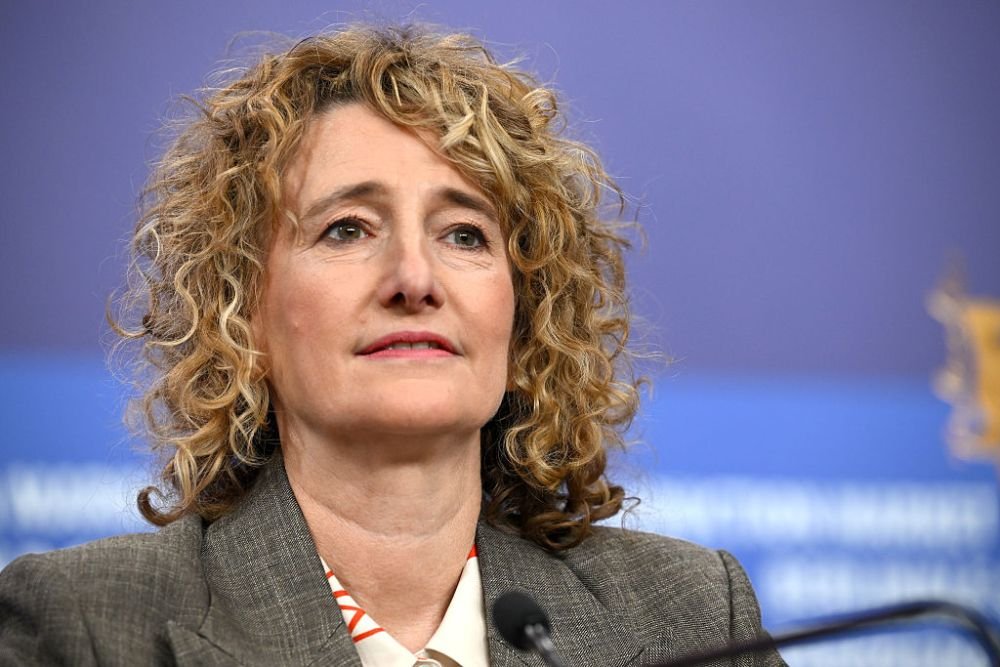
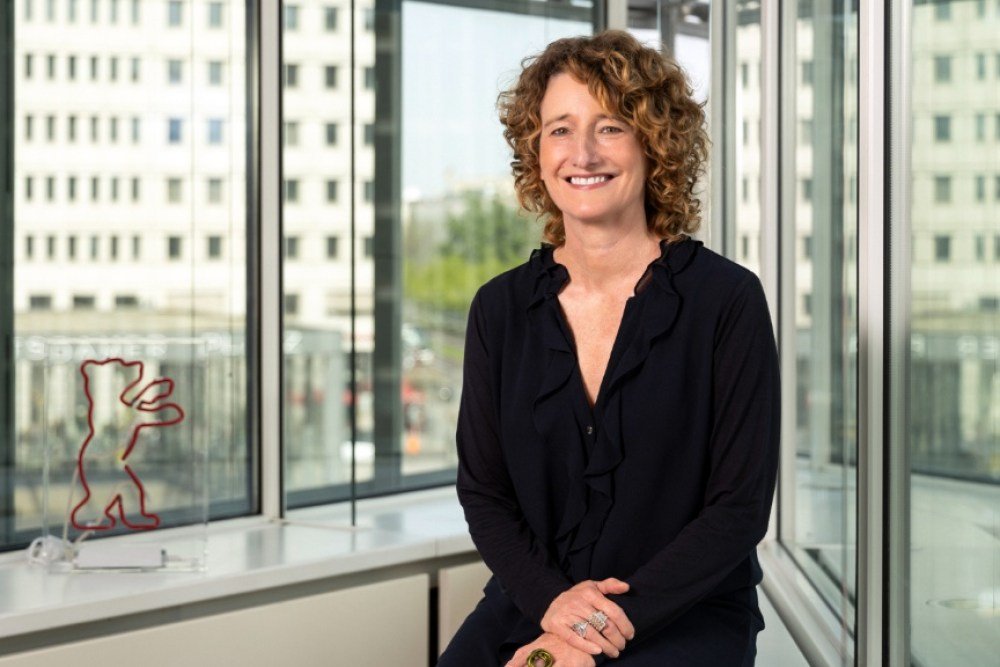
    Israel’s film community – led by a group of film institutes, film festivals and film funds – have thrown their support behind embattled Berlin Film Festival chief Tricia Tuttle in a letter sent to the festival’s governing body.

    The letter, whose signatories include the heads of Docaviv Film Festival, Jerusalem Film Festival, Haifa Film Festival and the Israel Film Fund, was sent yesterday to the KBB supervisory board, which oversees the Berlinale.

    It states, “We wish to highlight her commitment to diversity of voices, non-censorship and creating a space of open debate to all voices. We deeply value her continued commitment to hearing and showing Israeli cinema.”

    While some festivals, like the International Documentary Film Festival Amsterdam, have taken a hard line against Israeli films and producers, Berlin has invited some of that country’s filmmakers, including Assaf Machnes, a Berlinale Talent alum, whose film “Where To,” produced out of Germany and made with Palestinian collaborators, played in the Perspectives section.

    “The Berlinale doesn’t boycott culture workers,” Tuttle told Variety. “Artists are the people who can hold a mirror up and ask difficult questions. Isolation is not the answer.”

    Here’s the letter in full:

    Date: February 25, 2026
    To: KBB Supervisory board
    Ms. Charlotte Sieben
    From: The Israeli Film Institutes, Festivals, and Film Funds
    Re: Formal Expression of Support for Festival Director Tricia Tuttle

    The undersigned, representatives of the Israeli film community—including its primary film funds, major international festivals, and cinematic institutes—are writing to formally express our deep appreciation and steadfast support for Tricia Tuttle’s leadership of the Berlin International Film Festival.

    The past two years have been characterized by unprecedented global political turmoil, especially so in our region, which has inevitably bled into the cultural and cinematic spheres. Navigating these complexities requires more than just administrative skill; it requires a profound commitment to the integrity of art. We have watched with great respect as Tricia Tuttle has steered the Berlinale through these turmoil with a clear-sighted dedication to the festival’s mission.

    In particular, we wish to highlight her commitment to diversity of voices, non-censorship and creating a space of open debate to all voices. We deeply value her continued commitment to hearing and showing Israeli cinema. By providing a platform for our filmmakers, she has ensured that the multifaceted reality of Israeli society continues to engage in a meaningful dialogue with the world.

    The Berlinale has long been a home for Israeli filmmakers. Under Tricia Tuttle’s guidance, we feel confident that the festival remains a place where the power of the moving image transcends rhetoric and fosters genuine human connection.

    Sincerely,
    Yoav Abramovich – CEO – Rabinovich foundation – Israel Cinema project
    Limor Aharonovich – festival director, Michal Weitz – artistic director Docaviv festival
    Oshrit Bitton, Daniel Gat – co-managers – Tel-Aviv International Students film festival
    Ruth Diskin – CEO and Artistic Director – Gesher Multicultural Film Fund
    Amit Goren – CEO and Artistic Director – Makor Foundation
    Pnina Halfon-Lang, artistic director – Co-Pro Foundation
    Roni Mahadav-Levin – Executive director – Jerusalem Film Festival, Jerusalem Cinematheque
    Dr. Noa Regev – CEO – Israel film fund
    Yaron Shamir – Manager – Haifa Film Festival, Haifa Cinematheque
    Eyal Shirai – Manager – Arava Film Festival
    Orel Turner – CEO – The New Fund for Cinema and Television

  • Petition in Support of Berlinale Chief Tricia Tuttle Surpasses 1,200 Film Industry Names, Including Sean Baker, Todd Haynes and Tilda Swinton

    Petition in Support of Berlinale Chief Tricia Tuttle Surpasses 1,200 Film Industry Names, Including Sean Baker, Todd Haynes and Tilda Swinton

    UPDATE: A petition in support of Tricia Tuttle, festival director of the Berlin Film Festival, has now grown to more than 1,200 film business insiders, including directors, producers and actors. As per the website, of 1,357 signatures, 1,218 have now been verified.

    Among the signatories are Oscar winning director Sean Baker, Oscar nominated filmmaker Todd Haynes, Oscar winning actress Tilda Swinton, Kleber Mendonça Filho, the director of Oscar nominated “The Secret Agent,” Oscar nominated director Oren Moverman, Ari Folman, director of Oscar nominated “Waltz With Bashir,” producer Nancy Spielberg, and Ilker Çatak, the director of Oscar nominated “The Teachers’ Lounge.”

    Other names include Caroline Link, director of Oscar winner “Nowhere in Africa,” Nadav Lapid, the director of Golden Bear winner “Synonyms,” actor-writer-director Maria Schrader, an Emmy winner with “Unorthodox,” director Ira Sachs, and Maren Ade, the director of Oscar nominated “Toni Erdmann.”

    The petition comes ahead of an extraordinary meeting, called by Germany’s culture minister Wolfram Weimer, of the Berlin Film Festival’s governing body on Thursday morning to discuss the “future direction” of the Berlinale. It is believed the meeting has been convened in response to criticism of political statements made at the festival.

    The petition says, “If an extraordinary meeting is convened to decide the future of the festival’s leadership, more is at stake than a single appointment. What is at issue is the relationship between artistic freedom and institutional independence.”

    Here is the full statement:

    Open Letter on the Future of the Berlinale
    As filmmakers in Germany and beyond, we are following the current debates surrounding the Berlinale and the proposed dismissal of Tricia Tuttle with deep concern. We stand in defense of the Berlinale for what it fundamentally is: a place of exchange.

    The Berlinale is more than a red carpet or a series of headlines. It is a space where perspectives intersect, narratives are questioned, and social tensions are brought into view. This is where discourse unfolds – at the very heart of cinema.

    Recent criticism has focused on statements made from the stage. None of these remarks were made by the festival leadership itself, but by invited filmmakers. An international film festival is not a diplomatic instrument; it is a democratic cultural space worthy of protection. Its strength lies in its ability to hold divergent perspectives and to give visibility to a plurality of voices.

    A photograph of the festival leadership with filmmakers, in which a Palestinian flag was visible, has likewise been subject to criticism. Being photographed with international guests is part of the practice of such a festival. The visibility of different identities is not an endorsement; it is an expression of an open and democratic public sphere.

    When personnel consequences are drawn from individual statements or symbolic interpretations, a troubling signal is sent: cultural institutions come under political pressure.

    If an extraordinary meeting is convened to decide the future of the festival’s leadership, more is at stake than a single appointment. What is at issue is the relationship between artistic freedom and institutional independence.

    The Berlinale has always been political — not party-political, but socially engaged. Film makes conflicts visible, opens up perspectives, and renders experiences of injustice and violence tangible. Cinema raises moral questions and asks us to endure ambiguity rather than resolve it prematurely. It illuminates power structures and gives visibility to experiences of oppression — not to deliver simple answers, but to enable meaningful public debate. That is precisely where its democratic value resides.

    Especially in times of global crisis, we need spaces capable of sustaining disagreement. The independence of cultural institutions safeguards not only artistic freedom, but the vitality of democratic discourse itself.

    If every controversy leads to institutional repercussions, discourse gives way to control.

    We stand for a culture of exchange, not intimidation.

    Where diversity remains visible, democracy remains alive.

  • Watch the trailer for Louis Theroux’s new documentary ‘Inside the Manosphere’

    Netflix has unveiled a trailer for its upcoming documentary Louis Theroux: Inside the Manosphere set to arrive on March 11th. It will be the first full-length Netflix documentary for Theroux, and see him interview “manosphere” influencers like Sneako, Justin Waller and HS Tikky Tokky, aka Harrison Sullivan. “I’ve made documentaries for over 30 years now, and in a way, this subject feels like the final boss,” the filmmaker told GQ.

    “From Miami to Marbella, meet the men that are reshaping and radicalising young men’s ideas about masculinity and manhood,” Netflix’s description reads. In the trailer, we see Theroux interview the influencers and get the tables turned on himself. “I know that they would be streaming or filming me and would put that content out,” Theroux told Deadline. “And I hoped we’d get this feedback loop where there was a meta narrative that was then affecting my approach to the story.”

    On top of making documentaries (and being famous for Jiggle Jiggle), Theroux is known for his Louis Theroux Interviews… podcast in which he interviews stars like Sean Penn and Florence Pugh. Prior to that, he did stories on conspiracy theories, UFOS and the porn industry, topics that he said were once niche but are now driving the internet and culture.

    “I wouldn’t be the first to point out that a lot of this is down to the influence of social media and the way in which it has given vent to the darkest parts of the human soul. Not just given vent to them, but actively amplified them and pushed them into our feeds. So yeah, this is not a niche subject.”