As part of its big week of announcements, Apple has unveiled a new pair of M5 chips alongside two new MacBooks. The new M5 Pro and M5 Max chips will power the new MacBook Pro that was just announced today, while the new MacBook Air comes with the base M5. According to the company’s press release, the M5 Pro and M5 Max come with an “advanced GPU with Neural Accelerators and higher unified memory bandwidth for a massive increase in AI compute.”
At the heart of the M5 Pro and M5 Max are what Apple is calling a new “Fusion Architecture” that “combines two dies into a single system on a chip (SoC).” The chips both feature a new 18-core CPU, six of which Apple is now calling “super cores, that are the word’s fastest CPU core.”
The other 12 are “all-new performance cores, optimized for power-efficient, multithreaded workloads.” ALtogether, Apple says these CPU changes improve performance by “up to 30 percent for pro workloads.” Meanwhile, the GPU is a jump over the next-gen design we saw in the M5, as it goes to up to 40 cores. Each GPU core has a Neural Accelerator in it, and together with the higher unified memory bandwidth, the company says the M5 Pro and M5 Max offer “over 4x the peak GPU compute for AI compared to the previous generation.”
This story is developing, please refresh for details.
MARA Holdings, one of the largest publicly traded Bitcoin miners in the US, has made a significant change to its treasury policy for 2026.
According to the company’s 10-K report submitted to the U.S. Securities and Exchange Commission (SEC), MARA has gained the flexibility to sell its Bitcoin ($BTC) reserves held on its balance sheet when necessary.
This step represents a significant departure from the company’s past strategy of “holding the Bitcoins it produces as a long-term investment.”
MARA implemented a strategy change in the second half of 2025, allowing the sale of Bitcoin generated from operations, and approved the inclusion of balance sheet assets in the sale scope starting in 2026. The company stated that it may buy and sell Bitcoin from time to time depending on market conditions and capital allocation priorities.
As of December 31, 2025, MARA holds a total of 53,822 $BTC. Approximately 28% of these assets are managed within the framework of an active digital asset management strategy.
9,377 $BTC were lent to counterparties, while 5,938 $BTC were used as collateral for a $350 million loan. $32.1 million in interest income was earned from the lent Bitcoins.
However, the company also experienced a significant decline in value in 2025. Due to the drop in Bitcoin prices, the fair value of its assets decreased by $422.2 million. Furthermore, the 2,000 $BTC account managed at Two Prime recorded a net loss of $22.1 million.
MARA produced 8,799 $BTC in 2025, a 7% decrease compared to the previous year. This decline was attributed to the halving in April 2024 and the increased network difficulty.
Markets are stuck between a corrective downtrend and stretched sentiment, where Bitcoin prezzo reflects both intense fear and signs of a tiring selloff.
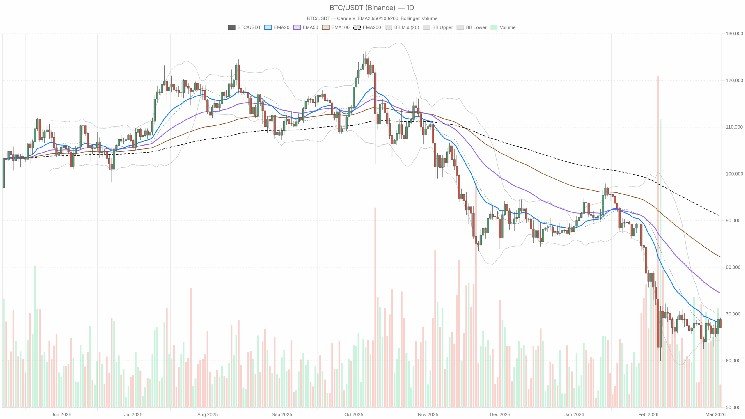
$BTC/USDT — daily chart with candlesticks, EMA20/EMA50 and volume.
Bitcoin prezzo: fear is in control, but the selloff is getting tired
Bitcoin ($BTC) is trading around $67,100, sitting below its short- and medium-term daily moving averages after a difficult run of months. On the higher timeframe, the market is still in a corrective, bearish regime, but the combination of extreme fear (Fear & Greed at 14) and a volatility structure that is no longer accelerating suggests we are closer to the late part of the downtrend than the start.
Right now the dominant force is risk-off positioning: $BTC dominance is high at about 56.5% and total crypto market cap is modestly up on the day. This usually means capital is hiding in Bitcoin and stables while avoiding high-beta altcoins. The question for the next legs is simple: does this correction evolve into a deeper trend break toward the mid–$60Ks and below, or does fear overextend and fuel a sharp mean-reversion rally back toward the low–$70Ks?
On the daily chart the bias is bearish, but the intraday structure is not in free fall. Moreover, hourly and 15-minute timeframes show short-term oversold conditions and fading downside momentum, which opens the door for a corrective bounce inside a broader downtrend.
Daily timeframe (D1): macro bias remains bearish
Trend and EMAs (D1) – Price: $67,111 – EMA 20: $68,333 – EMA 50: $74,476 – EMA 200: $90,959 – Regime flag: bearish
$BTC is trading below all the major daily EMAs, with a clear downside stacking: price < 20-day < 50-day < 200-day. That is classic downtrend structure. The 20-day EMA is close enough to price to act as an immediate dynamic resistance; the 50-day and 200-day are much higher and currently irrelevant for short-term price, but they remind us how far $BTC has pulled back from prior highs.
What it implies: the main scenario is still bearish. Any bounce toward $68.3K–$70K is, by default, a rally into resistance unless $BTC can reclaim and hold above the 20-day EMA.
RSI 14 (D1): 43.8 Daily RSI is sitting just below the midpoint, in the low 40s. Momentum is negative but not washed out.
What it implies: sellers remain in control on the higher timeframe, but this is not extreme oversold territory. There is room for another leg down if macro or flows deteriorate, yet we are close to the zone where dip buyers usually start to step in more aggressively if the structure stabilizes.
The MACD lines are deeply negative, reflecting the strong prior downside phase, but the histogram is now positive: the MACD line has crossed above its signal line while still below zero.
What it implies: the downtrend on the daily chart is losing momentum. This is typically what you see in late-stage selloffs or early base-building phases: price may still drift lower or move sideways, but the persistent, clean downside impulse is fading. It does not give us a buy signal on its own; it says the worst momentum is likely behind us, unless a new shock hits.
$BTC is trading very close to the middle band, after spending time below it earlier in the move.
What it implies: volatility is elevated but not explosive, and price has migrated back toward the midline after weakness. That is typical in a consolidation phase inside a broader downtrend. The lower band around $64.4K is the immediate volatility support; repeated tags of that area without follow-through would reinforce a short-term bottoming narrative. A daily close back above the midline and heading toward the upper band would be the first sign of a more constructive mean reversion.
ATR 14 (D1): $2,964 Average daily range is close to $3K.
What it implies: volatility is high enough that 4–5% daily swings are entirely normal here. Position sizing matters: levels can be pierced intraday without necessarily breaking the broader structure. Traders should not overreact to a $1–2K move; it is just one average day of noise in this environment.
Daily pivot levels (D1) – Pivot point (PP): $67,815 – First resistance (R1): $68,554 – First support (S1): $66,372
Price is currently trading below the daily pivot but above S1.
What it implies: intraday, $BTC is leaning to the bearish side of the daily range, but it has not yet tested the first support. The $66.3K–$66.5K pocket is the first real line in the sand for today’s session; sustained trading below there would open the path toward the lower Bollinger Band near $64.4K.
Hourly timeframe (H1): weak, but not collapsing
On the 1H chart the system labels the regime as neutral, which matches what the indicators are showing: downside pressure, but no clean one-way trend.
Trend and EMAs (H1) – Price: $67,104 – EMA 20: $68,068 – EMA 50: $67,458 – EMA 200: $66,731
Price is under the 20- and 50-hour EMAs, but the 200-hour is still below price. The short-term averages have rolled over, but the longer intraday trend is not fully broken yet.
What it implies: this is a short-term pullback within a broader intraday range. Sellers have the upper hand on the hourly chart, but until price convincingly loses the 200-hour EMA around $66.7K, it is more of a corrective drift than a new, impulsive breakdown.
RSI 14 (H1): 41.4 Hourly RSI is in bearish territory, but far from oversold.
What it implies: intraday momentum is negative and supports the daily bearish bias, yet there is capacity for both further grinding down and sharp squeeze rallies. It is a “do not chase late” zone rather than a fresh high-conviction short area.
The MACD values are slightly positive but the histogram is negative, meaning the MACD line is crossing down under the signal line while both sit above zero.
What it implies: the prior intraday bounce has stalled, and momentum is shifting back to the downside, but the overall hourly trend has not flipped deeply bearish. Think of this as a market that tried to rebound, failed to sustain it, and is now drifting lower rather than cascading.
Price is trading in the lower half of the band range, closer to the lower band but not hugging it.
What it implies: bears are in control intraday, but volatility is contained. There is no sign yet of a volatility expansion move; instead, the market is bleeding lower within an established envelope.
ATR 14 (H1): $581 The average hourly range is around $580.
What it implies: $400–800 swings on an hourly basis are standard noise here. For execution, it means entries that are too tight to the pivot or recent swing can get shaken out quickly.
Price is trading slightly below the hourly pivot and above S1.
What it implies: the market is leaning bearish within today’s intraday structure, but has not yet broken the key $66.7K–$66.8K zone that aligns with both S1 and the 200-hour EMA. That confluence is the immediate short-term battleground.
15-minute timeframe (M15): execution layer, stretched on the downside
On the 15-minute chart, the regime is tagged as neutral, but here the details matter more for timing entries and exits than for bias.
Trend and EMAs (M15) – Price: $67,107 – EMA 20: $68,013 – EMA 50: $68,241 – EMA 200: $67,428
Price is below all the intraday EMAs, including the 200 on the 15-minute chart.
What it implies: short-term structure is clearly weak; any quick bounce into $67.4K–$68K is, initially, just a retest of broken supports and short-term moving averages. Fast money will be looking to fade those bounces unless higher timeframes start to confirm a reversal.
RSI 14 (M15): 22.3 This is deeply oversold on the very short timeframe.
What it implies: the 15-minute chart is ripe for a bounce or at least a pause. That does not change the daily bias, but it warns that pressing fresh shorts here on the smallest timeframe offers poor immediate reward-to-risk; a squeeze back toward the 20- or 50-EMA on M15 would be entirely normal.
Both MACD and signal are below zero, and the histogram is negative.
What it implies: short-term momentum is still to the downside, consistent with the oversold RSI. The market is weak, but because it is already stretched, this is where you often start to see jagged, two-way price action: sharp little rallies inside a broader intraday downtrend.
$BTC is trading below the lower band on this timeframe.
What it implies: price is extended to the downside on the micro view. That often leads to snap-back moves toward the midline, even if the larger trend is down. It is a poor spot to initiate new aggressive shorts, but not yet a clear reversal area on its own.
ATR 14 (M15): $266 Average 15-minute range is about $266.
What it implies: for scalpers, this is a wide tape; intrabar moves of $150–$300 are routine. Tight stops around obvious levels will be hunted; more thoughtful placement away from the noise is crucial.
Price is slightly below the 15-minute pivot and hovering near S1.
What it implies: the very short-term tape is leaning bearish but trying to stabilize near the first support. It is exactly the kind of area where you expect either a minor intraday bounce or an acceleration if S1 breaks on volume.
Sentiment and broader market context
The crypto-wide Fear & Greed Index sits at 14 (Extreme Fear). $BTC dominance around 56.5% alongside a modestly rising total market cap points to capital rotating into Bitcoin and stables while the market de-risks elsewhere.
What it implies: fear is real, but it is already heavily priced in. Historically, extreme fear readings during a corrective phase often precede strong relief rallies, though they do not pinpoint timing. As long as dominance stays elevated and altcoins underperform, Bitcoin remains the relative safe asset within crypto, even if its own price is under pressure.
Scenarios for Bitcoin prezzo: where do we go from here?
Main bias from D1: bearish, but late-stage and vulnerable to a squeeze.
There is a clear tension across timeframes:
Daily chart: downtrend structure, negative but easing momentum.
Hourly chart: neutral-to-bearish drift, no capitulation.
15-minute chart: oversold and stretched, due for a bounce.
That mix usually resolves either into a relief rally inside a downtrend or a final flush that resets the shorter timeframes before a more meaningful reversal.
Bullish scenario (countertrend, then potentially more)
In the bullish path, the current oversold intraday setup turns into a rebound that gains traction on higher timeframes.
Key steps for this scenario:
1. Short-term stabilization above $66.5K The $66.3K–$66.8K zone is critical: it combines daily S1, hourly S1, and the H1 200 EMA. Holding above this area and putting in higher lows on the 15-minute and hourly charts would signal sellers are losing control intraday.
2. Reclaim of intraday moving averages Price needs to retake the 15-minute 200 EMA near $67.4K and then the 20- and 50-hour EMAs around $67.5K–$68.1K. That would turn the current bleed into a short-term trend reversal.
3. Break back above the daily pivot and 20-day EMA A daily close above the pivot at $67.8K and, more importantly, above the 20-day EMA near $68.3K would be the first serious sign that the correction is maturing. From there, a move toward the upper daily Bollinger Band and the $70K–$71K region becomes realistic.
4. Extension toward $72K–$74K If momentum improves and volume expands on the way up, the next logical magnet would be the prior supply area in the low–$70Ks, with the 50-day EMA at $74.5K as a stretch target for a full mean-reversion swing.
What invalidates the bullish scenario? A clean break and daily close below $64.4K (the lower daily Bollinger Band) would strongly argue that the market is not ready to base yet. That would put the focus back on lower supports and delay any sustained upside for weeks, not days.
Bearish scenario (trend continuation, potentially one more leg down)
In the bearish path, the daily downtrend re-asserts itself, and the short-term oversold conditions on the 15-minute chart are worked off via a shallow bounce that fails quickly.
Key steps for this scenario:
1. Failure to reclaim $68K If every small rally gets sold before $BTC can regain the hourly EMAs and the daily pivot, it signals strong supply overhead. Repeated rejections around $67.5K–$68.0K would confirm this.
2. Break of $66.5K and $66.3K supports Losing the $66.7K 200-hour EMA and the clustered S1 levels would open the door to a test of the daily lower band around $64.4K. In that move, 15-minute oversold conditions could persist as price grinds lower.
3. Daily close near or below the lower Bollinger Band ($64.4K) A decisive daily candle closing at or beneath the lower band would mark a volatility expansion to the downside, likely driven by renewed fear, liquidations, or macro headlines. From there, traders would start discussing deeper retracement zones below $60K.
4. Momentum rollover on D1 indicators If the MACD histogram on D1 turns back down toward zero or negative while RSI sinks into the 30s, it would confirm that the early signs of momentum easing were a false dawn and that the trend is accelerating again.
What invalidates the bearish scenario? A sustained move and daily close above $70K, accompanied by rising volume and a firm MACD histogram on the daily chart, would severely weaken the bearish narrative. In that case, the recent leg would be better framed as a correction in a larger bull market, with the path of least resistance shifting back upward.
Positioning, risk, and how to think about Bitcoin prezzo here
This is a tricky part of the cycle. The daily chart says downtrend, the intraday chart says tired but not reversed, and sentiment says everyone is scared. Those conditions often deliver sharp, counterintuitive moves in both directions.
A few practical takeaways for traders analyzing Bitcoin prezzo in this environment:
Respect the daily downtrend. Unless and until $BTC can reclaim the 20-day EMA and hold it, rallies are guilty until proven innocent. That argues against blindly buying every dip.
Do not ignore extreme fear. With sentiment this depressed and the daily MACD starting to turn, the risk of a violent short-covering rally is real. Shorts added late into intraday oversold conditions can be painful.
Size for volatility. With a ~$3K daily ATR and $500+ hourly ranges, levels will be overshot routinely. If your positioning cannot tolerate a few thousand dollars of noise against you, your sizing is probably too large for this tape.
Use confluence, not single signals. The more alignment you see between key supports (pivot levels, EMAs, Bollinger Bands) across timeframes, the more meaningful the area. Right now, $66.3K–$66.8K is one such zone on the downside; $68K–$70K is shaping up as the equivalent on the upside.
Overall, $BTC is in a corrective downtrend dominated by fear, but the internal momentum picture is no longer one-sided. For traders, this is a phase to stay nimble, respect both tails, and let the levels, not emotions, dictate whether the next big move is a breakdown or a squeeze higher.
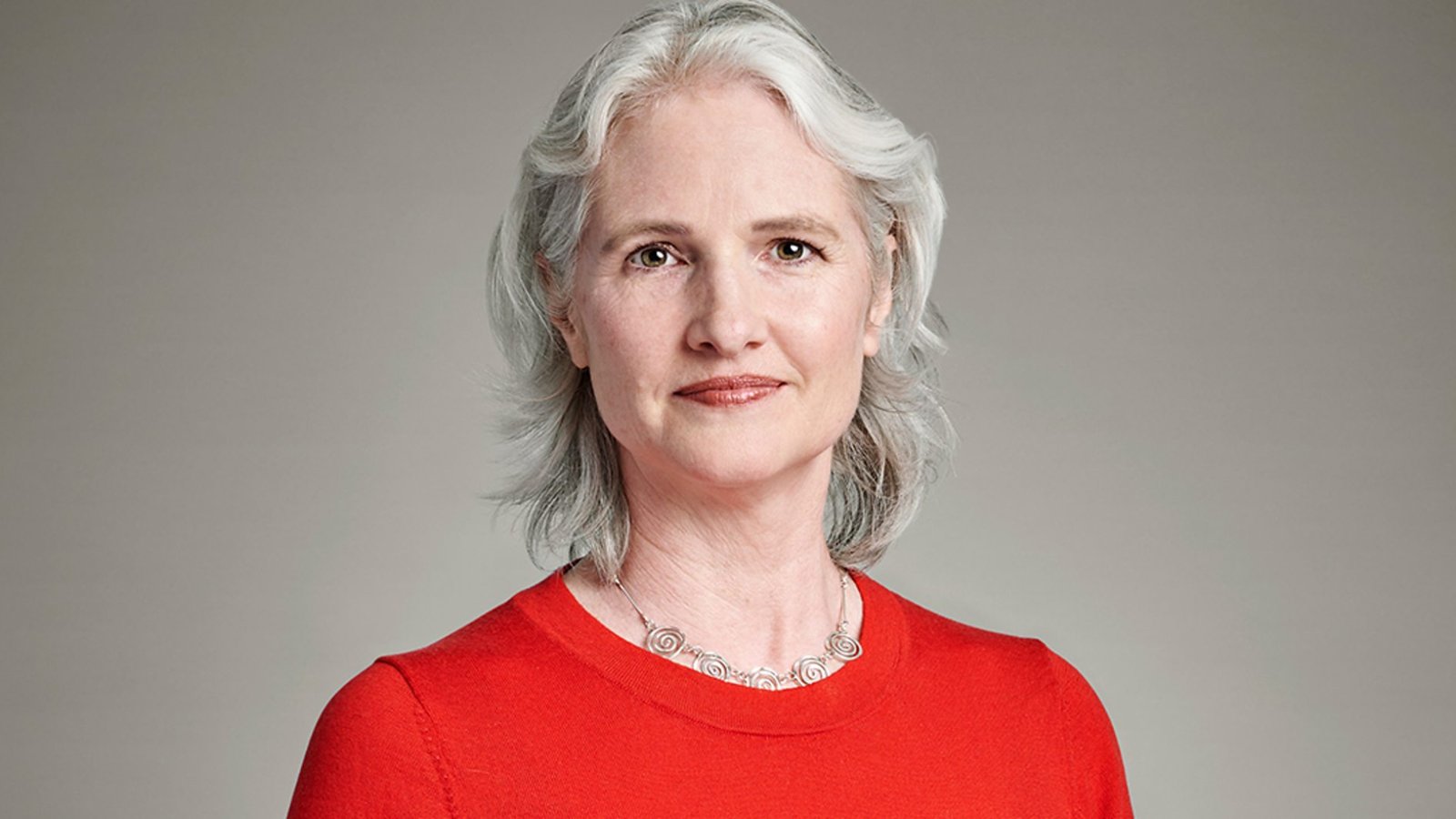
BBC COO Leigh Tavaziva will step down from her role in September, she has revealed in an internal letter sent to staff.
The move makes Tavaziva the third board-level exec to depart the British broadcaster in recent months, following the resignations of director-general Tim Davie and BBC News boss Deborah Turness late last year.
Tavaziva, who has been in the role for just over three years, said to colleagues: “After five brilliant years, I have taken the opportunity to reflect on my own role at the BBC and have decided that the time is right for me to leave to pursue new opportunities. I will be stepping down in September. It is a privilege and honour to work here and to have played my part, alongside you all, to ensure we deliver on the mission and purpose of an organisation that matters so much, and now more than ever.”
The news came with changes to the chief operating officer group, notably the creation of a new BBC Media Tech team. “This new division will unite all our Product and Technology teams in public service with tech and product colleagues from BBC Studios into a single Group team,” said Tavaziva. “Today, our technology capabilities are spread across multiple parts of the BBC, which can slow us down, create duplication, and make it harder to deliver seamless experiences to audiences. By forming a single division, we can focus our investment, make faster decisions, adopt shared tools and standards, and innovate quickly.”
She shared that Storm Fagan, currently chief product officer, has been appointed BBC chief technology and product officer to lead BBC Media Tech. “Storm is a pioneering leader who has delivered outstanding results in the Product Group and brings deep experience in delivering creative, audience-focused technology across the BBC and her previous organisations.”
Tavaziva added she will be “working closely” with interim director-general Rhodri Talfan Davies as he takes over in April, in order to “ensure we carefully manage this period of transition.”
“I do recognise the uncertainty many of you are facing with the changes we are announcing today,” she said. “We will continue to keep you updated as our plans and proposals develop and to ensure that you have an opportunity to feedback and input into the work.”
Elizabeth Banks and Matthew Macfadyen have quite a little problem on their hands in the newly released trailer for The Miniature Wife.
The Peacock series, which is based on the short story by Manuel Gonzales, “is a dramedy examining the power (im)balances between spouses after a technological accident induces the ultimate relationship crisis,” the official logline reads.
Banks’ Lindy Littlejohn says at the beginning of the footage (below), “My husband and I, we take turns supporting each other. So he supported me through my first book, and now it’s my turn.”
However, that support is put to the test when Macfadyen’s Les Littlejohn develops what he calls “the miracle of miniaturization,” which is supposed to help crops. But when it gets sprayed on Lindy by accident and she gets shrunk down to a few inches tall, Les must quickly find a way to restore her to her regular size.
“How long until you can fix me?” Banks character asks Les at the end of the trailer.
O-T Fagbenle, Zoe Lister-Jones, Sian Clifford, Sofia Rosinsky, Ronny Chieng, Aasif Mandvi, Rong Fu and Tricia Black round out the cast.
The Miniature Wife was created by Jennifer Ames and Steve Turner, who also serve as showrunners and executive producers. Banks, Macfadyen, Michael Aguilar and Suzanne Heathcote also executive produce alongside Michael Ellenberg and Lindsey Springer for Media Res and Greg Mottola.
All 10 episodes of The Miniature Wife premiere April 9 on Peacock. Check out more first-look images below.
Matthew Macfadyen and Elizabeth Banks in ‘The Miniature Wife.’
For decades, Ali Larijani was the calm, pragmatic face of the Iranian establishment – a man who wrote books on the 18th-century German philosopher Immanuel Kant and negotiated nuclear deals with the West.
But on March 1, the 67-year-old secretary of the Supreme National Security Council’s tone changed irrevocably.
Recommended Stories
list of 3 itemsend of list
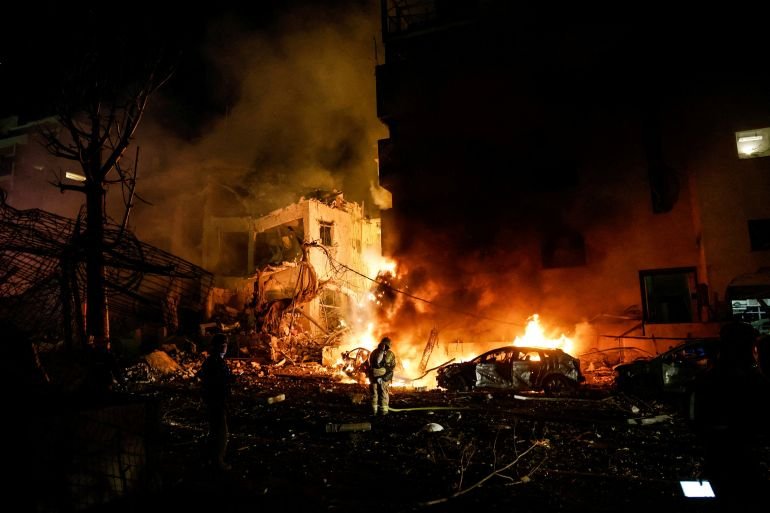
Appearing on state television just 24 hours after US-Israeli air strikes killed Supreme Leader Ayatollah Ali Khamenei and the Iranian Revolutionary Guard Corps (IRGC) commander, Mohammad Pakpour, Larijani delivered a message of fire.
“America and the Zionist regime [Israel] have set the heart of the Iranian nation ablaze,” he wrote on social media. “We will burn their hearts. We will make the Zionist criminals and the shameless Americans regret their actions.”
“The brave soldiers and the great nation of Iran will deliver an unforgettable lesson to the hellish international oppressors,” he added.
Larijani, who accused US President Donald Trump of falling into an “Israeli trap”, is now at the centre of Tehran’s response to its biggest crisis since 1979.
He is expected to have an important role alongside the three-man transitional council running Iran after Khamenei’s death.
So, who is the man tasked with steering Iran’s security strategy as its war with Israel and the US continues?
The ‘Kennedys’ of Iran
Born on June 3, 1958, in Najaf, Iraq, to a wealthy family from Amol, Larijani belongs to a dynasty so influential that Time magazine described them, in 2009, as the “Kennedys of Iran”.
His father, Mirza Hashem Amoli, was a prominent religious scholar. And like Larijani, his brothers have held some of the most powerful positions in Iran, including in the judiciary and the Assembly of Experts, a clerical council empowered with choosing and overseeing the supreme leader.
Larijani’s ties to Iran’s post-1979 revolutionary elite are also personal. At age 20, he married Farideh Motahari, the daughter of Morteza Motahhari, a close confidant of the Islamic Republic of Iran’s founder, Ruhollah Khomeini.
Despite his family’s conservative religious roots, his children have had a diverse trajectory. His daughter, Fatemeh, a medical graduate from the University of Tehran, completed her specialisation at Cleveland State University in Ohio, US.
The mathematician philosopher
Unlike many of his peers who came solely from religious seminaries, Larijani also has a secular academic background.
In 1979, he earned a bachelor’s degree in Mathematics and Computer Science from the Sharif University of Technology. He later completed master’s and doctorate degrees in Western philosophy from the University of Tehran, writing his thesis on Kant.
But it is his political positions that have been the centrepiece of his career.
After the 1979 revolution, he joined the IRGC in the early 1980s, before transitioning to government, serving as culture minister under President Akbar Hashemi Rafsanjani between 1994 and 1997, and then as the head of the state broadcaster (IRIB) from 1994 until 2004. During his time at the IRIB, he faced criticism from reformists who accused his restrictive policies of driving Iranian youth towards foreign media.
Between 2008 and 2020, he served as the Parliament (Majlis) speaker for three consecutive terms, playing a major role in shaping domestic and foreign policy.
Return to the security fold
Larijani ran for the presidency in 2005 as a conservative candidate, but did not make it to the second round. In the same year, he was appointed the secretary of Iran’s Supreme National Security Council, and the country’s chief nuclear negotiator.
He resigned from those posts in 2007, after growing distant from then-President Mahmoud Ahmadinejad’s nuclear policies.
Larijani entered parliament in 2008, winning a seat to represent the religious centre of Qom, and became the speaker. This allowed Larijani to grow in influence, and he maintained his connection to the nuclear file, securing parliamentary approval for the 2015 nuclear deal between Iran and world powers, known as the Joint Comprehensive Plan of Action (JCPOA).
After leaving his position as parliamentary speaker and member of parliament in 2020, Larijani attempted to run for president for a second time in the 2021 election. But this time, he was disqualified by the Guardian Council, which vets candidates. He was disqualified again when he attempted to run in the 2024 presidential election.
The Guardian Council gave no reason for the disqualifications, but analysts viewed the 2021 move as a way for the establishment to clear the field for hardliner Ebrahim Raisi, who won the election. Larijani criticised the 2024 disqualification as “non-transparent”.
But he did return to an influential position in August 2025, when he was reappointed as secretary of the Supreme National Security Council by President Masoud Pezeshkian.
Since taking the post, his stance has hardened. In October 2025, reports emerged that Larijani had cancelled a cooperation agreement with the International Atomic Energy Agency (IAEA), declaring that the agency’s reports were “no longer effective”.
Diplomacy amid war
Despite that tough stance, Larijani is often regarded as pragmatic and someone inside the Iranian system who may be willing to compromise, in part due to his past role in backing the 2015 nuclear deal.
Just weeks before the current escalation, Larijani was reportedly engaged in indirect negotiations with the US.
In February, during talks mediated by Oman, he stated that Tehran had not received a specific proposal from Washington, and accused Israel of trying to sabotage the diplomatic track to “ignite a war”.
In an interview with Al Jazeera prior to the US and Israel’s attacks on Iran, Larijani described his country’s position on talks as “positive,” noting that the US had realised that the military option was not viable. “Resorting to negotiation is a rational path,” he said at the time.
However, the air strikes, which began on February 28, have shattered the diplomatic window.
In his latest address, Larijani assured the nation that plans were in place to arrange the leadership succession according to the Constitution. He warned the US that it was delusional to think killing leaders would destabilise Iran.
“We are not intending to attack regional countries”, he clarified, “but we are targeting any bases used by the United States”.
The more pragmatic tone appears to have disappeared – for now. Larijani has rejected media reports that he wanted new talks with the US, saying on Monday that Iran would “not negotiate” with Washington.
Instead, with Khamenei gone and the region on the brink, Larijani has promised a response to the US and Israel with “a force that they have never experienced before”.
As its joint attack with the United States on Iran continues, Israel sees its task as the culmination of a longstanding policy on: ushering in regime change from within.
Taking to the airwaves in the wake of the killing of Iranian Supreme Leader Ayatollah Ali Khamenei on Saturday, Israeli Prime Minister Benjamin Netanyahu addressed the Iranian people directly, calling on them in Farsi to “come to the streets, come out in your millions, to finish the job, to overthrow the regime of fear that has made your lives bitter”.
Recommended Stories
list of 4 itemsend of list
“Your suffering and sacrifices will not be in vain. The help you wished for – that help has now arrived,” he said of the US-Israeli air strikes, which have already killed more than 555 people in Iran, including 180 at a girls’ school in the country’s south.
“The Israeli authorities don’t spell it out, but it is clear that what they want to see is a regime change in Iran,” said Ahron Bregman, a senior teaching fellow at the Department for War Studies at King’s College London, who had returned to Israel to research a book before the latest round of strikes took place.
“I’m stuck in Tel Aviv and spend many hours with Israelis in a local shelter. I’m taken aback by the strong support among these – mainly liberal – Israelis of the war,” he said. “They, like their leaders, believe that if you only topple the Iranian regime, the Middle East will totally transform for the better, which is, of course, nonsense.”
But there is a question of how invested Netanyahu and his allies are in ensuring that regime change in Iran is smooth.
Israeli officials know that Iran, including its opposition, has a diverse array of views and backgrounds.
Many Iranians who have taken to the streets, including in the large protests that took place in January, are united only in their hostility to the government, with various factions calling for everything from the restoration of the monarchy to a full democracy. Others, however, are rallying on the government’s side after the attacks on their country and Khamenei’s killing.
A plume of smoke ascends to the sky in Tehran after a strike on March 2, 2026 [Atta Kenare/AFP]
Questions remain
“I think there’s a public opacity to Israel’s war aims,” former Israeli government adviser Daniel Levy told Al Jazeera. “My sense is that Israel has no real interest in smooth regime change. I think most [Israeli leaders] regard that as a kind of fairytale, though that’s not something Netanyahu and allies might be ready to admit publicly.”
“Israel’s more interested in regime and state collapse,” Levy noted. “They want Iran to implode, and if the spillover from that takes in Iraq, the Gulf and much of the region, so much the better.”
“They’ll have removed a significant regional counter to their freedom to act, leaving Israel and its allies free to remake the regions and, critically, to continue both killing Palestinians, and possibly even move against Turkiye, which is the next logical step,” he said, reflecting a recent rise in anti-Turkiye rhetoric in Israel, with politicians even characterising the country as the “new Iran”.
However, while public appetite for the war may be high, there is an understanding that the duration of that war might not be of Israel’s choosing.
The bulk of Israel’s military spending is underwritten by the US, where the attack on Iran is proving less than popular. Equally, in a world where many states had belatedly grown critical of Israel’s genocidal actions towards Palestinians – in particular in Gaza – US diplomatic heft has been vital in protecting its ally from criticism, and even wider sanctions.
How long the US’s allies in the Gulf are ready to withstand Iranian assaults on their territory in response to a war they had repeatedly cautioned against is far from clear. Equally, how long it might be before regional diplomatic pressure on US President Donald Trump begins to have an impact is also hard to predict, Levy warned.
“It’s fitting that this is the holiday of Purim, which also marks the survival of the Jewish people over a threat from Persia 2,500 years ago, and we still celebrate it today. People understand that,” Barak said.
“Israel going to war in tandem with our greatest ally and the world’s greatest power is unprecedented,” Barak continued. “It’s hard to make any predictions, but Trump has his own priorities and his own endgame, which might not be the same as ours. It could be that Trump pulls out and leaves Israel holding the bag. What happens then, I don’t know.”
Public backing
Iranian missiles may be hitting Israel, but analysts there say the general sentiment among the public is supportive of active hostilities against Iran, with the backing of the US.
It stems from years – if not decades – of messaging that Iran and its allies are the main threats to Israel.
From Netanyahu’s repeated warnings that Iran is on the brink of acquiring nuclear weapons, to the predictions from politicians of all stripes that Israel’s destruction at the hands of Iran is imminent, the outbreak of a conflict that many Israelis see as the final showdown with their enemy has almost been welcomed.
Politicians from the right to the centre-left have backed the US and Israeli decision to attack Iran.
Yair Golan, the leader of the centre-left Democrats, who, in May last year, outraged many Israelis by saying that the endless killing of Palestinians risked reducing Israel to a “pariah state”, welcomed the war, saying the Israeli military had his “full backing” in “removing the Iranian threat”.
Other opposition politicians, such as the centrist Yair Lapid and the right-wing Naftali Bennett, have all fallen into line behind Netanyahu in his confrontation with Iran.
“People here know Iran is a threat. They know it because Iran keeps telling us,” said Mitchell Barak, a political pollster who was an aide to Netanyahu in the early 1990s. “They [Iran] have the weapons, the will, and we know they’re ready to attack. Everyone is happy that the war is under way, and this time, it will be finished.
“It gives Israelis a great sense of pride that it is a fully joint operation with the United States,” Barak, who spoke from a shelter in West Jerusalem, said. “The aim is regime change and protecting Israelis. They understand that. Israelis are hunkering down and resolved to see this through.”
Bitcoin traded near $68,000 on Tuesday as U.S. spot ETFs pulled in $458 million, according to data curated by SoSoValue, marking one of the quarter’s strongest inflow days despite the ongoing conflict with Iran.
The inflows suggest institutional investors are treating bitcoin’s recent volatility stemming from the war as contained rather than systemic.
Singapore-based trading firm QCP Capital said in a recent note that the roughly $300 million in long liquidations triggered by the weekend headlines were “notable but contained,” arguing that positioning had already been materially lightened in recent weeks.
Options markets told a similar story, QCP wrote, with one-day implied volatility briefly spiking to 93% before quickly retracing, a sign traders were hedging event risk rather than bracing for prolonged escalation.
Meanwhile, U.S. spot bitcoin ETFs added $1.1 billion over three consecutive sessions last week, according to SoSoValue data previously reported by CoinDesk, with BlackRock’s IBIT accounting for roughly half.
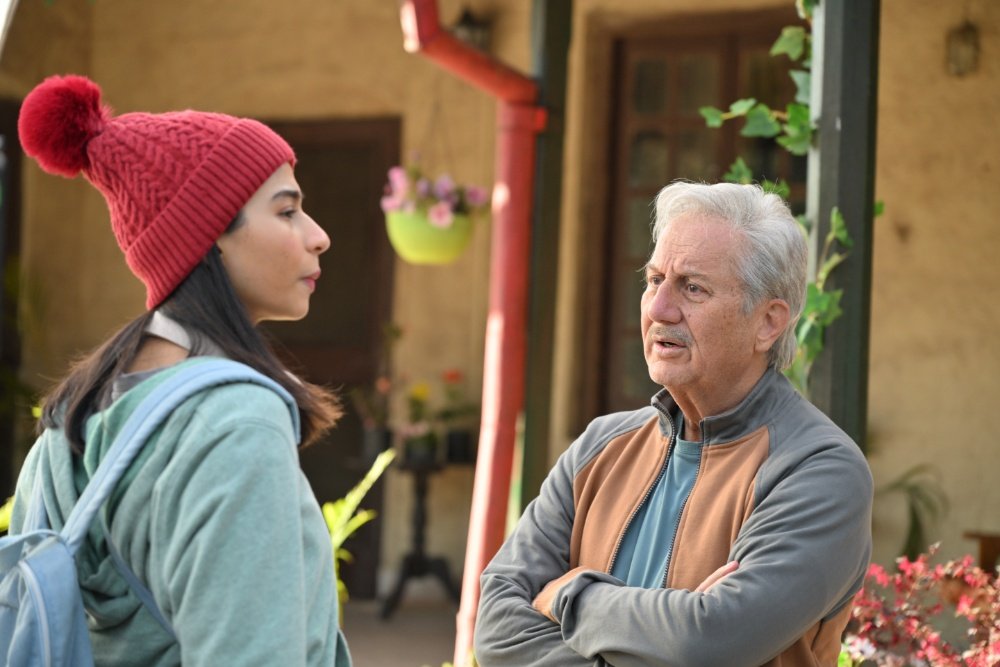
Indian thespian Anupam Kher is developing a new film set in Varanasi that echoes the themes of his 1984 breakthrough “Saaransh” while unveiling his latest directorial effort “Tanvi the Great” for its global streaming premiere on Prime Video March 3.
“I’m working on a story about Banaras [Varanasi], about a person in Banaras,” Kher says of the new project. “I was discussing with [“Saaransh” director] Mahesh Bhatt… it’s a ‘Saaransh 2,’ basically. This time, the man is not passive in the sense he was aggressive in his thoughts. This time I just feel that I need to reinvent myself.”
The actor-director describes the Varanasi-set film as the story of “a 70-year-old man who feels like a 28-year-old man” – a reversal of his iconic debut where he played a 65-year-old character at age 28 in “Saaransh,” Bhatt’s 1984 drama about an elderly couple coping with the loss of their only son. That film, which was India’s entry for the Oscars, established Kher as a serious actor and remains one of his most celebrated performances. “When I was 28 I played a 65-year-old man role. Now at that time, I portrayed 65 what I thought 65 will be like, but I’m going to be 71 on March 7, I feel like a 28-year-old man,” he says. The new project will unfold “in the genre of a funny thriller, but human story. I don’t know how to tell other stories. I can only tell stories which are human, which have a human angle, which have a human feeling, but positive. I like happy endings.”
As Kher discusses his future projects, he’s simultaneously unveiling “Tanvi the Great” for its worldwide streaming debut, bringing the autism-centered drama to audiences worldwide after a festival and theatrical run. The film follows 21-year-old Tanvi Raina [debutant Shubhangi Dutt], an autistic woman who discovers her late soldier father’s unfulfilled dream – to stand at Siachen, the world’s highest battlefield, and salute the Indian flag – and becomes determined to fulfill this mission despite societal pushback and institutional barriers against autistic recruits in the military. The film portrays autism as a superpower rather than a disability.
Following its world premiere at the Cannes Film Market, “Tanvi the Great” screened in London, New York – where Robert De Niro attended – and Houston before being shown to the President of India, the army chief, and 2,000 cadets at the Indian National Defence Academy. The theatrical release in India came on July 18, alongside the blockbuster “Saiyaara.” “‘Saiyaara’ was like a tsunami, so it got lost in that,” Kher acknowledges, though the film found life through special screenings for 20,000 school students and a re-release that has now reached its 23rd week in limited theaters.
“If film is to be judged from a box office, it did not do well, but if it is to be judged by appreciation and the kind of response of the Autism Society of India, the army, the children, the school children, the people who saw it, is, it is, I think, priceless,” Kher says.
But perhaps the most meaningful validation came from De Niro, who had initially planned a brief 10-minute appearance at the New York premiere. “He had come for 10 minutes, but he stayed till the interval,” Kher recalls. De Niro, who Kher starred alongside in “Silver Linings Playbook,” later requested to see the complete film. “He said, ‘It’s very moving.’ And he told the girl [Dutt] that you are terrific, which I thought was the ultimate compliment for any actor in the world, that the God of acting is telling a person who has done her first film that you are terrific.”
The response from the autistic community has been particularly gratifying. “We have presented Tanvi as a superpower… they like that because they say that there is some special things about them,” Kher explains. “Usually, people portray them as helpless and tragic and this and that. They love the quirkiness of Tanvi. They loved that she takes up a job which her father could not fulfill. They love the portrayal of Shubhangi very well. They love the relationship of grandfather and granddaughter. That she can sing and she can do things and that she’s naughty. She’s not portrayed as somebody with a disability.”
As Kher unveils the film for its Prime Video release, he emphasizes its appeal as a rare family film in today’s market. “You very rarely can see films where the whole family sits together and can watch it,” he says.
Kher positions “Tanvi the Great” as an antidote to contemporary cynicism, particularly as it reaches a global streaming audience. “It makes you believe in humankind. And that’s what we need in today’s time. I think if you want to practice a religion today, that needs to be that of humanity. And this film makes you believe in that,” he says. “It also makes you feel that the only good people in this world are people who are neurodivergent.”
The director describes the viewing experience in evocative terms: “It’s like a first sip of coffee in the morning, which makes you feel good. It’s like sunshine in winter through a window. When I was in Shimla, on the winter nights, the sun used to filter through these chinar trees. I wait for that feeling to happen. It makes you feel warm, like you’re wearing a quilt of goodness around you.”
Lead actor Shubhangi Dutt from “Tanvi the Great” “is winning awards right now” and working on another Anupam Kher Studio production called “Flicker.” On the acting front, Kher has just completed “Khosla Ka Ghosla 2” and is finishing an untitled Sooraj Barjatya film. He’s also preparing a new musical play titled “Jaane Pehchaane Anjaane” (Intimate Strangers).
“Tanvi the Great” is produced by Anupam Kher Studio in association with India’s National Film Development Corporation, with music by Oscar winner M.M. Keeravani (“RRR”) and sound design by Oscar winner Resul Pookutty (“Slumdog Millionaire”).