A mum who says she tried to save a man from jumping into the tiger enclosure before a horror incident at a wildlife park has spoken out about the ordeal.
Emergency services were contacted shortly after 1.30pm on 10 October when a man had entered the enclosure at the Yorkshire Wildlife Park.
He was pronounced dead at the scene, South Yorkshire Police have said, with the park still remaining closed amid investigations.
Videos circulating online appear to show a man being pawed at and grappled by a tiger named Altai in the enclosure at the park, near Doncaster.
The park said ‘many, many people’ had contacted them about Altai, the Amur tiger involved in the incident, and it confirmed he is ‘safe and well’ and will not be euthanised.
Visitors who were observing the big cats later revealed how panic ensued as they watched the man grapple with the tiger.
Police raced to the scene of the tiger incident (SWNS)
A video appears to show the victim sat next to the tiger before being clawed at as he appeared to try and communicate with the animal and was heard shouting “Stop, stop, stop, stop, stop.”
One witness told LADbible they saw ‘staff running around’ frantically and ushering people towards the exit, ‘but wouldn’t say anything about why’.
Now, witnesses have told how a mum tried to save the man from jumping into the enclosure.
Eyewitnesses claimed the victim, who has not been named, posed for a photo with the big cat in the background moments before jumping in from a viewing platform.
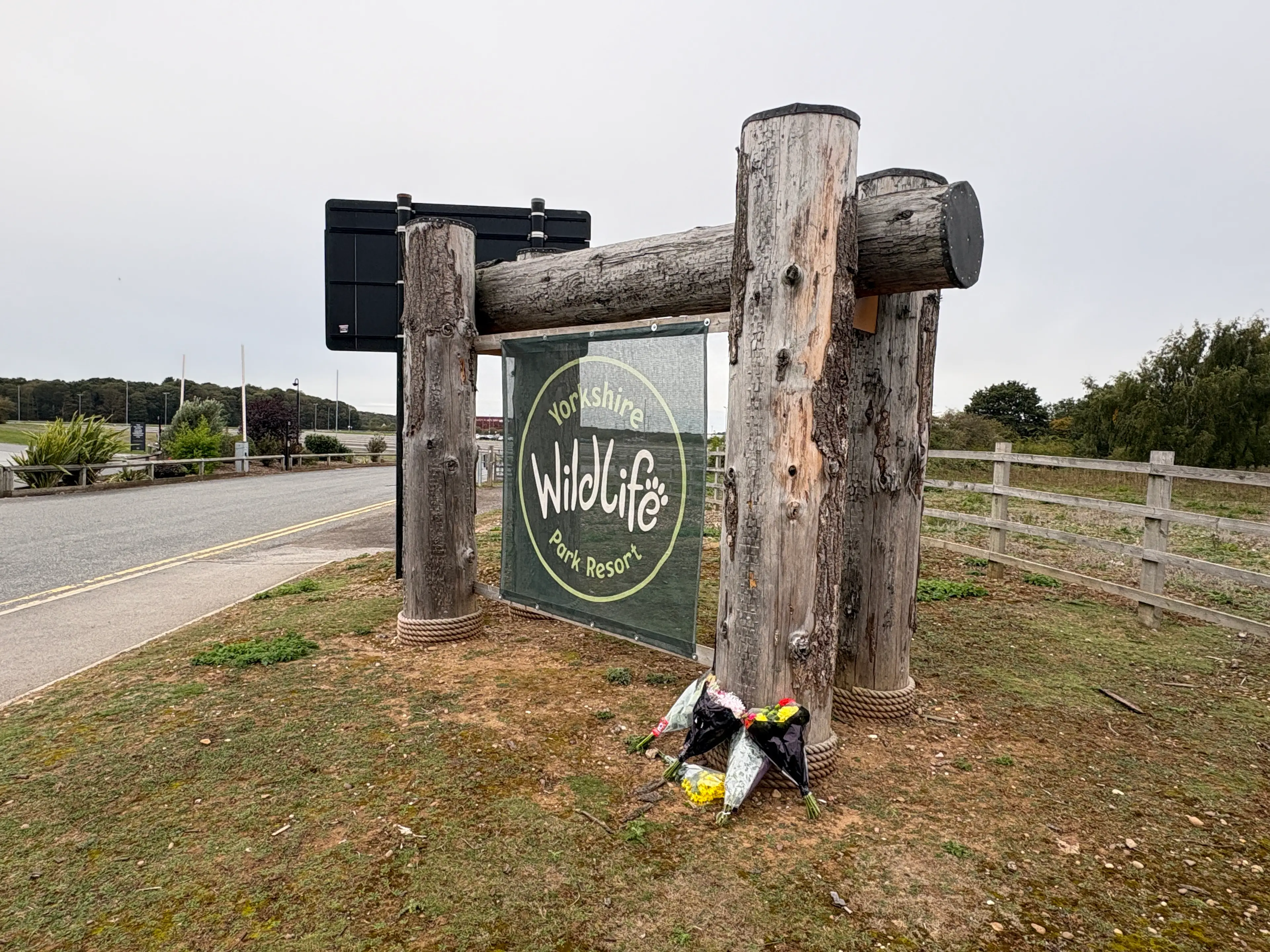
Floral tributes left at the park (Dave Higgens/PA Wire)
Anthony Hunt and his girlfriend Scarlet Hogan, who were visiting the park on Saturday, told The Telegraph that a woman with two children ‘desperately tried to pull back’ the man as he tried to get into the compound.
“He overpowered her and jumped off. She seemed really frightened,” Hunt told the publication. “We spoke to her after and she was like, ‘I tried to pull him back’ but I guess she didn’t want to risk her own life as well.”
Hogan added: “The man started praying to the tiger, bowing down to it – the tiger looked a bit confused.
“Up until he got attacked, it was like he was in a trance, not in reality at all. We were just stood there, frozen.”
The park has confirmed that the tiger will not be euthanised (Getty Stock)
Park remains closed after tiger attack
It was understood the wildlife park would reopen on Monday (12 October) after it was evacuated following the incident and remained closed on Sunday.
But in a message sent to ticketholders on Monday morning, the park said: “Due to the serious incident that occurred at Yorkshire Wildlife Park on Saturday, the 10th of October, unfortunately the park remains closed for the whole of Monday, the 12th October.
“Anyone with a booking for this date will be contacted within the next five working days with details of how to reschedule your booking.
“We apologise for the late notice any inconvenience caused.”
Police at the scene following the incident (SWNS)
In a previous statement on social media, the wildlife park said people had contacted them about Altai before it was confirmed he is ‘safe and well’ and will not be euthanised following the incident.
It added that members of park staff were ‘deeply affected’ by the incident and receiving specialist support.
South Yorkshire Police meanwhile said it is aware of the footage of the attack online and asked people not to share it.
A spokesperson previously said: “At 1.35pm today (Saturday 10 October) we received reports of a man entering a tiger enclosure at Yorkshire Wildlife Park. The tiger subsequently attacked the man, resulting in serious injury.
“Emergency services attended and sadly, despite the best efforts of medical personnel, the man was pronounced dead at the scene.
“The man’s family is aware and is being supported by specialist officers. Our thoughts are with them at this distressing time.
“Regarding rumours surrounding the condition of the tiger, the animal was uninjured and remained in the enclosure following the incident and there is no wider risk to the public.
“Following the incident, Yorkshire Wildlife Park was evacuated and officers remain on scene carrying out enquiries. We are aware of videos circulating online and we would encourage people not to share this footage.”
In October, a claim recirculated online that McDonald’s lost a lawsuit against TV chef Jamie Oliver, who — according to posts — proved that the fast food chain’s food is “unfit for human consumption” because it is “highly toxic.” The claim is unproven.
Snopes previously investigated a variation of this claim in 2018 and September 2026. On each occasion, we found that Oliver said in a 2011 TV program that beef trimmings used for a product he called “pink slime” were “not fit for human consumption.” We found no evidence that he specifically called McDonald’s food “unfit for human consumption” or “toxic,” as numerous posts have repeatedly suggested.
The American Meat Institute, a trade association that represents processors of meat and poultry, said in 2012 that beef trimmings used to make “pink slime,” which it calls Boneless Lean Beef Trimmings, are edible.
However, because we could not access a full version of the “Jamie Oliver’s Food Revolution” episode where Oliver discussed “pink slime” to see if he specifically mentioned McDonald’s, we leave this claim unrated.
Snopes will update this report if, or when, additional information surfaces. We contacted Oliver and McDonald’s to ask whether Oliver has ever called the fast food chain’s food “unfit for human consumption” or “toxic” or whether McDonald’s ever lost a lawsuit involving Oliver and are waiting for responses.
A persistent claim recirculated online at the start of October that fast food chain McDonald’s lost a lawsuit against Jamie Oliver after the TV chef proved the restaurant’s food is “unfit for human consumption” because it is “highly toxic.”
For example, one Facebook user has written, in part (archived):
McDonald’s loses lawsuit against chef Jamie Oliver, who proved that the food they sell is unfit for human consumption because it is highly toxic.
Chef Jamie Oliver won a lawsuit against the world’s largest fast-food chain.
Oliver demonstrates how hamburgers are made.
According to Oliver, fatty cuts of meat are “washed” with ammonium hydroxide and then used to fill the hamburger patties. Even before this process, the TV presenter says, this meat was unfit for human consumption.
Snopes readers contacted us about the claim throughout the start of fall 2026. We previously reported on the claim in September 2026 and January 2018.
The claim contains three parts: that McDonald’s sued Oliver, that Oliver made the comments about “pink slime” and that Oliver’s alleged comments were specifically about McDonald’s.
We found no evidence inonlinesearches (archived, archived, archived) that McDonald’s ever lost a lawsuit involving Oliver. AFP Fact Check reported in December 2021 that Oliver had never taken legal action against McDonald’s.
According to an excerpt of a 2011 episode of his program “Jamie Oliver’s Food Revolution,” Oliver said that the meat used to produce a specific type of beef product that the celebrity chef called “pink slime” is “not fit for human consumption.”
McDonalds reportedly ceased using “pink slime,” which is also known as Boneless Lean Beef Trimmings, in their food in 2011, as we noted in 2018 when we fact-checked a previous version of this claim. Oliver did not mention McDonald’s specifically in excerpts of the 2011 episode of “Jamie Oliver’s Food Revolution” that Snopes reviewed.
However, because we could not access a full version of the “Jamie Oliver’s Food Revolution” episode in question to see if it mentioned McDonald’s, we leave this claim unrated.
Snopes contacted Oliver and McDonald’s to ask whether the fast food chain ever lost a lawsuit involving the TV chef, whether Oliver had ever proved McDonald’s food was “unfit for human consumption” or “toxic,” and to ask whether the restaurant used Select Lean Beef Trimmings in 2026. We await replies to our queries.
Oliver’s allegations
In the first episode of the second season of his program “Jamie Oliver’s Food Revolution,” in which Oliver attempted to reform school lunches and fight obesity in the U.S., the celebrity chef held a demonstration where he showed children and adults where on a cow different cuts of meat come from.
According to a segment of the episode (archived) that an internet user uploaded to YouTube in 2016, after spray-painting prices on a live cow to show where various cuts are found, Oliver then addressed what happens to the remainder of the animal.
He said (time code 00:01), “The public loved seeing that, that, equalling a steak. They never for a minute thought I would clear all the meat and cuts away and introduce them to a new world of food. It’s called pink slime.”
Oliver added (time code 00:12), “When you’ve broken down a whole beast, you’re left with trimmings. You know, in my industry, we call those trimmings [BLEEP].”
Speaking to a crowd of people, Oliver described the trimmings used for “pink slime” as (time code 00:36) “not fit for human consumption.”
Oliver went on to say that processing plants took trimmings that were “not fit for human consumption,” separated the meat from the fat, killed harmful bacteria using ammonium hydroxide and sold the end product, which he called “pink slime,” as human-grade food. Ammonium hydroxide is a watery solution that can be used to regulate acidity in food or in hair dye or cosmetics.
In an excerpt from the program included in a 2012 CBS report, Oliver said (time code 00:32), “We’re taking a product that would be sold at the cheapest form for dogs, and after this process we can give it to humans.”
(Snopes could not locate a complete video of the “Jamie Oliver’s Food Revolution” episode in question. The clips we have found online appeared genuine and do not indicate any signs of possible manipulation.)
FDA says ammonium hydroxide ‘generally safe’
Around 11 months after Oliver’s episode discussing “pink slime” aired, the American Meat Institute President J. Patrick Boyle issued a statement to say that Boneless Lean Beef Trimmings is “a safe, wholesome and nutritious form of beef” that helps prevent food waste by utilizing trimmings that would otherwise go to waste.
The institute is a trade association that represents processors of meat and poultry.
Boyle’s statement says, similarly to Oliver’s demonstration, that processing Boneless Lean Beef Trimmings involves first separating the meat from the fat and using “food grade ammonium hydroxide gas” to destroy bacteria before blending the product into foods like ground beef.
However, he denied claims that the trimmings used to create Boneless Lean Beef Trimmings are not edible. The statement says:
Some recent media reports created a troubling and inaccurate picture, particularly in their use of the colloquial term ‘pink slime.’ The fact is, BLBT is beef. The beef trimmings that are used to make BLBT are absolutely edible. In fact, no process can somehow make an inedible meat edible; it’s impossible. In reality, the BLBT production process simply removes fat and makes the remaining beef more lean and suited to a variety of beef products that satisfy consumers’ desire for leaner foods.
The U.S. Food and Drug Administration, which regulates ammonium hydroxide use in food, says the ingredient is “generally recognized as safe.” This was also the case when we last reported on these claims in 2018.
In sum …
While Oliver did call the cuts of meat used for Boneless Lean Beef Trimmings “not fit for human consumption” and claimed (time code 00:59) the product was “admitted to being in at least 70% of ground beef products” in a 2011 program, the episode excerpts Snopes reviewed do not show him specifically accusing McDonald’s of using the product or calling the fast food chain’s products toxic.
McDonald’s said in a 2013 statement it had not used Boneless Lean Beef Trimmings in its products since 2011.
We found no evidence McDonald’s had lost a lawsuit involving Oliver since then. Given the prominence of McDonald’s and Oliver, such a lawsuit would have been widely reported by reputable news media sources. That has not been the case.
While the FDA generally recognizes ammonium hydroxide, which is used to process Boneless Lean Beef Trimmings, as safe, reporting by food safety publication Food Safety News claimed that fast food giants like McDonalds, Taco Bell and Burger King had all stopped using the product by January 2012.
Both ABC, which broadcast Oliver’s program, and the chef himself have faced lawsuits over their coverage of the product.
ABC settled out of court in 2017 in a $1.9 billion defamation lawsuit brought by Beef Products Inc., a producer of Boneless Lean Beef Trimmings, over Oliver’s program and other stories the network had reported about the product in March and April 2012.
A man who Beef Products Inc. laid off after negative press heavily affected the company’s sales sued Oliver, ABC and other defendants in 2012. He dropped the case in 2013.
George Washington University physicists Neil Johnson and Frank Yingjie Huo published a formula that estimates how many good tokens an AI model produces before its first bad one.
In the preprint, the formula correctly predicted whether a model would tip immediately or after a delay in 15 of 16 clear-cut cases.
The authors propose a parallel monitor that flags when models below a safety threshold.
Physicists at George Washington University have published a formula that estimates how many good answers an AI chatbot will give before it slips into a bad one, and early tests suggest it works.
The study, by Neil Johnson and Frank Yingjie Huo, appeared in the journal Patterns and builds on a preprint, a version posted publicly before formal peer review, first released in February.
Chatbots can answer sensibly for a long stretch and then veer into something harmful, such as bad advice on self-harm or extremist talk, and there has been no simple way to predict when the swerve will happen. The authors argue that existing safety tools often depend on a cloud connection that offline models lack.
Johnson and Huo trace the problem to the attention head, the part of an AI model that decides which earlier words in a conversation matter most when choosing the next one. As a chat grows, the accumulated context pulls that attention toward one cluster of possible answers or another, until it tips.
This is a common pattern exploited by many jailbreakers, and one of the reasons why mayn companies pay attention to system prompts (pieces of text the AI chatbot reads before any query). However, nobody can point out accurately how much effort is required to effectively weaken a model.
Their formula estimates the tipping point, called n, as the number of good tokens—the word fragments a model produces one at a time—that come out before the first bad one. If the conversation already leans toward the bad side, the model tips right away, with an n of zero. If it leans good, the model delivers a run of fine answers and then flips.
In the preprint, the formula picked the right case, immediate or delayed, in 15 of 16 clear-cut tests, or 94%. The researchers ran those tests on six open-weight models, meaning AI systems whose files are public so anyone can download and run them, from OpenAI, EleutherAI, and Meta.
All six sat between 124 million and 410 million parameters, the adjustable numbers inside a model that serve as a rough measure of its size. The published paper reportedly widens the test to seven models of up to 12 billion parameters, which is still small by current standards.
The target is on-device AI, the kind that runs entirely on a phone or laptop with no internet connection, including companion chatbots people talk to like a friend. Google’s experimental AI Edge Gallery app, which Decrypt tested last year, already lets an Android phone run models offline, and nothing typed into it is sent to Google’s servers, and this seems to be a trend that may grow with time as hardware becomes more powerful and smaller AI models become more capable.
A model running offline has no cloud service checking its output, which is the gap the authors want to close. They propose a low-cost monitor that runs in parallel with the model and flags when n* falls below a safety threshold, a bit like a warning light on a car dashboard.
BitcoinBTC · USD
$82,777−3.64%
Oct 5Oct 7Oct 9Oct 10Oct 12
$86.6k$84.6k$82.7k$80.7k
24h HighHigh$84,231
24h LowLow$82,957
VolVol$965.2M
Market projectionsOdds by Myriad
→
They also describe ways to push the tipping point out of reach, such as injecting content into the conversation so n* lands beyond the length of the response. Alignment training, the process of teaching a model to behave, can shift or suppress tipping for specific prompts but cannot remove the underlying mechanism, the authors say.
In April 2025, Decryptcovered an earlier paper from the same pair showing that “please” “and thank you” have a negligible effect on a model’s output, because the model treats polite words as orthogonal, or unrelated in the math, to the substance of a request. That version modeled a single, deliberately simplified attention head.
The preprint’s tests used small models and a 300-token window, or a few short paragraphs of text, and its predictions could be off by one output.
Daily Debrief Newsletter
Start every day with the top news stories right now, plus original features, a podcast, videos and more.
The family of a young woman who allegedly died after being given too many painkillers have filed a lawsuit against the hospital.
In April, university student Dale Alice Martin fractured her ankle while undertaking farm work and was informed that she would be kept in overnight for surgery.
“It didn’t seem like a very complicated medical issue,” the 21-year-old’s father, Lindsay Martin, recalled in an interview with NBC.
Fourteen hours later, Martin’s family received a phone call to say their daughter had been found unresponsive and was now brain dead. A medical report would later find that Martin had been given an accidental overadministration of narcotics, which caused her to stop breathing and go into cardiac arrest.
Martin’s family have now initiated legal action against Connecticut’s Waterbury Hospital, claiming their daughter died due to medical malpractice.
Dale Alice Martin’s family are now suing the hospital where she died (NBC News)
“Within 14 hours of admission, providers at the hospital had administered so much pain medication that Dale stopped breathing and later died,” Christopher Mattei of Koskoff, Koskoff & Bieder, who are representing the Martin family, said.
“No one checked on Dale during this time. The same medications that were interfering with Dale’s breathing were also sedating her,” the lawsuit continued. “Dale could not even call for help as she suffocated. At 7 a.m. on April 10, a Waterbury Hospital nurse finally checked on Dale. It was far too late. Her heart had stopped beating.”
An investigation into the hospital revealed that it was owned by Prospect Medical Holdings, a California-based private company which filed for bankruptcy three months before Dale passed away.
The hospital was later purchased by Hartford HealthCare and is now owned and operated by UConn Health. A spokesperson for the facility told the Hartford Courant: “he quality, safety and wellbeing of our patients is our top priority.”
When asked about the reports that funding at Waterbury Hospital was so tight that ‘nurses allegedly were buying food for patients’ and the facility was struggling to ‘function properly’, Martin’s father said the family had no idea this was the case until after her death.
Martin had been taken to Waterbury Hospital in Connecticut after breaking her ankle (Tyler Russell/Connecticut Public via Getty Images)
“Dale did not have a choice of where to go,” he said. “She was brought to the nearest hospital.”
“We will obviously learn more about the extent to which Prospect’s mismanagement of Waterbury Hospital contributed to the specific circumstances on the night that Dale died,” Mattei, the family’s attorney, said.
“But what we expect to find is that this was a hospital that was largely operating on fumes as a result of Prospect dismantling infrastructure within the hospital, reducing staff, training, and finding every way possible to extract value out of the hospital in a way that jeopardised care.”
LADbible has approached Waterbury Hospital and Prospect Medical Holdings for comment.
Bodhi Rae Breathnach, the young Irish-English actress who made her feature film debut in Chloe Zhao’s critically-acclaimed awards darling and box office hit “Hamnet,” has been signed by UTA for representation in the U.S.
The signing comes just as the 15-year-old’s latest film “Sense and Sensibility” prepares to opens in the U.S. The fresh take on Jane Austen’s novel, directed by Georgia Oakley and backed by Focus and Working Title, sees Breathnach star as Margaret Dashwood alongside the likes of Daisy Edgar-Jones, Esmé Creed-Miles, Caitríona Balfe, Frank Dillane, Herbert Nordrum, George MacKay and Fiona Shaw. The film, which released in the U.K. on Sep. 25 to positive reviews, is due to launch domestically on Oct. 16.
Breathnach — whose first screen appearance was the British conspiracy thriller series “The Capture” — also recently starred as the co-lead alongside Jason Statham in the action-thriller “Shelter,” released earlier this year by Black Bear. “She’s very talented, I think we’re going to see a lot of her,” Statham said of his young co-star at the time.
Next up, Rae Breathnach will appear in Robert Eggers’ “Werwulf,” alongside Lily-Rose Depp, Aaron Taylor Johnson, Ralph Ineson and Willem Dafoe, which Focus has slated for a December release. Meanwhile, she recently wrapped the leading role of Marjorie in Fifth Season’s film adaptation of Paul Tremblay’s novel “A Head Full of Ghosts,” directed by Veronika Franz and Severin Fiala, also starring Creed-Miles, Rebecca Hall and David Harbour.
At UTA, Rae Breathnach will be repped by Danie Streisand. In the U.K. she continues to be repped by The Artists Partnership.
This article contains images some readers may find distressing.
A woman experienced a serious case of psoriasis which left her with ‘mouldy skin’ so bad that she went bald after a traumatic birth which left her and her baby in intensive care.
Leonie Branaghan recalled how she had been discharged from hospital after contracting sepsis following the birth of her son Kobe, with the sepsis meaning that they spent time in intensive care after the birth.
The 30-year-old mum from Ipswich in Suffolk was discharged home, and said that she was so scared of losing her baby son that she didn’t put him down.
“The hospital said that the stress that I have gone through is what triggered [my psoriasis],” said Leonie.
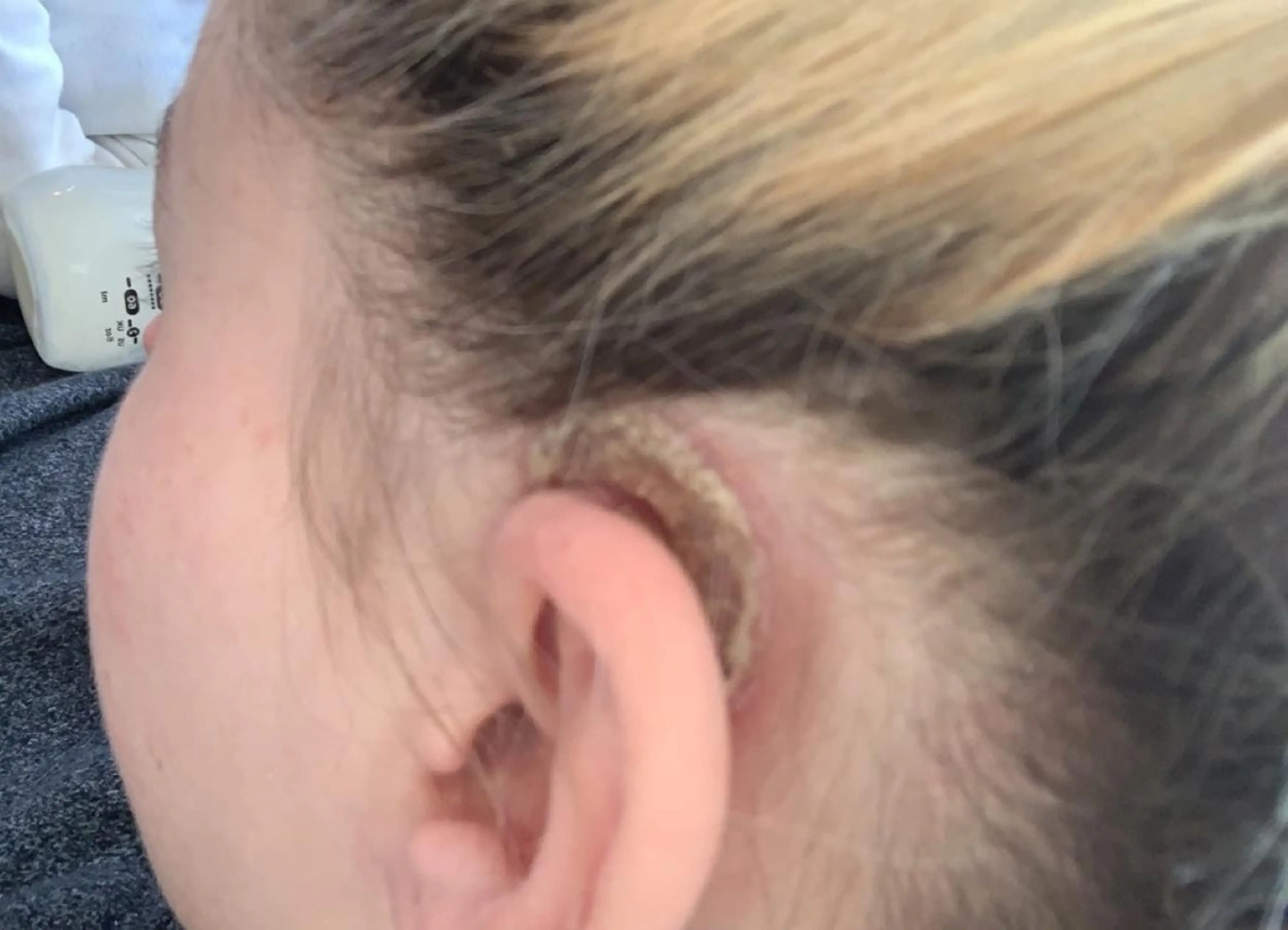
Around two months after being discharged home Leonie began to experience flashbacks to her experience in hospital, and noticed a small scab had appeared behind her ear.
Leonie noticed a patch of dry skin behind her ear, but initially dismissed it as dandruff (Kennedy News and Media)
At first she assumed that it was just dandruff, but in January 2024 she noticed that more bumps were appearing on her scalp, and made an appointment with her GP, where she was diagnosed with a fungal infection.
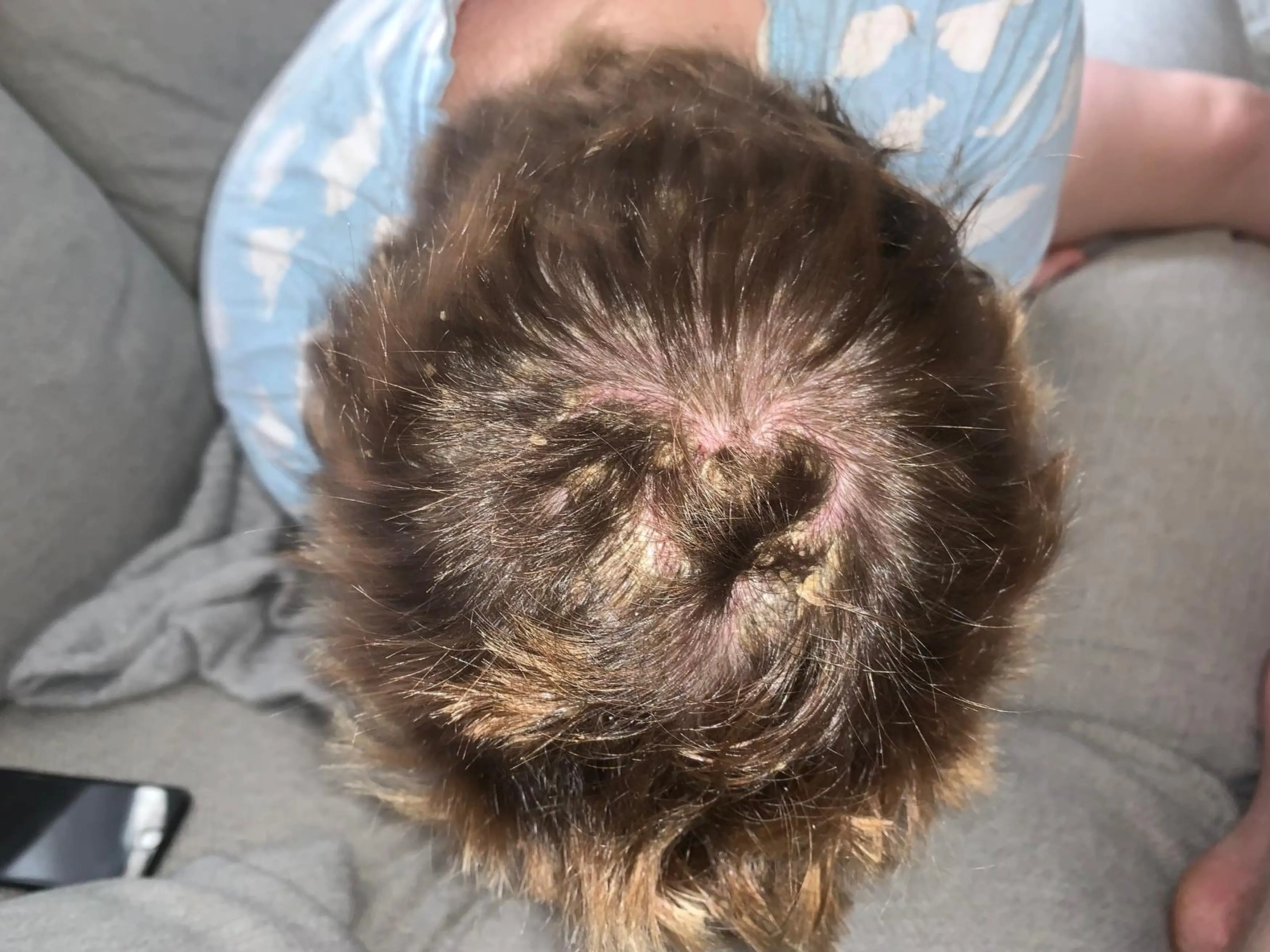
Over the following months, Leonie had patches of the itchy skin flare up all over her body, and on her head it became so bad that it caused her hair to fall out.
Leoni had patches of skin all over her body (Kennedy News and Media)
“I would make jokes I was a snake and my skin was shedding”
In September 2024 Leonie was diagnosed with psoriasis, this is a condition which causes patches of flaky and dry skin on the body, which does not currently have an outright cure.
One big cause of psoriasis is stress, and Leonie believes that this was directly linked to the extremely difficult birth, which she called ‘the scariest thing I have been through’.
“It’s very itchy so when you scratch it, it then burns and it would bleed and ooze. There was so much coming out of it,” she said.
“It was clear liquid and had the worst smell to it as well. I’ve never smelt anything remotely similar to what that smelt like.
Leoni had a challenging birth (Kennedy News and Media)
“It almost felt surreal [when my skin would come off]. I thought there was no point crying about this as I have it for the rest of my life. I would almost make jokes like I was a snake and my skin was shedding.”
Leonie has tried several different medicines including oral and injected, in an attempt to treat the health condition, but it does not have a cure.
The mum of two has sometimes worn wigs and close-fitting hats, known as ‘cancer caps’ for their popularity with people who are undergoing chemotherapy, when she leaves the house, but says that she has had cruel remarks from strangers.
“I had taken my little boy shopping and at this point my hair had completely gone and my head was at its worst,” she recalled.
“I didn’t want to go out with no hair so I balanced a wig on my head and put a beanie hat on to hold it in place.
“This lady came up to me and asked why I had a winter hat on when it’s warm outside. I just don’t know why she needed to comment on it.”
Leonie had the patches all over her head (Kennedy News and Media)
She added: “I lost all my hair at the age of 27 due to psoriasis. I had really nice hair, it was really long and blonde, it was such a big part of me.
The condition has even gotten so bad that Leonie has been unable to play with her son because her ‘hands would split’.
“I wouldn’t be able to take him to the park either because it makes it hard to walk,” she said.
Leonie now hopes to raise awareness of the condition and urge people to see a doctor if they are worries they have psoriasis.
“My head is starting to get quite bad again and my hair is starting to fall out again in little bits,” she said.
“If you think you have psoriasis you should not wait for as long as I did to get in touch with someone in the medical profession.”
According to the NHS, psoriasis is defined as a common skin condition that causes itchy and painful patches of dry, flaky skin.
It is most commonly found on the head and behind the ears, on the chest, tummy, back, bottom, elbows and forearms and lower legs. It can also be found in skin creases.
It cannot be cured, but there are treatments to help manage symptoms, including steroid creams.
British horror icon Hammer Films could be returning to the chilling world of one of its most successful movies.
John Gore Studios, which owns Hammer (bought by theater mogul John Gore in late 2023) has acquired all rights to the works of Dame Susan Hill, who famously wrote the 1983 Gothic horror “The Woman in Black.”
Considered one of the most defining British ghost stories of the modern era, “The Woman in Black” would be adapted into a hugely successful stage adaptation, which ran in London’s West End for 33 years. In 2012, Daniel Radcliffe — fresh out of Hogwarts — fronted a Hammer production of “The Woman in Black” feature, which earned $127.7 million, becoming the highest-grossing British horror in 20 years (and with the biggest U.S. opening for a Hammer film in the studio’s history).
Alongside “The Woman in Black,” Hill’s body of work across a publishing career spanning more than six decades, also encompasses literary fiction, crime writing, children’s books, memoir and radio drama. Among her many accolades, her novel “The Bird of Night” was shortlisted for the Booker Prize in 1972, while her wider honours include the Somerset Maugham Award, the Whitbread Novel Award and election as a Fellow of the Royal Society of Literature.
“For any author, it’s heartening to see their stories continue to find new life,” said Hill. “John Gore Studios brings together a genuine respect for heritage with an understanding of how classic stories can reach new audiences, and Hammer has a long and distinguished place in the history of British gothic storytelling, so I’m very pleased that these worlds can come together for the next chapter.”
Gore recently revealed to Variety that, having so far released 4K restorations of Hammer’s library, he was now looking at bringing some of its classic monsters, including Dracula and Frankenstein, back to screen with new adaptations. Hill’s library — including “The Woman in Black” — adds further opportunities. John Gore Studios said it was looking to exploit her portfolio across film and TV while also looking at opportunities in theater where existing rights arrangements allow.
“Susan Hill is one of Britain’s most distinctive literary voices, and it is a privilege to become a custodian of such an extraordinary body of work,” said Gore, founder and executive chairman of John Gore Studios. “Our ambition is to approach these stories with the same care, craftmanship and respect for character, suspense and atmosphere that Susan has brought to them throughout her career. As we explore new ways of bringing her work to audiences across film, television and beyond, Susan’s voice and vision will remain at the heart of everything we do. Above all, we hope that each new interpretation will encourage audiences to discover, or return to, the remarkable writing that inspired it.”
The acquisition was led by John Gore Studios’ Chief Operating Officer, Anouska Spiers. Development will be overseen by Chief Creative Officer Francis Hopkinson and the wider John Gore Studios creative team, while Spiers will oversee the portfolio/franchise management and overall exploitation strategy for John Gore Studios. Hill will remain actively involved in new creative projects and will be part of the ongoing management relationship around the portfolio and development strategy, as well as being an executive producer on new projects.
“Susan Hill’s extraordinary body of work represents exactly the kind of timeless storytelling that sits at the heart of John Gore Studios’ creative ambition,” said Spiers. “The success of ‘The Woman in Black’ proved the power of her storytelling on screen, but that is only the beginning. Susan Hill’s catalogue offers a rich world of gothic horror, psychological suspense and unforgettable characters and we look forward to expanding that legacy, creating interconnected opportunities for iconic stories, new adaptations and worlds that can captivate audiences for years to come.”
Susan Hill is represented by Peters Fraser and Dunlop (PFD). Caroline Michel, literary agent and CEO of PFD, was instrumental in bringing the transaction together, and will continue representing John Gore Studios as owner of the works.
Meanwhile, which calls itself the first life insurer licensed to operate entirely in Bitcoin, raised $37.5 million from existing investors led by Bain Capital Crypto, bringing its total raised to over $180 million.
The round follows a record year fueled by its BTC Life 1-Pay single-premium policy for high-net-worth clients abroad.
The company is backed by Sam Altman and licensed in Bermuda since 2024.
Meanwhile, a life insurance company that operates entirely in Bitcoin, has raised $37.5 million as demand for its unusual policies climbs among wealthy families overseas.
The Bermuda-based insurer said Thursday the funding came from existing investors, led by Bain Capital Crypto, with participation from Haun Ventures, Framework Ventures, Pantera Capital, Apollo, Northwestern Mutual Future Ventures, and Morgan Creek Digital.
Meanwhile, whose backers also include OpenAI CEO Sam Altman, has now raised more than $180 million in total.
The company bills itself as the first life insurer licensed to run entirely on Bitcoin, with its balance sheet, reserves, and audited financials all denominated in the cryptocurrency. It said it received the first license of its kind from the Bermuda Monetary Authority in July 2024 after two years in the regulator’s sandbox, and holds all policyholder Bitcoin with regulated institutional custodians.
The raise follows what Meanwhile called a record year, driven by international demand. In early 2026 it launched BTC Life 1-Pay, a single-premium whole life policy aimed at high-net-worth clients outside the U.S., its second product after a 10-payment version built for American taxpayers.
BitcoinBTC · USD
$82,778−3.64%
Oct 5Oct 7Oct 9Oct 10Oct 12
$86.6k$84.6k$82.7k$80.7k
24h HighHigh$84,231
24h LowLow$82,957
VolVol$964.8M
Market projectionsOdds by Myriad
→
Under the single-premium policy, a client pays once in Bitcoin and receives a guaranteed death benefit in Bitcoin for life, with the policy’s value growing in Bitcoin and the owner able to borrow up to 90% of it after the first year with no repayment schedule or margin calls.
Meanwhile said it has signed 15 brokers since launch, including in insurance hubs like Singapore, Hong Kong, the UAE and Switzerland, and that its net long-term underwriting income has already surpassed last year’s total.
“Wealthy families around the world already hold Bitcoin. What they haven’t had is a regulated way to pass it on,” said Zac Townsend, Meanwhile’s co-founder and CEO.
The funding reflects a broader push to weave Bitcoin into traditional financial products. Delaware Life teamed up with BlackRock last year to offer Bitcoin exposure through a fixed indexed annuity, a sign that insurers are increasingly looking to pair the volatile asset with long-term planning vehicles.
Daily Debrief Newsletter
Start every day with the top news stories right now, plus original features, a podcast, videos and more.
According to the statement, the service is provided through the bank’s Dubai International Financial Centre (DIFC) branch. DIFC allows eligible corporate clients to hold their digital assets in the bank’s custody infrastructure.
The bank also added that it is working with Ripple and LMAX Group to make $RLUSD acceptable as collateral under its Collateral Mirroring model. According to the bank, another aspect of this work involves extending Standard Chartered’s existing Collateral Mirroring model to LMAX Group.
This model aims to allow assets to be held in a custodian institution while the corresponding balances can be used as collateral on the trading platform. This enables institutions to access liquidity and reduce counterparty risk without transferring their assets to trading platforms.
What Does This Mean for the Institutional Cryptocurrency Market?
This development has the potential to expand $RLUSD’s use in institutional custody, collateral, and transaction processes. The previously announced partnership between Ripple and LMAX Group also aims to increase the stablecoin’s use in institutional markets.
Jack McDonald, Senior Vice President of Stablecoins at Ripple, stated: “$RLUSD was developed specifically for these types of institutional use cases. Our clients want the efficiency of a regulated stablecoin without sacrificing the custody standards they already trust. Combining $RLUSD on the $XRP Ledger with Standard Chartered’s custody capabilities and LMAX Group’s institutional transaction infrastructure creates a practical way for institutions to use stablecoins in global markets.”
Germany’s leading broadcaster RTL Deutschland unpacked its recent partnership with YouTube at Mipcom Cannes, revealing that its long-running action series “Cobra 11” has thrived on the platform.
On stage alongside Pedro Pina, YouTube’s VP for EMEA, RTL Deutschland chief executive Stephan Schmitter said the broadcaster uploaded more than 200 full episodes of the series to YouTube a year ago, and was able to draw 30 million views — a major feat for a show which has aired since 1996 and previously sold to more than 120 countries worldwide.
RTL is the latest broadcaster to partner up with YouTube, following Channel 4 and BBC in the U.K., and France Télévisions in France.
While linear broadcasters, like streamers, are still perceiving YouTube as a major disruptor and challenger, a number of them have started working more closely with the platform to tap into younger demographics and generate new advertising revenue. The appeal of YouTube has also grown due to the fact that it’s now being consumed on TV screens which makes it a straightforward competitor to traditional outlets.
Schmitter pointed out “Cobra 11” had little commercial value left for RTL after being extensively rerun on linear and streaming, but have found a new audience on YouTube, where 83% of viewers are men with an average age of 30. It also translated into a 123% increase in first video views for the series on RTL+ and a 26% rise in subscriptions linked to the show.
“Our theory was that young men today also love big stunts, flying cars, big explosions and the German Autobahn, where there are no speed limits. That is the key. They discover, or rediscover, the show. And if they want new episodes, more flying cars and explosions, they have to go to RTL+,” Schmitter said.
The YouTube partnership on “Cobra 11” has also been lucrative on the advertising side. RTL’s advertising sales arm Ad Alliance has been in charge of packaging inventory across the broadcaster’s linear channels, RTL+, Sky and YouTube.
“Now we can go to the advertisers, to our huge portfolio of advertisers, and offer them a 360-degree proposition. And this really works out, especially on the big screen, because it’s only one switch away,” said the exec.
“This combination makes sense to advertisers, and they’re very interested in what we are doing with YouTube and how the inventory is shared. In the end, we get additional money, and our revenues are significantly up this year,” he said, citing near “double-digit millions” in revenues.
Earlier this year, France Télévisions struck a deal to bring about 20,000 hours of content a year to YouTube, including national and local news bulletins plus its flagship current-affairs and investigative magazines. It’s already paid off. The broadcaster’s news channel franceinfo hit 110 million YouTube views in September, eight times more than a year earlier.
Pina argued that traditional broadcasters should stop looking at YouTube solely as a threat to their business.
“All in all, it is a self-reinforcing partnership that can only produce value. But again, the value that it produces, interestingly and importantly, is feeding into the IP that is already successful and breathing new life into stuff that was already successful before. And that is so energizing,” Pina said. “And it is the model of creators. So back to your point initially, Evan, of thinking like a creator.”
Like France Televisions, RTL has also made its news channel, NTV, available on the platform alongside shorter videos and content produced with digital creators.
As younger audiences increasingly turn to YouTube and TikTok for information, Schmitter said the move is particularly important at a time of political polarization in Germany, with the far right party AFD on the rise.
“I think for us it’s important, and also for our role in the democratic system, to reach everybody,” Schmitter said.
Pina echoed Schmitter’s argument, pointing to the growing presence of legacy news organizations like BBC and France Télévisions on YouTube.
“The more traditional players start leaning in on YouTube, the more a cross-section of voices can be heard, and that can only be good for democracy,” Pina said.