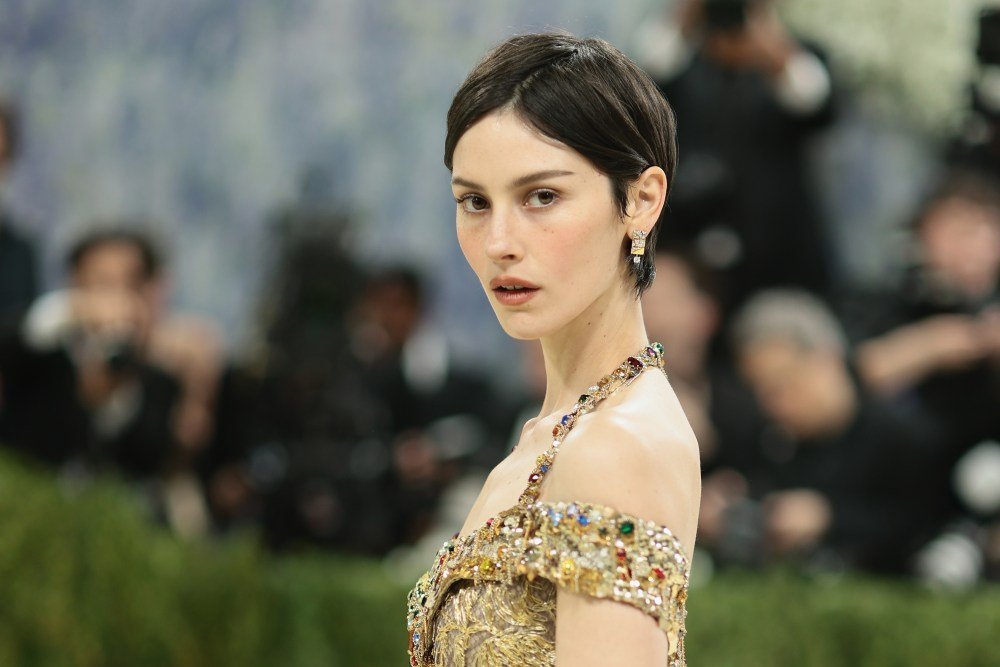
Gracie Abrams has earned her first No 1 on the Billboard 200 with her third album “Daughter From Hell,” bowing atop the chart with 124,000 equivalent album units.
The singer-songwriter announced the album back in May, along with the release of its first single “Hit the Wall.” Her last project, 2024’s “The Secret of Us,” became her first to hit No. 1 in the United Kingdom, Australia and the Netherlands. The album peaked at No. 2 on the Billboard 200, and led into a world tour that year and a subsequent arena run in 2025.
Abrams recently announced the 64-date “Look at My Life” international arena tour, which will set sail across North America in December and continue through March 2027 before moving onto Europe next April and May. The North American leg will include 37 shows and kicks off at Denver’s Ball Arena before wrapping up March 16-20 with a four-night stint at Brooklyn’s Barclays Center. She will then take a three-week break before resuming in the U.K. and Europe for 27 shows, including four nights at London’s O2.
Elsewhere on the albums chart, Olivia Rodrigo’s “You Seem Pretty Sad for a Girl So in Love” lands at No. 2, followed by Morgan Wallen’s “I’m the Problem,” Ella Langley’s “Dandelion” and Noah Kahan’s “The Great Divide.” Drake’s “Iceman” comes in at No. 6, while Future’s “The Real Me” dips from No. 1 to 7. Michael Jackson’s “Thriller” ticks up from No. 9 to 8, while Morgan Wallen’s “One Thing at a Time” holds at No. 10.
BTS, meanwhile, makes the most noise in the top 10 this week as “Arirang” rebounds from No. 26 to 9. The album, which debuted at No. 1 following its release in March, got a surge thanks to the release of a vinyl picture disc edition.
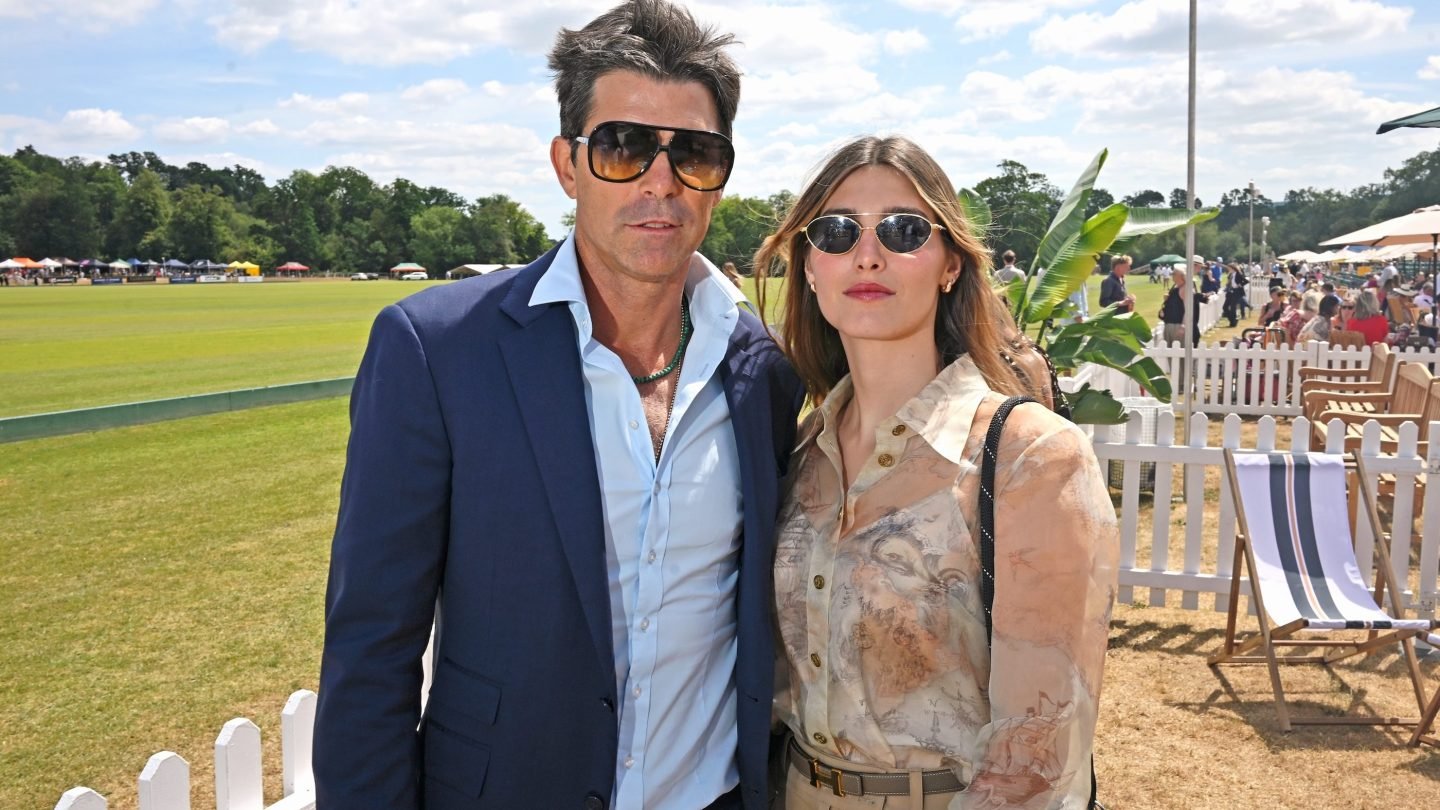
Polo legend Nacho Figueras says the centuries-old horseback sport could finally be poised for a mainstream breakthrough thanks to the recent success of the World Cup.
Speaking to The Hollywood Reporter at The St. Regis British Open Polo Championship for the Cowdray Gold Cup in the UK last weekend, Figueras says the resounding buzz and fan engagement around the World Cup has him believing that polo could find a similar audience.
“I think it’s been an incredible moment for sports in America,” he says, also citing the New York Knicks’ recent NBA championship win. “People are learning to love sports events, especially when it’s very well put together, and polo, I think, has all the ingredients to be the next big thing.”
While Figueras appeared in the 2024 Prince Harry-produced Netflix documentary, Polo, the Argentine sporting icon says he’s working on his own real-life project to “bring polo to the cities.” Describing it as “Formula 1 meets Sail GP meets Padal [and] mixed with the Longines equestrian series,” the polo star says he envisions events that will be “like the F1 version of polo,” complete with a film crew to capture how it all comes together.
“The idea is to do a Drive to Survive-type thing, because I think that giving people access to our kitchen and the kitchens of the athletes, really helps you feel connected to the person on the horse,” he says. Plus, he adds, “Polo has horses, good looking men and women, athleticism and beautiful spots [where the matches take place]. What else could you want?”
Assouline
ASSOULINE CLASSICS COLLECTION
Polo Heritage
Co-written by Figueras
Figueras was among the VIP guests taking in the Cowdray Gold Cup in West Sussex last weekend from the St. Regis tent. As the official “St. Regis Connoisseur,” the athlete and model got to enjoy a rare day off from the polo field, instead watching the proceedings alongside stars like Andrew Scott, Gwendoline Christie, British designer Giles Deacon and writer Jack Guinness, who all enjoyed storied St. Regis rituals like a champagne sabrage, and sips of the brand’s signature Bloody Mary (the tomato-based cocktail was said to have originated in the U.S. at the King Cole Room inside the St. Regis Hotel in New York in 1934).
Giles Deacon, Gwendoline Christie, Jack Guinness and Andrew Scott at the St. Regis British Open for The Cowdrey Gold Cup Polo Final at Cowdray Park Polo Club on July 19, 2026 in Midhurst, England.
Photo by Dave Benett
Guests at the polo event also got a preview of the St. Regis London, expected to open in the city’s Mayfair neighborhood this fall. Occupying the former Westbury Hotel location at the intersection of Bond Street and Conduit Street, the new property will feature 193 guest rooms inspired by its Savile Row and luxury fashion house and auction house surroundings. The property will also open with Le Perroquet, a French brasserie-style restaurant from acclaimed Chef Daniel Rose, best known for La Bourse et La Vie in Paris and the Michelin-starred Le Coucou in New York.
“St. Regis is an old brand with heritage, with family values, and with an actual history and connection to polo,” Figueras says, noting that the hotel chain’s founding family, the Astors, were a prominent fixture at polo matches on New York’s Governors Island. “This event and this partnership just makes sense.”
Agata Noweta Studio
The Gaston Polo Team, led by Chilean patron Jean Paul Luksic, was crowned Cowdray Gold Cup champions after a nail-biting 9-8 victory over the previously unbeaten Dubai Polo Team. While Figueras was mum on who he was cheering for — explaining that he has friends and fellow Argentine players on both teams — he says the weekend event in England was further proof that the sport is ready for a U.S. invasion. And in addition to his planned polo event series and documentary, Figueras says he has one other idea he’d like to pitch.
“I feel very bullish about doing a scripted thing,” the memorable Gossip Girl guest star says, noting that, “what Yellowstone did for Western was incredible. I would love to work with a guy like Taylor Sheridan, who is really one of the most incredible storytellers out there and who loves horses, and say, ‘Hey, I think that polo could be a perfect anchor for one of your amazing shows.”
“I also love Succession,” Figueras adds, “so I believe that this polo show could be the perfect marriage between Yellowstone and Succession.”
Has he been in touch with Sheridan?
“No, I don’t know him, so maybe this [article] will help,” the dashing polo star says with his magazine-cover smile. “Taylor when you read this, please get in touch.”
This week, the crypto market stayed under pressure.
On the macro front, renewed geopolitical tensions kept investors cautious, pushing Bitcoin [BTC] ETF flows back into negative territory. To make matters worse, DeFi exploits further weighed on market sentiment.
Even so, a handful of AI and mid-cap altcoins outperformed, showing that capital is still rotating into selective narratives rather than the broader market.
Weekly winners
Why Audiera [$BEAT] needs FOMO to sustain its momentum
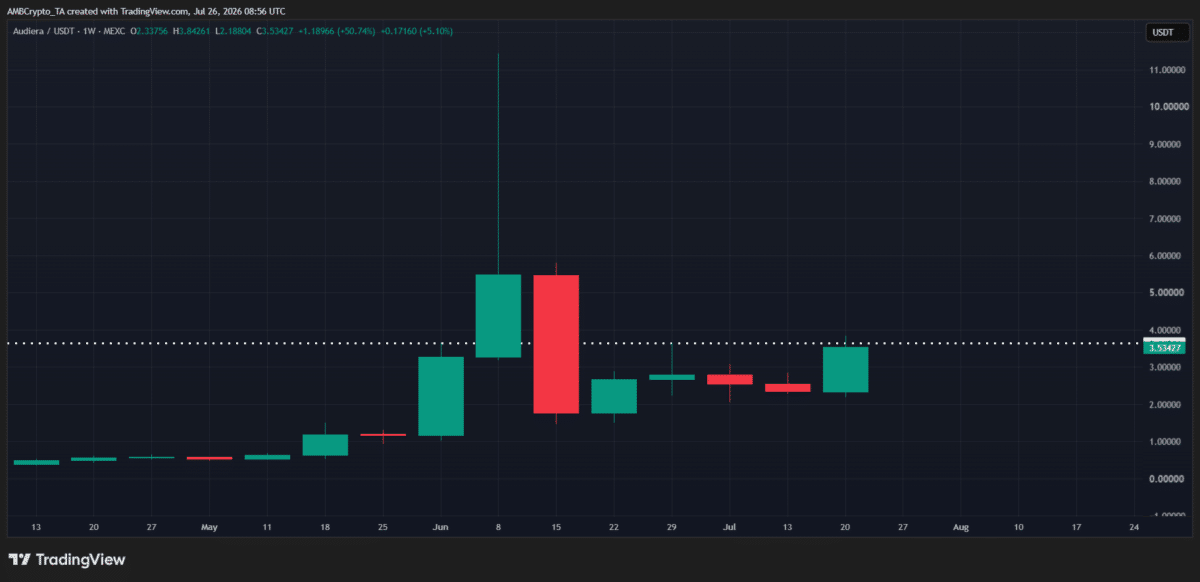
Audiera [$BEAT] led this week’s top gainers with a 50% rally. More importantly, the move came after two straight weeks of decline and a broader consolidation phase, suggesting this wasn’t just a random spike. Instead, bulls stepped in to buy the dip, shifting momentum back in their favor.
The technical setup also remains constructive. The RSI is rising but hasn’t reached the extreme overbought zone yet, meaning there’s still room for the rally to extend. With buyers back in control and momentum building, $BEAT has a good chance of carrying its gains into the coming week.
That said, the next hurdle is a big one. As the chart below shows, $BEAT has broken above the $3.60 resistance and is now approaching the $4.00 psychological level. This is where sell-side pressure could start picking up as short-term traders take profits.
Source: TradingView ($BEAT/$USDT)
If bulls can absorb that selling and turn $4.00 into support, the rally could extend further. But if they fail to hold the breakout, $BEAT could see a healthy pullback before attempting another move higher.
That makes FOMO the next key catalyst to watch.
Early signs are already showing up on the daily chart, with $BEAT gaining more than 5% intraday. If that momentum continues and buyers keep chasing the breakout, $BEAT could be on track to test the $4.50-$5.00 resistance zone over the coming sessions.
Shiba Inu [$SHIB] rallies as supply squeeze fuels momentum
Shiba Inu [$SHIB] emerged as the second-best performer of the week, gaining nearly 35%. It’s also $SHIB’s strongest weekly rally since November 2024, showing that buyers are starting to rotate back into the meme coin after months of muted price action.
What’s interesting is that $SHIB’s move looks different from the rest of the market. According to Shibburn, nearly 280 million $SHIB were burned this week, while whale accumulation also picked up. That suggests this isn’t just a momentum-driven rally. Instead, on-chain demand is backing the move, even as the broader market remains relatively quiet.
From a technical standpoint, $SHIB has broken out of its recent range and is now building momentum toward the next resistance zone around $0.000026-$0.000027. If buying pressure and whale accumulation continue at the current pace, that target looks well within reach, putting $SHIB back near its early May trading range and making it one of the key altcoins to watch heading into Q3.
Venice Token [$VVV] token faces a key test this week
Venice Token [$VVV] finished as the third-best performer of the week, gaining 9%. While that’s smaller than the other two top gainers, $VVV’s price action arguably looks the healthiest from a technical standpoint.
This week’s move extends two straight weeks of gains, taking $VVV’s total rally to nearly 30%. So, instead of a one-day spike, the token has been climbing steadily, showing consistent buying pressure. That’s usually a stronger setup because it suggests accumulation rather than short-term speculation.
The RSI is starting to heat up, but the gradual pace of the rally leaves room for the trend to continue. If buyers stay in control, $VVV looks well-positioned to push into the $15 resistance zone. Even if some profit-taking shows up along the way, it would likely be a healthy pullback to shake out weak hands rather than a sign that the uptrend is over.
Other notable winners
Outside the majors, altcoin movers also stole the spotlight this week.
Score [SN44] led the market with a staggering 3,988% gain, followed by Pons [PONS], which surged 179%, while Euler [EUL] climbed 135%, rounding out the week’s top performers.
Weekly losers
DeXe [$DEXE] faces a full-blown capitulation sell-off
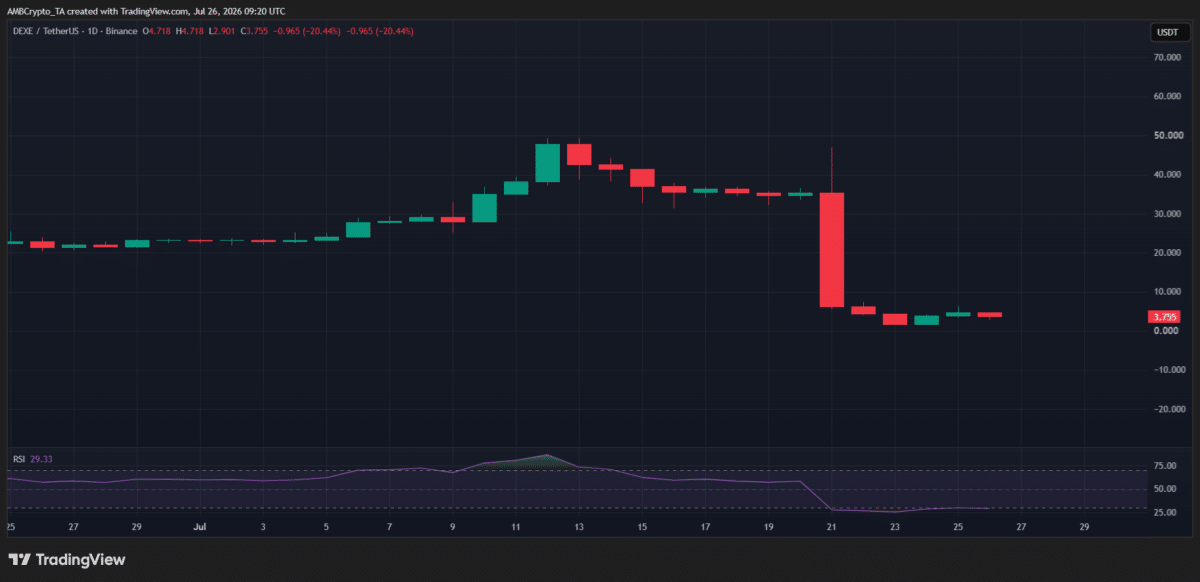
DeXe [$DEXE] topped this week’s losers list after crashing nearly 90%. It looked like full-blown capitulation, wiping out months of gains and sending $DEXE back toward its early Q1 price range around $1.50. As a result, many holders who bought during the rally are now sitting at a loss.
The sell-off also wasn’t isolated, though. The crypto market was shaken by three DeFi hacks in a single day, triggering fresh FUD. Since $DEXE is a DeFi token, it was hit harder than most as traders rushed to cut risk.
That said, the selling pressure looks like it’s finally cooling off. Since the initial crash, $DEXE has been consolidating around the $3.50 level, while the RSI has dropped into deeply oversold territory. That doesn’t guarantee a reversal, but it does suggest the capitulation phase may be ending.
Source: TradingView ($DEXE/$USDT)
If buyers start stepping back in and $DEXE holds its current range, a short-term relief bounce could be the next move to watch.
Midnight [$NIGHT] reinforces bear control as sellers continue to dominate
Midnight [$NIGHT] ended the week as the second-biggest loser, falling 26.7%. While the decline looks relatively mild compared to DeXe’s capitulation, the technical picture still favors the bears.
This week’s drop comes after the last two weeks’ 25%+ decline, extending $NIGHT’s lower-high, lower-low structure and dragging the token below the $0.002 area. Although the daily chart posted a modest 1.5% bounce, it hasn’t been enough to change the trend. The RSI also remains well above the oversold zone, suggesting selling pressure hasn’t been fully exhausted yet.
Unless buyers step in with stronger volume, $NIGHT could be setting up for another break below support, just like it has over the past few weeks. For now, the chart still points to bears staying in control, with a stronger bullish setup likely to emerge only after accumulation starts picking up.
Zcash [$ZEC] reaches a key inflection point
Zcash [$ZEC] finished as the third-biggest loser of the week, slipping 10.16%. Unlike the other two names on the list, though, $ZEC’s pullback doesn’t look like a breakdown. Instead, it looks more like a healthy cooldown after a strong run.
Technically, $ZEC rallied nearly 40% across late June and early July, reclaiming the $500 level. After a move like that, some profit-taking was always likely. So far, that’s exactly what the chart is showing—a typical pullback where weak hands take profits while longer-term buyers wait for better entries.
If this setup holds, $ZEC could be positioning for another leg higher once market sentiment improves. The main thing to watch isn’t $ZEC itself, but the broader market. If the current wave of FUD starts fading, $ZEC’s pullback could end up looking like nothing more than a reset before the next move.
Other notable loses
In the broader market, downside volatility hit hard.
BitMart [BMX] led the losers with a 64.9% decline, followed by Starpower [STAR], which fell 38.5%, while Up [UP] dropped 36.6% as bearish momentum intensified.
Conclusion
This week was a rollercoaster for crypto. Big pumps, sharp dips, and nonstop action. As always, stay sharp, do your own research, and trade smart.
Final Summary
Audiera [$BEAT], Shiba Inu [$SHIB], and Venice token [$VVV] led the week in gains.
DeXe [$DEXE], Midnight [$NIGHT], and Zcash [$ZEC] saw significant declines.
Marvel boss Kevin Feige recently told Empire how David Jonsson was cast as the next Black Panther. He explained that “The Long Walk” star met with “Black Panther” director Ryan Coogler in a “secret meeting,” and that the Oscar winner quickly identified Jonsson as his next leading man.
“We hadn’t started a search yet,” Feige explained. “Ryan was working on ‘Sinners,’ and when Ryan works on a project he’s all in. So the presumption very much was we would sit with him after ‘Sinners’ came out, after the Academy campaign. We were waiting ’til after the Academy Awards to sit with Ryan and begin that process.”
He added, “A month and a half or so before that process, he called me and said, ‘I found him’. I said, ‘What do you mean?’ He goes, ‘I found him. He’s this guy, David Jonsson.’ He mentioned his movies. I had seen some of them. I watched more. He goes, ‘I’m going to meet him.’ He had a secret meeting with him under cloak of darkness in a hotel somewhere, and called me afterwards and said, ‘He’s the guy, he’s the guy, I felt it. I felt it in my soul. He’s a good man, and he is the next Black Panther.’ And I got chills, and I got a little welled-up and said, ‘Let’s do it’. So we’ve been sitting on this secret for a good five or six months.”
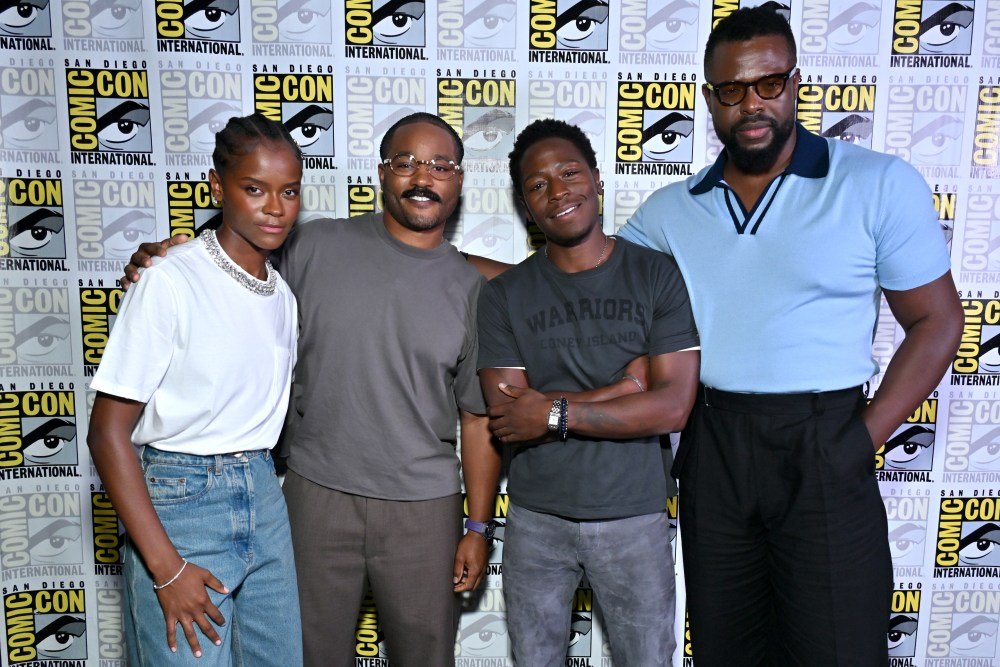
Jonsson will play T’Challa’s son in “Black Panther 3,” which hits theaters Dec. 15, 2028. The announcement was made during Marvel’s Hall H panel on Saturday at San Diego Comic-Con. Original cast members Leticia Wright and Winston Duke are returning for the new chapter, which follows Prince T’Challa II as he comes of age and takes up the Black Panther mantle.
Marvel launched the first “Black Panther” in 2018 to overwhelming acclaim. It grossed $1.3 billion at the worldwide box office and earned seven Oscar nominations, including best picture.
Decentralized cloud storage provider Storj Labs has filed for Chapter 11 bankruptcy protection. The company said it plans to keep its network running while restructuring legacy liabilities and exploring an ownership pathway for STORJ tokenholders.
On Sunday, Storj said it filed the voluntary case in the US Bankruptcy Court for the Northern District of West Virginia. The company said ordinary operations and customer services would continue during the process, subject to court oversight, while its parent company, Inveniam, would continue to support the business.
The restructuring could become an unusual test of whether utility-token holders can participate in the ownership of a company emerging from bankruptcy.
In an open letter to its community, Storj said its liabilities largely predate its current strategy and are too substantial to resolve through business growth alone. It said the network continues to operate normally and its token’s utility is unchanged.
STORJ showed no significant immediate price reaction following the announcement, trading around $0.072 at the time of writing, according to CoinGecko.
Storj explores equity pathway for tokenholders
Storj said management intends to propose a mechanism allowing tokenholders to participate in the reorganized company’s equity.
However, Storj has not disclosed how tokenholder eligibility would be determined, whether participation would involve a token snapshot or lockup, or how much equity might be allocated. The company acknowledged that any plan must follow bankruptcy priorities and receive court approval.
Cointelegraph reached out to Storj for comment but did not receive a response before publication.
Storj is among the crypto industry’s longest-running decentralized infrastructure projects. Storj began in 2014 as an open-source peer-to-peer cloud storage project that sought to let users rent storage from other network participants rather than rely on centralized providers.
Storj’s bankruptcy filing comes in the same month as at least two other crypto companies sought Chapter 11 protection.
Movement Labs filed under Subchapter V on July 15 after months of turmoil linked to its MOVE token, while Bitcoin mining pool Poolin filed on July 22 as it pursued a court-supervised sale of two Texas mining sites.
BitMEX also announced in July that it would shut down after 11 years. Still, the derivatives exchange did not file for bankruptcy, instead opting for an orderly wind-down following a strategic review.
SPOILER ALERT:This article contains spoilers for Season 3, Episode 3 of “House of the Dragon,” now streaming on HBO Max.
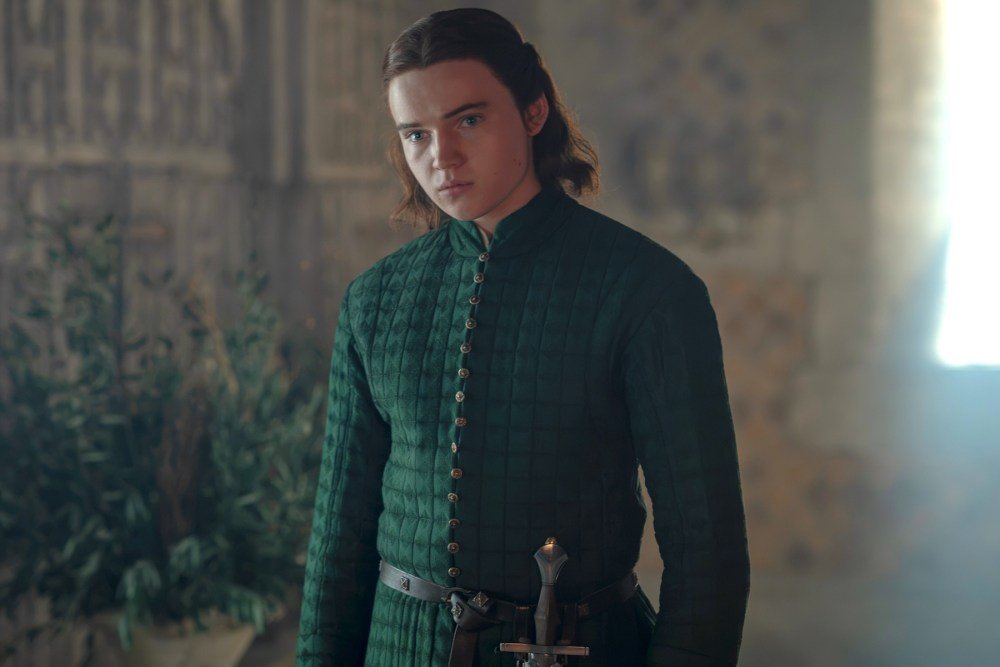
Daeron Targaryen (Benjamin Evan Ainsworth) is growing up: On this week’s episode of “House of the Dragon” Season 3, the youngest (and least blonde) child of Alicent Hightower (Olivia Cooke) and Viserys Targaryen (Paddy Considine) experienced his very first assassination attempt!
While sharing a meal with his cousin/keeper Ormund Hightower (James Norton) and his uncle Gwayne Hightower (Freddie Fox) in Tumbleton, a group of Baratheons tried to kill the young prince seemingly on the orders of his half-sister, Queen Rhaynera Targaryen (Emma D’Arcy). The attack was unsuccessful, as Gwayne jumped to his nephew’s rescue in time, which only resulted in a couple of deaths and Ormund projectile vomiting at the smell.
But the latest deadly move between the “Blacks” (who currently hold the Iron Throne through Rhaynera) and the “Greens” (who are splintered off into multiple factions) will have a profound effect on Daeron heading into the final two episodes of “House of the Dragon” Season 3.
Ormund Hightower (James Norton) in “House of the Dragon”
Courtesy of HBO
“I think shock is a big part of that scene in general,” Ainsworth tells Variety. “This is an escalation he wouldn’t have ever expected. There’s also this idea of the power dynamics between him and Ormund leveling out and clashing in a way. ‘Bold’ Jon Roxton there has very much been a man who’s followed Ormund’s orders, and it’s the first time I’m trying to stop him, and Ormund’s ordering him to do something. So there’s something about that which is stepping up this dynamic within this group amidst the chaos of everything.”
Daeron holds back Ser Jon Roxton (Joplin Sibtain) when he attempts to dive into the situation and stop Gwayne, before Ormund realizes Gwayne has sussed out the assassination plan before it’s begun. And that little bit of leadership from Daeron, combined with his disgust with Ormund’s handling of the situation, could fuel how Daeron continues to respond to Ormund’s attempts to make him the new king.
Gwayne Hightower (Freddie Fox) in “House of the Dragon”
Theo Whiteman/HBO
“He’s trying to take more ownership of the situation, but also that’s over the bedrock of just shock and tension and a frustration, too, with Ormund and the way that he’s almost debilitated by his senses,” Ainsworth says. “And he’s throwing up right next to me. And there’s an absurdity to that scene, which Daeron is feeling just in the shock of it in itself. Let alone the dead bodies everywhere.”
It’s Gwayne’s arrival in Tumbleton after he’s left Fabien Frankel’s Ser Criston Cole (RIP) that has Daeron really thinking through what role he needs to play in this ongoing war.
Criston Cole (Fabien Frankel) in “House of the Dragon”
Theo Whiteman
“It’s exactly that. The verb ‘thrust’ feels correct because it’s almost a violent thing,” Ainsworth says. “He’s suddenly within the chaos, and so I don’t think he’s had much time to think about it or to process it, which is why there’s so much tension inside of him and in this desperation he has with Gwayne. In the scene he has with Gwayne, he’s almost forced to think of the idea of becoming king, just what would that mean? Would that mean space between him and Ormund?”
After weeks of buildup, it’s clear after this week’s assassination attempt that “House of the Dragon” Season 3 is about to feature a confrontation between the Blacks and the Greens in Tumbleton. Would Daeron, who takes to fencing in the courtyard after his brush with death, be capable of joining the fight if it comes to that? After all, he is known as “Daeron the Daring” in George R.R. Martin’s “House of the Dragon” source material, “Fire & Blood.”
“I think he would be. Whether he’s ready, I think that’s something he’s questioning himself,” Ainsworth says. “It’s the reason he goes out to spar after that assassination scene. There’s an element of getting away from the stresses of things and focusing on something that he enjoys, something that he’s good at. But he’s also proving to himself that he can protect himself if something like that happens again. And he knows Ormund and Gwayne are watching him, too. So I don’t want to spoil anything either way.”
Read more from Variety’s interview with Ainsworth below.
How do you view Daeron’s relationship with his uncle Gwayne in comparison to what we’ve seen between him and Ormund? Gwayne is the first other member of the family we’ve seen Daeron interact with since we met the character.
There’s a growing tension and growing stakes within Tumbleton this season. And this episode feels like the power dynamics are really pushing and grating against each other within Ormund and Daeron’s relationship. And Gwayne is a figure in his life who is more of a brotherly uncle, someone he can speak with, can connect with, and doesn’t have to cover himself up or conceal anything in any way with. It’s very much a breath of fresh air and needed; confiding away from Ormund’s chaos and manipulation.
I think this version of Daeron was always the center, and then when it’s with Ormund, I felt it was just more so covering up and containing, and he was thinking more about every choice, everything he says. Whereas with Gwayne, it’s much more instinctual. There’s a safety he feels with Gwayne that just isn’t there because of how dangerous Ormund can be and this kind of twisted feeling of needing Ormund’s affection, as well. Being the perfect squire, being the perfect version of Daeron around him, and there’s a part of that which has made him a more balanced person. He’s been away from the sour politics of King’s Landing, his brothers, his half-sister. It’s all kind of crazy, and he’s managed to live away from that. But I think this season poses a completely different prospect because he’s thrust in the middle of the chaos.
Rhaynera Targaryen (Emma D’Arcy) in “House of the Dragon”
Have you seen the fan theories that Ormund not only dyed the fake Daeron’s hair blonde, but that he’s actually been dyeing the real Daeron’s hair a Hightower color for years because Ormund hates the Targaryens?
I have seen that. Do you know what, it’s funny because it wouldn’t be too far-fetched for Ormund to think of something like that. He seriously is the type of guy to do that. It’s been so cool to see all of the audience reception and theories and the excitement that people have for the character in the show is beyond me.
There’s an element to it where it wasn’t explicitly said when we were on set either way. So there’s a world in which that could be happening, but I don’t know. I think there’s something quite nice about him having his mother’s hair, there’s this connection he feels. He hasn’t seen his mother in years, but he’s made an ideal image of what his mother might be in the hope of some kind of other future for him. So the hair being the same, and the green colors, and the picking of his nails, things like that — I think it’s quite nice to draw that link between Alicent and Daeron.
We’ve only seen Daeron with his dragon Tessarion once because Ormund keeps the dragon locked away. Do you think his relationship with his dragon is different from his siblings who don’t have to keep their dragons locked up?
I think he has a really good relationship with Tessarion. She’s been his constant throughout his time in Old Town, a friend who’s always been there for him. Gwayne comes and goes. As we see in this season, he’s returning after a long time away. But Tessarion’s always there and there’s a love and a deep appreciation that goes both ways with them. And it’s something that I think keeps him hopeful about his Targaryen side, because we’ve seen the rhetoric that Ormund has against the Targaryens. He thinks that their blood is tainted and it’s an obscenity to have dragons. Yet [Daemon’s] relationship with Tessarion is what I think is keeping him balanced and not just a pawn for Ormund’s use.
Alicent Hightower (Olivia Cooke) in “House of the Dragon”
Ollie Upton
I know all the cast members decide their own ways they want to approach the character based strictly on the scripts or also George R.R. Martin’s books. Are you a “Fire & Blood” reader or not?
I’ve read from Aegon’s conquest to [the plot of] Season 3, because I wanted to know what has happened, because he’s grown up in Old Town under the Faith of the Seven. I feel like he would have a base understanding of those concepts and I wanted to be able to bring that into the character. And he would have learned about the history. But I also quite like giving room for this character to grow.
I’m aware of “Daeron the Daring” and where this character goes, and the reputations he has within the books. But I think it’s quite cool to try and explore those reputations within the show and within the scripts as well, these morally gray characters and the interpersonal relationships so brilliantly written and well acted by James Norton and Freddie Fox and to get to share that with them has been awesome.
This smell thing is a real problem for Ormund. Do you think Daeron has used that at all to his advantage throughout his childhood?
Oh, I think it’s definitely something he’s been aware of throughout his childhood, but I don’t think he’d then do anything about it or manipulate. I think, if anything, his involvement with Ormund’s senses would be to try and help. I imagined him putting together pomanders for him, because it’s those things to please him in order to almost save his own ass, as well.
There’s a scene in this episode that cuts off after Daeron asks Gwayne if he saw his mother, Alicent, when he was last in King’s Landing. Was there more to this scene? Did Gwayne have an answer for him?
I don’t know exactly what was said, but I remember talking with Freddie and there is a moment at the end of that scene, which I don’t think made the cut, but where he comes to me, he puts his arm around my shoulder and then we go off. That’s the screenplay version, at least anyway. I think there’s something about, even if he is going back to Old Town, there’s still a sensitivity there. And they have a deep respect for each other. I think their dynamic is one to look out for, and one that means a lot to Daeron.
Speaking on The Peter Schiff Show Podcast, the economist and longtime Bitcoin critic said the AI trade cracked open this week even as broader indexes held up. Alphabet fell 10% after the company announced higher capital spending than investors expected. Oracle dropped nearly 8% on the week and is now down 41% for the year. Meta fell 7.3%, Amazon lost 6.8%, and Microsoft slipped 2.7%, pushing its year to date decline to 19.3%, close to bear market territory.
Schiff said the market’s reaction marks a shift from prior quarters, when hyperscalers announcing bigger artificial intelligence (AI) budgets typically saw their share prices climb. “Investors are now finally starting to question whether or not these investments are in fact going to pay off,” he said.
SpaceX and Tesla Take the Brunt
SpaceX shares dropped another 7.7% during the week and now trade 49% below the stock’s post IPO high. The company’s public float is set to expand from 5% to 40% of shares by the end of the year, a change Schiff explained could add further pressure on the stock.
Tesla fell 18% over the same stretch and sits 35% below its 52 week high. Together, the declines in Tesla and SpaceX cost Elon Musk close to $100 billion in a single week, according to Schiff’s estimates.
A Dot-Com Comparison
The gold proponent and economist compared the roughly three-quarters of a trillion dollars in annual AI capital spending to the buildout that preceded the dot-com crash. He said many of the early internet favorites that investors poured money into eventually went bankrupt without ever recovering their spending. He does not doubt the long term potential of AI, but argued markets are overestimating near term returns on hyperscaler investment.
Japan’s Bond Market Under Strain
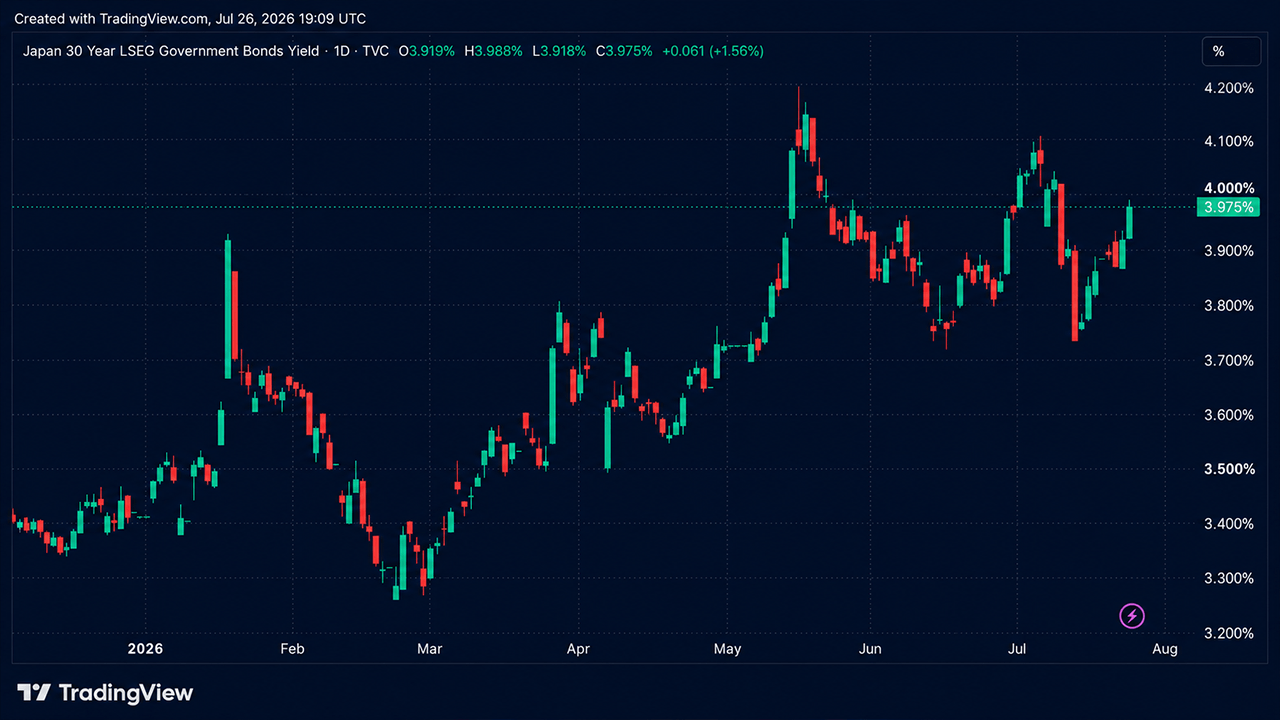
Schiff pointed to Japan as a bigger and more immediate risk than the AI selloff. The yen fell to its lowest level against the dollar in 40 years. Japan’s 30-year government bond yield closed near 4%, a record for that maturity, while the 10-year JGB yield climbed to levels last seen in 1996.
Japan’s 30-year government bond yield via Tradingview.
Japan’s public debt exceeds 200% of gross domestic product, and the country’s benchmark policy rate remains at just 1%. Schiff said the Bank of Japan faces a choice between raising rates aggressively, which could trigger a domestic recession and a wave of repatriated capital, or staying passive and risking a currency collapse. Either path, Schiff stressed, has consequences for the United States.
Japan holds more than $1.1 trillion in U.S. Treasuries, the largest foreign holding of any nation. Schiff said a Japanese debt crisis could force large-scale selling of that position. “It may be the pin that pricks our bubble,” he said of Japan’s situation relative to the U.S. economy. Schiff added:
“The Japanese bubble popping ends up pricking the even bigger U.S. bubble.”
U.S. Treasury Yields Hit Multi-Decade Highs
The 30 year U.S. Treasury yield closed the week at 5.16%, the highest level since 2006, while national debt has surpassed $39.6 trillion. Schiff noted the government is carrying more than four times the debt it held in 2006, making today’s borrowing costs harder to absorb than the last time yields were this high.
Oil, Gold, and Inflation Pressure
Oil prices climbed above $100 a barrel and are up roughly 30% in July alone, driven by tensions tied to Iran. Schiff said the increase all but guarantees a hotter Consumer Price Index reading when July data is released in August.
Gold rose about 1% on the week despite the jump in bond yields and oil prices, a combination Schiff called notable given gold’s recent inverse relationship with oil since the Iran conflict began. Mining stocks outperformed the metal, with the GDX index up 5.6% and the GDXJ up 5.8%, a move Schiff read as a possible signal that a bottom is forming in the sector.
Labor Market and Trump’s Tariffs
Schiff also challenged the Trump administration’s framing of a recent drop in weekly jobless claims to 187,000, arguing the growth of gig work and weak hiring trends make the metric far less meaningful than in past decades. Separately, he criticized new tariffs imposed on roughly 60 countries under a provision of the Trade Act of 1974 aimed at goods linked to forced labor, calling the policy an unconstitutional tax that ultimately falls on American consumers rather than foreign governments.
Retro arcade gaming has become much more accessible in recent years, whether it’s buying a modern reconstruction of one of the original machines, updated for the modern era, or simply downloading home console versions of classics off modern game stores. Collectors don’t need to hunt down expensive used machines on sites like eBay or Craigslist anymore.
But if you’re a fan of Lego and Nintendo, and you’re up for something quite a bit more time-consuming, you can now literally build your own classic Donkey Kong arcade cabinet out of Lego. The new set isn’t just a piece of quirky decoration for your living room. It will be fully playable, though not quite identical to the original game.
Donkey Kong, first published in 1981, was Nintendo’s first major hit outside of Japan and is considered one of the key titles of arcade gaming’s golden era. It also pioneered the platformer genre by introducing the jumping mechanic, which Nintendo would revisit time and time again.
Once built, owners will be able to navigate the game’s web of scaffolds, ladders, and hammers, dodge barrels, and interact with characters like Donkey Kong, Jumpman (Mario’s original name), and Lady.
Donkey Kong Arcade will cost $200 and will ship on August 1, 2026. But it’s not just the money—actually completing the set, which numbers 1,367 pieces and is 15.5 in. (39 cm) high, 10.5 in. (27 cm) wide, and 5.5 in. (15 cm) deep, will be quite a commitment. Though it’s still considerably smaller than the original arcade cabinet.
Recommended by Our Editors
This isn’t the first time Lego has given fans the chance to build classic Nintendo hardware. In July 2025, Lego revived Nintendo’s bestselling original Game Boy as another buildable model, retailing at $59.99 for the set.
About Our Expert
Experience
I’m a reporter covering weekend news. Before joining PCMag in 2024, I picked up bylines in BBC News, The Guardian, The Times of London, The Daily Beast, Vice, Slate, Fast Company, The Evening Standard, The i, TechRadar, and Decrypt Media.
I’ve been a PC gamer since you had to install games from multiple CD-ROMs by hand. As a reporter, I’m passionate about the intersection of tech and human lives. I’ve covered everything from crypto scandals to the art world, as well as conspiracy theories, UK politics, and Russia and foreign affairs.
Picking up a Mac after years on Windows tends to surface one problem fast: the Office files you already have need software that actually works on macOS, and Microsoft’s default answer is a Microsoft 365 subscription you didn’t ask for. Microsoft Office Home & Business 2021 for Mac solves the compatibility problem without the recurring bill.
You don’t need the newest release to open a spreadsheet a coworker sent you or format a resume the way you always have. This gets you the full offline Office lineup built specifically for Mac, so files from a Windows machine open the way they’re supposed to, without hunting for a workaround or a free app that half-renders formatting.
The license activates with a Microsoft account, and once that’s done, the desktop apps run independently. No active Microsoft 365 plan required to keep using them, no features that quietly stop working if a subscription lapses.
What’s Included
Word, Excel, PowerPoint, Outlook, and more, built for Mac
Full offline functionality for school, work, or travel
The familiar Office interface, with templates and editing tools intact
One-time activation with permanent ownership, no recurring fees
It’s a practical fix for anyone switching to Mac, running Mac and Windows machines side by side, or just tired of Microsoft steering every option toward a subscription.
Prices subject to change. PCMag editors select and review products independently. If you buy through StackSocial affiliate links, we may earn commissions, which help support our testing.
About Our Expert
StackCommerce Team (Sponsored)
Experience
Products featured in these stories are selected by our partners at StackCommerce. If you buy something through links on our site, PCMag may earn an affiliate commission.
A 15.2-inch-square by 9-inch-deep box made of 0.80mm steel sheet, the Q300L V3 delivers rigidity that’s amplified by its semi-compact dimensions. (Our sample’s black; you can also get it in white.) A surprising feature in this extreme-budget case is its modular front port panel, which you can move to various other positions (more about that in a moment). It’s reflective of Cooler Master’s FreeForm 2.0 campaign, which allows for case-component swappability and relocation.
On the port panel, one USB 3.2 Gen 2×2 Type-C and two USB 3.2 Gen 1 Type-A ports abide, plus a headset (headphone and mic) combo jack. All are arrayed around a lighted power button that wears a black sticker to take on a lighted-ring appearance when the finished system is powered on. The panel is surrounded by a PVC filter sheet, and repositioning the ports to the top of the front panel requires only that the sheet be rotated 180 degrees.
(Credit: Thomas Soderstrom)
Flipping the case the other way, you can see that the right side’s panel is held in place by big screws that also can serve as four alternative case feet. That’s right, the case is designed to function in either vertical or horizontal orientation.
The rear panel features a nicely sized single 140mm exhaust fan on a dual-pattern mount that also supports 120mm replacements (should you want to swap it out). Also back here is a folded-out cardholder tab and a boxed-in power supply mount. That removable box is designed to space the power supply past the bottom panel’s corner radius. (In an elegant design flourish, this panel is curved at both front and back.)
(Credit: Thomas Soderstrom)
As a builder, I’ve made a fairly big deal of the fact that folded-out designs for a case’s PCI Express card mounts are a cheap and inconvenient substitute for a boxed-in slot panel. But it wasn’t until I was reviewing a certain high-end case that I put numbers to that inconvenience. For trouble-free PCIe card insertion, some high-end boards and graphics cards need the gap above the card slots to be at least 0.75 inch high, and removing the slot covers from the Q300L V3 opens its gap to nearly an inch. So not only has Cooler Master addressed the greatest of my concerns regarding this cost-cut, it’s done it in a case that’s way cheaper than some much pricier offenders.
(Credit: Thomas Soderstrom)
I removed the power supply’s spacer, as well as the card slot access cover, in the photo above. Here’s what those pieces look like (below)…
(Credit: Thomas Soderstrom)
While the top, front, and bottom panel’s fan mounts all match, their filter sheets differ. The top sheet has only the vent holes; the front sheet adds a wide hole for the port section (as alluded to earlier); and the bottom has four, oh, let’s call them “flovals” (flattened ovals) plus two round holes to fit around the four snap-in feet and the bases of two pushed-in rubber plugs.
All three sheets stick weakly to the case via magnetic edge strips. The bottom panel’s rubber plugs provide additional support to prevent that filter, at least, from falling off.
(Credit: Thomas Soderstrom)
The top and front panels have wide mounting holes for the port module, which can be relocated to either the top of the front panel or the front of the top panel and finished simply by swapping the PVC dust covers. (A fourth location, at the back of the top panel, is too close to the rear fan to be useful.)
As for the fan mounting on the top panel? The fan-mount holes are spaced to support two 120mm fans positioned in the middle or offset 42mm to the left, or a pair of 140mm fans in the middle or 32mm to the left. The offset holes provide additional clearance between motherboard components and any top-mounted cooling devices.
(Credit: Thomas Soderstrom)
And you may need that space. You see, there’s only 22mm of clearance between the top of the case and the top of the motherboard, and even most fans alone (without a radiator) are 25mm to 26mm thick. Using the offset mounts with our test-standard 240mm-format cooler gave us 56mm of horizontal clearance between the right edge of our cooler and our motherboard’s top surface. No interference problems there.
Users who want a more symmetrical appearance might instead mount all their fans to the front panel, where motherboard spacing isn’t a factor.
(Credit: Thomas Soderstrom)
The Q300L V3’s motherboard tray has no extra holes for motherboards with reverse-facing cable connectors (a laMSI Project Zero or Asus BTF), but two extra holes below the motherboard area, hidden behind the power supply, do wonders for cable management. The tray extends all the way to the front panel, providing space to press-mount two 2.5-inch drives via included grommets and threaded pins.
Note that the edges of the panel opening have six notches (two top, two front, two bottom) and the same number of panel clip-mounting holes, even though only two of the clips are filled. The design welcomes builders who want to push the limit, attempting an inverted build with the glass-paneled opening on the right side. (Just know that doing so might reduce the performance of gravity-assisted heat-pipe component coolers on your GPU and motherboard chipset, so proceed with caution.)
(Credit: Thomas Soderstrom)
The space behind the motherboard tray is more than sufficient for stowing excess cable lengths in most builds, and Cooler Master even offers an alternative use for part of that space: drive mounting.
(Credit: Thomas Soderstrom)
The mount in question is a removable tray with holes spaced to fit either one 3.5-inch or two 2.5-inch drives. Unlike the mounting points on the motherboard tray, the drive tray’s holes accept ordinary screws (which are also included in the installation kit).