Blog

  • Charles Schwab, Citadel Securities weigh entering prediction markets

    Charles Schwab, Citadel Securities weigh entering prediction markets

    Traditional finance giants Charles Schwab and Citadel Securities are both considering entering prediction markets, with each separately weighing up how they wish to get involved in the fast-growing sector.

    “I think at some point we likely will have prediction markets,” Rick Wurster, the CEO of the banking and investing titan Schwab, told investors during a call on Thursday.

    He added that prediction markets weren’t “of tremendous interest” when he recently asked a group of Schwab clients about them, but it was an area the company would “take a hard look at, and it would be quite straightforward for us to offer.”

    Charles Schwab CEO Rick Wurster speaking to CNBC after the company launched Bitcoin and Ether trading on Thursday. Source: CNBC

    Prediction markets such as the popular Kalshi and Polymarket have exploded in use over the past few months, with both platforms seeing a record combined total monthly trading volume of $23.6 billion in March, according to Token Terminal.

    However, Kalshi, Polymarket and other prediction market platforms have also caught the ire of some US state regulators, who have accused them in court of offering unlicensed sports betting.

    Some federal lawmakers have also vowed to crack down on prediction markets, claiming the platforms weren’t doing enough to stamp out insider trading.

    Wurster said Schwab’s potential offering would steer away from allowing bets on areas such as sports, politics and pop culture as it looks to position itself as a partner for building long-term wealth.

    “Prediction markets that are not aligned to that are not something that we want to pursue,” he said. “If you look at the stats on the success of gamblers, they’re not strong, and people generally lose money.”

    Citadel “keeping an eye” on prediction markets

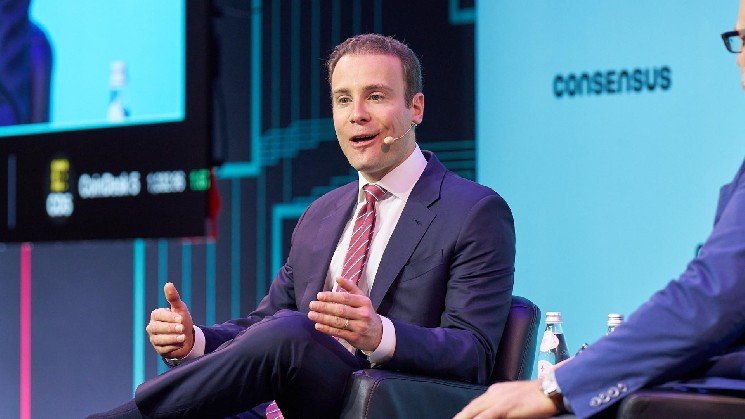
    Meanwhile, Citadel Securities president Jim Esposito said at a Semafor conference in Washington, DC, on Thursday that the company is “absolutely keeping an eye on developments” in prediction markets.

    Citadel Securities president Jim Esposito speaking at the Semafor World Economy conference on Thursday. Source: YouTube

    “We’re not there yet, there’s not that much liquidity,” he added, but said that the market is likely to “ramp and scale,” and it was “certainly possible” that the market-making firm would potentially look to get involved.

    Related: Democrats question CFTC chair on insider trading in prediction markets

    Esposito said Citadel was “not looking at sports at the moment at all, I don’t see us entering that market,” but did signal an interest in some event contracts.

    He added that Citadel could see its retail and institutional clients use some event contracts as a hedge for risks to their investments, such as contracts for elections, which have been known to move markets.

    “That’s going to be some of the biggest risks to investors’ portfolios that they’re going to have to grapple with,” Esposito said. “Having a clean and distinct way to hedge certain risks, I think there’s a good use case and industrial logic to it.”

    Magazine: Should users be allowed to bet on war and death in prediction markets?

  • 30-Year Analyst Explains: “According to the Elliott Wave Theory, the Bitcoin Downturn Is Over”

    30-Year Analyst Explains: “According to the Elliott Wave Theory, the Bitcoin Downturn Is Over”

    Jordi Visser, a veteran macro investor with over 30 years of experience, assessed recent market developments. According to Visser, while artificial intelligence and commodity scarcity are ushering the world into a new economic era, Bitcoin is re-emerging with its “scarcity” argument.

    Visser argues that investor psychology and central bank policies are changing in the digital age. Stating that the Fed has perfected its QE (quantitative easing) game plan, Visser said, “I don’t think we’ll see multi-year recessions or prolonged bear markets again in the rest of my life. The moment a crack appears in the system, it is intervened with money printing and interest rate cuts.”

    He also added that in the hyper-connected world, investors experience “amnesia,” quickly forgetting negative events and focusing on new narratives.

    According to the analyst, despite the deflationary pressure created by artificial intelligence (AI), a serious inflationary risk is looming in the short term. Visser argued that the AI world has reached its physical limits and is experiencing massive processor (CPU), memory (DRAM), and energy shortages.

    Related News Will Bitcoin’s Major Rally Continue? Here’s What the Experts Say

    Visser, particularly highlighting Elon Musk’s “Terra Fab” announcement, predicts that this bottleneck in the hardware and commodities sectors will keep inflation well above the Fed’s target of 2%, reaching 4% and higher.

    Visser, who analyzed Bitcoin’s recent performance from a technical and macroeconomic perspective, stated that according to Elliott Wave theory, Bitcoin has completed its correction phase and entered a new uptrend from the $60,000 level.

    He argued that Bitcoin is now priced not just as a growth asset, but as a representative of “digital scarcity” in a world experiencing processor and energy shortages. He stated that traditional software companies (SaaS) are threatened by AI, but computing-focused firms like Oracle and Bitcoin miners will profit from this process.

    Visser stated that Bitcoin’s place in portfolios will become undeniable by the end of the year, sending this message to asset managers and investment advisors: “By the end of the year, we will reach a point where you will have to explain why 3% to 5% of your portfolio isn’t Bitcoin.”

    *This is not investment advice.

  • One person holds the keys to $200 million of a project’s crypto. His co-founder says that has to end

    One person holds the keys to $200 million of a project’s crypto. His co-founder says that has to end

    For years, $NEO‘s treasury was held in a setup that would be unusual for most financial institutions: hundreds of millions of dollars in crypto assets were controlled through personal wallets, with no multisig protections and little formal oversight.

    That person, according to co-founder Da Hongfei, is Erik Zhang, $NEO‘s other co-founder and the architect of its core protocol.

    “Around 85% is controlled by Eric alone with single signature,” Da said in an interview. “It had never been transferred to any individual or any multi-sig.” The native $NEO and $GAS tokens Zhang holds are currently worth between $200 million and $250 million, Da estimated. That’s more than $NEO‘s current $197 million market capitalization.

    Zhang, for his part, has accused Da of separate problems. The two founders have been airing those disputes in public since December.

    The fight has since produced rival governance plans and an unsuccessful mediation effort in Hong Kong.

    Da published his restructuring proposal on GitHub on April 9. It calls for redomiciling the Neo Foundation from Singapore to the Cayman Islands, replacing the current two-founder governance with an independent five-member board, barring both founders from that board for 24 months, and redistributing roughly 26 million $NEO and 40 million $GAS to tokenholders.

    Zhang’s counter-proposal called staying on the board keeping the Foundation in Singapore, not move it to the Cayman Islands.

    Most pointedly, Zhang’s proposal calls for a formal investigation into historical asset management, including provisions to address potential corruption, improper asset transfers, and concealment of public assets.

    Da dismissed those provisions flatly. “I think it’s a very blunt and empty accusation,” he said. “There is no corruption, no misuse of funds.”

    For some observers, however, the numbers seem quite stark. $NEO‘s treasury holds ~$460 million in assets, roughly double the project’s $197 million market value, while the token has dropped 98% from its 2018 peak.

    Mutual disarmament

    $NEO‘s FY2025 financial report, its first comprehensive disclosure since 2020, revealed over 1,100 $BTC, more than $100 million in stablecoins and cash, and a portfolio of venture investments including an unliquidated stake in Binance.

    Da broke the treasury into two halves. The first, the native $NEO and $GAS tokens, sits largely under Zhang’s single-signature control. The second, bitcoin, ether, stablecoins, fund-of-fund investments, and bank balances, is managed by NGD, the entity Da runs.

    Those non-token assets, once relatively modest, have grown to over $200 million, driven largely by the appreciation of its $BTC and ETH holdings accumulated through early-stage investment returns.

    The result is a treasury split almost evenly between two people who are no longer speaking productively, each holding leverage over the other, neither willing to move first.

    Da framed his proposal as mutual disarmament.

    “NGD will lose its control over most of the assets, including the $BTC and stablecoins, which are over $200 million. And Eric will lose his personal control of the majority of the $NEO tokens,” he said.

    “Basically, me and Eric need to sacrifice our individual control over assets. I think that’s the fundamental change.”

    He said he’s willing, but doesn’t know if Zhang is.

    Da’s restructuring depends entirely on Zhang’s cooperation for its most critical step of transferring the single-signature token holdings to a multisig lock address. In an April 10 AMA, Da committed to a one-to-three month timeline.

    Asked what happens if Zhang refuses, Da was candid.

    “If there’s one person holding around half of a crypto native token and not willing to hand over to a multi-sig, constitutional governance, then what the community should do, I think the answer should come from the community itself.

    CoinDesk reached out to Erik Zhang for comment and had not heard back by time of publication

  • A Bullish Signal Seen in XRP for the First Time in Three Months

    Ali Martinez, a closely followed analyst in the cryptocurrency markets, shared an important assessment indicating that the technical outlook for $XRP is regaining strength.

    According to Martinez, a critical indicator for $XRP, which has been under selling pressure for a long time, has given a bullish signal for the first time.

    According to the analyst, the SuperTrend indicator on the daily chart has turned bullish for the first time since January 17th. This development suggests that a trend reversal may be beginning in the market after months of decline. Martinez stated that this signal could herald a potential recovery for $XRP.

    However, the analyst pointed to a critical level for confirming the uptrend. Martinez stated that the $1.55 level stands out as strong resistance for the $XRP price, arguing that breaking above this level would be decisive. Specifically, a clear breakout and daily close above this level could trigger a rapid upward movement, known in the market as a “relief rally.”

    Martinez noted that the SuperTrend indicator is now beginning to act as support, and in a potential bullish scenario, the first target is the $1.90 range. A move towards this level could indicate that the medium-term trend reversal in $XRP is gaining strength.

    *This is not investment advice.

  • Iran war: What is happening on day 51 of the US-Iran conflict?

    Iran war: What is happening on day 51 of the US-Iran conflict?

    Tehran will keep the strategic Strait of Hormuz closed until Washington ends the blockade of Iranian ports.

    The strategic Strait of Hormuz was closed again amid the standoff between Iran and the United States, as the influential Iranian parliamentary speaker indicated that a conclusive peace agreement was still “far” away, even though talks made some headway.

    With mediators pressing on after high-level discussions in Pakistan failed to produce an accord, Tehran declared it would keep the vital maritime trade corridor closed until Washington lifts its blockade on Iranian ports.

    Recommended Stories

    list of 3 itemsend of list

    Iran’s Islamic Revolutionary Guard Corps (IRGC) warned that any attempt to pass through the strait without permission “will be considered cooperation with the enemy, and the offending vessel will be targeted”.

    The current two-week ceasefire will expire on Wednesday unless it is extended.

    Here is what we know:

    In Iran

    • US ⁠President ⁠Donald Trump has no justification to ⁠deprive Iran of its nuclear ⁠rights, the Iranian Students’ News Agency quoted Iranian President Masoud Pezeshkian ‌as saying on Sunday, as Washington and Tehran continue to face disagreements over nuclear ⁠issues.
    • Iran’s “valiant navy” is “ready to inflict new bitter defeats on its enemies”, Supreme Leader Mojtaba Khamenei said on Saturday.
    • Deputy Foreign Minister Saeed Khatibzadeh dismissed Trump’s claims over the uranium and sounded a note of caution with regard to future talks between the two countries.
    • “There is now a certain sense of frustration and uncertainty when it comes to the road ahead. We know that Iranians are very much worried, not only about the shadow of the war, but also about the element of surprise, even during this ceasefire,” Al Jazeera’s Tohid Asadi reported from Tehran.
    • Minister of Education Alireza Kazemi has said the government does not have plans to resume “in-person education” at the moment.
    • The Tasnim News Agency, citing the deputy director of Iran’s Civil Aviation Organisation, said the country’s airspace would be reopened, with flights from east to west established gradually.

    War diplomacy

    • Mohammad Bagher Ghalibaf, speaker of the Iranian parliament, said in a televised address on Saturday night that there had been “progress” with Washington, “but there are many gaps and some fundamental points remain”.
    • “We are still far from the final discussion,” said Ghalibaf, one of Tehran’s negotiators in the talks aimed at ending the war launched by Israel and the US against Iran.
    • Prime Minister Shehbaz Sharif returned to Pakistan on Saturday from his visit to Saudi Arabia, Qatar and Turkiye in advance of an expected second round of US-Iran talks.
    •  Egypt’s Foreign Minister Badr Abdelatty said Cairo and Islamabad hoped to secure a final agreement “in the coming days”.

    In the US

    • Trump accused Iran of getting “a little cute” with its recent moves and warned Tehran not to try to “blackmail” Washington by flip-flopping on the strait.
    • “We have very good conversations going on,” the president told reporters at the White House, adding that Washington was “taking a tough stand”.
    • The US military said it forced 23 ships to turn around near the Strait of Hormuz since it imposed a naval blockade of Iranian ports. In a post on X, the Central Command said US forces were still enforcing the blockade “against ships entering or exiting Iranian ports and coastal areas”.

    In Israel

    • The Israeli military said another soldier had been killed in combat in southern Lebanon, the second death announced in less than 12 hours.
    • Israeli forces said they have established a so-called “yellow line” in southern Lebanon, similar to an Israeli military measure in the besieged Gaza Strip. Israel has also been accused of violating the terms of the ceasefire with Lebanon.
    • More than 1,000 homes in Tel Aviv have been left uninhabitable by the recent war with Iran, the city’s mayor said on Saturday.

    In Lebanon

    • United Nations Secretary-General Antonio Guterres condemned Saturday’s attack that killed a French soldier serving with the UN mission UNIFIL in Lebanon.
    • Naim Kassem, head of the Iran-backed Lebanese group Hezbollah, in a statement read on the group’s Al-Manar TV, said a paper published by the US Department of State, which he described as the text of a ceasefire agreement between Lebanon and Israel, “means nothing at the practical level, but it is an insult to our country”.
    • “Everyone knows that the government of Lebanon has not met or approved this statement,” he said.
  • Iran, US still ‘far’ from breakthrough amid Strait of Hormuz impasse

    Iran, US still ‘far’ from breakthrough amid Strait of Hormuz impasse

    Tehran is ‘fully prepared’ for US to resume hostilities at any moment, says Iran’s parliament speaker Ghalibaf.

    Iran and the United States have made progress in negotiations but are still a long way from a deal, according to Iran’s parliament speaker and chief negotiator – amplifying concerns about a possible return to war when their ceasefire is set to expire on Wednesday.

    In a nationally televised address on Saturday night, Mohammad Bagher Ghalibaf said that despite “progress” with the US, “many gaps and some fundamental points remain… we are still far from the final discussion”.

    Recommended Stories

    list of 3 itemsend of list

    On Sunday, Iran’s President, Masoud Pezeshkian, said that US ⁠President ⁠Donald Trump cannot justify depriving Tehran of what he called its ‘nuclear rights’.

    “Trump says Iran ⁠cannot make use of its nuclear ⁠rights, but doesn’t say ⁠for what crime. ⁠Who is he to deprive a nation ‌of its rights?” Pezeshkian was quoted as ‌saying by the Iranian Student News Agency.

    The future of Iran’s nuclear programme and the Strait of Hormuz are key sticking points in the negotiations.

    The latest comments from the political leadership came after Iran’s Islamic Revolutionary Guard Corps (IRGC) reimposed restrictions on the Strait of Hormuz, less than 24 hours after reopening it. The reversal, it said, was due to the continuing naval blockade of Iranian ports by the US.

    Ghalibaf, one of Iran’s top negotiators, called Washington’s blockade “ignorant” and “foolish”, saying Tehran would not allow others to transit the strait if its own ships were blocked.

    He also said Iranian forces are “fully prepared” for the US to resume hostilities at any moment.

    Al Jazeera’s Tohid Asadi, reporting from Tehran, said Iranian officials are using the strait, through which 20 percent of globally traded oil normally transits, “as a pressure point” in negotiations, calling it perhaps the “most important bargaining chip”.

    ‘Start dropping bombs again’

    Mediators have been pushing for a second round of US-Iran peace talks, after a first round in Islamabad ended on April 12 with no deal. The White House had said another round would likely be held in Islamabad. But Iran’s deputy foreign minister said on Saturday that no date could be set before the two sides agree on a “framework of understanding”, accusing Washington of maintaining a “maximalist” stance.

    Donald Trump gave a series of mixed remarks on Saturday, saying Iran “got a little cute” on the Strait of Hormuz and that the US would not be “blackmailed”. The president added that US and Iranian officials remained in contact and negotiations were “working out really well”.

    Earlier in the day, Trump said the US would “have to start dropping bombs again” if no deal was reached by Wednesday, when the ceasefire is due to end.

    Al Jazeera’s John Holman, reporting from Washington, DC, said Trump was likely trying to frame the latest setback in the Strait of Hormuz as “a bump in the road rather than anything definitive”.

    “What we don’t have so far is whether there’s going to be a second round in the negotiations, as was thought just a day or two ago,” said Holman.

    Abbas Aslani, a senior fellow at the Centre for Middle East Strategic Studies in Tehran, said Iran is facing a “dual track” of negotiations and pressure from the US.

    “The first track was negotiations, but Iran has been saying that if the US is genuinely seeking an agreement, why are they engaging in a naval blockade, why are they adding sanctions, and why are they intensifying their military presence in the region?” he asked.

    “There are no signs of extension of these agreements, and nobody’s talking about extending this ceasefire,” he told Al Jazeera.

  • Lionel Messi scores twice as Inter Miami defeat Rapids in MLS

    Lionel Messi scores twice as Inter Miami defeat Rapids in MLS

    Argentine forward’s brace included the match winner against Colorado Rapids in front of over 75,000 fans in Denver.

    Lionel Messi scored a brace and ‌German Berterame headed another as Inter Miami earned a ⁠3-2 win over ⁠the Colorado Rapids in Major League Soccer (MLS) on Saturday in Denver.

    Messi scored the go-ahead goal in the 79th minute. He started a run just inside midfield and went ⁠unchallenged until the box, where he blasted into the upper left corner for a 3-2 lead.

    Recommended Stories

    list of 4 itemsend of list

    Rafael Navarro and Darren Yapi each scored for Colorado (4-4-0, 12 points) in front of 75,824 at Empower Field, the second-largest crowd in MLS history.

    Miami (4-1-3, 15 points) took a 1-0 lead in the 18th minute after Colorado goalkeeper Zack Steffen’s pass was intercepted by Yannick Bright. Josh Atencio offered a hard challenge ‌and was shown a yellow card after video review.

    Messi took the resulting penalty and rolled his shot straight down the middle as Miami took a 1-0 lead.

    Colorado had a solid look at the goal when midfielder Wayne Frederick attempted a one-touch lob. Miami goalkeeper Dayne St. Clair was out of position and well beyond the penalty arc after heading away a loose ball, but Frederick’s attempt sailed ⁠over the open net.

    In the fifth minute of first-half stoppage ⁠time, Miami extended their lead to 2-0, connecting on a series of passes deep in their attacking third. Messi got the run of play started with a tight touch pass to Rodrigo De ⁠Paul.

    De Paul sent Mateo Silvetti on a run to the boundary line. His inward-spinning cross floated to the front of ⁠goal, where Berterame rose above the Colorado defence and ⁠tucked a header under the bar.

    Navarro’s goal cut Miami’s lead to 2-1. He started a run in midfield and used a step-over move to get an open shot a few steps into the ‌box that tucked inside the left post past a diving St. Clair in the 58th minute.

    In the 62nd minute, second-half substitute Yapi settled on a direct pass from Lucas ‌Herrington ‌and sizzled a shot past St. Clair for the equaliser.

    Miami closed the win playing a man down as Yannick Bright was sent off with a red card in the 87th minute.

    Lionel Messi in action.
    Inter Miami forward Lionel Messi scores his 13th-minute penalty against the Colorado Rapids [Geneva Heffernan/AP]
  • Billie Eilish and SZA Join Justin Bieber for Coachella Headlining Set

    Billie Eilish and SZA Join Justin Bieber for Coachella Headlining Set

    Grammy Award-winning singers Billie Eilish and SZA were among a group of surprise guests brought out during Justin Bieber’s headlining set at the 2026 Coachella Valley Music and Arts Festival into the early Sunday morning hours.

    Bieber, returning to headline for week two of the desert-set music festival, immediately hugged Eilish who collapsed — laughing in what seemed to be equal parts embarrassment and delight — after she was pushed onto the stage to be serenaded by Bieber during a performance of his 2009 hit, “One Less Lonely Girl.” The headliner then brought her over to a stool on the minimally set-designed stage to sing the song. Bieber seemed to be delighting in the moment as well, laughing along with Eilish throughout the song.

    The “Daisies” singer played the track as part of a section of his stripped back Coachella headlining set where he pulls up old music videos on YouTube to sing along to. The portion of the set produced a rare sight — a current day Bieber singing along with his shockingly young past self. The crowd went wild for nearly all songs during the throwback portion, but particularly when the crowd realized it was Eilish on the stage.

    The “Wildflower” singer was not the only guest to join Bieber on the stage. He was also joined by SZA, who came out near the end of his set to perform with him. The pair surprised the crowd with their acoustic duet of her hit song, “Snooze.” Bieber’s Coachella crowd erupted when SZA took the stage.

    Bieber told the “Kill Bill” singer he loved her “so much” before she admitted she was so nervous that she didn’t how to get off the stage. The “Peaches” singer guided SZA off the stage, shouting their love for one another as she exited.

    Big Sean, Sexyy Red and Dijon also joined Bieber onstage for performances throughout the set. The headliner had special guests during weekend one of the festival, but there were slightly more for the second week.

    Weekend two seemed to be the favored choice for surprise special guests. PinkPantheress brought out a gaggle of famous faces during her Saturday Mojave tent set, including Janelle Monae, Zara Larsson, Tyriq Withers, Chase Infiniti, Manon of KATSEYE and more.

    Addison Rae was joined by Olivia Rodrigo on the Coachella main stage earlier in the day. The pair performed Rae’s “Headphones On” and the first live performance of Rodrigo’s new single, “Drop Dead.”

    Pop star Sabrina Carpenter wowed the audience at her Friday night headlining set by bringing out Madonna. The pair even sang a rendition of Madonna’s “Like A Prayer.” The hit song came back into the zeitgeist late last year after a video of Heated Rivalry star Connor Storrie dancing to the track went viral.

    Karol G is set to close out the festival with a Sunday night headlining set.

  • Justin Bieber Serenades Billie Eilish, Duets With SZA During Coachella Weekend Two Headlining Set

    Justin Bieber Serenades Billie Eilish, Duets With SZA During Coachella Weekend Two Headlining Set

    Justin Bieber brought out the big guns during his Coachella weekend two headlining set, tapping Sexyy Red, Billie Eilish and SZA as he took a trip down memory lane through his discography.

    He began by running through the lot of the “Swag” songs that dominated his weekend one set, including “Go Baby” and “All I Can Take.” But it’s when he transitioned into the previous YouTube section — the moment where he scrolled the site to revisit old songs — that he kicked it into full gear, enlisting super fan Billie Eilish to come up on stage with the singer for his single “One Less Lonely Girl.”

    Eilish crawled up the stage and sat on a chair as Bieber sang the song to her midway through his Coachella set. Eilish has consistently credited Bieber as an inspiration, meeting at Coachella in 2019 and subsequently collaborating on the remix to her song “Bad Guy.”

    SZA was the closing guest artist, popping up to sing “Snooze” with Bieber. They previously connected to perform the song last year at Los Angeles’ SoFi Stadium as part of her co-headlining tour with Kendrick Lamar.

    Bieber closed out Coachella weekend two with a retrospective of his pair of “Swag” albums, which took up the majority of the set. He also brought out a few other guest artists during the show, including Sexyy Red on “Sweet Spot” and Big Sean for “As Long As You Love Me” and “No Pressure.”

    Last weekend, he introduced the standout YouTube segment by running through clips and singing along to them, reminiscing about his early days along with the Coachella audience. This Saturday night, he pulled up old clips of him singing along to early age covers of him performing Justin Timberlake’s “Cry Me a River.” It was mostly a nostalgic affair, traipsing through memes and early viral videos before settling back into a “Swag” portion that closed out the evening.

    Though Bieber capped off a pair of Coachella weekend headlining performances, rumors have been swirling that he may be prepping a tour, according to fans who have been tracking his website, which was recently updated with a message that any new concert dates will be emailed to subscribers.

  • Analyst Claims Selling Pressure on XRP’s Twin Altcoin May Have Eased

    Analyst Claims Selling Pressure on XRP’s Twin Altcoin May Have Eased

    Ali Martinez, an analyst closely followed in the cryptocurrency markets for his technical analysis, shared a new assessment highlighting critical levels for Stellar ($XLM).

    According to Martinez, the $XLM price has been moving within a distinct channel since February. During this period, each upward attempt has been rejected at the $0.179 level, followed by a pullback to the $0.147 support zone. The analyst argues that this pattern has formed a recurring price behavior for months.

    Related News BREAKING: Aave Issues Official Statement Regarding the $293 Million Hack

    Martinez noted that recent developments show $XLM is once again approaching the $0.179 resistance level, stating that this area has historically acted as a strong “sell” zone. However, he added that this level is about to be tested for the fourth time, and pointed out that in technical analysis, frequently tested resistance levels tend to weaken over time.

    According to Martinez, the critical scenario for investors will be a daily close above this level. The analyst stated that a clear break above $0.179 could indicate that the selling pressure accumulated in this region has been exhausted.

    Martinez stated that this situation could trigger a strong upward movement in the $XLM price, predicting that the first target after a possible breakout could be around $0.22, representing a rise of approximately 20 percent.

    *This is not investment advice.