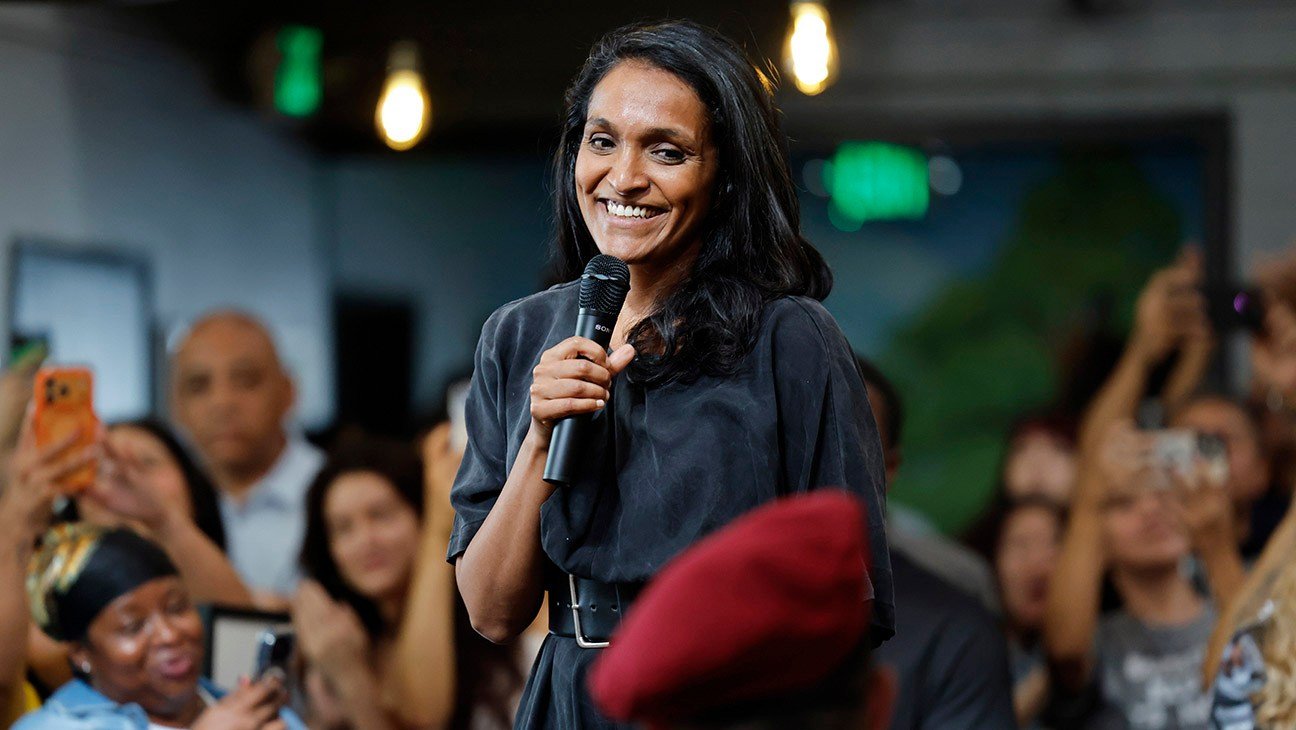
The sitting L.A. councilmember reiterated her support for California Attorney General Rob Bonta‘s antitrust suit to block the $111 billion deal in a statement to The Hollywood Reporter on Thursday.
“Los Angeles’ film industry is already in crisis. The Paramount–Warner Bros. Discovery merger would deepen it, costing an estimated 4,500 film and television jobs, more than 10,000 jobs regionwide, and billions of dollars in economic activity, according to a new County report,“ Raman said. “This is a bad deal for entertainment workers and a bad deal for Los Angeles. That’s why I support Attorney General Rob Bonta’s antitrust lawsuit and stand with the workers fighting this merger.“
The Councilmember added, “Paramount’s threat to leave California unless the lawsuit is dropped is an attempt to strong-arm our state. Serious questions about this merger’s legality should be decided in court, not through corporate threats.”
Raman‘s statement arrived on the same day that sitting Mayor Karen Bass held a press conference calling for a hasty resolution to the standoff between Bonta and Paramount Skydance. “It is time for all parties to come to the table. The continued uncertainty is not good for workers, not good for productions and not good for the future of this industry,“ Bass said.
The sitting mayor added that any solution must include enforceable commitments to keep Paramount and Warner Bros. based in L.A. and to retain jobs, film and TV shoots and investment in California.
In saying so, Bass followed the lead of movie theater trade group Cinema United and the unions the Directors Guild of America and IATSE, which also have recently asked the parties in the lawsuit to come together quickly and hash out their differences to avoid any further industry disruption.
Raman and Bass are set to go toe-to-toe in the general election in November. While Bass has gained the support of some Hollywood crew unions and industry figures like J.J. Abrams and Samuel L. Jackson, Raman — whose husband Vali Chandrasekaran was a writer-producer on 30 Rock and Modern Family — has her own deep bench of Hollywood supporters, especially amongst writers and comedians.
The mayoral candidates‘ statements on the Paramount-Warner Bros. Discovery deal arrived just one day after the L.A. Department of Economic Opportunity and CVL Economics released a report detailing how thousands of jobs are at risk as a result of the proposed merger.
Prime Video has unveiled a landmark $2 billion-plus investment plan in Latin American entertainment spanning 2027 to 2030 in a concerted bid to increase viewership and engagement.
The move comes in what is considered the second fastest growing region for streaming in the world, with Netflix the clear frontrunner.
At an inaugural showcase event in Mexico City led by top execs, the streaming giant announced a massive commitment that entails doubling its original local programming by 2030, expanding its live sports coverage, digital stores and local creative infrastructure across Mexico, Brazil, Argentina, Colombia and Chile.
It also plans to grow third-party streaming subscriptions, rentals and purchases to six new territories – Costa Rica, Dominican Republic, Guatemala, Paraguay, Peru and Argentina – which will not require a Prime membership to purchase or subscribe.
Furthermore, it is also investing in behind-the-camera crew training via programs like “Brasil no Set” and a new physical/post-production skills initiative with Mexico’s SAE Institute.
“What’s happening in Latin America right now is extraordinary — the talent, the stories, the audiences. Today we’re matching that energy with more than $2 billion through 2030 across original and licensed programming and sports. What excites me most is the breadth; this isn’t a bet on one country or one genre. It’s an investment in the entire region, across every way fans engage with Prime Video. This region deserves this level of ambition and we’re delivering it,” said Kelly Day, VP of International, Prime Video.
The company plans more than 25 new titles in 2027 alone, including scripted series, films, unscripted and reality formats while in live sports programming, it has expanded its NBA coverage, bolstered its Brazilian football rights and clinched a flagship four-year deal for 38 home matches of the Mexico National Team starting in September.
“Our job is to find stories that are undeniably local and make them undeniably universal,” said Javiera Balmaceda, head of international originals for Latin America, Canada, and Australia, Prime Video & Amazon MGM Studios. “This slate — from a forbidden love story on the polo fields of Punta del Este to an unsolved crime that still divides Brazil — is proof that when you trust Latin American storytellers with ambition and resources, the world pays attention.” Among its recent bets was its most ambitious show to date, the Chilean limited series “The House of the Spirits,” directed by Francisca Alegria, Fernanda Urrejola and Andres Wood.
In Mexico, an alliance with By Invitation Only and leading acting schools brought together aspiring talent for a professional development workshop, giving participants the opportunity to perform directly for casting directors and agents. Scholarships were also provided to students from low-income backgrounds.
“We’re not just producing programming in Latin America, we’re investing in talent and creative partnerships that will help shape the future of Latin American storytelling,” said Tomás Tejero, regional lead, Latin America & Canada, Prime Video. “What we announced today goes beyond what audiences see on screen. It reflects a broader vision for the region and our long-term investment in everything that happens behind it.”
Upcoming 2026 releases include Argentina Original movie “Barreda,” the third season of “Betty La Fea: Más Fea Que Nunca,” both premiering Aug. 28; docuseries “Los Tinelli S2,” premiering Sept. 30; “El Juicio,” a Mexican thriller inspired by true stories, starring Eugenio Derbez and Pedro Alonso, premiering Sept. 11; Brazil Original docuseries “Marília Mendonça: Sentimento Louco,” premiering Oct. 16; as well as “LOL: Last One Laughing” Argentina S3, hosted by Marcelo Tinelli and “Lo Único que te pido,” a Chilean movie, both premiering later this year.
CME Group Chairman Terry Duffy and Kalshi co-founder Luana Lopes Lara clashed during a CFTC roundtable in Washington, D.C.
Duffy singled out Kalshi while questioning whether prediction markets face the same regulatory scrutiny as established exchanges.
The clash comes amid a fight between federal and state regulators over prediction markets.
A CFTC roundtable on prediction markets turned heated Thursday when CME Group Chairman Terry Duffy and Kalshi co-founder Luana Lopes Lara traded insults over market manipulation and regulation.
The confrontation unfolded during a Commodity Futures Trading Commission meeting in Washington, D.C., as executives from traditional finance, crypto, and prediction markets debated how event contracts should be regulated.
Duffy, whose CME Group operates the world’s largest futures exchange by volume, said he was “a lot concerned” about prediction markets and argued that some contracts are susceptible to manipulation.
“We’re not a bunch of carnival barkers at a circus,” Duffy said. “We are running the most envious markets in the world in the United States of America.”
Duffy then took aim at the types of contracts Kalshi offers, mocking one in particular.
“There’s another really economic contract that has been massively important for the United States. That’s a Nathan’s hot dog eating contest,” Duffy said sarcastically.
He also questioned why Kalshi could offer a compute prediction market while CME’s proposed compute contracts remained under review.
After Kalshi was called out by name, Lara challenged Duffy on CME’s own history.
“I just wanted to respond since we were called by name here,” Lara said. “I would actually have to ask Terry: Has CME ever had any issues with any market manipulation, any issues ever in its history?”
“If you’d like to have a debate, I’m happy to have a debate with you,” Duffy replied.
“I’m just asking a simple answer to a question,” Lara said.
“I have more people in my regulatory department than you have in your whole company,” Duffy said, referring to the size of CME Group’s operation compared to Kalshi.
“Maybe you should learn a bit about efficiency then,” Lara fired back.
“Well, maybe you should learn about credible markets,” Duffy replied, before moderator Walt Lukken stepped in.
Lara then argued that the problems Duffy raised were not unique to prediction markets.
“Every market has risk and every nascent market will have risks as well, and there have been issues in every single traditional market and every single exchange here, onshore and offshore,” she said. “And I think the point of having regulation is that you find these issues, you address these issues, and there’s a way to address them in a correct way.”
DraftKings CEO Jason Robins later urged participants to stop attacking each other’s businesses.
“I would just ask everybody, both in this hearing and then also in future communications, to try to refrain from taking shots at each other’s business models or decisions you may not 100% agree with,” Robins said. “That doesn’t advance the discussion.”
Prediction Markets Face Regulatory Fight
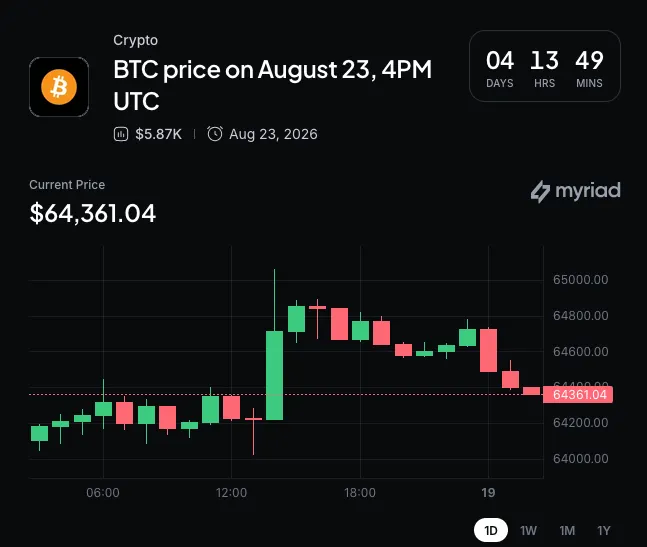
Prediction markets allow their users to wager on the outcome of virtually any event through futures contracts that settle for $1, with the price of the contract implying the odds of the event. For instance, on Myriad—a prediction market operated by Decrypt’s parent company Dastan, the event contract for “Bitcoin highs in August” is priced at 59 cents on the $75K outcome, implying users believe there’s a 59% chance Bitcoin reaches $75,000 before the end of the month.
Prediction market platforms that operate in the United States, like Polymarket and Kalshi, have become the focus of a fight between federal regulators and states over whether contracts tied to sports, elections, and other real-world events are federally regulated derivatives or gambling products subject to state law.
CFTC Chair Selig has defended the agency’s jurisdiction over federally regulated prediction markets, warning states challenging that authority in February.
“We will see you in court,” Selig said in a video posted to X. The agency has since taken legal action against states seeking to regulate event contracts under their gambling laws.
In June, the CFTC proposed restrictions on certain contracts involving war or assassination and some sports proposition bets considered particularly susceptible to manipulation.
Earlier this month, nine Democratic senators urged Selig to prohibit wildfire event contracts, warning they could create incentives for arson, insider trading, and disaster profiteering.
Kalshi has faced legal setbacks in several states. Last week, a Washington judge ordered the company to stop offering contracts on sports, elections, politics, and other events in the state, finding it likely violated state gambling and consumer protection laws. Two days earlier, the CFTC ordered Kalshi to keep trading amid a separate dispute over New York’s attempt to block its contracts.
Daily Debrief Newsletter
Start every day with the top news stories right now, plus original features, a podcast, videos and more.
Justin Sun said Thursday that a federal judge rejected an effort by World Liberty Financial to move all of his claims into private arbitration, marking the latest development in his legal dispute with the crypto project.
Sun said in a post on X that his individual claims will remain in open court following a hearing in California federal court. He said the judge also rejected World Liberty’s argument that all claims connected to his companies must be arbitrated.
The parties were instead ordered to meet and determine which company related claims should remain in court and which should proceed through arbitration, according to Sun.
The case, Sun et al v. World Liberty Financial LLC, was filed in April in the US District Court for the Northern District of California and is assigned to Judge James Donato.
Sun sued World Liberty after investing $45 million in the project, alleging fraud and accusing the company of using mechanisms in its smart contracts to freeze his $WLFI tokens. World Liberty has disputed Sun’s allegations and separately accused him of damaging the company through a public campaign against it.
In his Thursday post, Sun said World Liberty had sought to move the dispute behind closed doors and argued that token holders should be able to see how the project handles its investors.
Sun also repeated allegations from his complaint that World Liberty secretly embedded functionality allowing it to freeze, restrict or burn $WLFI tokens and later used those controls against his holdings.
World Liberty’s risk disclosures state that it can block or freeze wallet addresses and associated tokens when it determines they are linked to illegal activity or violations of its terms. The company has previously said Sun agreed to its freezing authority under an agreement governing his tokens.
Sun’s lawsuit seeks hundreds of millions of dollars in damages. He previously obtained an order preventing World Liberty from permanently burning, reallocating or otherwise disposing of the tokens involved in the dispute, according to his account of the litigation.
Sun also raised concerns Thursday about World Liberty’s USD1 stablecoin and the company’s financial position, though those claims remain allegations and have not been established by the court.
The broader dispute remains unresolved. World Liberty has denied wrongdoing and has separately sued Sun in Florida for defamation, accusing him of conducting a campaign to damage the company’s reputation and $WLFI token. Sun has denied those allegations.
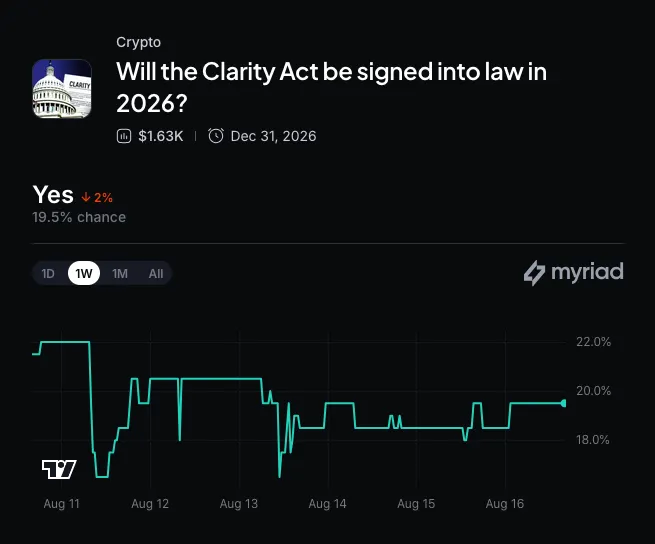
Michael Selig, who chairs the US Commodity Futures Trading Commission (CFTC), signaled that the agency would not be idle while Congress continued to debate provisions in a cryptocurrency market structure bill.
In prepared remarks for the inaugural meeting of the CFTC’s Innovation Advisory Committee on Thursday, Selig said that the commission would move forward on crypto regulations even in the absence of the Digital Asset Market Clarity (CLARITY) Act being passed by lawmakers, adding it would “help [Donald Trump] deliver if Congress will not.” According to the chair, he had already directed staff to allow registered and non-registered entities to offer “crypto asset trading on a leveraged or margined basis” and explore developer protections.
“We’re going to give CLARITY its breathing room for a vote, but if the Democrats cannot support a bipartisan work product, which reflects compromises from both sides of the aisle, and ultimately send a fair version of the bill to the President’s desk, then rest assured, I will direct CFTC staff to move swiftly to propose these new rules for the industry,” said Selig.
The market structure bill is effectively paused until the US Senate returns to session in September, when Majority Leader John Thune is expected to hold a cloture vote on the legislation. CLARITY would need 60 votes to pass the chamber and return to the House of Representatives, whereupon it could go to Trump’s desk for final approval or a veto.
Selig’s remarks came just a day after the CFTC chair stood alongside Trump and other crypto industry leaders at a White House meeting. The president urged Congress to pass a “fair version” of CLARITY to keep the country “ahead of China.”
Many Democrats in Congress have been calling for stronger ethics provision in the market structure bill specifically to address the Trump family’s crypto investments, which netted the president $1.4 billion in 2025. Although Trump said on Wednesday that a “lot of Democrats” approved of CLARITY, it’s unclear whether enough lawmakers will support the bill to meet the 60-vote threshold to pass the Senate.
The CFTC chair’s agenda echoed that of the US Securities and Exchange Commission (SEC), which on Tuesday released proposed rules for digital asset regulation. The securities regulator said the rules could provide crypto companies with a safe harbor policy from tokens being treated as “investment contracts” and certain exemptions for issuers.
CFTC still lacks a full panel of commissioners
Selig spoke alongside Innovation Advisory Committee Chair Walt Lukken and the body’s Designated Federal Officer Michael Passalacqua on Thursday. As the only Senate-confirmed commissioner at the CFTC in a leadership panel expected to consist of a bipartisan group of five members, Selig has been solely responsible for directing the agency’s agenda since December.
The CFTC committee also discussed issues related to artificial intelligence and prediction markets on Thursday. Under Selig, the agency has claimed that it has “exclusive jurisdiction” over prediction markets due to event contracts on the platforms being considered “swaps.” The chair has directed the commission to file lawsuits against state-level authorities challenging this position in cases involving companies like Kalshi and Polymarket.
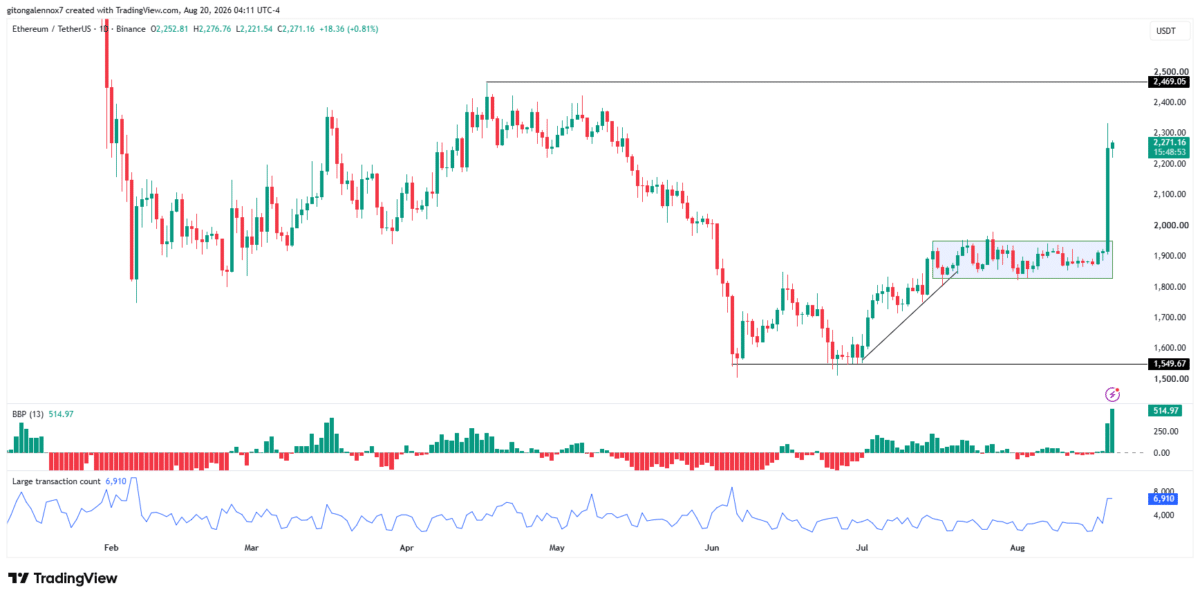
Ethereum [$ETH] led the broader altcoin market after surging by more than 18% in the past hours, at press time. Ethereum surges back above the $2,000 level as bullish momentum continues to push it to higher zones.
Leverage, new investors, supply dynamics, and a breakout from an accumulation pattern influenced this sudden uptick. Can bulls sustain this uptrend and stay above $2K?
$ETH exchange supply falls 15%
For leverage, a whale created a fresh wallet and loaded $20 million in USDC on the Hyperliquid exchange. The amount was deposited in three transactions of $10 million, $9.41 million, and $589K. Then, the whale opened a 4x leveraged long position of 20K $ETH, worth $45.38 million.
The position coincided with the sudden surge, suggesting the whale could be privy to the move. Technically, Ethereum was about to breakout from a sideways range. As a result, the whale is sitting at an unrealized profit of $6.66 million.
Ethereum Spot ETFs added to the buying pressure, as per data from SoSoValue. Participants bought $189.15 million prior to the 18% move, the largest single-day buying volume in 10 months.
$ETH Spot ETFs by BlackRock, Fidelity, and Grayscale led the pack with $122 million, $36.54 million, and $16 million, respectively. Even from a broader perspective, investors still bought Ethereum aggressively.
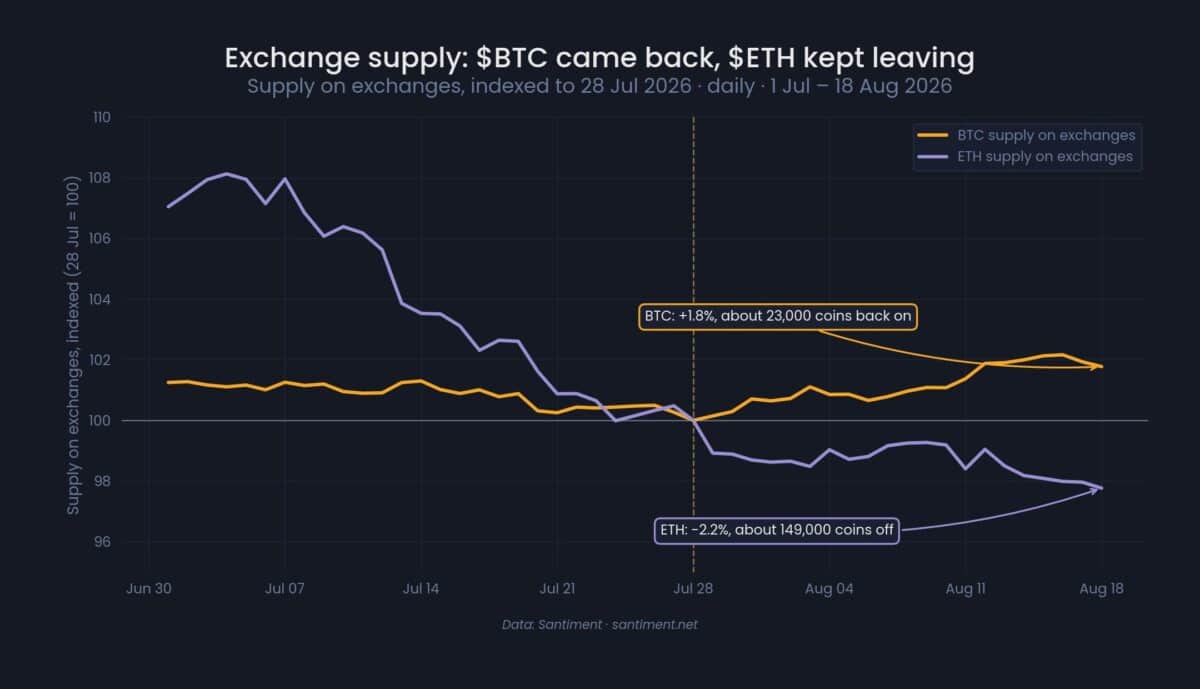
According to Santiment data, the exchange supply of $ETH declined by 15% in eleven weeks. The supply plunged from 7.70 million on the 2nd of June to 6.54 million on the 18th of August, with roughly 1.15 million $ETH coins withdrawn.
Source: Santiment
Can $ETH’s price reach $2,500?
The charts showed the altcoin first hinted at a bottom on the 6th of June, after rebounding at $1,549. The potential bullish reversal was reinforced by the double bottom whose neckline at $1,800 was broken through.
The retest of the breakout lasted for a month before the eventual breakout. Now, Ethereum appears to be headed toward $2,500. The Bull/Bear Power (BBP) has hit its highest level this year, at about 528 as of writing. Additionally, large transaction count has increased from 2,690 to 6,910, almost a 3x increase in a day.
Source: $ETH/USDT on TradingView
While this move is a signal of shifting market structure, bulls need to push $ETH past $2,500 for a confirmation. The zone acts as the most recent lower high of the existing bearish market structure.
If the zone were turned into support, Ethereum would turn bullish in the midterm. Otherwise, the supply zone of $2,500 could reverse the current aggressive buying pressure, though it looks unlikely.
Final Summary
Ethereum rallied over 18% as $ETH Spot ETFs saw their largest single-day inflows in 10 months.
$ETH price action is bullish in the short term but needs to flip $2,500 to shift the market structure to bullish in the mid-term.
Washington’s new measures against the ICC have been widely condemned but welcomed by Israel.
The United States has issued more sanctions against the International Criminal Court (ICC), sparking condemnation from the United Nations and the European Union.
But it is just the latest pressure from Washington since the ICC issued a warrant for Israeli Prime Minister Benjamin Netanyahu for alleged war crimes in Gaza.
So is the future of the court in danger?
Presenter: James Bays
Guests:
Geoffrey Nice – Human rights lawyer who worked on ICC cases
Greg Swenson – Chairman of Republicans Overseas UK
Kenneth Roth – Visiting professor at Princeton University and former executive director of Human Rights Watch
Let the music play with this deal. Amazon has the Bose SoundLink Plus Bluetooth speaker on sale for $199, down from its regular $269 list price. This gives you a 26% discount on a premium portable speaker featuring resonant acoustics with booming bass, IP67 dust and waterproof durability, up to 20 hours of battery life, USB-C power-out charging, and Bose SimpleSync connectivity. Connect with this deal before it’s too late.
Securing a premium, rugged outdoor speaker equipped with 20-hour stamina, custom app EQ tuning, and phone-charging capabilities for under $200 is an exceptional value. It makes this flash clearance the ideal window to upgrade your outdoor entertainment system or travel audio kit.
This $70 price cut lowers the financial barrier typically tied to premium audio, giving hikers, beachgoers, and backyard hosts an opportunity to capture signature Bose acoustic warmth and go-anywhere durability without standard retail price strain. I’d grab it before the discount gets any ideas!
The Bose SoundLink Plus speaker gets the party started with bold, resonant acoustic drivers with deep, booming bass. It comes with an IP67 dust proof, waterproof, shock-resistant, and rust-proof build with an integrated carry loop. PCMag expert Christian de Looper even rated it “Excellent” in his in-depth review, calling it a high-end portable speaker with a stylish and rugged design, good sound quality, and support for a wide range of Bluetooth codecs. Completed by up to 20 hours of battery life, USB-C device charging, custom app EQ tuning, and SimpleSync smart pairing, it effortlessly handles your on-the-go music needs.
The Bose SoundLink Plus masterfully pairing rich acoustic depth with an adventure-proof design. At under $200, it places 20 hours of battery life, USB-C device charging, and IP67 weather resistance straight into your backpack. Get one, and make sure the party never stops.
Recommended by Our Editors
However, if you’re looking to overhaul your entire audio setup, check out PCMag’s Amazon Back-to-School roundup, which features epic discounts on speakers, headphones, and earbuds, along with a lot more.
The Toronto Film Festival has unveiled its final Summit lineup for its inaugural TIFF: The Market event, launching in September.
Actor and director Seth Rogen, actor Colman Domingo, Slumdog Millionaire director Danny Boyle and Nigerian media mogul Mo Abudu join the roster of speakers headed to Toronto for the Sept. 10 to 16 run for TIFF: The Market.
Rogen and Boyle will appear as part of the Visionaries program, presented by The Hollywood Reporter, which earlier announced Gary Oldman as one of its speakers. And the Dialogues program is adding Hirokazu Kore-eda, Yeon Sang-ho, Kat Sandler, Rick Hansen, Amber Midthunder, Broderick Johnson, Brad Kane and Cody Lightning to its own lineup.
And the Perspectives section will include a session with Clint Bentley, Greg Kwedar and Colman Domingo talking about equity and parity in indie film, and another about global sales led by CAA’s Roeg Sutherland and FilmNation’s Glen Basner. There’s also a fireside chat with Club Kid director Jordan Firstman.
In all, the TIFF: The Market will include over 70 sessions and events. “Our aim was to reflect the big questions and opportunities facing the industry,” Charles Tremblay, head of TIFF: The Market, said in a statement. “Giving delegates the diverse perspectives they need to navigate the shifting global dynamics was also a key part of our strategy; we’re thrilled to see how well it’s all come together.”
After years of informal dealmaking in Toronto, TIFF will launch its first fully fledged content market at next month’s event and to run alongside the festival. The Market aims to become an official market in Toronto to go beyond film content to serve as a one-stop shop for buying and selling television, gaming and immersive formats.
The Toronto Film Festival is set to run Sept. 10 to 20.
Like to keep an eye on your physical health as much as you do the time? You can check both at once with a smartwatch, arguably one of the most popular wearable devices money can buy. Garmin is considered royalty in the wearable space, especially among athletes and runners, and has a whole assortment of smartwatches to choose from.
But allow me to put the spotlight on the Garmin Vivoactive 5 smartwatch right now. Why? Not only does it pack GPS tracking, 11-day battery life, and health tracking into its bright display—it’s also a massive 37% off right now on Amazon. That cuts $110 off the $299.99 list price, bringing this smartwatch below $200. It’s savings time, baby!
Garmin Vivoactive 5
4GB storage, 264-hour battery life, 164 feet water resistance
Sure, the Vivoactive 5 can tell the time, but that’s the least interesting thing about this smartwatch. It has a gorgeous, vibrant 1.2-inch AMOLED display that gives you a quick status snapshot of your daily activity, along with the hour and minute, which you can customize to your liking. It might not be the newest version of the Vivoactive, but this smartwatch still packs all the punchy features you need to paint a holistic picture of your health.
It can track any way you move, with more than 30 preloaded GPS and indoor sports apps, including running, walking, swimming, and even wheelchair-based activities. But if you need a little guidance, you can follow exercises built right into your watch instead—or even create your own in the app. However, my favorite bit will pique your interest if you’re a runner: the watch also features the Garmin Coach, which provides free adaptive 5K, 10K, and half-marathon training plans right from the experts themselves.
The Vivoactive 5 also offers advanced health features such as menstrual and pregnancy tracking, HRV status, sleep data, heart rate monitoring, Pulse Ox, stress metrics, and more. The watch will also consolidate all the data it collects to deliver a Body Battery rating that shows your energy levels, sleep quality, and how stress might be affecting your day. It comes wrapped up in a morning report that helps you prepare for the day ahead!
Recommended by Our Editors
All that with an 11-day battery life, 4GB of storage, and water resistance up to 164 feet? It’s enough to warrant an “Excellent” rating in our detailed review. PCMag expert Andrew Gebhart especially loved it for its rounded design and onboard music storage. And for $110 off, the time is ticking to snag your own!
And if you’re looking for something different, check out our experts’ list of the best smartwatches for 2026!