Blog

  • Chris Hansen Didn’t Watch ‘Primetime’ Screening Because “A24 Wanted Me to Sign Away My Rights”

    Chris Hansen Didn’t Watch ‘Primetime’ Screening Because “A24 Wanted Me to Sign Away My Rights”

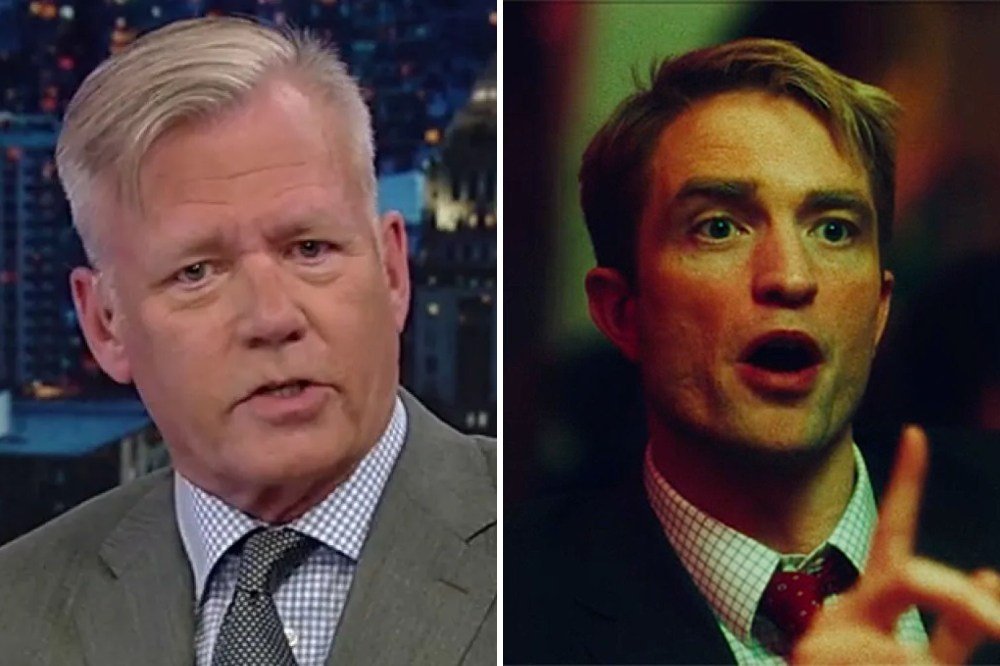
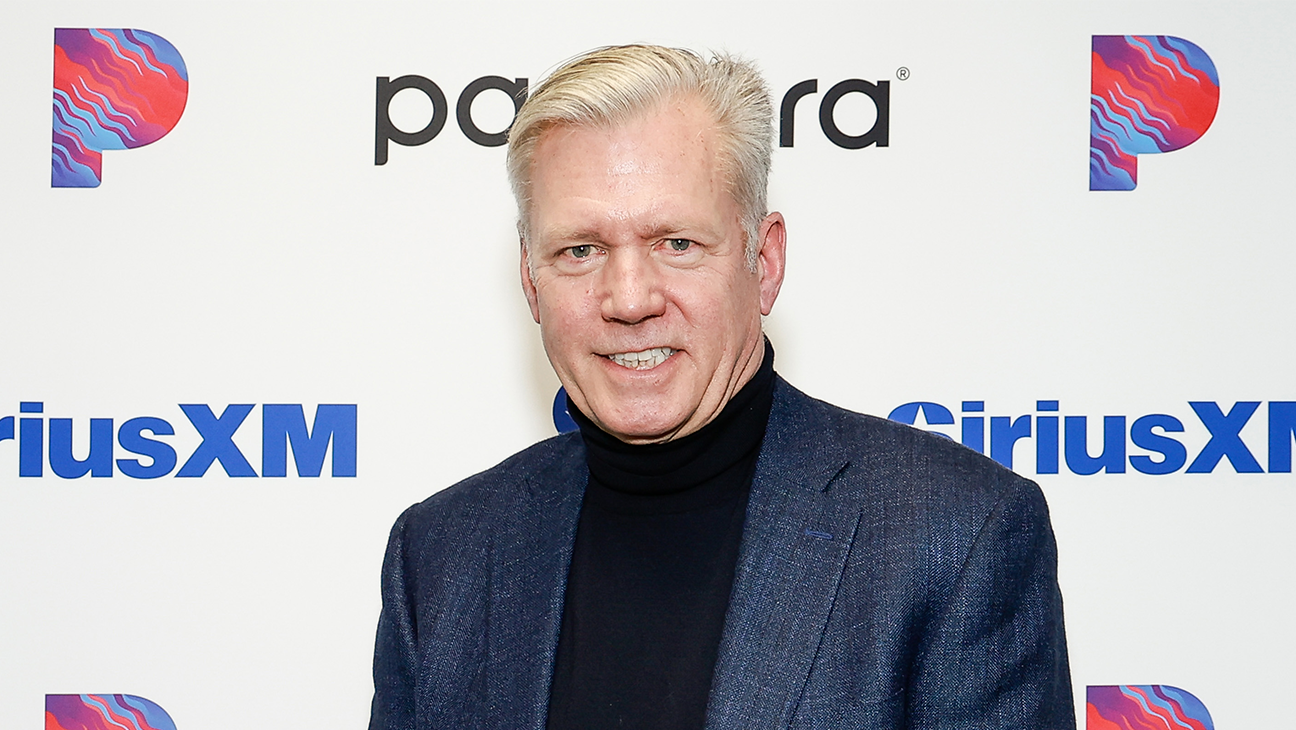
    Chris Hansen said he didn’t watch an early screening of Robert Pattinson‘s Primetime because he claimed that “A24 wanted me to sign away my rights.”

    During an interview on Fox News’ Jesse Watters Primetime Thursday evening, the former To Catch a Predator host said he went to the indie production studio and distributor’s office earlier in the day for a private screening of the film, but ended up leaving without seeing it.

    “The lawyers at A24 wanted me to sign away my rights to my name, image and brand, essentially, as well as any potential legal rights that would come out of the movie,” Hansen alleged. “I couldn’t sign that, so they didn’t show me the film. I went all the way over there. … But who’s going to sign something like that?”

    He added that it was a “very restrictive agreement” and that he “had never seen anything quite like it.”

    The Hollywood Reporter learned that Hansen was asked to sign a standard NDA a week in advance that all preview audiences must sign in order to watch an unreleased A24 film. It’s mostly to prevent spoilers and protect the studio’s IP. 

    Hansen noted to Jesse Watters that his “lawyers had already seen” the NDA before he arrived at A24’s offices.

    When asked by the host what A24 might be worried about, the veteran journalist replied, “I don’t know! I haven’t seen the film. If you look at the trailer, obviously it’s a very dramatized version. They had told me that it’s fictionalized in many aspects. I know other people have seen it who didn’t sign an NDA, and yet they wanted me to sign it.”

    Primetime, which stars Pattinson as the Dateline NBC correspondent, chronicles the intense production, ethical dilemmas and media sensationalism behind To Catch a Predator, which ran from 2004 to 2007.

    During an interview with podcaster Annie Elise last week, Hansen questioned “Hollywood’s motive” behind the movie directed by Lance Oppenheim, but refused to judge the film until he’s seen it.

    “A couple months ago, they came and said, ‘Hey look, we’re doing this, we’d like you to have some sort of consideration in terms of helping us with this,’” he said. However, Hansen noted that the film was already made before “they” reached out to him.

    “As a reporter, it’s sort of silly for me to talk about something that I haven’t seen yet,” he added. “My suspicion is that they used my name because it helps in a commercial enterprise.”

    Primetime, also starring Merritt Wever, Skyler Gisondo, Phoebe Bridgers, Matthew Maher and Bokeem Woodbine, hits theaters on Sept. 25.
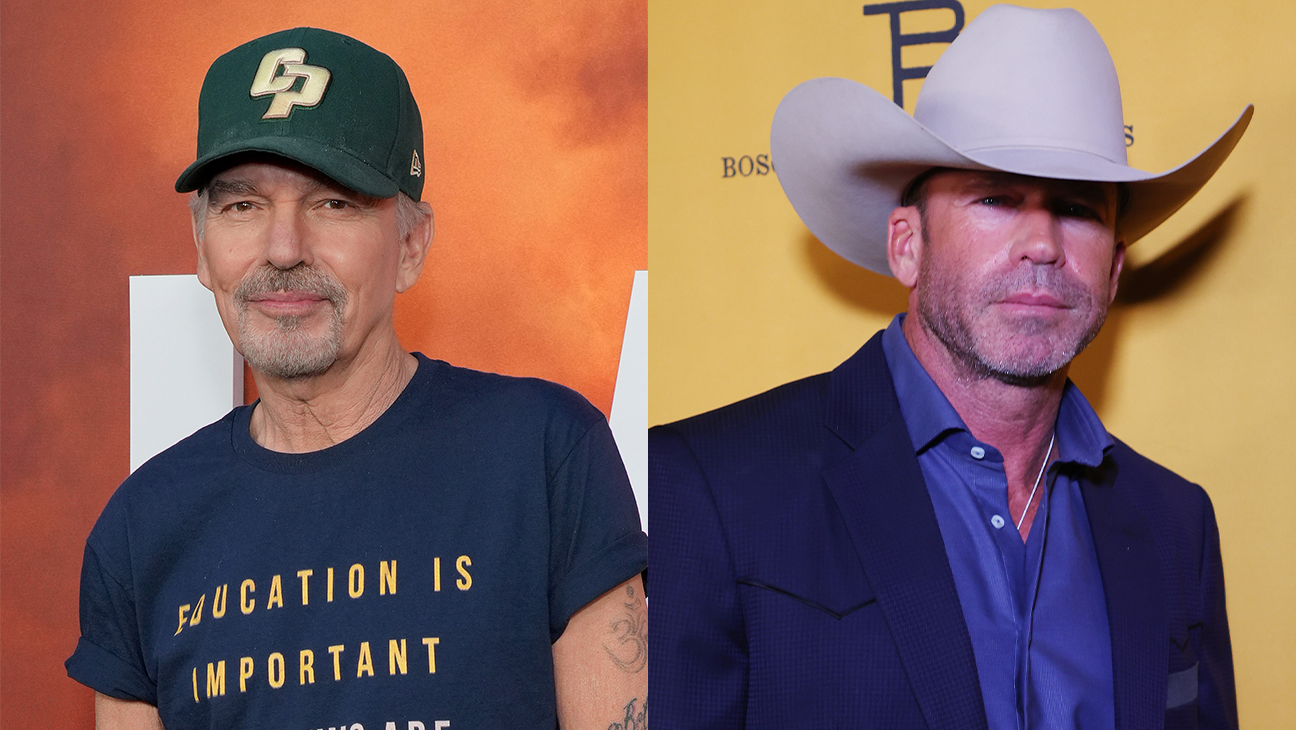

  • Billy Bob Thornton Says “Holly­wood Wasn’t Nice” to Taylor Sheridan, But That “Texas Accepted” Him

    Billy Bob Thornton Says “Holly­wood Wasn’t Nice” to Taylor Sheridan, But That “Texas Accepted” Him

    Billy Bob Thornton is opening up about how he feels Texas embraced prolific TV creator Taylor Sheridan unlike Los Angeles.

    During a recent interview with Town & Country for a cover story about Sheridan, the Landman star said, “Holly­wood wasn’t nice to Taylor. There’s something about being an outsider that drives you.”

    Prior to building his television empire, which includes hit shows from Yellowstone and Mayor of Kingstown to Landman and Special Ops: Lioness, Sheridan was a struggling actor living in L.A.

    “I was homeless twice,” he said. “I lived in my car. Sometimes I’d go to Ojai, just somewhere where I could safely sleep. I did that for six months.” Despite the challenges, Sheridan said he “chose to sleep in my car” rather than giving up on his dream.

    However, after spending roughly two decades as a working actor, appearing on shows like Sons of Anarchy and Veronica Mars, his dream slightly changed when he pivoted to screenwriting — ultimately changing his life.

    Sheridan told The Hollywood Reporter during a 2023 cover story, “Hollywood will tell you what you’re supposed to do if you listen. If you’re banging your head against the wall for 20 years trying to be an actor, maybe you shouldn’t be an actor. But the first thing I ever wrote [the pilot for Mayor of Kingstown in 2011] got me meetings at every major network, at every agency. I had multiple people trying to buy it.”

    Once he gathered enough money from his early hits, such as Yellowstone, Sheridan decided to return to Texas, where he spent most of his childhood. He started buying up land and now owns more than 250,000 acres of ranchland across Texas, which includes his Four Sixes (6666) Ranch and Bosque Ranch.

    Thornton told Town & Country, “I think the ranch community in Texas accepted Taylor 100 percent because he’s not phoning it in. He doesn’t go to the tourist cowboy shop and get an outfit. This is the real thing.”

    Sheridan now spends most of his time in Texas, as he often invites castmembers to come to his ranch for meetings rather than going back to L.A. The ranching empire he’s built has also given him a creative edge, influencing the stories he writes that audiences love.

    “When I lived in Los Angeles, everything I saw was the same and I didn’t learn anything in my day-to-day life,” Sheridan previously told THR. “Here, I get to experience so much. I heard 25 iconic pieces of dialogue today. Most of my great lines I heard someone else say, or some version of it. I’m banking story all the time.”

  • Binance launches Agent OS and MCP trading server

    Binance launches Agent OS and MCP trading server

    Binance launched Binance Agent OS and its Model Context Protocol Server on Aug. 20, giving compatible artificial intelligence applications controlled access to market data and trading functions.

    The developer platform combines Binance APIs, Wallet Agentic Hub, x402, Skill Hub and MCP support. Binance said the broader system is intended to reduce the need for developers to build separate connections for each crypto function.

    Its Binance MCP Server acts as the connection layer between supported AI clients and the exchange. Users can authorize compatible applications without storing Binance API keys locally, according to the company’s announcement.

    Availability depends on the user’s location, account status and access to individual Binance products. The launch does not make every Binance function available through every AI application.

    Binance Agent OS combines five developer components

    Agent OS brings several existing and new developer services into one platform. Binance APIs provide access to trading, market, wallet and blockchain functions, while Wallet Agentic Hub supports wallet interactions controlled through user permissions.

    Meet Agent OS – a new way to build, deploy and use AI agents on Binance.

    Bring Binance market intelligence, payment, on-chain, data and trading capabilities directly into your AI workflow.

    Build. Analyze. Trade. With AI. 🫡

    Experience it ↠ https://t.co/O4E5Dmg42K pic.twitter.com/1JIkcaP4Ot

    — Binance (@binance) August 20, 2026

    Binance x402 provides payment and settlement tools for transactions initiated by software agents. Skill Hub gives developers a directory of modular functions covering trading, wallets, market information and blockchain activity.

    The MCP Server provides a standardized method for compatible AI clients to discover and call those functions. MCP is an open protocol for connecting AI models with external services, data sources and software tools.

    Binance lists Claude, Claude Code, Codex, ChatGPT and VS Code as compatible applications. This means those clients can connect to the server when they support the required MCP setup. It does not mean that Binance controls or operates those applications.

    As previously reported, Coinbase also gave AI agents the ability to spend and trade crypto through wallets equipped with programmable controls. The launches show exchanges competing to become the execution layer for AI applications.

    The MCP Server supports trading but blocks withdrawals

    Public market information does not require authentication. An AI client can retrieve tickers, order books, candlestick data and funding rates without receiving access to a Binance account.

    Authorized account functions include balance checks and internal transfers. Users can also grant access to supported spot, margin and Convert products. The system covers USDⓈ M and COIN M futures where the account and region are eligible.

    Binance said agents cannot withdraw crypto to external addresses through the MCP Server. They also cannot move assets from a main Binance account into the dedicated Agentic subaccount.

    Users must fund that subaccount themselves. The separation limits the assets available to an authorized agent, although it does not remove trading losses, faulty instructions or the risks associated with granting software transactional permissions.

    The company advises users to review order and transfer details before confirming them. Scopes should also be limited to functions required for the intended task.

    In related coverage, Base introduced a similar architecture that keeps transaction approval under the user’s control while allowing AI applications to prepare wallet actions.

    Developers can connect through one MCP endpoint

    Developers and users can connect a compatible client to Binance through its published MCP endpoint. They must then create and fund an Agentic subaccount before authorizing account related actions.

    The subaccount can receive an optional read only view of the main account. Trading and transfers remain confined to the funds and permissions assigned to the Agentic environment.

    Binance has not announced a deadline for adding more applications or functions. The company said Agent OS provides a foundation for expanding wallet capabilities, developer tools and agent skills over time. Such additions remain forward looking until Binance publishes product details.

    The platform also includes Binance x402 as agent payment infrastructure. The protocol uses the HTTP 402 payment status to support automated payments between applications. As crypto.news reported, the standard has gained support from major cloud and payment companies.

    Binance has published technical setup instructions through its developer documentation. Users must still check regional product restrictions and review every permission before making funds available.

  • Bitcoin news: BTC reclaims $74,000 as ETFs see $5.3B volume

    Bitcoin news: BTC reclaims $74,000 as ETFs see $5.3B volume

    Bitcoin’s latest rally has been backed by a sharp increase in institutional activity. U.S. spot Bitcoin ETFs recorded more than $5.3 billion in trading volume as BTC reclaimed $74,000 for the first time in 86 days.

    BlackRock’s IBIT dominated activity with $4.44 billion in volume. Fidelity’s FBTC came next at $438 million and Grayscale at $208.8 million. Meanwhile, Bitwise, ARK Invest, VanEck, Morgan Stanley, Franklin Templeton, Invesco, Valkyrie, WisdomTree and Hashdex accounted for the remaining volume as per data.

    $517M Flows as Bitcoin Jumps 17%

    U.S. spot Bitcoin ETFs also attracted $517.19 million in net inflows, their strongest inflow day since May 4. Eight of the 12 funds recorded positive flows. BlackRock’s IBIT led with $284.7 million, followed by ARK and 21Shares’ ARKB at $77.7 million. Fidelity’s FBTC came next at $62.4 million.

    The ETF activity came as Bitcoin surged roughly 17% in two days. It added around $11,000 and more than $220 billion to its market capitalization.

    The rally has also triggered a major short squeeze. More than $3.6 billion in short positions have been liquidated over the past 72 hours, including $2.75 billion in Bitcoin shorts on Wednesday. Over the following 24 hours, another $783.2 million in Bitcoin positions were liquidated. Of this, $747.7 million came from shorts, according to CoinGlass data.

    What Fueled this Rally?

    • The rally followed the U.S. Treasury Department’s decision to at least double liquidity-support buyback operations for longer-dated nominal coupon securities. This applies in the 10- to 30-year segment.
    • Additional catalysts included the SEC’s latest crypto proposal. There was also a White House meeting between President Donald Trump and prominent crypto executives, helping trigger the unexpected move higher.

    McGlone Warns Rally Could Fade

    Despite the surge, Bloomberg’s Mike McGlone remains bearish. He described the move as “a bounce within the purge”, arguing that August can produce short squeezes even during a broader bear market.

    McGlone criticized Bitcoin’s volatility and correlation with stocks, saying institutional investors face unfavorable risk-reward characteristics. He also argued that the rapid expansion of the wider crypto market has created excessive supply. Consequently, he expects Bitcoin to potentially roll over by year-end.

    While he supports blockchain technology, McGlone argues Bitcoin’s original peer-to-peer cash use case has weakened. This comes with the emergence of crypto-dollar alternatives.

  • Aster jumps 10% on Hyperliquid optimism – Is $0.80 next?

    Aster [$ASTER] extended its rally, gaining over 10% in 24 hours to $0.65. The move followed growing regulatory optimism around decentralized perpetual futures exchanges.

    President Donald Trump said CFTC Chair Mike Selig was working to bring Hyperliquid into the U.S. He said the process would happen in a “fully compliant and legal fashion.”

    Because Aster directly competes with Hyperliquid, traders appeared to treat the news as a sector-wide catalyst. Trading Volume and Funding Rate also increased, placing $0.67 and $0.80 under focus.

    Could Hyperliquid’s U.S. entry help Aster?

    Trump’s comments strengthened optimism across the already bullish crypto market. Hyperliquid’s compliant U.S. entry could signal a more accommodating environment for decentralized derivatives.

    As a perpetual futures DEX backed by Changpeng Zhao [CZ], Aster could benefit from greater sector-wide attention and capital.

    Zhao recently argued that any preferential treatment granted to one firm should extend across the industry. This makes $ASTER’s rally unusual: Traders are pricing a rival’s regulatory progress as Aster’s opportunity.

    Does Aster’s volume confirm the rally?

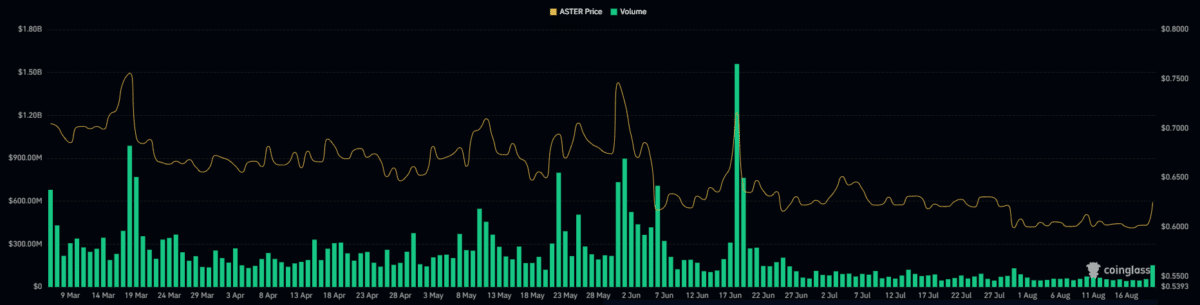
    $ASTER’s Trading Volume climbed from $55 million to $152 million over 24 hours, nearly tripling. The expansion confirmed stronger participation behind the 10% price gain.

    Sustained Trading Volume could help $ASTER challenge $0.67. However, volume must now survive beyond the regulatory headline.

    Source: CoinGlass

    Are $ASTER traders becoming too bullish?

    Derivatives positioning also leaned bullish.

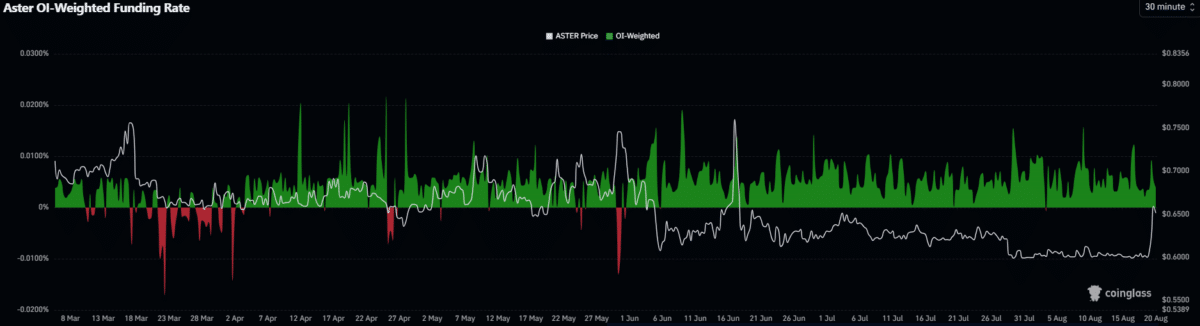
    $ASTER’s OI-Weighted Funding Rate stood at 0.0069%, meaning Longs paid Shorts to maintain their positions. The positive reading reflected a modest long bias.

    Further increases could crowd Longs and raise liquidation risk during a reversal. Funding confirmed optimism. It also showed where the rally could become vulnerable if price stalled.

    Source: CoinGlass

    Can $ASTER reach $0.80?

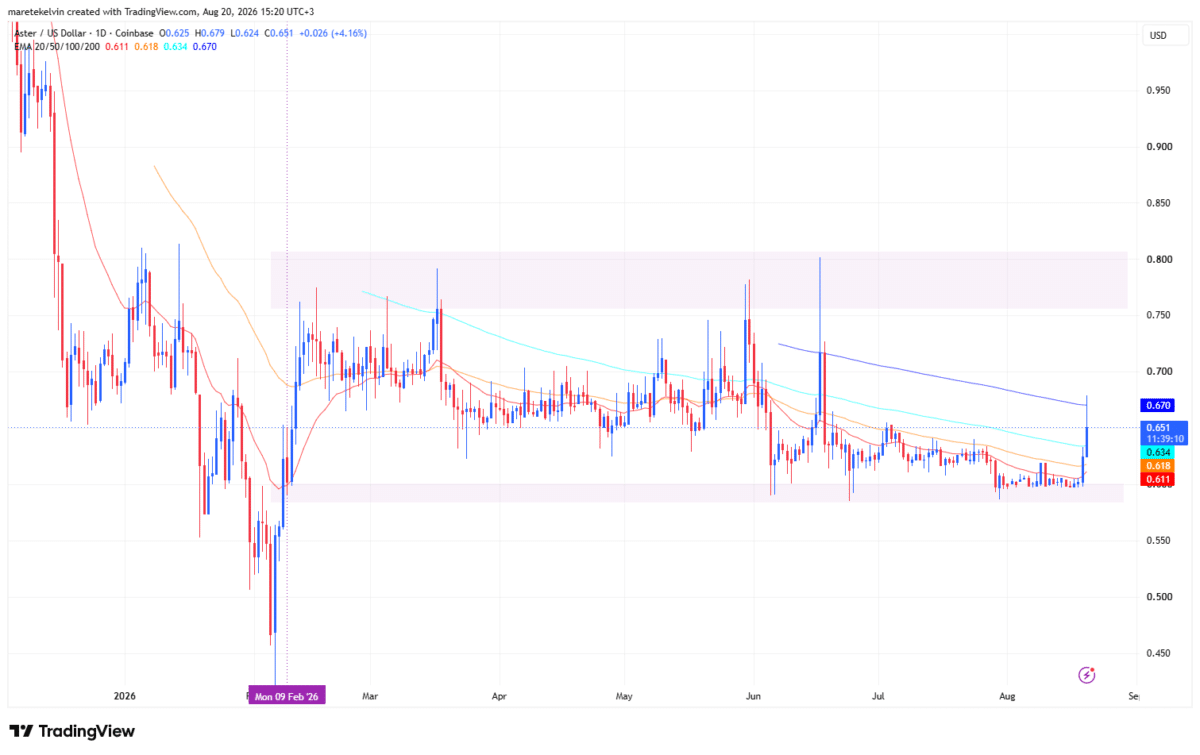
    $ASTER bounced from $0.60 support and reclaimed the 20-day, 50-day, and 100-day EMAs. The token then tested the 200-day EMA near $0.67.

    Reclaiming these averages strengthened the short-term and medium-term structures. However, the 200-day EMA remained the longer-term hurdle.

    Source: TradingView

    A decisive close above $0.67, supported by Trading Volume, could open the $0.80 range high. A rejection could return $ASTER toward the reclaimed EMAs before another breakout attempt.

    Hyperliquid opened the regulatory door. $ASTER must prove rival platforms can walk through it too.


    Final Summary

    • $ASTER gained over 10% as Hyperliquid’s potential U.S. entry lifted decentralized derivatives optimism.
    • Aster’s Trading Volume nearly tripled from $55 million to $152 million.
  • Gwyneth Paltrow Pokes Fun at That Viral Dinner Party Invite for OpenAI’s Sam Altman

    Gwyneth Paltrow Pokes Fun at That Viral Dinner Party Invite for OpenAI’s Sam Altman

    Gwyneth Paltrow better get a bigger table.

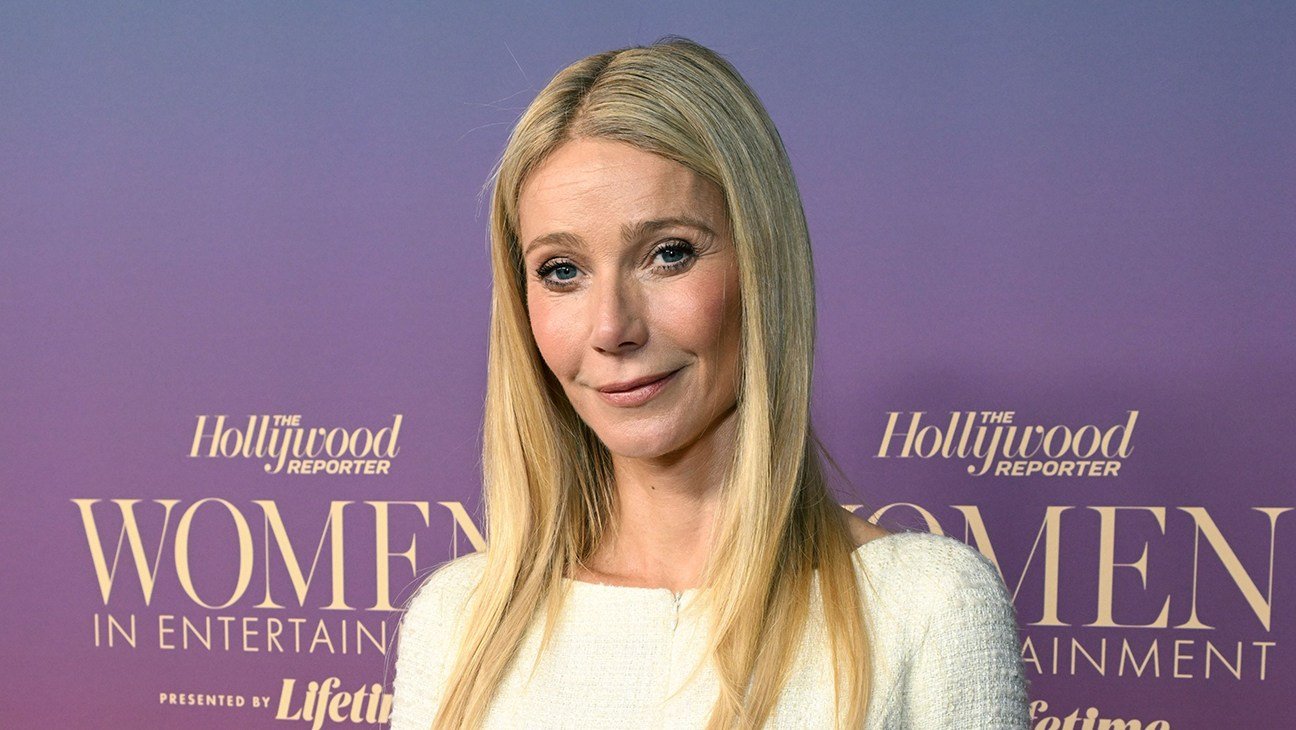
    The Goop founder and Oscar-winning actress is leaning in on the swirl surrounding her supposed dinner with OpenAI chief Sam Altman by posting a series of faux invites in honor of various bold-faced yet fictional characters. “Gwyneth Paltrow invites you to a private, off-the-record al fresch dinner at her home in honor of M3GAN,” reads the first in a carousel of images shared with her 9.2 million Instagram followers. Other characters she’s welcoming to the table: Samantha Jones (Kim Cattrall’s Sex and the City character), Shrek, Jessica Rabbit (of Who Framed Roger Rabbit fame) and Chanty Beluga (a meme queen created by L.A.-based comedian and actor Courtney O’Donnell).

    “We’re serving swordfish burritos, cheddar foam lattes on request,” wrote Paltrow in the caption of the new post, which was shared Thursday afternoon as word continued to spread online about this alleged dinner. First reported by Puck’s Matthew Belloni, Paltrow is said to be hosting Altman for an off-the-record dinner at her Amagansett home on Saturday, Aug. 29.

    Neither Paltrow nor Altman has confirmed the validity of the invite or whether the dinner party is really happening, but a reporter from BBC Verify posted on X that the invite itself had “likely” been created using OpenAI tools.

    It’s not the first time Paltrow has gone viral for her association with an AI company. Following the kiss cam controversy at a Coldplay concert involving senior executives at Astronomer, Paltrow partnered with the tech data company as a “very temporary spokesperson” to poke fun at the scandal in a commercial that traveled far and wide.

    She’s also reportedly invested in several AI-forward start-ups and her Goop Kitchen signed a lease at 405 Howard Street in San Francisco as part of an expansion for the fast-casual empire. The ground floor unit is in a building that serves as part of the massive headquarters for top AI company Anthropic.

    If Paltrow actually hosts Altman to break bread outside her home, she would be part of a larger trend among Hollywood actresses promoting or at least endorsing the use of AI, like Reese Witherspoon and Sandra Bullock.

  • Chris Hansen Says He Refused to Sign His Rights Away in Order to Screen Robert Pattinson’s ‘Primetime’

    Chris Hansen Says He Refused to Sign His Rights Away in Order to Screen Robert Pattinson’s ‘Primetime’

    Chris Hansen didn’t get to take a seat for the new A24 movie “Primetime.”

    The 66-year-old veteran journalist went to the offices of indie distributor A24 to watch the Lance Oppenheim film, in which he is played by Robert Pattinson, before it bows at the Venice Film Festival. But he left without seeing it.

    The former “To Catch a Predator” host went on Fox News’ “Jesse Watters Primetime” to say he showed up at the studio’s offices for a 10 a.m. private screening of “Primetime” on Thursday. The Pattinson-led drama is built around Hansen’s run atop the hidden-camera franchise. But Hansen claims he walked away after refusing to sign a legal agreement he describes as unlike anything he has encountered in four decades on the beat.

    A source close to A24 said Hansen was asked to sign a standard NDA that all preview audiences must adhere to for an unreleased film — mostly to prevent spoilers and protect the studio’s IP.

    “The lawyers at A24 wanted me to sign away my rights to my name, image and brand essentially, as well as any potential legal rights that would come out of the movie,” Hansen claimed during the appearance. “I couldn’t sign that, so they didn’t show me the film. I went all the way over there.”

    Pressed by Watters on whether he walked in without legal cover, Hansen says his attorneys had already reviewed the paperwork and advised against signing. “Of course not,” he says when asked if he put his name to anything without a lawyer present. “This was a very restrictive agreement. I’ve never seen anything quite like it.”

    The agreement Hansen describes would be a much larger legal matter than a standard screening NDA, and would not be asked of other individuals screening the film — including press and third-party marketing agencies.

    The account marks a sharp turn from where Hansen left things only days earlier. Speaking on the “Serialously With Annie Elise” podcast, he said A24 was setting him up with a private screening “in the next week or so,” after which he would render a verdict on the film and how he felt about the depiction of his career.

    Robert Pattinson as Chris Hansen in A24’s “Primetime.”

    Courtesy of A24

    Hansen says he cannot say what the studio might be worried about, because he still has not watched a minute of the picture. “I haven’t seen the film,” he says. “If you look at the trailer, obviously it’s a very dramatized version. They had told me that it’s fictionalized in many aspects. I know other people have seen it who didn’t sign an NDA, and yet they wanted me to sign it.”

    In the trailer and other marketing materials for the film, the indie distributor has labeled “Primetime” as “inspired by true events” and has not characterized it as a biopic of Hansen or his life.

    The film is written by Ajon Singh, one of Variety’s 10 Screenwriters to Watch from 2025, and is inspired by “Tonight on Dateline This Man Will Die” by Luke Dittrich.

    Hansen is careful to note he is not chasing a payday. “I have no financial stake in this film,” he says, adding that no one from the production paid him or brought him aboard as a consultant. He learned the movie existed, he says, the way he has learned most things across a long career. “I’m just a working reporter, and I’m not learned in the sophisticated ways of Hollywood. But I find stuff out,” Hansen says. “I’ve been an investigative reporter for four decades, so I knew this was going on.”

    His frustration, he suggests, is less about the film than the timing of the outreach. “I get a call today saying, ‘Well, you know, everybody’s concerned. They want you to be happy with the film,’” Hansen says. “Well, then why didn’t you tell me about it when you started shooting the film?”

    “Primetime” opens in theaters Sept. 25 following its world premiere in competition at the Venice Film Festival. Directed by Oppenheim in his narrative feature debut and written by Ajon Singh, the movie follows Hansen in 2006 as “To Catch a Predator” makes the leap from “Dateline NBC” segment to its own primetime block. Pattinson stars and produces through his Icki Eneo Arlo banner, with a supporting cast that includes Merritt Wever, Skyler Gisondo, Phoebe Bridgers and Bokeem Woodbine. Former NBCUniversal chief Jeff Zucker appears as himself.

    “To Catch a Predator” ran from 2004 to 2007 as a recurring “Dateline NBC” investigation, pairing Hansen and a camera crew with decoys posing as minors to confront men who arrived at sting houses. The franchise was canceled after a 2006 Texas operation in which Rockwall County assistant district attorney Louis Conradt died by suicide as authorities and the show’s crew closed in on his home.

    For now, it looks like Hansen will have to see the movie the way the rest of the country will, with a paid theater ticket. Asked what he would say to Pattinson, he reaches, inevitably, for the line that made him famous. “Take a seat right over there,” Hansen says.

    A24 declined to comment.

  • HSBC and Standard Chartered Execute First Live Tokenised Deposit Transaction on Swift’s Ledger

    HSBC and Standard Chartered Execute First Live Tokenised Deposit Transaction on Swift’s Ledger

    HSBC and Standard Chartered have completed the first live cross-border interbank transaction using tokenised deposits on Swift’s blockchain-based ledger, the banks announced in a joint Aug. 19 statement. The transaction marked the first interbank transfer executed on Swift’s ledger since it became ready for live use.

    “HSBC’s interoperability transaction with Standard Chartered via Swift is a landmark moment for the promise of tokenised deposits,” said Lewis Sun, HSBC’s head of digital currencies. He said the demonstration shows how bank-issued digital money can be interoperable across institutions while maintaining regulatory oversight.

    How the transaction worked

    The transfer was conducted through an exchange of payment messages between the two banks using Swift’s ledger. The resulting obligations were recorded as tokenised deposit obligations on both HSBC’s Tokenised Deposit Service and Standard Chartered’s tokenised-deposit infrastructure, the announcement said.

    For clients, the banks said the work highlights the potential for cross-border payments to support an increasingly 24/7 global economy, in contrast with settlement that pauses outside traditional banking hours.

    Building on Swift’s July readiness

    The transaction follows Swift’s announcement on July 9 that its blockchain-based ledger was ready for initial live use for tokenised deposits. The ledger is being piloted with 17 banks across six continents, including MUFG, Wells Fargo and Lloyds, and supports multiple currencies including CNH, HKD, SGD, EUR, GBP, USD and AED.

    The project is part of a broader industry effort to use distributed ledger technology for real-world payment use cases while preserving the role of regulated bank money, rather than replacing banks with unregulated alternatives.

    What it means for cross-border payments

    A successful live transaction between two global banks is a step beyond proof-of-concept and toward production interbank settlement on shared infrastructure. Unlike stablecoins issued by non-bank firms, tokenised deposits are liabilities of regulated banks, which proponents argue keeps them anchored to existing supervision even as settlement becomes near-real-time. The demonstration is notable because it ran between two regulated banks on shared ledger infrastructure rather than in a closed pilot.

    If the pilots expand, the approach could reduce the friction of correspondent banking by enabling near-real-time settlement of tokenised deposits between institutions that already operate under existing oversight.

  • A $2 million bet on XRP volatility crosses the tape as prices surge

    A $2 million bet on XRP volatility crosses the tape as prices surge

    A large options bet that would pay off from a surge in $XRP ($XRP) volatility crossed the tape Thursday, just as the cryptocurrency staged one of its sharpest single-day rallies of the summer.

    The trade was a “long straddle,” involving the simultaneous purchase of call and put contracts at the $1.16 strike level, according to derivatives analytics firm Laevitas. The trader purchased 2 million contracts in total, worth $2.32 million, while paying roughly $62,000 in premium. The position expires on August 28.

    “2M $XRP long straddle opened at the 1.16 strike for 28AUG26, $62k premium,” Laevitas reported. Charts showed a clear spike in open interest and buy volume at that strike on crypto exchange Deribit.

    A long straddle is a classic volatility play. The buyer profits if the price moves far enough from the strike to cover the premium, regardless of direction. With only eight days left until expiration, this is a short-term bet that $XRP will not stay near $1.16.

    The timing looked solid. $XRP jumped nearly 15% to $1.34 Thursday before settling around $1.26 as of this writing. Trading volumes also rose sharply.

  • Bitcoin pushes past $75,000 as rally continues.

    Bitcoin pushes past $75,000 as rally continues.

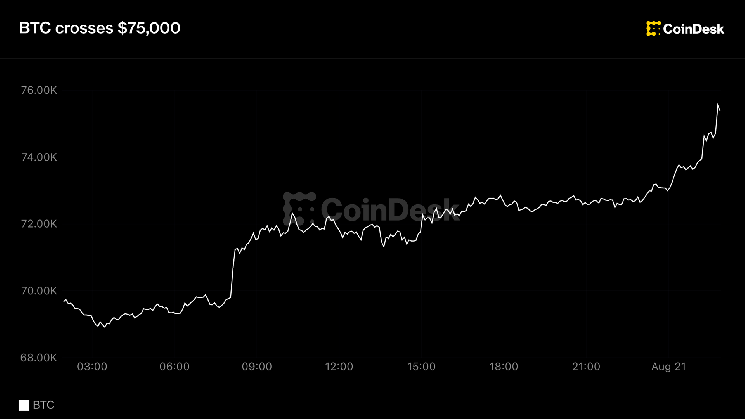
    Bitcoin BTC$75,368.24 reclaimed the $75,000 level for the first time since late May in late U.S. Thursday evening trading.

    At the current $75,400, bitcoin is higher by 8% over the past 24 hours. Ether ETH$2,365.95 at 2,376 is up 4.8%. Leading the majors is $XRP ($XRP), up 16% to $1.29.

    “Price pain capitulation in February,” wrote bitcoin analyst James Check as bitcoin crossed $75,000 minutes ago. “Time pain capitulation in June. Bears in pain, right now.”

    On a weekly basis, bitcoin is now higher by 19%, ether by 25%, and $XRP by 28%.