Blog

  • Bill Maher Pays Tribute to Dolly Parton With Nipple Joke

    Bill Maher Pays Tribute to Dolly Parton With Nipple Joke

    During the Friday episode of Real Time, Bill Maher addressed Dolly Parton’s death that got some backlash on social media.

    He began his monologue by discussing current events of the week, specifically the United States’ trade war with Canada. “All this is going on, and all America could really talk about this week was how sad it is we lost Dolly Parton,” Maher said.

    “Everybody around the country, even around the world” was honoring the late singer, he said. “London, they’re doing things. The Santa Monica ferris wheel is lit up with hearts. The Empire State Building was put up in pink. The Sphere in Las Vegas added a nipple.”

    The joke drew some criticism on social media. “Even Trump refused to be shitty about Dolly Parton in her passing it’s wild that Bill Maher would choose to be this much of a shit bag about a beloved person on both sides of politics,” wrote one person on X. Added another: “Imagine if this is the thing that finally gets him thrown off the air.” Posted another: “typically charmless and classless. Thinks he’s on some superior plane.”

    Parton died Tuesday after a “brief battle with cancer,” a rep announced. Her death has sparked a plethora of tributes as people around the world have continued to honor her legacy. Among those who remembered Parton were Miley Cyrus, Taylor Swift, Beyoncé, Sabrina Carpenter, Billy Ray Cyrus and many more.

    Another tribute, like Maher’s, that drew negative attention was that of Ricky Schroder, who portrayed Parton’s father in two biopic movies based on her childhood. “I didn’t agree with her advocating for Transgender & Covid Vaccine support … but Loved her anyway. Thank you for choosing me Dolly to be your Movie Daddy,” he wrote online.

    In a follow-up post after the backlash from his initial comments began, Schroder reportedly posted a clip on his Instagram Stories about the two-time Oscar nominee’s support of the COVID-19 vaccine, writing, “I warned Dolly to not support the Experiment. Wished she listened.”

    Fox Sports South Florida co-host Josh Cohen, in response to Schroder’s post, wrote on X, “Congratulations to former child TV actor Ricky Schroder on becoming the first person to disrespect Dolly Parton in her passing. What an absolute douche.”

  • Box Office: ‘The Dog Stars’ Struggles With Just $3 Million on Friday; ‘Spider-Man: Brand New Day’ to Win Weekend Again

    Box Office: ‘The Dog Stars’ Struggles With Just $3 Million on Friday; ‘Spider-Man: Brand New Day’ to Win Weekend Again

    20th Century’s “The Dog Stars” and Keylight Pictures’ “Coyote vs. Acme” both debuted in theaters on Friday, but Sony and Marvel’s “Spider-Man: Brand New Day” will once again win the weekend.

    “Coyote vs. Acme” fared best of the two major newcomers, landing in second place with an estimated $5.2 million domestically on Friday from 3,575 screens. The “Looney Tunes” live-action animation hybrid comedy should gross about $13.5 million by Sunday

    From director Dave Green, “Coyote vs. Acme” puts a twist on the classic Road Runner cartoons. After Acme products (think anvils and rocket skates) failed him one too many times, Wile E. Coyote takes the ubiquitous gadget manufacturer to court. Will Forte and Lana Condor star alongside John Cena, Tone Bell, Martha Kelly, Luis Guzmán, P.J. Byrne and John Early.

    “The Dog Stars” fell to No. 4 after earning just $3 million on Friday from 3,330 North American theaters. Rival estimates have the Ridley Scott action drama making $7.2 million through the weekend.

    Jacob Elordi leads “The Dog Stars” as a lonely man with a canine companion living in a post-apocalyptic wasteland. When he discovers a mysterious transmission, he is determined to find its source. Other cast members include Margaret Qualley, Josh Brolin, Guy Pearce, Allison Janney and Benedict Wong.

    “Spider-Man: Brand New Day” is still leading the domestic box office through its fifth weekend in theaters. It added $5.5 million on Friday and should pull in $21 million by Sunday. That would notch the North American total for Sony-Marvel superhero epic to $890 million.

    Christopher Nolan’s “The Odyssey” continues to show out as it enters its seventh weekend, taking third with $3.7 million on Friday. By the end of the weekend, the sprawling historical drama should earn $14.6 million, pushing its domestic haul to $564 million.

    “Insidious: Out of the Further” made $2.9 million on Friday, slotting at No. 5. By the end of its sophomore weekend, it’s expected to make $9.32 million, which represents about a 60% drop from last week’s debut. $9.32 million would bring the horror sequel’s North American revenues to about $42.85 million.

  • ‘This Seems Incorrect’: Ripple CTO Emeritus Slams Kalshi CFTC Argument

    ‘This Seems Incorrect’: Ripple CTO Emeritus Slams Kalshi CFTC Argument

    Fresh debate on whether U.S. states or the Commodity Futures Trading Commission (CFTC) should regulate the fast-growing prediction markets industry has emerged after a federal appeals court ruled that ​Kalshi cannot block Nevada gaming regulators from overseeing its platform.

    Prediction markets platform Kalshi and the CFTC have said sports event contracts are “swaps” under the 2010 Dodd-Frank financial reforms, affording the agency oversight through its authority to regulate national swaps markets.

    Ripple CTO Emeritus David Schwartz engaged with an X post from sports betting and gaming lawyer Daniel Wallach, who argued that the CFTC’s rulemaking is effectively “dead on arrival” because of the major-questions doctrine, which limits federal agencies from claiming broad powers without clear authorization from Congress.

    Schwartz responded that this premise might be incorrect, arguing that the central question is narrower: whether Congress actually delegated authority to regulate gambling through exchange-traded contracts.

    “This seems to be incorrect to me. The question is only whether Congress delegated the power to regulate gambling through exchange-traded contracts. As Kalshi correctly points out, traditional sportsbook gambling is very different,” Schwartz wrote.

    This seems to be incorrect to me. The question is only whether Congress delegated the power to regulate gambling through exchange traded contracts. As Kalshi correctly points out, traditional sportsbook gambling is very different. https://t.co/EY6MKlq1Mx

    — David ‘JoelKatz’ Schwartz (@JoelKatz) August 28, 2026

    Explaining further what he meant, Schwartz stated that: “Of course Congress didn’t intend to replace state-regulated sportsbook gambling with exchange-traded products outside of state regulation. It meant to create a new, uniform federal framework for creating exchange-traded products outside of state regulation.”

    What happened?

    The legal dispute began in March 2025, when the Nevada Gaming Control Board sent Kalshi a cease-and-desist letter claiming that Kalshi’s sports-event contracts constituted an unlicensed sports pool under state gaming law.

    Kalshi argued that the CFTC’s authority over swaps preempted Nevada’s gaming rules.

    On Friday, the 9th U.S. Circuit Court of Appeals in San Francisco upheld Nevada oversight of prediction markets. Circuit Judge Ryan Nelson said Kalshi’s contracts have the hallmarks of sports betting, “a quintessential form of gambling” that the CFTC does not regulate.

    “The CFTC is not a national gambling regulator,” Nelson said, adding that “it is difficult, then, to conclude that Congress intended to ​upend its decades of careful regulation ​of gambling based on broad definitions of the words used in a Wall Street Reform Bill.”

  • Leading Asset Manager Bitwise Moves $15.4 Million of XRP Off Supply

    Leading Asset Manager Bitwise Moves $15.4 Million of XRP Off Supply

    Leading asset management firm Bitwise has sparked discussions following its consistent $XRP purchases while $XRP continues to show mixed price actions as momentum begins to fade.

    Per recent data showcased by Whale Insider, Bitwise has extended its $XRP buying streak after it bought a large amount of $XRP worth $15.4 million.

    $XRP institutional demand skyrockets

    The recent price breakout has sparked confidence across the $XRP ecosystem, fueling rising demand among both retail and institutional investors.

    The bullish momentum has extended to the $XRP ETF market as all existing funds have continued to record steady daily inflows for the past two weeks.

    Following this consistent capital injection in the $XRP ETF market, Bitwise has continued to record growing demand for its $XRP product from institutional investors.

    Its latest $XRP purchase has particularly drawn attention from market analysts as it has come when $XRP has turned negative, reversing from its recent bullish performance.

    $XRP exits bullish zone

    Despite the sustained demand from $XRP institutional investors, it appears that momentum is fading as the asset has suspended its price rally, returning to red territory.

    Latest on-chain data shows that $XRP has retreated to the $1.3 price level, showing a price decline of about 2% over the last 24 hours as speculative trading appears to be outweighing its demand.

    Although $XRP has slowed from its recent price surge, the asset still maintains the highest price gain for this month following several months of extreme volatility.

  • The SEC is reviewing automatic filing pathways after exotic crypto and event-linked ETF proposals flooded the market

    The SEC is reviewing automatic filing pathways after exotic crypto and event-linked ETF proposals flooded the market

    Wall Street now wants a ticker to hold almost any financial idea an investor might type into a brokerage search bar, from Bitcoin and funds promising two or three times a stock’s daily return to private assets and contracts tied to elections or economic events.

    The ETF began as a cheap way to own a broad market portfolio, then became the distribution system for exposures that once required a futures account, a private placement, a crypto exchange, or a patient reading of a structured-note prospectus.

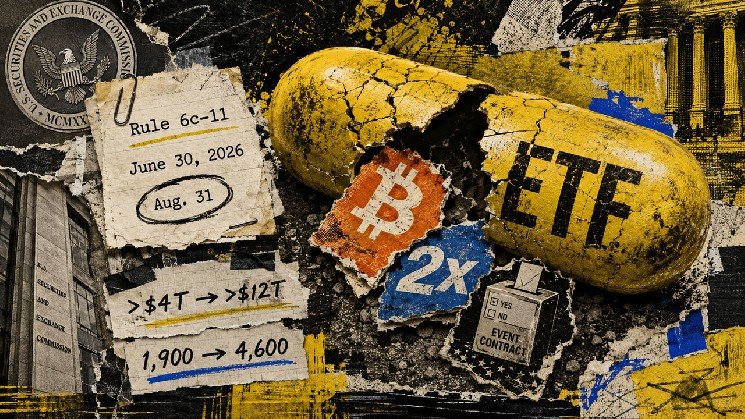
    The SEC is reviewing how far that distribution system can stretch. Its June 30 request for public comment covers crypto assets, commodities, heightened gearing, single-stock products, blockchain-based opportunities, private assets, and event contracts, with comments due Aug. 31.

    The review reaches beyond any single application because the agency is examining whether its existing rules give staff enough time and authority to assess products whose economic behavior can differ sharply from the diversified funds investors learned to trust.

    Assets in US ETFs climbed from more than $4 trillion at the end of 2019 to more than $12 trillion at the end of 2025, while the product count rose from almost 1,900 to more than 4,600, according to the SEC’s concept release.

    A format built for indexing has become the default shelf space for financial products whose risk can be hard to infer from the ticker alone.

    The ticker is the product

    An ETF packages a portfolio into shares that trade throughout the day on an exchange, letting investors buy exposure through the same account they use for ordinary stocks.

    The creation and redemption process lets authorized participants exchange large blocks of fund shares for the underlying basket or its cash equivalent, which helps keep the trading price close to the portfolio’s value.

    That mechanism turned what was essentially operational design into a retail habit by giving investors intraday trading, transparent pricing, broad brokerage access and, in many structures, better tax handling than a comparable mutual fund.

    Asset managers gained a product they could put inside model portfolios and trading apps, and every successful launch encouraged sponsors to place a more specialized exposure behind the same interface.

    The regulatory framework grew around that original bargain because early ETFs needed individual exemptive orders for features, including exchange trading and in-kind redemptions, that didn’t fit neatly within rules written for open-end mutual funds.

    In 2019, the SEC adopted Rule 6c-11, allowing qualifying ETFs registered under the Investment Company Act of 1940 to operate without seeking an order for each launch, provided they met conditions involving portfolio information, trading data, and the arbitrage mechanism.

    Rule 6c-11 made launches faster and more standardized, helping the product count more than double by the end of 2025. A plain index fund, a concentrated thematic portfolio, and a derivatives strategy can now look almost identical on a brokerage screen, even though their holdings, valuation methods, and loss profiles bear little resemblance to one another.

    The term ETF just describes the container, while the assets and contracts inside determine what an investor owns.

    The common brokerage screen hides several legal categories because many stock and bond ETFs are registered investment companies under the 1940 Act, while spot Bitcoin and Ethereum products commonly use commodity-trust structures registered under the Securities Act of 1933.

    Exchange-traded notes add another category: unsecured debt obligations whose return depends on the issuer’s promise, and brokerage interfaces often place all three side by side under a broad exchange-traded product heading.

    Those legal categories govern custody, board oversight, diversification, borrowing, derivatives use, valuation, and the remedies available when an issuer or service provider fails. A familiar ticker reduces the effort required to buy an exposure while leaving those differences intact, which is why the SEC is examining the conditions attached to the wrapper as closely as the portfolio inside it.

    Crypto taught the old ETF a new trick

    Spot crypto products became the cultural turning point because investors treated exchange listing as a bridge between an unfamiliar asset and an established account.

    The SEC’s approval of spot Bitcoin products in 2024 gave advisers and institutions a regulated trading venue, standardized disclosures, and conventional custody relationships, while the agency stressed that its order wasn’t an endorsement of Bitcoin itself.

    The distinction between legal approval and perceived legitimacy became harder to see as the product menu widened.

    Many investors encounter an ETF ticker at a major broker and infer that the underlying exposure has passed through a common filter, even when one product owns a broad equity basket and another holds a volatile commodity or rolls derivatives that can drift from the reference asset. Crypto showed sponsors how much commercial value sits inside that familiarity.

    Sponsors have since applied the same distribution logic to staking, options overlays, token products promising a multiple of the daily move, and baskets of digital assets. Each design can serve an investment use while adding its own custody, valuation, market-hours, and concentration issues.

    Crypto trades around the clock, ETF shares trade during exchange hours, and the creation process has to bridge those clocks when prices move sharply overnight or across a weekend.

    Event-contract funds expand into more unfamiliar territory by tying returns to election outcomes, economic releases, or other defined events inside shares that trade like ordinary funds. CryptoSlate identified more than two dozen event-linked ETF proposals, showing how quickly a niche contract market could reach retail brokerage accounts once an ETF supplies the route.

    The regulatory difficulty comes from function because an event contract can trade on an exchange overseen by the CFTC while the fund shares and disclosures sit within the SEC’s remit.

    Risks can spread across several rulebooks, requiring the review to examine how the contract settles, who supplies prices, what happens when trading halts, and whether the fund can meet redemptions near the event date.

    Those criteria apply differently to every category in the concept release.

    A private-asset fund can face stale valuations and limited exits, a single-stock multiplier product can reset daily and compound away from its stated multiple over longer periods, and a token-based product can depend on custody or staking arrangements that have no close counterpart in a traditional index fund.

    A product-by-product framework can attach conditions to each source of risk more precisely than a single definition of novelty.

    The SEC fast lane reached unfamiliar territory

    The SEC also has to decide whether its filing process gives staff enough time to examine unfamiliar structures before shares reach the market.

    Certain registration statements or post-effective amendments can become effective automatically once a statutory or rule-based waiting period expires, and some amendments filed under Rule 485 can take effect immediately when they meet specified conditions.

    Those pathways make routine fund updates and launches efficient, and the same route can carry a portfolio that staff hasn’t encountered before.

    SEC Chair Paul Atkins said in May that several sponsors had agreed to delay novel ETF launches, including event-contract products, while the agency evaluated the issues.

    A voluntary delay gives staff breathing room for the current set of filings, while a durable policy could require rule amendments, added disclosure conditions, a different review track, or a clearer boundary around which products qualify for automatic treatment.

    Every revision carries a cost because a broad restriction could slow ordinary fund launches and give established issuers an advantage over smaller sponsors, while a narrow rule could leave staff racing against automatic deadlines whenever a new payoff structure appears.

    The agency also has to preserve the arbitrage mechanism that keeps ETF shares close to net asset value, since disclosure alone can’t repair a portfolio whose assets are too hard to price or acquire during creations and redemptions.

    Crypto issuers have a direct stake in the outcome even if event contracts command the most attention.

    New staking structures, tokenized securities, multi-asset baskets, and products with daily return multiples could face added filing requirements based on how the SEC defines novelty and which safeguards it demands.

    A framework centered on custody, valuation, liquidity, and payoff complexity could give sponsors a clearer route, while a wrapper-level restriction could group economically different crypto products together.

    The SEC has already posted public comment letters and meeting records ahead of the Aug. 31 deadline. Once the current input period closes, the agency will have to weigh those submissions, decide whether current authority and disclosure standards are sufficient, and publish any proposed rule amendments through the normal notice-and-comment process.

    Existing products and pending applications will keep supplying data about premiums, discounts, trading quality, and investor use during that process.

    The ETF conquered Wall Street by making investment exposure easy to distribute, turning the wrapper into financial infrastructure for almost every kind of portfolio. A brokerage customer can move from an S&P 500 fund to Bitcoin, a two-times stock position, or an election-linked contract with a few taps, even though each trade enters a different economic world.

    The SEC now has to decide which exposures require a different gate before the common ticker persuades investors that the gate has already done all the work.


  • Score a Refurbished Apple Watch SE 1 for Just $90

    Score a Refurbished Apple Watch SE 1 for Just $90

    TL;DR: Get a refurbished 40mm Apple Watch SE 1 with GPS, fitness tracking, safety features, and up to 18 hours of battery life for $89.99 (MSRP $249).

    The first-generation Apple Watch SE is a practical entry point for someone curious about the Apple Watch but unwilling to pay flagship prices. This refurbished 40mm model costs $89.99 (MSRP $249).

    Paired with a compatible iPhone, it can make calls, send messages, provide Maps directions, access Siri, play Apple Music, and complete Apple Pay purchases. Wi-Fi, Bluetooth, and NFC support its connected features.

    For activity tracking, the watch records walking, running, cycling, swimming, yoga, HIIT, and other workouts. Activity Rings monitor daily movement, exercise, and standing goals, while the optical sensor tracks heart rate throughout the day.

    Fall Detection and Emergency SOS add built-in safety functions.

    The Retina LTPO OLED display reaches up to 1,000 nits of brightness, keeping notifications and workout metrics visible. Its 50-meter water resistance makes it suitable for swimming.

    Battery life lasts up to 18 hours on a single charge.

    Recommended by Our Editors

    This is a Grade B refurbished product, so it may show light scuffing around the case or minor scratches and dents on the body.

    For a first smartwatch, backup wearable, or practical gift, the Apple Watch SE is a smart buy at $89.99 (MSRP $249).

    Refurbished Apple Watch SE 1 (2020)

    40mm


    $89.99
    at StackSocial

    $249.00
    Save $159.01


    Get Deal

    Prices subject to change. PCMag editors select and review products independently. If you buy through StackSocial affiliate links, we may earn commissions, which help support our testing.

    About Our Expert

  • Wanna Sit on a Thumbstick? IKEA Announces Quirky Xbox Furniture Collab

    Wanna Sit on a Thumbstick? IKEA Announces Quirky Xbox Furniture Collab

    Component shortages and their resulting price hikes might be making it borderline unaffordable for many people to buy current-gen consoles, including the Xbox Series X. But if you’re interested in adding some more Xbox to your gaming setup but can’t afford a new device—how about some Xbox-themed homeware?

    IKEA and Xbox are collaborating on a new nine-item collection, dubbed Yxstaby, focused on furniture and objects meant to be used by gamers.

    Highlights from the collection include a green stool designed to mimic the thumbstick on the original Xbox controller. According to Wired, the design team labored over this item, finally incorporating rubber rings into the base to keep it stable despite its unconventional design, which allows you to swivel on it.

    The collection also includes an elegant metal platter based on the D-pad of the original Xbox controller, which is also available as a pillow, in both green and black.

    Many products in the collection are more subtle in their debt to the Xbox aesthetic. The collection also features a mash-up between a laptop stand and a gaming hardware toolbox, which can be used to store all your gaming accessories, and has an on-brand green cutaway at the bottom.

    Another item up for grabs is a gaming chair with built-in storage slots to store your gaming accessories under the seat, again featuring the classic Xbox green trim. You can also grab a rounded mobile side table designed specifically for gaming setups, for storing controllers, as well as a circular mobile stand, featuring an integrated shelf with space for equipment and accessories.

    Recommended by Our Editors

    Metallic D-Pad

    (Credit: Microsoft)

    The collection will be available in IKEA stores and online from 1 October. Availability may vary by market, and prices have yet to be announced.

    If you’re really set on maximizing your commitment to the classic Xbox design aesthetic, earlier this week, Microsoft started taking preorders for the limited edition of its translucent and green Xbox Series X, the Xbox Series X25 Limited Edition. Though at $899 it’s quite an investment in your gaming set-up.

    About Our Expert

  • Oscar Winner Matt Damon to Headline Ripple Event as Featured Speaker

    Oscar Winner Matt Damon to Headline Ripple Event as Featured Speaker

    Academy Award winner Matt Damon will appear at the upcoming Ripple Swell event, scheduled for October 27-29, 2026.

    Ripple is bringing together the global financial community for the Swell event in New York City. For the first time, Ripple is combining the Swell event and XRPL Apex developer summit into a single event intended for institutional leaders and fintech innovators, as well as the developers and researchers building on the $XRP Ledger.

    As seen on the official Swell page, actor and screenwriter Matt Damon, who is also the co-founder of water.org, is named as a featured speaker at the event alongside top Ripple executives including CEO Brad Garlinghouse, President Monica Long and CTO Emeritus David Schwartz.

    Others include Tom Farley, Chairman and CEO of Bullish; Johann Kerbrat, SVP & GM of Crypto at Robinhood; Laide Majiyagbe, Global Head of Markets at BNY; Michael Blaugrund, Vice President of Strategic Initiatives at Intercontinental Exchange (ICE); and Raghuram Rajan, former Governor of the Reserve Bank of India.

    In a Friday X post, the Swell event updated its speaker list to include Alastair Sewell, Senior Investment Director at Aviva; Chase Lax, CEO of Susquehanna Crypto; Gary White, CEO and co-founder of water.org; and Jenny Just, co-founder of PEAK6.

    More voices are joining the Swell speaker lineup:

    Alastair Sewell, Senior Investment Director at Aviva

    Chase Lax, CEO of Susquehanna Crypto

    Gary White, CEO and co-founder of https://t.co/SBdXm1OVeI

    Jenny Just, co-founder of PEAK6

    See all speakers: https://t.co/LB3NRvg1iB pic.twitter.com/7mMxA7WebP

    — Swell (@RippleSwell) August 28, 2026

    Water.org, co-founded by Damon, is a Ripple partner, which makes his appearance significant. The connection gives Damon’s appearance a more practical angle than a typical celebrity keynote; however, the exact details of what Damon will discuss were scarce at press time.

    Ripple expands

    In October 2025, Ripple revealed that several of the world’s leading development and humanitarian nonprofit organizations, including Water.org, are leveraging Ripple Payments and the Ripple USD (RLUSD) stablecoin to help improve the speed, transparency, and impact of aid delivery and funding.

    In an announcement on Friday, Ripple unveiled the launch of its Delta One business within Ripple Prime, its global, multi-asset prime brokerage platform. Ripple Prime’s Delta One enables clients to execute Total Return Swaps across U.S.-listed equities, indices, and digital assets.

  • Analyzing Bitcoin’s 14M profit milestone – BTC’s next move hinges on THIS level

    Analyzing Bitcoin’s 14M profit milestone – BTC’s next move hinges on THIS level

    Sentiment around Bitcoin [$BTC] remained largely positive as the cryptocurrency repeatedly tested $80,000. However, Bitcoin still faced key levels before confirming a decisive bullish move.

    Investor reactions to recent gains could now determine whether the rally extends or loses momentum.

    Will profitable holders support Bitcoin?

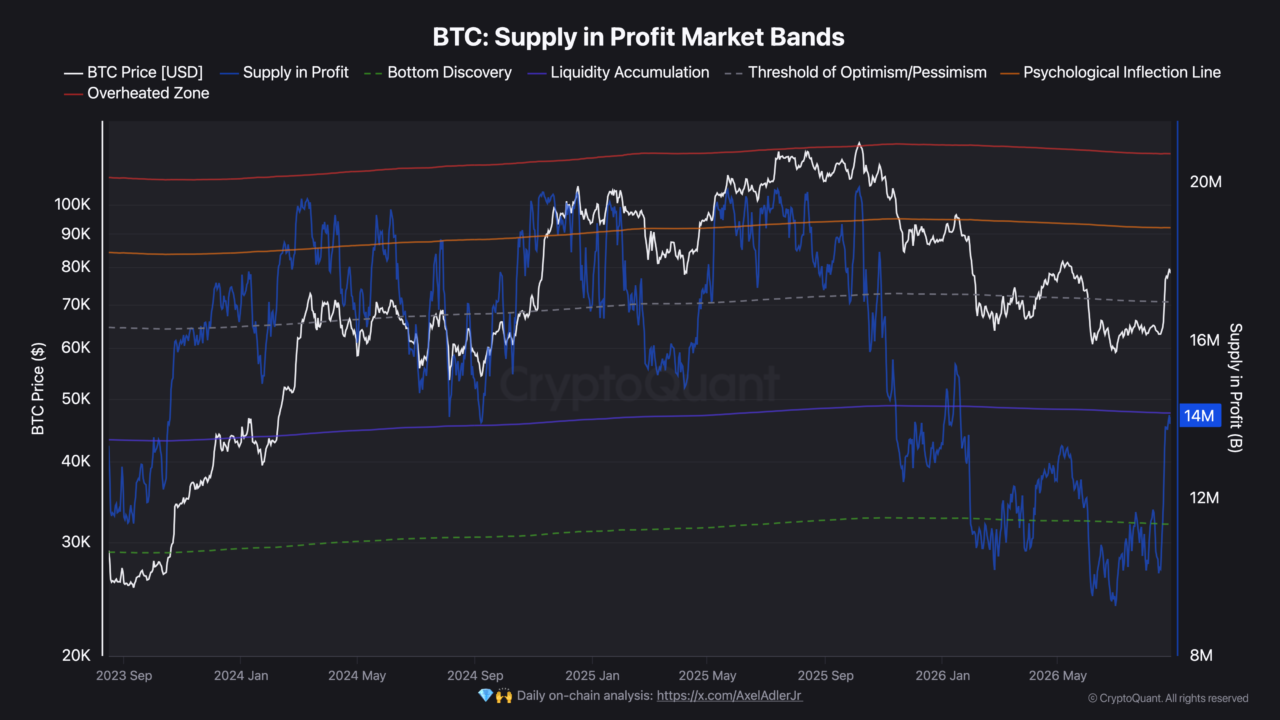
    Bitcoin’s Supply in Profit reached 14 million $BTC at press time, indicating widespread unrealized gains across the market.

    Interestingly, this coincided with the chart’s Liquidity Accumulation level. Historically, this zone influenced whether $BTC extended its recovery.

    Source: CryptoQuant

    Bitcoin last entered this zone in January but failed to move above it. It subsequently fell from $95,000 toward $60,000 in February.

    By contrast, Bitcoin remained above the Liquidity Accumulation level from October 2023. That strength preceded its 2024 all-time high. This history places investors at an interesting crossroads.

    Continued accumulation could support the rally. However, profit-taking among 14 million profitable $BTC could create significant selling pressure.

    Are investors still accumulating?

    Investor behavior suggested that confidence was gradually returning.

    Bitcoin’s Spot Market Netflow remained negative for three consecutive days, according to CoinGlass. Cumulative Netflows reached approximately -$261 million. Negative Netflows indicated that more Bitcoin left exchanges than entered them.

    Such movements could reduce immediately available selling supply.

    Source: CryptoQuant

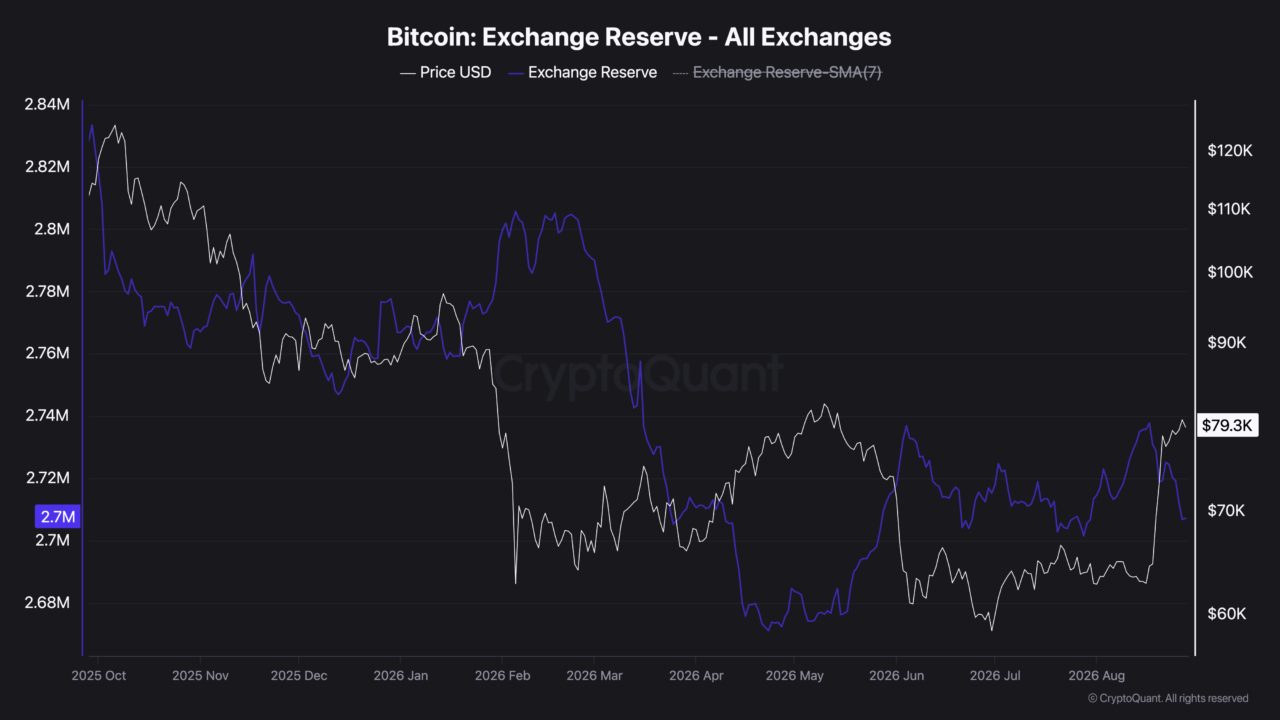
    That move aligned with a broader decline in Exchange Reserves.

    Exchange Reserves fell from 2.735 million Bitcoin [$BTC] on the 15th of August to 2.707 million $BTC. The decline suggested that holders were moving Bitcoin away from trading venues despite recent price gains.

    Can institutions push $BTC above $80K?

    Institutional participation remained critical because sustained ETF demand could absorb selling from profitable holders.

    BlackRock recently acquired 3,260 $BTC, according to AMBCrypto’s tracking. Meanwhile, Bitcoin exchange-traded funds [ETFs] recorded $3.51 billion in August inflows, according to SoSoValue.

    Bitcoin’s next move could therefore depend on which force acts first: institutional accumulation or profit-taking near $80,000.


    Final Summary

    • Bitcoin repeatedly tested $80,000 but had yet to confirm a decisive breakout.
    • Bitcoin’s Supply in Profit reached 14 million $BTC, increasing possible profit-taking pressure.
  • Solana ETFs attract $138M in 10 days – Is SOL ignoring the demand?

    Solana ETFs attract $138M in 10 days – Is SOL ignoring the demand?

    As the market sees fresh bullish optimism, the spot Solana [$SOL] ETF recorded its strongest period of investor demand since these products launched.

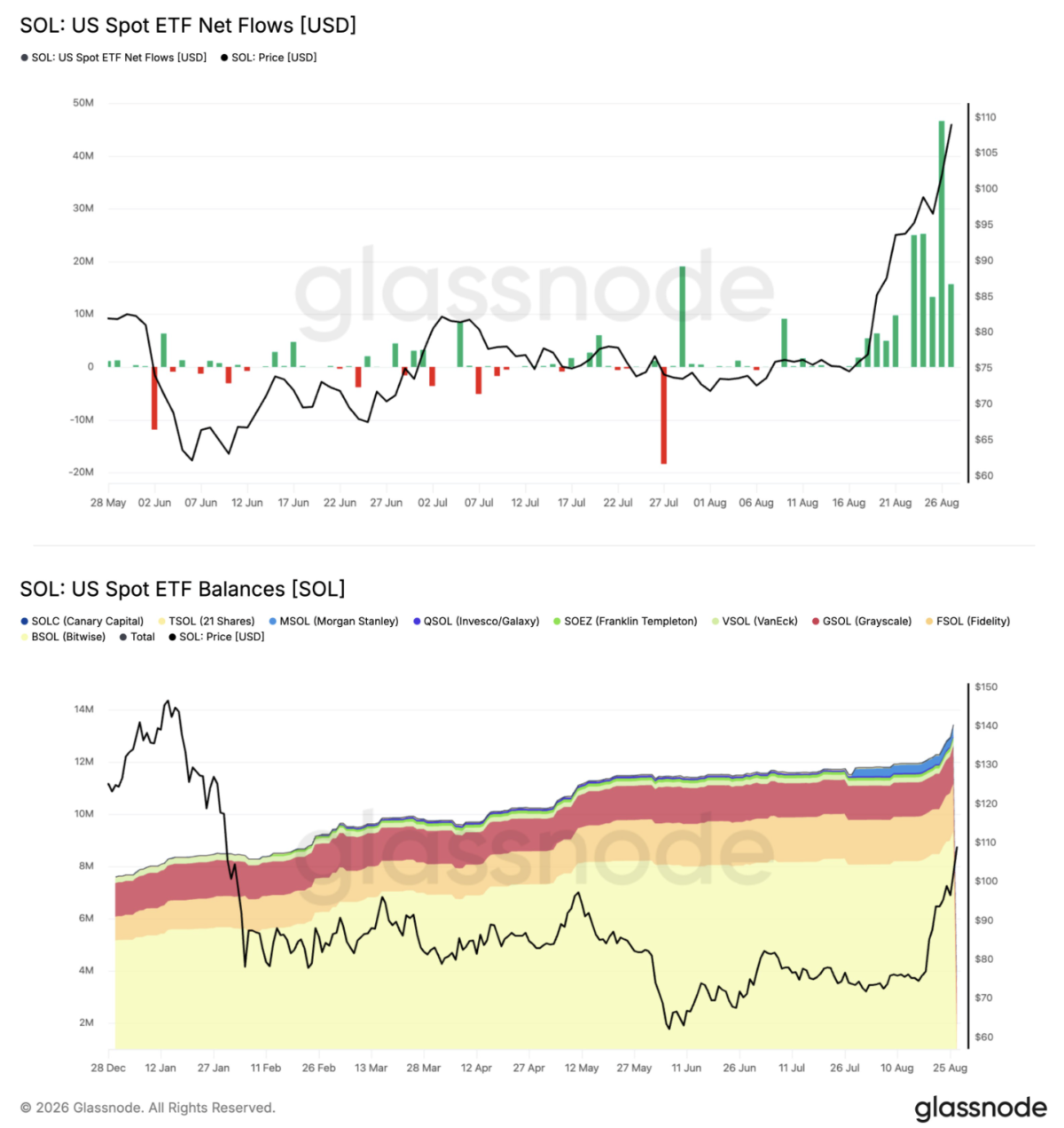
    According to Glassnode, Solana spot ETFs recorded $138 million in net inflows over the course of 10 days. Of these, the most eye-catching day was the 25th of August when the Solana products collectively attracted around $47 million in a single day.

    Solana ETF breaks record, but…

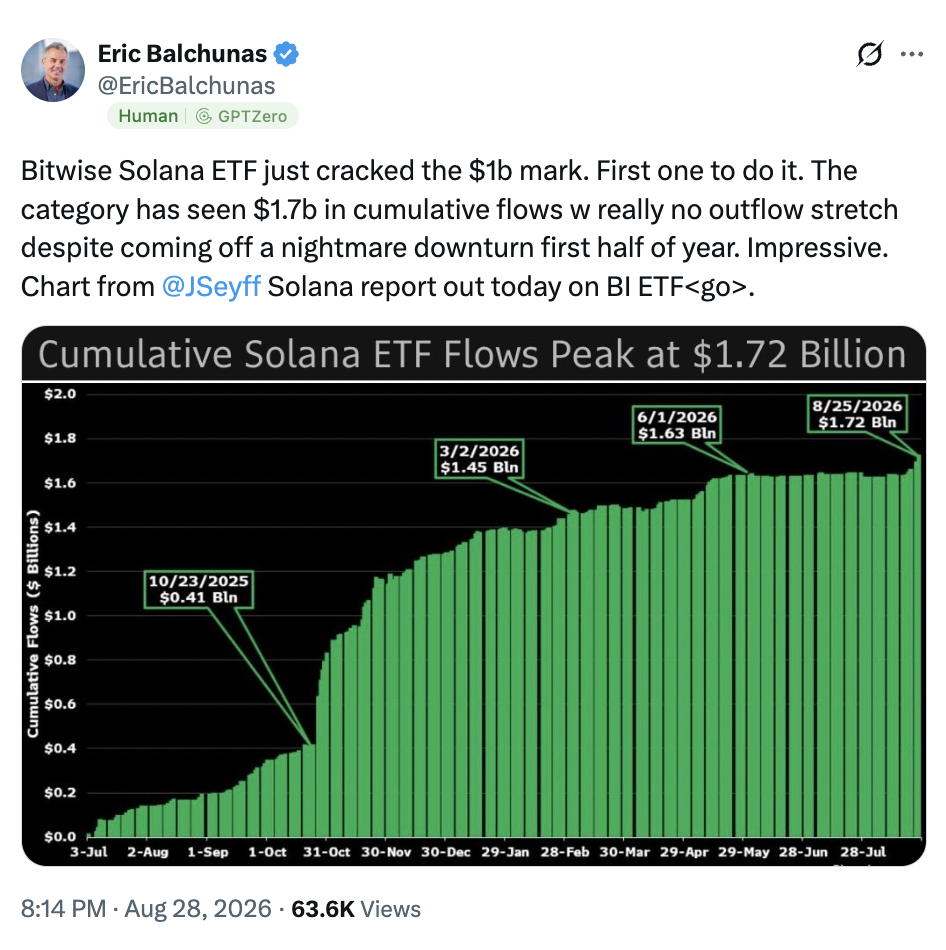
    At the same time, the overall Solana ETFs accumulated roughly $1.7 billion in total inflows, according to Bloomberg ETF analyst Eric Balchunas.

    Source: Eric Balchunas/X

    Interestingly, the category avoided prolonged Net Outflows despite difficult market conditions during the first half of 2026.

    Bitwise’s Solana Staking ETF, BSOL, emerged as the largest beneficiary. The fund crossed $1 billion in Assets Under Management [AUM], becoming the first Solana ETF to reach that milestone.

    Source: Glassnode

    Bitwise’s official fund data shows that BSOL held 9,332,360.79 $SOL, worth approximately $1.018 billion, as of the 26th of August. In fact, the fund was launched in October 2025, meaning it reached the $1 billion mark in roughly 10 months.

    However, the ETF inflows should not be interpreted as a guaranteed bullish signal for $SOL’s price. This is because $SOL was trading at $104.05 at press time, after a drop of 3.1% in the past 24 hours but a hike of over 10% in the past week.

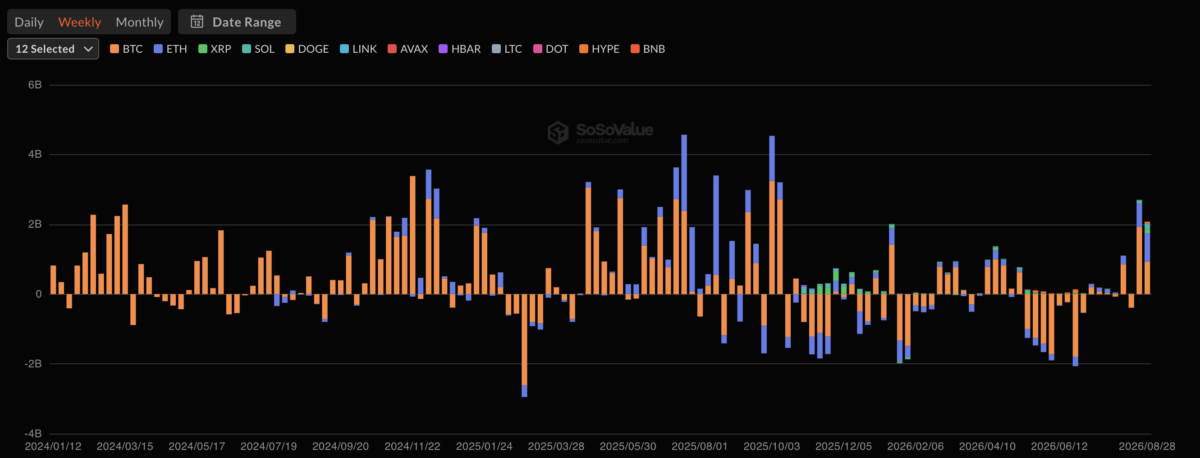
    Meanwhile, Bitcoin ETFs, along with other altcoin ETFs, all exhibited an inflow streak during the same period.

    Source: SoSoValue

    Solana’s governance voting adds to the optimism

    At the same time, Solana’s first round of on-chain governance voting has now concluded, with the community approving two proposals—SGP-0001, “The Solana Constitution,” and SGP-0002, “Double Disinflation.”

    While rejecting SGP-0003, the “Resource and Inclusion Fee” proposal.

    For its purpose, SGP-0002 doubles Solana’s annual disinflation rate from 15% to 30%, allowing $SOL to reach its 1.5% terminal inflation rate in about 2.8 years instead of 5.7 years.

    Meanwhile, SGP-0003 failed with 53.90% support.

    The latter proposed splitting transaction fees into a fixed inclusion fee and a resource fee, with the latter fully burned.

    All in all, Solana approved faster disinflation but rejected the proposed new fee-and-burn structure. This comes on the heels of the Solana-based AVICI price crashing 37% after a reported $600K card withdrawal incident.


    Final Summary

    • Solana ETF category has accumulated roughly $1.7 billion in cumulative flows.
    • Bitwise’s Solana Staking ETF, BSOL, alone crossed $1 billion in assets under management (AUM).