Blog

  • Cardano Founder Explains Why Midnight and NIGHT Differ Fundamentally From Ripple and XRP

    Cardano Founder Explains Why Midnight and NIGHT Differ Fundamentally From Ripple and XRP

    Cardano founder Charles Hoskinson contrasts Midnight ($NIGHT) with Ripple and $XRP, arguing that the two models differ fundamentally in how value is created and distributed.

    Hoskinson made this known during a recent interview with Wendy O on “The O Show.” His commentary centers on ownership, token utility, and whether network growth directly benefits token holders.

    Key Points

    • Cardano founder Charles Hoskinson argues that Midnight ($NIGHT) and $XRP differ fundamentally in value creation and distribution.
    • He argues Ripple uses $XRP sales to generate capital for external investments and acquisitions, but $XRP holders never benefit from this model.
    • Hoskinson compares Ripple’s model to Tether’s, where value accrues mainly to a central entity.
    • His comments have reignited tensions with the $XRP community, raising the prospect of renewed disputes with figures like Brad Garlinghouse.

    $XRP Holders Don’t Benefit From Ripple’s Value Creation Model

    Speaking in response to questions about $XRP’s recent momentum, Hoskinson acknowledged the token’s visibility but challenged the underlying structure supporting its growth.

    He claimed that Ripple retains significant control over $XRP supply and uses the token as a mechanism to generate capital, which it then deploys into external ventures such as acquisitions and new business lines.

    According to him, this model creates a disconnect between $XRP holders and Ripple’s broader financial success. While the company expands its footprint through moves like acquiring firms such as Hidden Road or launching new products, he argues that $XRP holders do not gain ownership rights or direct financial exposure to those developments.

    He further pointed to the absence of staking or yield mechanisms as evidence that $XRP’s value proposition is not designed to redistribute returns to holders. Instead, he likened the structure to Tether, in which a centralized entity captures most of the economic upside while users primarily benefit from access to the network.

    WATCH: Charles Hoskinson explains how Midnight and $NIGHT are “radically different” from Ripple and $XRP pic.twitter.com/i5H1Z8xDbF

    — Wendy O (@CryptoWendyO) April 17, 2026

    Midnight Is Radically Different

    In contrast, Hoskinson described Midnight and its $NIGHT token as “radically different,” suggesting a model where tokenomics are more closely aligned with user participation.

    For context, the Midnight Foundation allocated the total supply to users across eight blockchains, including Cardano and $XRP. However, only a few of these tokens were claimed by eligible beneficiaries who held at least $100 of the supported tokens on the snapshot date.

    This differs from $XRP, where around 80% of the pre-mined 100 billion supply was distributed to Ripple.

    Fresh Hostility Between Hoskinson and $XRP Community Looms

    His recent commentary has reignited criticisms from some $XRP proponents who suggest that Hoskinson is merely obsessed with Ripple and $XRP. Both have been at loggerheads for several years, particularly during the peak of the Ripple lawsuit, but only resolved the differences after Donald Trump’s re-election.

    Following the reconciliation, Hoskinson suggested several initiatives to mend fences, including supporting $XRP on the Lace wallet and $XRP DeFi.

    However, the relationship between him and $XRP proponents began to deteriorate again after he accused Ripple CEO Brad Garlinghouse of supporting the Clarity bill that makes $XRP and other established tokens winners, while newer projects are automatically classed as securities.

    His recent commentary about how $NIGHT differs from $XRP has reignited discussions that another lengthy dispute might be around the corner.

  • Bitcoin falls back to $76,000 as Iran reportedly shuts Hormuz again

    Bitcoin falls back to $76,000 as Iran reportedly shuts Hormuz again

    One of the biggest short squeezes of 2026 came and went in a single session.

    Bitcoin climbed to $78,000 late Friday, triggering $762 million in liquidations across 168,336 traders with $593 million of that on the short side, per CoinGlass.

    By Saturday evening hours in Asia, bitcoin had pulled back to $76,091, up just 0.8% on the day, as Iran broadcast that the Strait of Hormuz was closed to maritime traffic again less than 24 hours after its foreign minister declared it fully open.

    Two tanker owners told Bloomberg their vessels received Iranian radio transmissions shutting the waterway, with one supertanker reporting gunfire and aborting transit.

    State news agency Nour said Hormuz had returned to “strict management and control by the armed forces” in response to a U.S. blockade of Iranian shipping. Several oil tankers that had raced toward the strait Friday on the initial reopening news turned back.

    Friday’s breakout rally ended up in a $590 million shorts rout, with bets on bitcoin accounting for $381 million in liquidations, the largest share, followed by ether shorts at $167. Shorts outweighed longs by nearly four to one, the cleanest short-heavy breakdown in a liquidation event since February.

    The setup had been building for weeks. Funding rates on bitcoin perpetuals were pinned negative, meaning shorts were paying longs a premium to hold their positions.

    Friday’s Hormuz reopening was the catalyst that flipped it. Crude oil dropped nearly 10% to $85.90 per barrel on the initial headline, and bitcoin broke above the $76,000-$78,000 zone that has capped every rally attempt since the February 5 crash.

    President Donald Trump then told reporters Friday night that Iran had agreed to an “unlimited” suspension of its nuclear program, though Tehran never confirmed the claim.

    None of that survived into Saturday intact.

    The market pattern is now familiar, where ceasefire headlines drives a rally but a reversal headline arrives before the breakout can consolidate. The forced unwind gets another setup to work against.

    Ether held up better than bitcoin on the retreat, down just 0.2% over 24 hours while solana dropped 1.3% and dogecoin fell 2.1%. On a weekly basis, ether is still up 5.2%, XRP leads at 6.4%, BNB added 4.6%, and bitcoin sits at 4.5%.

    Whether the $76,000 zone holds into Monday’s open is now the question. A clean weekly close above $76K would preserve the structural break even if the peace trade keeps whipsawing.

    A loss of the level and bitcoin is back in the same range it has been trapped in since March, only this time with the short base that just got wiped looking to rebuild.

  • Sabrina Carpenter Goes Full ‘Thelma & Louise’ at Coachella Weekend Two With Geena Davis Monologue

    Sabrina Carpenter Goes Full ‘Thelma & Louise’ at Coachella Weekend Two With Geena Davis Monologue

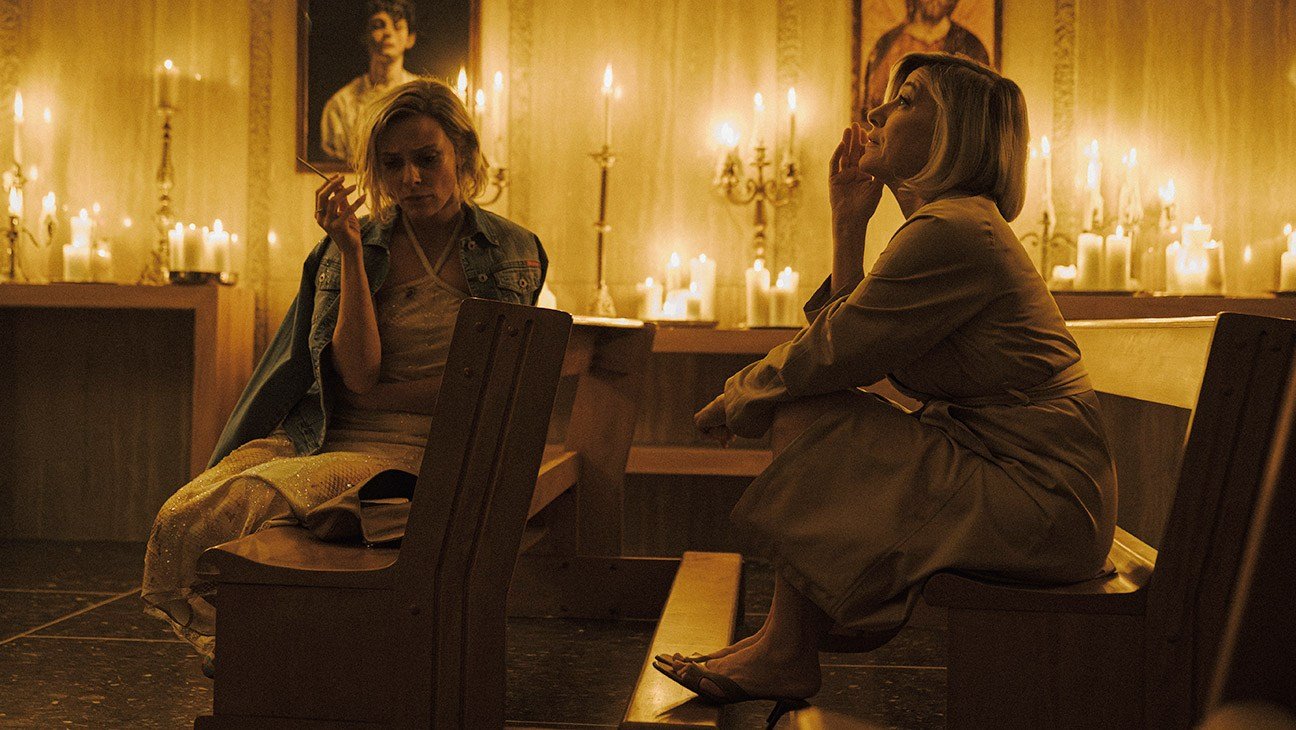
    Sabrina Carpenter leaned into a “Thelma & Louise” theme with her weekend-two Coachella appearance Friday by featuring Geena Davis reading the mid-show monologue as an older “Aunt Sabrina,” succeeding last weekend’s guest Susan Sarandon.

    The monologue was half the length of Sarandon’s uncomfortably overlong version last weekend, lending credence to rumors that Sarandon had been asked to stretch and improvise due to a technical delay.

    Her appearance was doubly a surprise as it came amid hurricane-force rumors that Madonna will be joining Carpenter during the show, which led many to wonder if she would perform the monologue instead of Sarandon, only to find that she was being saved for an actual musical appearance later in the show.

    Sitting in one of the 1950s cars that are a theme of Carpenter’s set, amid a makeshift drive-in theater lot in the middle of the field, Davis read through a monologue that preceded largely along the lines of last weekend’s script. However, the young drive-in carhop, played by her former “Girl Meets World” TV costar Corey Fogelmanis, arrived after three and a half minutes instead of seven to help her settle up her tab.

    Even though the monologue hit many of the same beats as last week’s, it was paraphrased throughout. Sarandon opened with: “What a moron I was. Running around like nobody’s going to judge you, just bippity boppity boo. When of course, everybody’s judging you.” Davis’ opening: “What a moron. I was running around like that carefree, all hippity, skippity…”

    The many trims that cut the speech in half included losing somewhat audience-confusing references to a fictional sister, Laurie, who Sarandon-as-Sabrina said “was always really uncomfortable whenever I was the center of attention. Sometimes she would just ignore what I was doing or other times she would shit on me. And probably she’s putting down my career right now…” Also dropped was the whole wistful/inspirational final part of the monologue, in which Sarandon had spoken of “that little voice (where) you say, fuck it, I can do this. I can do whatever I put my mind to… Why do people stop saying that to themselves when they become 12 years old?”

    Later in the set, Will Ferrell was succeeded in his comedic role as an electrician by Terry Crews, playing the same part, but with different dialogue, and without the failed attempt to light a cigarette.

    Of course, Madonna ultimately provided the mother of all cameos with a medley/duet of her hits… and extended astrology talk that threatened to erase the memory of any filibustering that might have gone on during Sarandon’s speech the previous week.

  • Renowned Analyst Benjamin Cowen Issued a Warning Despite Bitcoin’s Rise

    Renowned Analyst Benjamin Cowen Issued a Warning Despite Bitcoin’s Rise

    In his latest video, Benjamin Cowen, a leading analyst in the cryptocurrency market, evaluated Bitcoin’s current price movements using historical data and “seasonality.”

    Analyzing Bitcoin’s return to the $77,000 level, Cowen warned investors about potential weakness in the coming weeks.

    Cowen noted that Bitcoin’s current trajectory bears striking similarities to the “US midterm election years” cycles of 2018 and 2022. According to the analyst, Bitcoin hit a low of $60,000 in February, followed by a higher low in late March and early April.

    However, Cowen argued that this was not an absolute bullish signal, but rather that “time-based capitulation” within a bear market was more significant than price-based decline.

    One of the most striking points in the analysis was the risks projected for late April and early May. Cowen predicts that Bitcoin could reach a local peak at the end of April, similar to 2018, and then decline again at the beginning of May after sweeping that high.

    The Fed meeting on April 29th stands out as one of the biggest risk factors for the markets. Bitcoin is currently facing resistance at the 100-day moving average. If this level is breached, the next major resistance point is expected to be the 200-day moving average.

    Related News A Big XRP Surprise from Solana – They’ve Officially Announced It

    Cowen stated that tracking USDT and USDC dominance is critical for understanding market direction, and noted that stablecoin dominance finds support at the 100-day moving average.

    This suggests that the tendency for investors to move risky assets (like Bitcoin) to cash remains strong, and Bitcoin could retest the $60,000 level later this year.

    Benjamin Cowen says Bitcoin is highly likely to be rejected from the bear market resistance band, and a true bottom can only be confirmed after these levels are tested repeatedly throughout the year.

    According to the analyst, May and June historically remain “weakness windows” for crypto markets.

    *This is not investment advice.

  • Sabrina Carpenter Goes Full ‘Thelma & Louise’ at Coachella Weekend Two With Geena Davis Monologue

    Sabrina Carpenter Goes Full ‘Thelma & Louise’ at Coachella Weekend Two With Geena Davis Monologue

    Sabrina Carpenter leaned into a “Thelma & Louise” theme with her weekend-two Coachella appearance Friday by featuring Geena Davis reading the mid-show monologue as an older “Aunt Sabrina,” succeeding last weekend’s guest Susan Sarandon.

    The monologue was half the length of Sarandon’s uncomfortably overlong version last weekend, lending credence to rumors that Sarandon had been asked to stretch and improvise due to a technical delay.

    Her appearance was doubly a surprise as it came amid hurricane-force rumors that Madonna will be joining Carpenter during the show, which led many to wonder if she would perform the monologue instead of Sarandon, only to find that she was being saved for an actual musical appearance later in the show.

    Sitting in one of the 1950s cars that are a theme of Carpenter’s set, amid a makeshift drive-in theater lot in the middle of the field, Davis read through a monologue that preceded largely along the lines of last weekend’s script. However, the young drive-in carhop, played by her former “Girl Meets World” TV costar Corey Fogelmanis, arrived after three and a half minutes instead of seven to help her settle up her tab.

    Even though the monologue hit many of the same beats as last week’s, it was paraphrased throughout. Sarandon opened with: “What a moron I was. Running around like nobody’s going to judge you, just bippity boppity boo. When of course, everybody’s judging you.” Davis’ opening: “What a moron. I was running around like that carefree, all hippity, skippity…”

    The many trims that cut the speech in half included losing somewhat audience-confusing references to a fictional sister, Laurie, who Sarandon-as-Sabrina said “was always really uncomfortable whenever I was the center of attention. Sometimes she would just ignore what I was doing or other times she would shit on me. And probably she’s putting down my career right now…” Also dropped was the whole wistful/inspirational final part of the monologue, in which Sarandon had spoken of “that little voice (where) you say, fuck it, I can do this. I can do whatever I put my mind to… Why do people stop saying that to themselves when they become 12 years old?”

    Later in the set, Will Ferrell was succeeded in his comedic role as an electrician by Terry Crews, playing the same part, but with different dialogue, and without the failed attempt to light a cigarette.

    Of course, Madonna ultimately provided the mother of all cameos with a medley/duet of her hits… and extended astrology talk that threatened to erase the memory of any filibustering that might have gone on during Sarandon’s speech the previous week.

  • Caitlyn Jenner’s Memecoin Triumphs in Court Ruling

    Caitlyn Jenner’s Memecoin Triumphs in Court Ruling

    In a significant legal decision, a California judge has determined that the $JENNER memecoin, introduced by former Olympic gold medalist and television personality Caitlyn Jenner, does not meet the criteria to be classified as a security. This conclusion comes after a class action lawsuit filed in late 2024 by Lee Greenfield, who reported losses surpassing $40,000 from his investment in the token.

    What Allegations Faced Caitlyn Jenner?

    Greenfield, who acquired the $JENNER token through the Solana and Ethereum blockchains in May 2024, alleged that Jenner leveraged her fame to promote the token. It led investors to anticipate substantial profits. Jenner’s social media posts featured AI-crafted images displaying “JENNER ETH” shirts, accompanied by American flags, and conveyed hopeful messages such as “Let’s make everyone rich!”

    Jenner is a household name in the United States, known for her athletic achievements and reality show appearances. By venturing into the cryptocurrency space with her token initiative, she attracted significant attention from both crypto enthusiasts and the general public.

    How Did Key Legal Arguments Shape the Outcome?

    The lawsuit also involved Jenner’s manager, Sophia Hutchins, who passed away in July 2025. The defense argued against the classification of the $JENNER token as a security and stated that Hutchins could not be deemed a vendor in this context.

    Judge Stanley Blumenfeld, Jr. invoked the pivotal 1946 Howey case from the US Supreme Court to determine if the investment qualified as a security. This test examines if investments are combined in a unified endeavor, with profits deriving from the efforts of others. Despite Greenfield’s investment, the judge concluded it didn’t involve a common enterprise, crucial for the security classification.

    “Considering the claims as a whole, it is not reasonable to assert that investors pooled funds to share profits or losses, raise capital, or finance any project beyond the coin itself. Thus, there is no common enterprise on the basis of horizontal commonality,” Judge Blumenfeld articulated in his decision.

    Judge Blumenfeld further stated there was an absence of both horizontal and vertical commonality among the investors, failing to meet the “common enterprise” component of the Howey test. Consequently, he did not address whether profit expectations hinged on Jenner’s activities.

    What Lies Ahead for State-Level Proceedings?

    Following the dismissal of the federal securities claim, the ruling clarified that any unresolved state-level charges could proceed in California’s jurisdiction. Greenfield retains the option to pursue his allegations locally under state laws.

    “Given the absence of a common enterprise, further review is unnecessary,” the judge explained in his ruling on the matter.

    This court decision contributes to the diverse perspectives within American judiciary systems regarding how some cryptocurrencies, like meme tokens, should be interpreted under securities law. The California ruling might inform future legal proceedings concerning similar digital assets.

  • Why are deadbeat stocks Oracle, Microsoft, and AMD suddenly the week’s best performers?

    Why are deadbeat stocks Oracle, Microsoft, and AMD suddenly the week’s best performers?

    This week gave beaten-up stock names a strange new job. They stopped acting like laggards and started leading the screen. Oracle (NYSE: ORCL), Microsoft (NASDAQ: MSFT), and AMD (NASDAQ: AMD) came into Friday on track for huge weekly gains, the kind that reset charts and force traders to stop laughing at names they had written off.

    Oracle rose 27% for the week, its best run since June 1999. AMD added 14% for the week, hit an all-time high on Thursday, and kept alive a 13-session winning streak that has pushed the shares up more than 42%.

    Microsoft also climbed 14% in what is its best week since April 2015 after a brutal March quarter in which the software giant lost almost a quarter of its value, its worst quarter since 2008.

    Tesla (NASDAQ: TSLA) gained about 15% this week after Elon Musk said on Wednesday that the company hit a key milestone on its AI5 chip.

    Broadcom (NASDAQ: AVGO), Micron (NASDAQ: MU), and ON Semiconductor are each up about 30% so far in April. Marvell is up 41% this month. The iShares Expanded Tech-Software ETF, or IGV, is up about 14% week to date, which puts it on track for its best week since its record week in October 2001.

    The SPDR Info Tech Fund, known as XLK, hit an all-time high on Friday for the first time since October 2025 and closed at a record level after 13 straight days of gains. That fund also logged its best week since April 2025.

    Oracle locks down power while AMD and Microsoft rip higher

    Oracle on Monday had expanded an artificial intelligence data center power deal with Bloom Energy, locking in 1.2 gigawatts of capacity from Bloom.

    The week before, Oracle was also issued a warrant to buy $400 million worth of Bloom shares. That added another layer to the story and gave traders more reason to chase the move.

    AMD’s run looked even more dramatic on the chart. The stock rose 14% this week, but the weekly number only tells part of it. The shares have climbed more than 42% during a stretch of 13 consecutive up days. That is AMD’s longest winning streak in more than 20 years.

    Microsoft, meanwhile, just finished its worst quarter since 2008 in March, when it lost almost a quarter of its market value. Now it has posted its best week since April 2015.

    Since the year started, a lot of stocks have been getting sold on the fear that AI would crush old software models or force expensive catch-up spending.

    But this week, hopes for a lasting peace deal between the U.S. and Iran helped fuel the rebound across the sector. Even after this rally, IGV is still down about 19% so far this year.

    Tesla joins the surge as chip names and tech funds pile on

    Tesla’s setup though is more complicated. Musk said Wednesday that Tesla reached a key milestone on its AI5 chip, and the stock rose about 15% for the week.

    Wall Street analysts expect revenue of $22.08 billion, down 9% from a year earlier. They also expect adjusted EPS of $0.35. Adjusted EBITDA is seen at $3.217 billion, down 14.4% from the same quarter last year.

    Earlier this month, Tesla said it delivered 358,023 vehicles globally in the first quarter. That missed the 364,645 analysts expected, though it was still up 6.3% year over year. There is a catch in those year-over-year numbers.

    Last year’s total was unusually weak because of the changeover to the new Model Y, which means the base for comparison was already low. Tesla is also expected to give investors an update on its full self-driving effort and its robotaxi plans.

    Meanwhile, Broadcom stayed in focus as Jim Cramer discussed the recent market rotation on Mad Money and said: “You may think it’s fanciable to discuss a no-name company like Broadcom, but did you even realize that it’s actually bigger in market cap size than Meta? After the stock’s 4.2% rally today, isn’t that incredible? I’m going to be sure of this because you never know with these things. But I have to tell you, this Meta is back, okay? But Broadcom is the one that I think you need to focus on.”

  • Pakistan PM, army chief wrap up key trips in push for more US-Iran talks

    Pakistan PM, army chief wrap up key trips in push for more US-Iran talks

    Field Marshal Asim Munir leaves Tehran while premier Shehbaz Sharif heads home from Turkiye amid hopes of another round of US-Iran talks.

    Pakistan’s army chief and the prime minister have wrapped up separate diplomatic visits aimed at advancing efforts to end the United States-Iran conflict, with Field Marshal Asim Munir leaving Tehran and Prime Minister Shehbaz Sharif returning from Turkiye.

    Munir met Iran’s leadership and peace negotiators during a three-day visit to Tehran, a Pakistani military statement said on Saturday.

    Recommended Stories

    list of 4 itemsend of list

    The visit demonstrated Pakistan’s “unwavering resolve to facilitate a negotiated settlement… and to promote peace, stability and prosperity,” the military said ahead of expected US-Iran talks in Islamabad in the coming days.

    Munir held talks with the country’s president, foreign minister, parliament speaker and head of Iran’s military central command centre.

    Parliament Speaker, Mohammad Bagher Ghalibaf, and Foreign Minister, Abbas Araghchi, led the Iranian delegation to Islamabad for peace talks with the US last week, the highest level face-to-face contact between Washington and Tehran in decades.

    Those talks ended without agreement, and a ceasefire is due to expire on April 22.

    But diplomacy has continued, with Pakistan’s Prime Minister, Shehbaz Sharif, visiting Saudi Arabia, Qatar and Turkiye to push the peace process.

    His three-country trip concluded on Saturday, with Sharif and Foreign Minister Ishaq Dar departing a diplomacy forum in Antalya, according to statements from both officials.

    “I leave Antalya [Turkish city] with fond memories and a renewed commitment to further strengthening the enduring fraternal bonds between our two nations, and to continuing our close cooperation to advance dialogue and diplomacy for lasting peace and stability in the region,” Sharif posted on X.

    The flurry of diplomacy comes as further negotiations are expected in Pakistan in the coming days as Islamabad intensifies contacts with regional and global leaders in an effort to sustain momentum towards a US-Iran deal.

    Pressure for a deal between the two countries has grown after Iran reimposed restrictions on the Strait of Hormuz, hours after its reopening following the start of a ceasefire in Lebanon. Tehran accused the US of violating a deal to reopen the strategically important waterway.

    Donald Trump has said a second round of talks with Iran could be held in Pakistan in the coming days. The New York Post reported that Trump praised Munir, saying he was “doing a great job”.

    Reporting from Islamabad, Al Jazeera’s Kamal Hyder said Munir landed back home on Saturday as Pakistan prepared for another round of US-Iran talks expected “within the next few days”.

    “We have also seen a lot of praise from the Trump administration on social media, praising the Pakistani leadership. So all eyes are on Islamabad. Serious differences remain, but there is a flurry of diplomatic activity and a hope and expectation that some sort of breakthrough may happen,” he said.

  • Sabrina Carpenter Goes Full ‘Thelma & Louise’ at Coachella Weekend Two With Geena Davis Monologue

    Sabrina Carpenter Goes Full ‘Thelma & Louise’ at Coachella Weekend Two With Geena Davis Monologue

    Sabrina Carpenter leaned into a “Thelma & Louise” theme with her weekend-two Coachella appearance Friday by featuring Geena Davis reading the mid-show monologue as an older “Aunt Sabrina,” succeeding last weekend’s guest Susan Sarandon.

    The monologue was half the length of Sarandon’s uncomfortably overlong version last weekend, lending credence to rumors that Sarandon had been asked to stretch and improvise due to a technical delay.

    Her appearance was doubly a surprise as it came amid hurricane-force rumors that Madonna will be joining Carpenter during the show, which led many to wonder if she would perform the monologue instead of Sarandon, only to find that she was being saved for an actual musical appearance later in the show.

    Sitting in one of the 1950s cars that are a theme of Carpenter’s set, amid a makeshift drive-in theater lot in the middle of the field, Davis read through a monologue that preceded largely along the lines of last weekend’s script. However, the young drive-in carhop, played by her former “Girl Meets World” TV costar Corey Fogelmanis, arrived after three and a half minutes instead of seven to help her settle up her tab.

    Even though the monologue hit many of the same beats as last week’s, it was paraphrased throughout. Sarandon opened with: “What a moron I was. Running around like nobody’s going to judge you, just bippity boppity boo. When of course, everybody’s judging you.” Davis’ opening: “What a moron. I was running around like that carefree, all hippity, skippity…”

    The many trims that cut the speech in half included losing somewhat audience-confusing references to a fictional sister, Laurie, who Sarandon-as-Sabrina said “was always really uncomfortable whenever I was the center of attention. Sometimes she would just ignore what I was doing or other times she would shit on me. And probably she’s putting down my career right now…” Also dropped was the whole wistful/inspirational final part of the monologue, in which Sarandon had spoken of “that little voice (where) you say, fuck it, I can do this. I can do whatever I put my mind to… Why do people stop saying that to themselves when they become 12 years old?”

    Later in the set, Will Ferrell was succeeded in his comedic role as an electrician by Terry Crews, playing the same part, but with different dialogue, and without the failed attempt to light a cigarette.

    Of course, Madonna ultimately provided the mother of all cameos with a medley/duet of her hits… and extended astrology talk that threatened to erase the memory of any filibustering that might have gone on during Sarandon’s speech the previous week.

  • You Can Now Use XRP on Solana—Here’s How

    You Can Now Use XRP on Solana—Here’s How

    In brief

    • The Ripple-linked $XRP is now live for trading and use in DeFi on Solana.
    • It’s made possible due to Hex Trust’s wrapped token offering, which is 1:1 backed with native $XRP.
    • Around $1.2 million in wXRP has already been minted on Solana.

    The prominent Ripple-linked cryptocurrency $XRP is now live for use on Solana, letting individual users and institutions alike gain access to the token on the layer-1 blockchain via a wrapped token issued by Hex Trust.

    The initiative, first announced in December, will open up the utility of $XRP beyond the $XRP Ledger, expanding its use in market-making and decentralized finance (DeFi) to Solana.

    More than 834,000 $XRP, or around $1.2 million worth of the token, has already been wrapped and activated on Solana.

    BREAKING: $XRP is live on Solana https://t.co/pWiljVfc6m pic.twitter.com/QZbwd6qEN4

    — Solana (@solana) April 17, 2026

    To do so, authorized users send native $XRP to Hex Trust’s regulated custody services, and the firm then mints wXRP tokens on Solana or supported Ethereum Virtual Machine (EVM) blockchains like the Ethereum mainnet, Optimism, or HyperEVM. Institutions seeking access to the project can register to gain early access to the feature via Hex Trust.

    The 1:1 backed wXRP can then be used in DeFi protocols on those chains, all of which have more robust DeFi ecosystems when compared to the native $XRP Ledger. According to data from DeFiLlama, Ethereum and Solana rank first and second in DeFi total-value-locked (TVL) with $57.2 billion and $6.08 billion, respectively.

    Meanwhile, $XRP Ledger ranks 41st, with just $51.46 million in DeFi TVL.

    “There’s growing demand to use $XRP across the wider crypto ecosystem and institutions, and so we are excited to see Hex Trust address this demand,” Ripple X SVP Marcus Infanger said in a statement when the initiative was launched in December.

    With the wrapped token’s launch on Solana, now they can do so.

    In addition to the $1.2 million in wXRP on Solana, 50 million tokens or around $74.5 million worth of wXRP has been minted on Ethereum. Almost all of those tokens have been in the same Ethereum wallet—one likely connected to the token issuer—since early November, prior to the wXRP announcement.

    Less than 60 total transactions involving the wrapped token have taken place all-time, according to Ethereum block explorer, Etherscan.

    A representative for Hex Trust did not immediately respond to Decrypt’s request for comment. $XRP is up around 2% in the last 24 hours, recently changing hands at $1.49. It remains 59% off its all-time high of $3.65 created last July.