Shiba Inu is attempting one of its more important technical breakouts in months, with $SHIB finally challenging the long-term resistance that has capped its recovery since the summer.
Shiba Inu pushes through
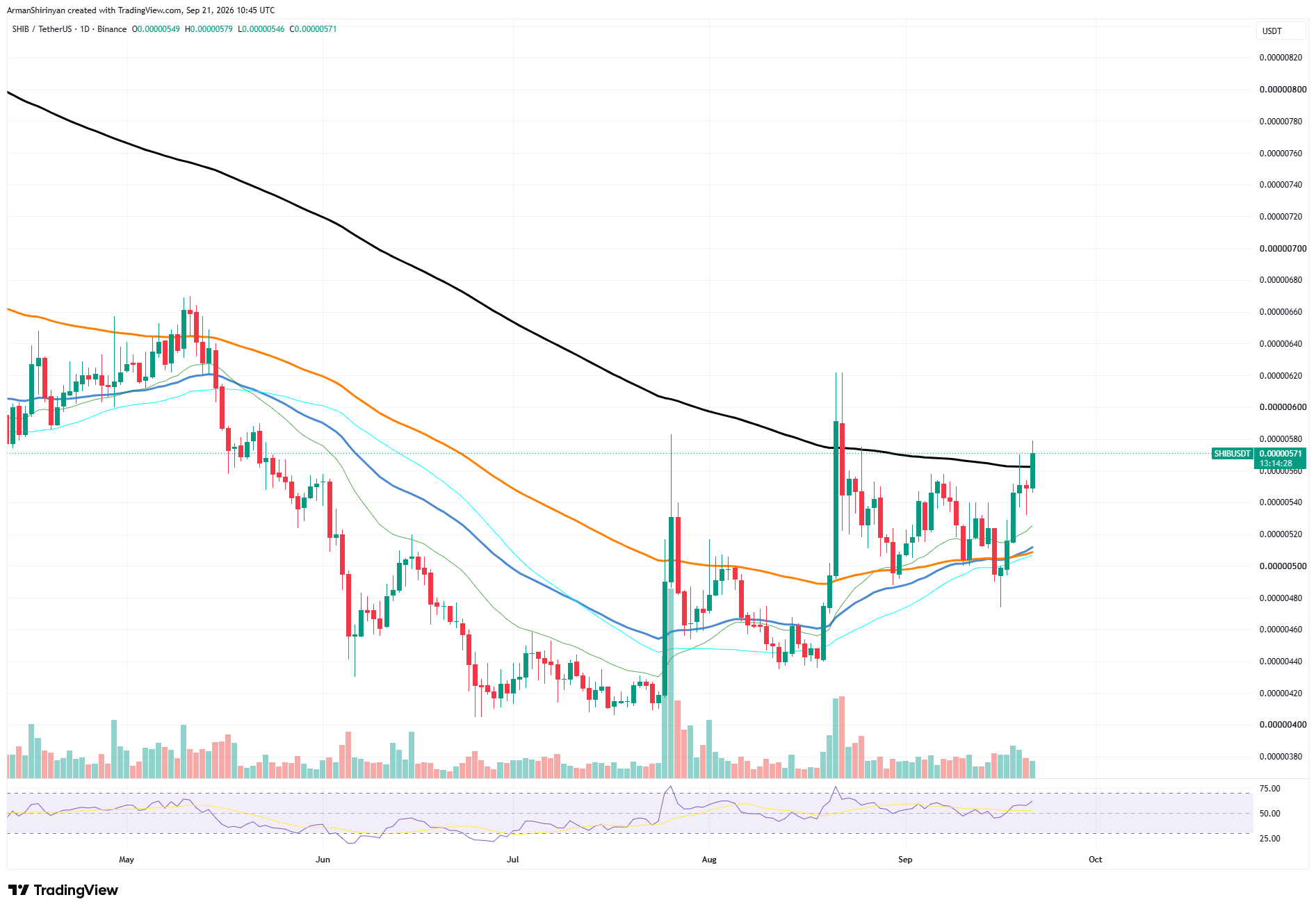
$SHIB currently trades around $0.00000571, following an intraday push to approximately $0.00000579. The critical development is the interaction with the black long-term moving average on the daily chart. This level has been declining for months and has repeatedly functioned as an overhead barrier. $SHIB has now pushed marginally above it, putting the market in a position to confirm a broader trend change.
$SHIB/USDT Chart by TradingView
The rest of the moving-average structure has already improved considerably. $SHIB trades above its shorter moving averages clustered around $0.00000505–$0.00000525, while those averages have started turning upward. The RSI has climbed above 60 but remains below overbought territory, giving the breakout some room before momentum becomes excessively stretched.
Volume has also expanded during the latest advance, although it remains below the extreme spikes accompanying some previous $SHIB breakouts.
Exchange data introduces one significant risk. Exchange reserves increased 0.14%, while total netflow rose 1.06%. Total inflows increased 0.86%, compared with a 0.73% increase in outflows. More notably, the seven-day moving average of mean exchange inflows jumped 24.12%.
That does not automatically mean investors are preparing to sell, but increasing exchange deposits generally increase the amount of $SHIB immediately available for trading and potential distribution. It therefore creates additional supply-side pressure precisely as $SHIB tests an important resistance level.
Major target is next
Technically, confirmation now matters more than the initial breakout. $SHIB needs to maintain daily closes above roughly $0.00000560–$0.00000570. If it succeeds, the next target becomes $0.00000600, followed by the previous spike around $0.00000620.
Failure to hold the breakout would put $0.00000540 back into focus. Below that, the moving-average cluster around $0.00000500–$0.00000520 provides considerably stronger support.
$SHIB has therefore cleared the first major obstacle, but the breakout is not yet comfortably established. Holding above the long-term moving average while absorbing rising exchange inflows would provide much stronger confirmation than the initial move alone.
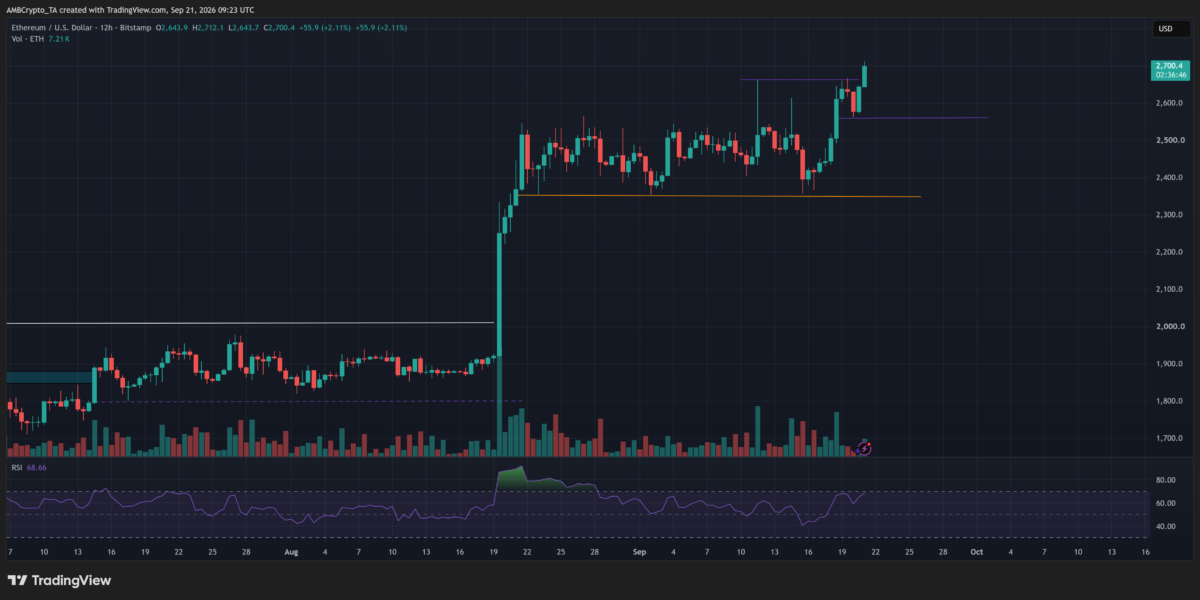
Ethereum’s latest breakout extends a trend that has steadily shifted support higher. The recent pullback at $2,560 and a brief test of lower support at $2,550. Following this, buyers re-entered the market, pushing the price to a new high in the $2,600 to $2,700 range.
The move accelerated between the 20th and the 21st of September as Ethereum [$ETH] reached $2,712 before declining slightly, settling around the $2,700 level. Volume also increased during this time, indicating greater participation in the increase.
Source: TradingView
Meanwhile, RSI climbed to 68.66, approaching overbought territory. Despite that, it did not cross that threshold, which is above 70. A sustained move above $2,700 would reinforce the breakout and keep higher resistance levels within reach.
The current strength indicates the potential for a short-term cooling after the large gain. However, the structure still appears supportive so long as $2,560 continues to hold.
$ETH whale demand strengthens
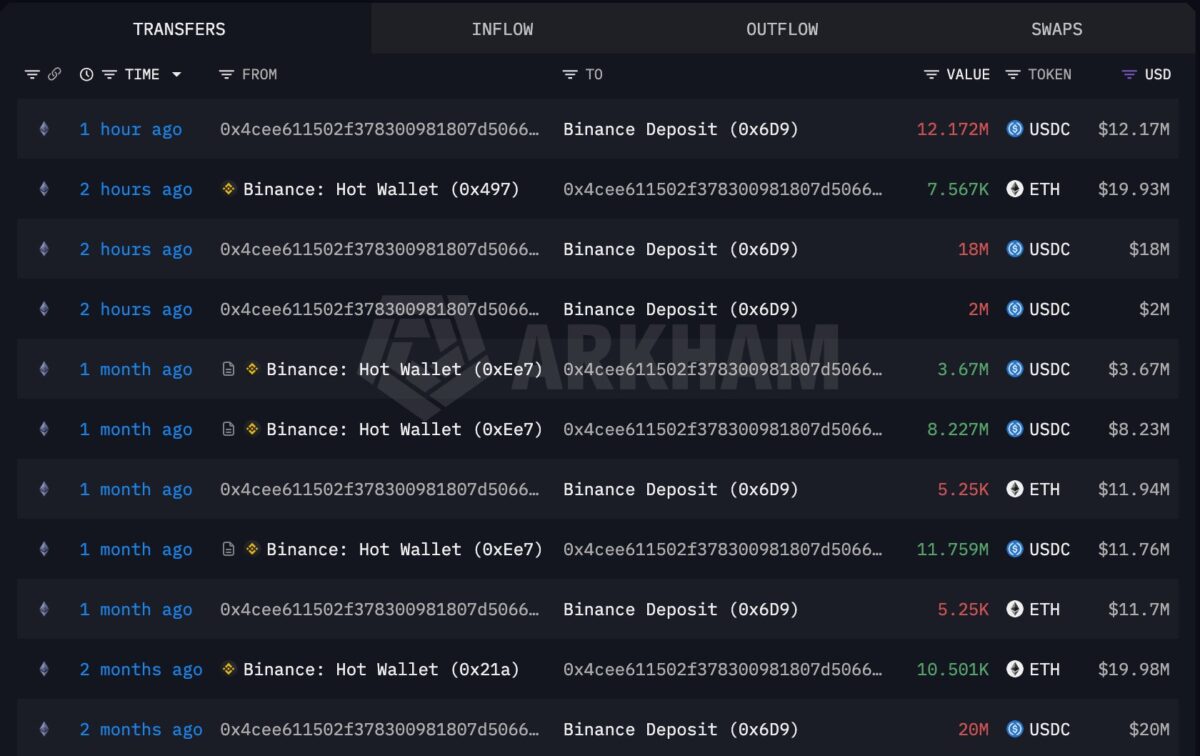
Ethereum’s recent breakout has attracted significant spot demand from larger holders, adding depth to the move above $2,700. Wallet 0x4cee purchased 7567 $ETH worth approximately $19.9 million after transferring stablecoins to Binance.
This purchase stood out due to the fact that the same wallet sold 10500 $ETH a month ago for an average price of about $2252 per $ETH.
The buyer secured $3.66 million in profits on that sale. This indicates that the trader is more convinced of an upside potential than during the earlier sale.
Source: LookOnChain
Notably, the recently purchased $ETH was transferred from Binance, reducing the supply immediately available for resale. As such, this represents a much stronger positive demand indicator than if the investor had established a leverage position.
If similar accumulation continues, whale buying could reinforce the breakout and help $ETH sustain prices above $2,700.
Can $ETH hold $2,700?
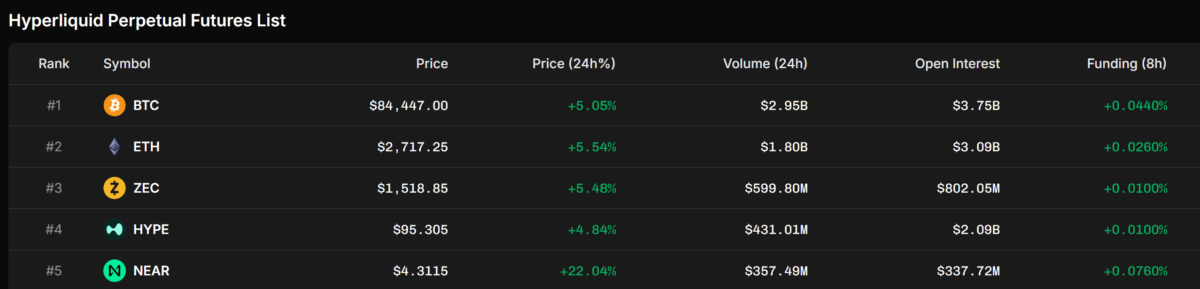
Ethereum’s breakout now faces a derivatives market that supports momentum without showing excessive leverage. Hyperliquid holds roughly $3 billion in $ETH Open Interest, yet funding remains slightly positive.
Source: Loris Tool
On the other hand, short liquidation volumes reached $170 million as Ethereum forced short-sellers to buy back their positions during the upward breakout through $2,700.
When prices surged past resistance, forced market orders from liquidated short positions acted as secondary buying pressure. As a result, they accelerated the upward momentum toward $2,712.
Source: CoinGlass
In turn, buying pressure will increase the upward speed of prices, but it may fade as soon as all shorts are liquidated. As a result, $ETH will need to get spot buyers to replace that temporary demand and defend $2,700
Whale accumulation strengthens this setup, while mixed ETF flows leave confirmation incomplete. Holding $2,700 could open $2,760. Consequently, if it loses $2600, it could lead to weakened momentum.
Final Summary
Ethereum holds near $2,700 as whale buying and short liquidations support the breakout.
$ETH needs sustained Spot demand above $2,700 to target $2,760 and preserve bullish momentum.
Google and Apple are seeking employees with expertise in digital assets, adding to signs that Big Tech firms are preparing for a larger role for stablecoins, tokenization and blockchain-based payments.
Google Cloud is hiring an Industry Principal Architect in Hong Kong to work with protocol foundations, exchanges, custodians and financial institutions to tokenize real-world assets across the Asia-Pacific (APAC) region.
The role calls for experience with blockchain networks, smart contracts, stablecoin infrastructure, tokenized deposits and custody technologies. Google said the hire would advise executives and help shape its Web3 product roadmap as it seeks to become the preferred cloud provider for digital-asset builders and institutional adopters.
Apple is also expanding into digital assets. It is looking for an Apple Pay Financial Product Strategy Lead based in Cupertino, California or New York.
The listings do not confirm that either company is launching a new crypto product, but it does show that stablecoins and tokenized deposits are becoming relevant expertise inside two of the world’s largest tech and payments ecosystems, rather than remaining the preserve of crypto-native firms.
Whatever the true state of settlement talks this weekend among Paramount, a coalition of state Attorneys General and the Writers Guild of America to end the antitrust action over the $111 billion Warner Bros Discovery merger, the people against the deal from the beginning are not going quietly.
“As Trump tries to ban CNN from the White House, it would be a massive mistake to cave on the Paramount merger,” Sen. Elizabeth Warren (D-MA) said Saturday morning as the current WBD-owned CNN and MS Now journalists were denied access to the Executive Mansion. “The last thing we need is another Trump-controlled media conglomerate abusing its power to stomp out competition. This is a dangerous merger.”
Compared to Warren, the A-list-supported Block the Merger is truly angry and feeling betrayed.
“The rumored ‘deal’ to usher the Paramount-Warner Bros. merger forward is an insult to everyone who has stood up against this harmful transaction and to the hundreds of thousands of workers, journalists, and consumers who will be hurt if it goes forward,” the DC-based group told Deadline today of reported behind-closed-doors negotiations underway right now. “Let’s be very clear: an agreement based on unenforceable concessions is a win only for David Ellison. It is an L for everyone else.”
As leaks of talks between the AGs, led by California’s politically ambitious AG Rob Bonta, and the Ellison-run Paramount flooded the media late Friday, the possible L (loss) that BTM are spotlighting could include guardrails around CNN editorial independence, some selloffs and job assurances. The hope down on Melrose is such a deal would render moot the March 2, 2027, trial start date currently on the calendar in federal court — and all the financial and political blast radius that comes with it for the Trump-friendly Ellisons.
To that, with massive job, production and tax-revenue losses on the table, Paramount’s plan B for the last eight weeks has been to pressure Bonta from all sides to make a deal. Two days of court-ordered settlement talks have already been set for mid-October, but that’s procedural in the judicial system and widely expected to go nowhere fast.
Also, mid-October doesn’t quite line up with Ellison’s balance sheet.
Looking at an October 1 date in which a $7 million-a-day ticking fee to WBD shareholders begins, as well as a September 24 hearing on a Hail Mary desire for a $1.88 billion bond from the states and the WGA, Ellison’s crew has been leaking more than ever threats to exit California for a red state.
Even as the likes of outgoing California Gov. Gavin Newsom acknowledged privately at the recent Primetime Emmys that the Ellisons were being too heavy-handed, the multi-pronged pressure campaign seems to have paid off. Whereas Bonta once accused Paramount of “blackmail” with its threats and theatrical promises, the reelection-seeking AG now has his lieutenants in the room with Ellison’s execs.
The latest word on the wire is the parties could have an agreement before the official start of Yom Kippur this weekend.
Word is also out there that New York AG Letitia James isn’t as “in step,” according to a source, with Bonta as she was when it came to burying the hatchet with Paramount. There is also the wildcard of the WGA, which joined the AGs’ July 13 suit after filing an anti-merger action of its own.
“This is such bullsh*t,” an industry insider told Deadline this morning of the ParaBros talks. “Bonta should have called their bluff, instead he caved,” she added, noting such tactics are typical of Democratic politicians in the MAGA era.
Block the Merger, with its support from such names as Bryan Cranston, Hannah Einbinder, Bradley Whitford, W. Kamau Bell, Kristen Vangsness, Jane Fonda and Rati Gupta, wasn’t quite as blunt today in its statement, but the vibe was much the same.
“Thousands of industry leaders took a risk when they spoke out publicly about the harm the Paramount-Warner Bros. merger would cause,” said the outfit, which also counts Noah Wyle, Denis Villeneuve, Atsuko Okatsuka, Damon Lindelof and Sofia Coppola among its backers. Claiming that more than 75,000 people have joined them to tell the state AGs to stand strong including national leaders like Warren, the group said, “We know a bad deal when we see one. AG Bonta and his fellow state AGs should reject this deal, stand strong, and fully block the merger with no concessions.”
That mention of Warren may have greater significance this weekend than initially apparent. Like everyone else, Paramount is keenly aware of what the polls are projecting going into November’s midterms. If the midterms actually occur and if the new Congress is actually seated (two big ifs in America right now), a projected Democratic majority in the House and Senate have promised to probe and even break up mega media mergers.
Even with Oracle founder Larry Ellison the primary backer of his son’s ParaBros dreams, the even older Ellison’s net worth, which has been declining of late, may not be able to handle the strain of months and months of such probes. So perhaps it is the first week of November, not October 1, that is the calendar date the younger Ellison is hoping to beat this weekend.
Paramount has been in “no comment” mode for weeks since the Melrose lot got burned on allegations of leaks detailing past preliminary talks with Bonta’s gang.
Bonta’s office did not respond Saturday to Deadline’s request for comment on Warren and Block the Merger’s opposition to the talks.
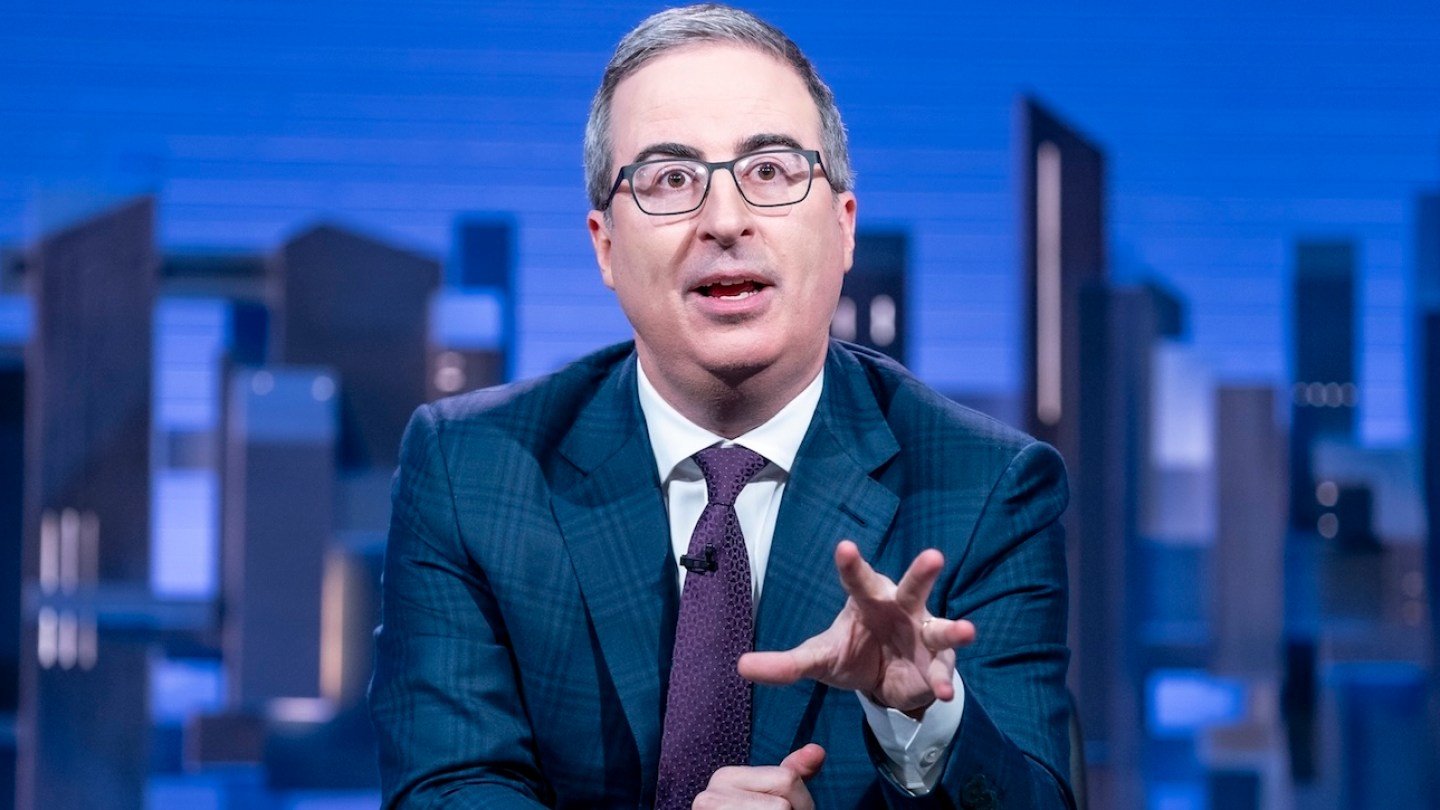
John Oliver took a jab at “soon-to-be business daddy” David Ellison on Sunday’s Last Week Tonight.
The HBO show’s host did a deep dive into UnitedHealthCare record of denying customers much-needed health care, starting off by noting that Luigi Mangione is due to be sentenced in December for killing CEO Brian Thompson, an act that many people rejoiced amid their frustration with the company.
Oliver gave several examples of patients who were denied crucial health care, including a cancer patient whose parents ultimately had to fork over $95,000 for due to UHC’s denials.
Here he took the opportunity to take a jab at Ellison, the CEO of Paramount Skydance, which is in the process of trying to get regulator approval to purchase Warner Bros. Discovery, the current parent company of HBO.
“Now in the end her parents paid $95,000 out of pocket to cover the treatment, which in happy news did actually work, but having access to wealthy parents just cannot be the system to get badly needed healthcare, even if it is apparently the system that lets you be in charge of HBO,” Oliver said, showing a photo of Ellison.
The Hollywood Reporter can unveil a never-before-seen clip from San Sebastián competition feature What Remains.
Turkish filmmaker Yeşim Ustaoğlu returns to the Basque festival following her Golden Shell win in 2008 for Pandora’s Box, which also earned lead actress Tsilla Chelton the Silver Shell for best actress.
With What Remains, premiering on Sept. 22, the prolific director tells the story of Elif, a poet who breaks free from her suffocating life to “reconnect with her inner voice and conscience and allow her creativity to flow again.” A plot synopsis continues: “As she begins to question the conventions of family, identity and the meaning of life, her journey towards self-discovery challenges those around her to reconsider their own lives — taking the whole family in a new direction.”
Turkish star Öykü Karayel plays the protagonist, with Metin Akdülger co-starring as Mehmet, Ali Kayra Kul as Selim and İlyas Salman as Mustafa.
The clip released through THR on Monday — which you can watch below — shows a painful conversation between Elif and Mehmet, where he puts to her: “Do you even love me anymore?”
Ustaoğlu said What Remains began to take shape “precisely when I started asking this question again.” She said that the feature is a personal project: “It grew out of a desire to break free from a sense of suffocation and weariness — one I had begun to witness not only in myself, but in the people around me. A suffocation that traps our lives in a systemic cycle, standardises us, grinds us down, and eventually drains our ability to create. The only way out seemed to be to stop everything, step outside it all, leave, look, and try to understand.”
The Match Factory is handling global sales on What Remains. Mubi, which owns The Match Factory and is a co-producer on the film, has acquired all rights in Turkey. The movie is a Ustaoglu Film production from Turkey, with Luxembourg’s Tarantula, Bulgaria’s RFF International and France’s Cite Films. Mubi is a co-producer alongside Pak Ventures and Yuvision, with What Remains made in collaboration with Istos Film.
The 74th San Sebastián Film Festival runs Sept. 18-26. Watch the clip from What Remains below.
Writer-director Pablo Larraín, best known for his trilogy “Jackie,” “Spencer” and “Maria,” ventures into Argentina for the first time in “My Sad Dead” (“Mis muertos tristes”), based on three stories by Argentinean writer Mariana Enriquez. It stars some of Argentina’s brightest talent, led by Mercedes Moran, Dolores Fonzi, Alejandra Flechner and Carolina Álvarez. Not unlike his 2023 feature “The Count” (“El Conde”), “My Sad Dead” enters into genre territory.
The Netflix four-part miniseries produced by Larraín’s btoher Juan de Dioas Larraón and their label Fabula, was made into a feature version of nearly three hours to vie for the Golden Shell in San Sebastian’s official competition.
The story follows Ema (Moran), a recently retired doctor who can see and hear the dead. She is haunted by her mother’s death and her own unfinished business. When her niece Julie arrives and three teenagers are murdered in the violence-ridden neighborhood of Piedrabuena, something strange begins to spread, tearing apart the fragile boundary between the living and the dead. What was once Ema’s burden becomes everyone’s nightmare. The dead are making themselves heard – and no one can escape their ghosts.
In an interview with Variety in San Sebastian, Larraín and Enriquez held forth on their adaptation, which they co-wrote with Chilean playwright Guillermo Calderón, a coscribe on “The Club,” “Neruda” and “El Conde,” and Anastasia Ayazi (“Patagonia”)
Mariana, what inspired you to write these stories? Are they purely sourced from your imagination or inspired by events and people you know?
Enriquez: Like Ema, my mother is a doctor who has worked in a public hospital, and the neighborhood in the book is based on a real neighborhood. It’s different, but quite similar to my idea of the periphery, outside the city, kind of a forgotten place. Many of the violent situations are real situations, distorted a bit to make them more or less fictional. Of course, the woman who can speak to the dead is fictional, but it’s not that far removed from reality.
But these stories of women or people who can speak to the dead – do you actually know people who see them?
Enriquez: My aunt used to see my grandmother everywhere. My mother is very peculiar, she smells things, which is very weird. Like, she would be here, for example, and suddenly smell gasoline. And that means something. Not that the car is going to explode, but the smell isn’t supposed to be there. It’s not a phantom smell. It alerts her that something is going to happen. My aunties are more straightforward, seeing ghosts, that kind of thing.
And how did you come up with the character of the niece who engages in sex with ghosts.
Enriquez: Well, I’m very interested in genre in general. There was a famous movie in the ’80s called ‘The Entity,’ a horror movie where a woman is visited by spirits and has sex with them. You could see the hands touching her in a very cool special effect, but it was not consensual. I remember being very upset watching it and through the years I kept thinking: what if it was consensual? And I started thinking about the saints who said they were married to the Holy Spirit and this idea of a woman being able to touch the other side and actually have a physical relationship with it – not a relationship of fear, but of pleasure, of ecstasy, of sanity, in a way.
Pablo, This is your first time to shoot in Argentina, how was that experience?
Larraín: Of course, Argentina is our neighbor, but growing up, I was always more aware of our differences than our similarities. Then there’s always a moment when things can change. I’ve been to Argentina to travel around the country and I know it quite well, especially Buenos Aires. But doing this, working there, really looking around the city and engaging with local people, the local crews and everybody, I started to understand that the things that are similar are way more than the things that are different. There’s so much in common. It was fascinating. I really felt at home in a way. I know that for foreigners it’s obvious – they look down there in South America and think they must be very similar. But for me, it was a whole process to discover that.
I interviewed Gael Garcia Bernal a few weeks ago who’s worked with you on several films [“No,” “Ema”, “Neruda”] and he said that what he admires about you is your fearlessness in filmmaking – this attitude of, ‘Let’s just go for it. Let’s try. Let’s break it.’ Would you care to comment on that?
Larraín: Well, that’s kind and generous of him. He’s a friend, so I understand that, but I don’t really see it like that. I work with what feels comfortable. For example, when we approached Mariana and said, ‘Would you be okay? Would you join us? Would you want to be part of this adaptation?’ I had really got into her narrative and into the idea of trying to express visually what she wrote somehow. You could call it an adaptation, but there’s something about traveling from the book towards a visual representation that was very relevant.
What did you find the most challenging and interesting aspects of this project?
Larraín: I do think there’s something very beautiful and very unusual about the sound space, the number of things that are relevant for the story that we don’t see, but only hear. It’s massive, very unusual and very challenging, especially knowing that most people will see this on television. Everything that is not in the frame but has a sound that is relevant for the story, is very intriguing to me to work with. I think that was one of the most challenging things: to bring into the sound space things that are never seen in the story.
I think what I really found interesting and maybe discovered later in the process, is that when we talk about dead people and about the memory we have of them and how we experience them – whether we feel them, remember them in dreams, physically see them, or hear them – it’s always from the perspective of the living person.
What I think Mariana has found in this narrative is that now we get to know what the dead are also feeling when they’re claiming their presence and saying, ‘Hey, I’m here.’ They’re also saying, ‘Please, I need your attention.’ And so, it’s interesting because now we get to understand them a little bit more. There’s empathy towards them and I think that’s very gracious.
It’s no longer a secret that Basque cinema is getting some overdue time in the spotlight.
Thanks to an almighty production boom in the region, powered by a whopping 60 percent tax rebate (increasing to 70 percent for projects shot in the Basque language, Euskera), the Basque Country’s film and TV output has never looked so healthy. And the proof is in the pudding: The Hollywood Reporter took an in-depth look at the record 45 nominations for Basque projects at this year’s Goyas, also known as “the Spanish Oscars,” after a decade of concentrated investment.
With San Sebastián’s profile rising exponentially every September, the people working behind the scenes to make sure Basque cinema is capitalizing on every single success are already pushing the next generation of original voices into the festival hot seat. At the 74th edition, a total of 31 titles with Basque production ties — including David Pérez Sañudo’s hotly anticipated competition title The Harvester — will screen across the festival’s many selections. Twelve are documentaries, marking a real moment for Basque docs at this installment. But with award statuettes firmly on the mantel, the Basque region now sets itself the task of sustaining this run of form long-term. The answer? Find and nurture the next generation’s emerging talent.
For example, the debut feature from Nitya López Saitua in Zinemira, Family Drill, a project fuelled by word-of-mouth buzz across northern Spain. “He’s been doing great as a first AD and second AD for so many years,” begins Mar Izquierdo, coordinator of Zineuskadi, a non-profit operating at the epicentre of the Basque film and TV industry, “and everyone was like, ‘But he’s got it. He’s not going to be an AD.’ And we really do hope that with this film, everyone else will be able to see it.”
Izquierdo’s company works strategically to promote the Basque audiovisual sector, partnering with every production output in the region, working alongside the Basque government’s culture department and public broadcaster ETB Basque to help facilitate co-productions, distribution and sales deals, as well as earning key projects coveted slots at the globe’s biggest film festivals and plotting awards campaigns.
One young talent they’ve thrown their support behind is the 30-year-old López, who was in such a hurry to capture the creative process practically spilling out of his head that Family Drill — a co-production with Mubox Studio, who are distributing the film — was shot with just 10 people across three days in his childhood home on the Basque coast. He tells THR: “Iraia Elias and Miguel Garcés [play] my mom and dad and we recreate my parents’ relationship, [leading up to] the last argument that broke the relationship when I was four years old.” It is as deeply personal as it sounds. “This was a way to recreate memories that I didn’t have,” says López, firmly out of AD mode and in full-fledged director mode. “And I think it was very important to free-work on the scenes, without a script.”
Family Drill
San Sebastian Film Festival
López’s determination to start the shoot before he lost that powerful sense of direction in chronicling his parents’ split speaks to the strength of the Basque Country’s storytelling. “We have really great directors here in the Basque Country, and internationally they are [getting] more recognized,” continues the first-time filmmaker. “I have the opportunity of working with many of them, and I love their work, and I’m very proud to be part of the next generation making movies. I think that we are in a great moment [compared to] making movies here 20 years ago.” It used to be the case that, “if [creatives] want to direct, they must go to other places, go to Madrid,” he explains. Here in the region López calls home, there have never been so many reasons to put roots down.
One of his countrymen, Javier Giner, also arrives at the San Sebastián Film Festival with his first movie. This Solitude is premiering in the New Directors section. A debut feature it may technically be, but director-writer Giner has known global success with the International Emmy-winning I, Addict series, based on his own life and struggle with drug addiction. With This Solitude, Giner, who grew up in Bilbao, reacts to the unprecedented impact of that show. “I, Addict was a huge hit in Spain and it dealt with a part of my life where I suffered [with] the illness of addiction,” he says. “After that explosive TV series where I presented myself to the world with no mask, I needed to go back to my childhood, to a very intimate place, a very silent place — much smaller than I, Addict.”
Giner suddenly found himself shooting where he grew up, Bilbao, back to the places and locations that he says “have an emotional resonance” for him. The film, starring Oriol Pla, Marina Salas, Gemma Martínez, Kai Etxaniz and Itziar Lazkano, is a Balance Media Entertainment production, with The Embassy TV and Basajaun Filmak as co-producers, and Filmax handling distribution. “We meet two young people who live in Bilbao, Leo and Lorea, and we follow them through the grief process after they break a five-year-long relationship,” Giner explains. “And I use that journey as an excuse to talk about a lot of things like class, the housing [crisis]. […] Those moments in our lives everyone goes through, in a sense of reconstructing yourself because nothing works around you and you don’t quite grasp who you are [or] what you want.”
He speaks with as much gusto as López, who also, in some way, depicts his Basque youth on screen — a common theme running through many of these films — and seeing fellow regional filmmakers make a name for themselves in recent years only speaks to the urgency of the stories coming out of the Basque Country, according to Giner. “To be honest, it fills me with pride,” he says. “I think movies and filmmakers, when they’re honest with their upbringing and their roots, there’s something very beautiful in it. As an audience member, I love when I discover London through Mike Leigh’s eyes, for example, or I discover parts of the world that I don’t know about through some filmmaker’s eyes.”
Giner says that in the last 10 years, especially, Basque stories have been “very important to tell.” He continues: “I jokingly call This Solitude my very Basque movie, because there’s a reflection of identity in the movie… It tells [you] a lot about the place. And the Basque Country, it’s beautiful. It has beautiful landscapes. It has great possibilities. It is filled with really talented people, both in front of and behind the camera. So, I mean, it fills me with total pride if someone considers me the representation of the Basque Country at this year’s festival.” He is admittedly still pinching himself that he’s here: “It’s incredible. To be honest, a lot of my film education has to do with the San Sebastián Film Festival because when I was a teenager, I used to go from Bilbao to San Sebastián and watch movies.”
López concurs that Basque cinema has its own culture, but also lauds the region’s directors for still being able to make “really universal movies.” And Izquierdo says the variation across the projects this year is particularly exciting for her. “The best thing is we are covering every possible subject,” she says. “We have a biopic for a musical group. We have culinary cinema. We have a French co-production, a coming-of-age [film] within a school. We have everything.”
Basque filmmaker Javier Giner.
San Sebastian Film Festival
And naturally, the festival also serves as something of a springboard for those nail-biting awards runs. “It’s the most important film festival in Spain and one of the [category] A film festivals in the world,” says Giner about what a premiere in San Sebastián can do for one’s Goya hopes. “So it’s definitely a great trampoline. But it’s something that I don’t want to think about because I don’t want to get lost in that narrative and it take away from the pure pleasure of putting a film out there and sharing it with the public.”
Of course, it’s not just Basque filmmakers travelling to shoot here. Taiwan’s Tsai Ming-liang is presenting Dust in San Sebastián, a short film and exhibition piece as part of his Walker series, which is a Basque co-production. Nanni Moretti made the most of those tempting tax incentives, too, with his last movie It Will Happen Tonight filming in the region before its recent Venice Film Festival premiere, and the Catherine Zeta-Jones starrer Kill Jackie — releasing Oct. 2 — shot extensively across Bilbao. “It’s not only that we continue to have emerging talent, but we are able to co-produce and have A-class films as minority co-producers,” beams Izquierdo.
But she maintains that the most rewarding part of her job is platforming the next generation of Basque filmmakers, who are carving out a path by leading with instinct, leaning into personal storytelling, and celebrating each milestone. “The big names know how to [make] their way through the other festivals,” says Izquierdo. “But some of them need this in order to get the next one — it’s a window of opportunity for them, because otherwise maybe their documentary or small film would be just another small fish in the pond. Here,” she adds, “they get the chance on the big screen, where exhibitors and distributors will be able to notice them.”
The 2026 San Sebastián International Film Festival runs Sep. 18-26.
British South Asian drama “A Teacher’s Gift” has landed U.K. theatrical distribution through Peccadillo Pictures, the independent distributor known for its LGBTQ+ and world cinema output.
The deal confirms the film’s BIFA-qualifying status and puts it in contention for the British Independent Film Awards.
Eric Ollerenshaw produces the film, which was shot in the Midlands with Wolverhampton company New Lion Films co-producing, giving the project a regional footprint outside London. Artur Ribeiro (“Terra Nova”) directs from a script he co-wrote with Rajdeep Choudhury and Will D. Parry.
The film is backed by India’s National Film Development Corporation (NFDC) and British-South African entrepreneur Richard Murray. Its cast is led by Rajdeep Choudhury (“Simulacra”), Anthony Calf (“The Madness of King George”), Anjali Patil (“Newton”), Paula Lobo Antunes, Dhruv Sehgal, Virgilio Castelo and Varun Buddhadev.
The story unfolds across London and India, centering on Rohan, an ambitious Hindi teacher caught between family expectations and his own wants. A connection forms between him and an older, cultured Englishman over a mutual passion for books and cricket, and their relationship pushes both men toward a reckoning with who they are, cutting across age, culture and convention. The film examines identity, belonging and the ties between generations within Britain’s South Asian community.
“A Teacher’s Gift” has built a substantial festival record ahead of its U.K. release. It premiered at Tribeca Festival Lisboa before playing the Iris Prize LGBTQ+ Film Festival, earning a best feature Film nomination there, and picked up a special mention for best feature film at the BIFA-qualifying Unrestricted View Film Festival. The film went on to its Asian premiere at the 56th International Film Festival of India (IFFI) and its Latin American premiere at the Guadalajara International Film Festival, where it competed for the Premio Maguey.
Peccadillo Pictures’ U.K. theatrical release will bring “A Teacher’s Gift” to cinemas across the country.
Tom Abell, founder of Peccadillo Pictures, said: “‘A Teacher’s Gift’ is exactly the kind of nuanced, globally minded British cinema we’re passionate about bringing to audiences. Artur Ribeiro, Will D. Parry and Rajdeep Choudhury have crafted a tender, quietly radical story that traverses generations, continents and cultures without ever losing sight of its deeply human core. We’re proud to champion this film in U.K. cinemas and thrilled that our theatrical release secures its eligibility as a serious BIFA contender.”
Ollerenshaw said securing U.K. theatrical distribution with Peccadillo Pictures marks another remarkable step for an independent British film, adding, “This release doesn’t just qualify us for the BIFAs, it ensures the film and its story can be experienced on the big screen, where its themes of culture, care and connection really belong.”
“A Teacher’s Gift” is set to open theatrically in the U.K. in mid-November.