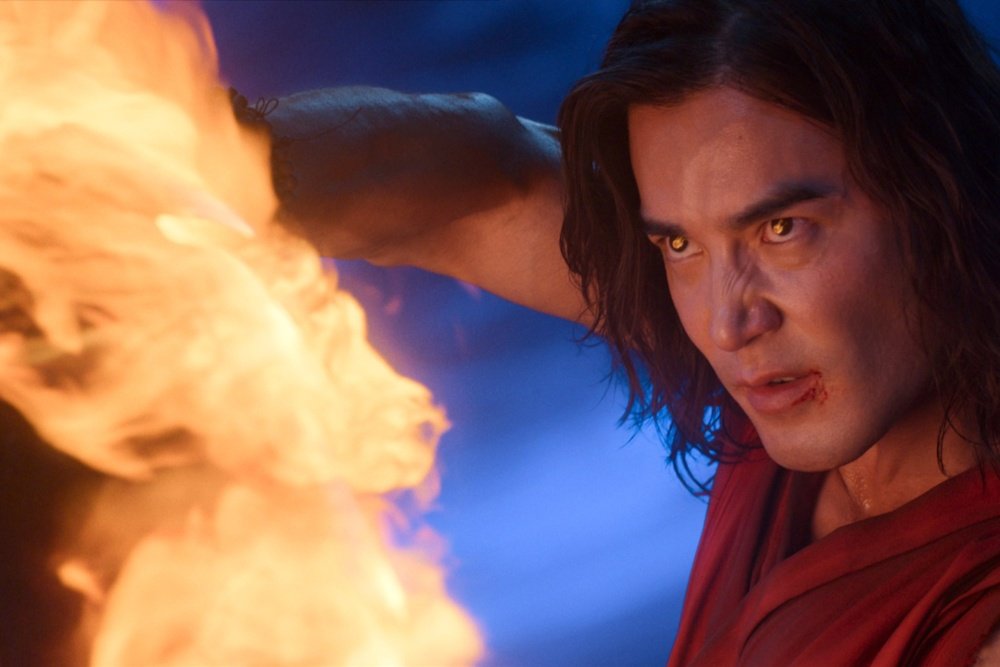
Ludi Lin has spent the better part of a decade punching, kicking and fire-bending his way through some of Hollywood’s biggest action franchises. He is very good at it. He would also like to do something else.
Three days before this interview, Lin had been in Indonesia for the premiere of “Mortal Kombat II.” The crowds there, he says, were unlike anything he’d experienced in a Western theater. People stood up. They grabbed their neighbors by the shoulders. When something happened on screen, they reacted out loud and in full.
“They’re so excited and expressive,” he tells Variety. “The fans are ravenous for content.”
Lin has been thinking a lot about Asia lately – as a market, as a creative space, as the place where the next chapter of his career is likely to unfold. He is, at this moment, a veteran of “Power Rangers,” “Aquaman” and the “Mortal Kombat” series, and is quietly, deliberately working out how to become something else.
He reprises his role as martial arts champion Liu Kang in “Mortal Kombat II,” the sequel to the 2021 film that became the most-watched title on HBO Max during the pandemic, outlasting “Dune” and “Justice League” in the platform’s viewership rankings. Directed once again by Simon McQuoid, the new film brings Earth’s champions together for the long-awaited tournament at the center of the franchise mythology. The stakes are the survival of Earthrealm against the dark rule of Martyn Ford’s Shao Kahn. Series regulars Sanada Hiroyuki, Joe Taslim, Jessica McNamee, Mehcad Brooks, Asano Tadanobu and Lewis Tan return, joined by newcomers Adeline Rudolph and Tati Gabrielle, and headlined by Karl Urban as Johnny Cage – whose absence from the first film was among the franchise fanbase’s most-discussed grievances.
The new film releases in Indonesia and the Philippines ahead of broader Asian markets, Australia and eventually the U.S. – an Asia-first strategy that Lin says is no accident.
“My bet’s on Asia,” he says.
The most striking element of that bet involves China. “Mortal Kombat II” will screen there without any edits or modifications – no inserted scenes, no re-cut sequences, the fatalities and brutality intact. “‘Mortal Kombat II’ is releasing in China with no cuts. This is a first,” Lin says, noting the contrast with earlier Hollywood approaches to the Chinese market, which added scenes featuring Chinese actors that appeared nowhere else. The unmodified release, he argues, flows naturally from who is actually in the film. The cast spans actors of Chinese, Japanese, Indonesian and Korean heritage. “This is why it’s trending internationally, rather than just focusing on domestic,” he says.
For Lin, Liu Kang in this sequel is in a darker emotional place than before. “He just steps more into his power. It’s the next step in his evolution,” Lin says. A self-described manga and anime devotee, he frames the arc as a kind of Super Saiyan upgrade – a reference to the power transformations central to the “Dragon Ball” franchise.
The physical demands of that evolution were considerable. For the first film, Lin wore a wig; this time, the hair is his own. He also added significant muscle, conscious that his co-stars cut imposing figures. The fight choreography grew in scope and complexity, most notably in a key sequence opposite Max Huang, who plays Kung Lao. “We put a lot of work into that fight, and we’re both really proud of what we accomplished,” Lin says.
He speaks about franchise filmmaking with the equanimity of someone who has been surprised by it before, in both directions. “Power Rangers” came with promises of a multi-film arc that never materialized; “Aquaman” crossed a billion dollars when he wasn’t sure audiences would respond. “With a franchise like this, expect the unexpected and really just enjoy the moment while you’re doing it,” he says.
The unexpected, right now, looks like this: Lin is pivoting. “Eternity,” which wrapped in January after a location shoot across Italy and Greece, is next. “It’s going to be sexy… there’s a heist element to it,” he says. “Finding Theo,” an indie drama about a young man wrestling with identity, romance and family, is set to begin production. “It’s going to exemplify another area of Asia that is seldomly seen,” he says. Beyond those two projects, Lin is attached to something set in Singapore and Indonesia – a role he describes as “quite meta” – though he won’t say more until it’s finalized.
The through-line, he says, is the desire to occupy a fuller range. In Hollywood he is an action star; working in the Chinese industry, he found room for dramatic roles that required physical transformation and dialect study – a chain-smoking retired soldier, among others. He wants more of that, on both sides. “A part of me also knows that as a person I’m more complex than just a fighting machine,” he says.
He is betting Asia agrees.
Leave a Reply