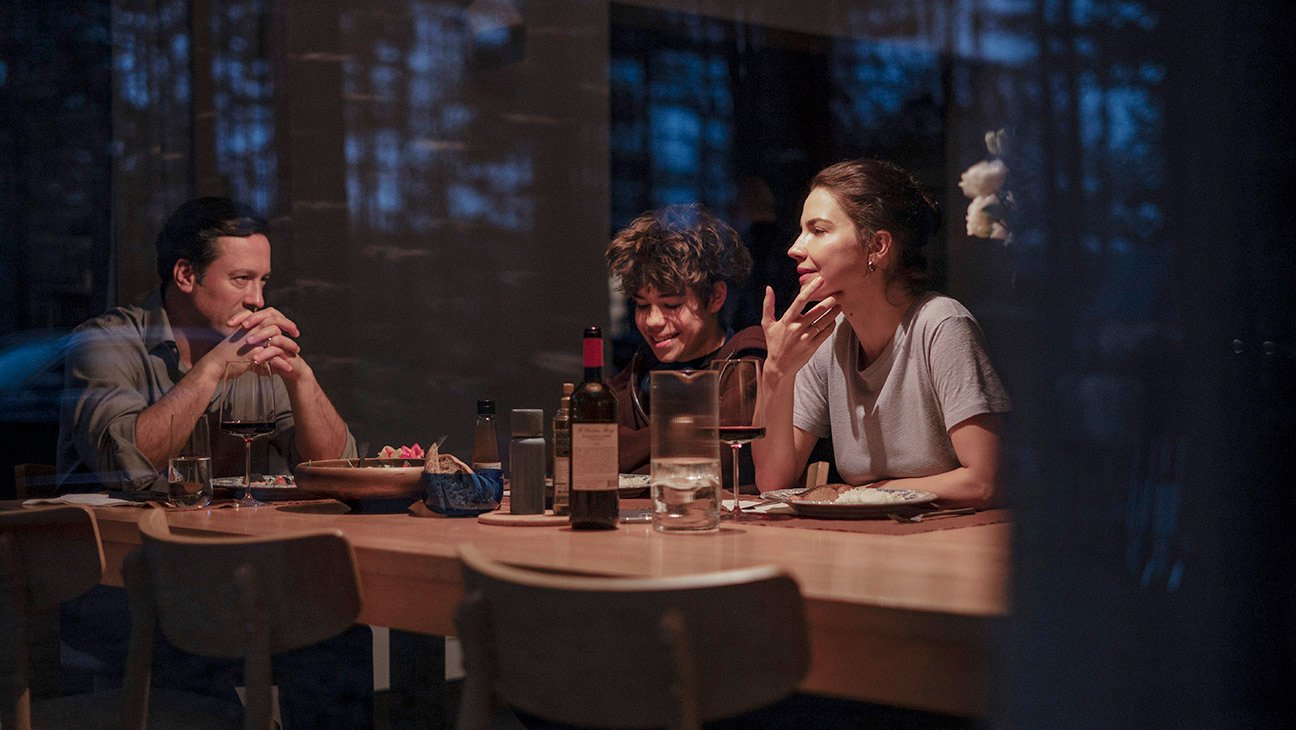
Minotaur may allude to a Greek myth, be loosely based on a film by Claude Chabrol (The Unfaithful Wife), and represent the first work director Andrey Zvyagintsev (The Return, Leviathan) has made entirely outside Russia. (Shot in Latvia, it is officially a French-German-Latvia co-production.) But it’s about as Russian as a film could be. It’s as Russian as horseradish vodka, forest steppe marmots, and the word toska, a Russian term that connotes a profound melancholy whose many shades Vladimir Nabokov said could not be captured in English, but which range from “great spiritual anguish” to “physical or metaphysical dissatisfaction, a sense of longing, a dull anguish, a preying misery, a gnawing mental ache.”
This rigorously well-made, grippy-as-a-live-squid, toska-steeped work is Zvyagintsev’s most openly critical commentary on the motherland’s current political, spiritual and moral malaise, a denunciation never said in so many words but expressed with intricate layers of irony.
Minotaur
The Bottom Line
An immaculate exercise in irony and indirection.
Venue: Cannes Film Festival (Competition)
Cast: Dmitriy Mazurov, Iris Lebedeva, Boris Kudrin, Yuriy Zavalnyouk, Varvara Zmykova, Vladimir Friedman, Elena Bogdanovich-Golubeva, Mikhail Samodakhov, Anatoliy Weissmann, Artur Smolyaninov, Kristina Zakharova, Stacy Tolstoy, Anastasia Mishenko, ArtIgoris Abramavičius, Artjoms Garejevs, Mikhail Safronov, Dmitrijs Punte, Volodymyr Gorislavets, Stanislav Kolodub, Sergey Golomazov
Director/editor: Andrey Zvyagintsev
2 hours 21 minutes
Moreover, this has the potential to reach a far wider audience than almost any of Zvyagintsev’s previous works. More dramatically concise than his last, the mercilessly depressing Loveless, and, for all its profoundly Russian sensibility and reference, more accessible than Leviathan, Minotaur looks squarely at the monster in the middle of the maze: the war — oh, sorry, Russia calls it a “special military operation” — against Ukraine, which is thought to have taken the lives of around 325,000 soldiers, with casualties conservatively estimated to be in the region of 1.2 to 2 million.
Even if that conflict has been edged off the front and home pages of the world’s media, it’s the unignorable entity that can’t be separated from any discussion of Russia and that region, unlike some of the many other smaller invasions and conflicts that were barely mentioned in 21st-century Russian-made, Russian-set or Russian-language cinema up until 2022. In the West, reviews of Belorussian-born, Ukraine- and German-based director Sergey Loznitsa’s 2018 drama Donbass (which also played in competition in Cannes) had to contain explanations of what Russia’s military invaders, the “little green men,” were doing in the Ukrainian province of the title, a conflict few outside the region were tracking.
So much has changed since then, and that’s painfully true for Zvyagintsev himself, who now lives in exile in France. As he’s shared widely in the lead up to Minotaur’s debut in Cannes, he was stricken in 2020 with a horrific case of COVID that landed him in a coma for a while and then left him temporarily unable to move when Russia invaded Ukraine in February 2022. Chillingly, Minotaur takes place in an unnamed Russian city around when that invasion began, although at first the special military operation is just something going on in the background. One of the first times we see the film’s protagonist, shipping company CEO Gleb Morozov (Dmitriy Mazurov), at work, he’s quietly gesturing to his colleague, HR head Natasha (Varvara Zmykova), that she best click away from the news report she’s watching on her laptop showing the shelling of Ukrainian cities.
Later on, he will be instructed by the city’s mayor (Vladimir Friedman) to submit the names of 14 men from his workforce to send to the military “recruiters,” people who will be shipped straight to the front with barely any adequate equipment or protection — a point that, were this mentioned in a film made in Russia itself, could end up getting the filmmakers arrested. Zvyagintsev and his team (he’s been reunited with many of his regular key collaborators, including DP Mikhail Krichman, production designers Masha Slavina and Andrey Ponkratov, and composers Evgeni and Sasha Galperine, all of whom now live abroad) have never been this openly critical of Vladimir Putin’s regime, and one fears for their safety after this.
Again, anything to do with the war looks at first like part of the story’s background, though that background slowly starts to come forward as the story progresses, with messages and even characters appearing on propagandistic billboards offering money for volunteers to fight or celebrating fallen “heroes” in very Soviet-sounding Russian. Nothing is random or accidental here, not even the background figures we see in the street with missing limbs or wheelchairs, survivors perhaps of the conflicts in Chechnya, Georgia or Donbass.
Gleb’s mind is occupied by a conflict much closer to home, between him and his wife Galina (Iris Lebedeva), who has become noticeably distracted, smiling at messages on her cellphone, supposedly going to the hairdresser in town only to come back with a coif that’s much the same as when she went. (They live in a luxurious, modern house with acres of tall windows, similar to the posh spread in Zvyagintsev’s Elena, in the rural outskirts of town.)
While Galina dutifully attends to her wifely and maternal duties — she and Gleb have a teenage son named Seryosha (Boris Kudrin) — Gleb can sense something’s up. He has his head of security Nikolai (Mikhail Samodakhov) do a little private investigation on the side, and soon the evidence comes back that she’s sleeping with a photographer who lives in an apartment on the cheating side of town, in a rundown social housing estate. It’s the kind of neighborhood where, despite the fact that there are hundreds of units looking onto a common bit of scruffy wasteland, no one is ever hanging out on their balconies apart from the occasional smoker. This lack of neighborly curiosity makes it remarkably easy for people to meet a very Russian kind of death, by defenestration or falling from high places.
This review may have already given away a little too much, but high places and plummeting are important details in this story. Photographs likewise feature significantly, especially ones that capture characters we know but are seen in the pictures at a much younger age, or transfigured by moments of joy or erotic abandon. The snapshots become totems of lost happiness, as well as truth-exposing clues. The script, credited to new collaborator Simon Lyashenko and Zvyagintsev and adapted freely from Chabrol’s 1969 thriller, wastes nothing, not even a throwaway comment at a restaurant dinner that Gleb and Galina attend about the last time Gleb cleaned his own house. Similarly economical and granularly detailed is a 20-minute sequence in the middle of the film that’s gruesome, comical and crucial to the propulsion of the story.
In some ways, it feels like exile and a brush with death have liberated or refined Zvyagintsev’s cinematic skills. While this runs 141 minutes, it never feels dragged out or bloated, which, in all honesty, one might have said about some of the director’s earlier, lesser works like The Banishment or Loveless. This is also Zvyagintsev’s first adaptation of pre-existing material, but the reworking feels more like a jazz virtuoso covering another artist’s tune, tweaking the rhythm, changing the key, and finding in the melody a whole new set of feelings.
As for toska – Minotaur explores so many shades of sadness, from the devastation of loss, to a powerlessness in the face of state authority (a brilliant near-final scene featuring soldiers shipping out), to the foreboding sense, in an airplane far above fluffy photogenic clouds, that things, as bad as they may seem now, are about to get even worse than you thought possible.
Leave a Reply