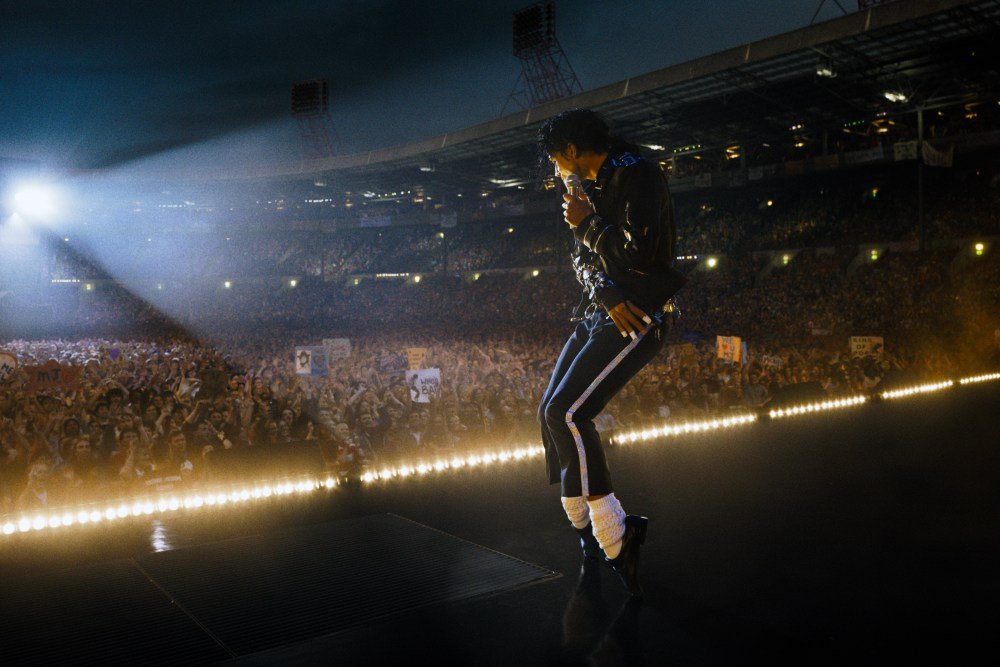
We go to a pop-music biopic to re-experience the power and glory of a star we love. We also want to tap into a feeling of discovery — to see that artist up close and personal in a way that we hadn’t quite before. Yet Michael Jackson may be a special case. He grew up in the limelight, a global pop superstar from the age of 10, and when he moved into adulthood and launched his career as a solo artist, he became the most obsessively scrutinized pop idol of his time. His staggering genius, his elfin but cagey personality, his cosmetic surgery, his troubled family ties, his fabled eccentricities: All of it was covered like a biopic in real time.
Michael Jackson was — and remains — the most transcendent pop-music artist since the Beatles, and that means it’s almost inevitable that “Michael,” Antoine Fuqua’s lavishly conventional biopic, is going to deal with drama, both onstage and off, that’s already extravagantly familiar. Since the movie avoids any reference to the child-sexual-abuse allegations that dogged Jackson starting in 1993 (allegations that have only grown more prominent since his death in 2009), you could say that that leaves “Michael” with a hint of a void at its center. Simply put, this is not a movie about Michael Jackson’s dark side.
Yet the surprise of “Michael” is how well it plays, and what an engrossing middle-of-the-road biopic it is. It’s basically an ’80s-TV-movie version of the Michael Jackson story with sharper acting and snazzier photography. It trots out the greatest hits of his career, from the “Don’t Stop ’til You Get Enough” video to his epochal performance of “Billie Jean” on the Motown 25th anniversary special, and winnows his inner demons down to just one demon — Joe Jackson, his hard-bitten hustler of a father, played under heavy prosthetics by Colman Domingo as the domestic Svengali monster Michael fought to liberate himself from. The movie is full of montages that use Jackson’s hits in an obvious fan-servicey ear-candy way. It’s got a boisterous cameo by Mike Myers as CBS Records president Walter Yetnikoff, for the inevitable scene in which Michael pushes Yetnikoff into strong-arming MTV to show Michael’s videos.
Yet if you zero in on what’s standard about “Michael,” or what the movie leaves out, you may miss the compelling urgency of what it gets in: Michael Jackson’s journey to become himself by freeing himself from the past. I think audiences are going to embrace that journey, and “Michael” itself, in a major way.
What holds the movie together and gives it meaning is the deft command and high sizzle of Jaafar Jackson’s performance. Jaafar, the 29-year-old son of Jermaine Jackson, is Michael Jackson’s nephew, and he has never acted in a movie before. But does he ever nail the look, the voice, the electrostatic moves — and, more than that, the mixture of delicacy and steel that made Michael who he was. Jaafar isn’t as beautiful a camera object as Michael (in the same way that Austin Butler wasn’t as divine-looking as Elvis), but his slightly more earthbound cuteness allows him to play up Michael’s vulnerability. And the movie, in its rather familiar way, conducts the electricity of Michael Jackson. It shows you how, like Brian Wilson or Little Richard, he was an artist of vision shaped by his wounds.
The film starts in the living room of the Jackson family home in Gary, Indiana, in 1966, where Joe is putting his five sons through the paces of a rehearsal as if it were a military hazing ritual. Joe is the coach and the manager, the one who believes that his boys can lift the Jackson family out of the lower-middle-class doldrums that would otherwise be their fate as Black Americans. Joe has a dream — the American Dream. But another way to put that is that the Jackson 5, led by Michael and his mini James Brown moves and unprecedented soprano soul virtuosity (no child in history has sung with that adult phrasing), are going to be his meal ticket. Joe is hardest on Michael, who he beats with his belt. There’s no ambiguity about what this is (it’s child abuse), but what’s even more wrenching is that Juliano Valdi plays the young Michael as a sweet kid who’s too sensitive to relate to other children. That’s why celebrity fulfills him. It makes his “specialness” into his very identity.
Having captured the rise of the Jackson 5, “Michael” cuts to 1978, when Michael teams up with the producer Quincy Jones (Klendrick Samson) to record “Off the Wall.” Jamaal Jackson gets Michael’s tentative high sugary voice just right, but he also shows us how that famous personality evolves. When Michael starts turning the Jackson home in Encino into a menagerie, filling it with a llama and a giraffe and Bubbles the chimp, those critters are Michael’s only friends, but they also express his inner aggression. At a law office, Michael bonds with John Branca (Miles Teller), a shaggy-haired entertainment lawyer who once repped the Beach Boys and Neil Diamond, and he immediately instructs Branca to fire Joe as his manager, which Branca does with a one-sentence termination notice delivered via fax. This gives Michael the emotional space to conceive and record “Thriller.”
There’s a terrific sequence where Michael goes into an L.A. club, with real gang-bangers, and draws the choreography for the “Beat It” video out of their moves. He wants a dance-pop aesthetic that channels the anger of reality; that will become his trademark. Yet even as Michael takes control of his life and his image (we see him get a nose job — though, in fact, he had more cosmetic enhancement at the time than that, and the film writes off all his skin lightening to vitiligo), the specter of his domineering father looms. After “Thriller” launches the age of Michael mania, Joe cuts a deal with Don King (Deon Cole), behind Michael’s back, for Michael to go on tour with the Jackson 5. Michael’s deal with Pepsi is part of that, and the film’s portrayal of the horrifying accident that befell him during the filming of a Pepsi commercial — a spark set his hair, and scalp, on fire — makes the trauma feel like an outgrowth of Joe’s karma.
I saw the Victory tour in 1984, and have always felt that it was a mistake for Michael to rejoin his brothers. Yet in the movie, watching Michael’s incandescent onstage performance of “Human Nature,” we see how even there he was able to express his sublime artistry. And then…he blows Joe off. Forever. After leaping ahead to an onstage Michael performance of “Bad,” the movie leaves us with the words, “The story continues…” In other words, “Michael” may be the first biopic that’s been set up to be a franchise. Normally, I’d be cynical about that. But if the filmmakers choose to continue Michael Jackson’s story, it will not be just a brand extension but an opportunity: to maybe get into that dark side after all.
Leave a Reply