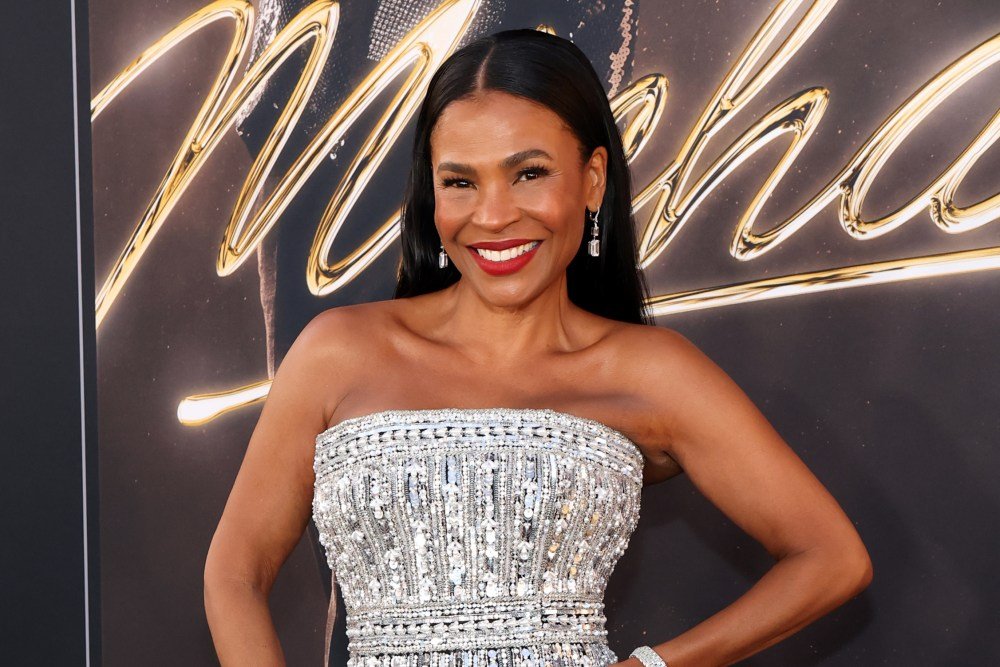
Last week, Nia Long got the tap on the shoulder she’s been waiting for forever. It was a summons from Katherine Jackson, the matriarch of the Jackson family, whom she portrays in the new biopic, “Michael.”
Long steeled herself as she walked into a green room backstage at the Dolby Theatre and, when they came face to face, she froze for a moment. Then, she kneeled down, held the 95-year-old woman’s hand and said, “Thank you so much for all your sacrifices, for your love, for your patience, for your commitment to family.”
“Mother Jackson,” as Long calls her, simply gazed back at her, so she continued: “I said, ‘Do you realize none of this would be possible without you? You are the beginning of the Jackson legacy.’ And she teared up. It was a beautiful moment, and it was confirmation for me that she’s very pleased with the film. It was just perfect.”
Indeed, Katherine Jackson was pleased with “Michael” — and audiences certainly seemed to be too, as the biopic earned a record-setting $97 million domestically and $217 million globally in its opening weekend, the best start of all time for a music biopic. And while Long had never met the Jackson matriarch before, she’d once met Michael in the early 90s.
Long and a few friends were at a Stevie Wonder concert when John Singleton, who’d directed her in “Boyz n the Hood,” stopped her and said: “I want you to meet my friend Michael.”
“I turned to my right, and it’s Michael Jackson,” she recalls. “I literally turned into a giggly schoolgirl. He just looked at me and said, ‘Hi, Nia Long, I really enjoy your work.’”
Long gets chills just thinking about that moment. “The thing that still stands out is his curiosity and his ability to connect on a very human level,” she says. “I knew that I was standing in front of Michael Jackson, this iconic treasure, [but] I felt in that moment that he was a new friend. He was meeting me exactly where I was at that time in my career, and that speaks to his humility and grace. And that comes from his mother.”
At the time, Long was still a newbie in Hollywood; she’d starred in Singleton’s Oscar-nominated film, but she had yet to establish herself as one of the decade’s hottest stars with movies like “Friday,” “Love Jones,” “Soul Food” and “The Best Man” franchise, plus a major arc on “The Fresh Prince of Bel-Air.” Regardless, Jackson was already impressed — but he couldn’t have known then that one day that young woman would add playing his mother to her resume.
“There’s a spiritual aspect to this process that has to be acknowledged,” Long says, looking back on the full-circle nature of that interaction. “I truly believe Michael has a hand in everything that’s related to this film.”
Here, Long tells Variety how she tapped into Katherine Jackson’s essence without ever meeting her, how her performance differs from previous depictions, what got cut from her character arc and her hopes for a potential “Michael” sequel.
Katherine Jackson birthed this line of tremendous artists and performers and held them together as a family. When you were asked to portray her, was it an immediate yes, or did you have any trepidation?
It was an immediate “Yes,” but then I paused. I had to get very clear with myself on my approach to curating the character. Because you’re not mimicking someone. It was very important to me to embody her spirit and soul, because that’s where the truth lies. I immediately tapped into grace, love, patience, and protection. Katherine Jackson is a woman of service, so there’s a humility and grace that she carries. I knew that if I started there, I would be able to fly through the scenes anchored in those emotions and those feelings and that truth.
Since you didn’t meet her beforehand and she is not hugely public and giving tons of interviews, how did you go about finding the essence of who Katherine is?
I watched as many videos online as I could. I spoke to Graham King and Antoine Fuqua for hours about her role in the film and how to approach the character. I tapped into my own mother wit — my understanding of being a mother and having my own personal experiences that really informed me on what it means to be graceful. Sometimes, grace is being still and being quiet and understanding that the most powerful thing we can do is trust the divine feminine energy, because it is capable of creating greatness. And that is what Katherine Jackson has done. She’s just a beautiful, exceptional soul, and meeting her in person qualified everything I thought I knew. I had to put Nia away for two years and tune into that energy of being the Queen Mother. That is who she is.
This film is a celebration for Michael, but it’s also an acknowledgement of Katherine Jackson’s greatness. She is the beginning of everything. And I want to celebrate her. I want everyone to stop and think about how much she had to carry to get here.

Nia Long as Katherine Jackson in “Michael.”
Glen Wilson / © Lionsgate / Courtesy Everett Collection
What was your experience of the 1992 miniseries “The Jacksons: An American Dream”?
I love Angela Bassett. The beautiful thing about being an artist is that we each have our own interpretation of the character, and there’s room for everyone’s performance. I thought it was great, but this is a different film. This film is through Michael Jackson’s eyes, so we have an intimate experience with him growing up. It’s a bit of a coming-of-age story, and you really see the loneliness that he experienced as he walked into stardom.
That series presented a different part of Katherine and Joe’s relationship; it was a lot more about their relationship dynamics — like the scene where Angela’s Katherine cries out, “I don’t want you no more.” In “Michael,” your scenes with Colman tend to be a bit more about their roles as parents and those pressures. How did you two go about capturing that dynamic?
Colman and I had lots of conversations in the hair and makeup trailer about the importance of showing joy in the midst of incredibly challenging times. We’re talking about the 1960s and the Civil Rights Movement, and we wanted to show the power of the Black family dynamic. Those very early scenes when we’re at the dinner table: we’re laughing, we’re talking, we’re sharing community and we’re showing the connection between family. Because when you think about family, it is the place where everyone is meant to feel safe and together and solid. And through their commitment, they were able to create greatness.
Was the relationship perfect? No. But the commitment is larger and more important and more solid than the conflict. We were adamant about finding those moments where, even if Katherine wasn’t in total agreement with what Joe was proposing, she still supported him, until she said, “This is enough.” That’s very real. Everyone has to play their role, the masculine and feminine. They each had a very specific role in the curation of the family — and there comes a point where there will be conflict and things may even fall apart — but I do believe that it is because of their commitment that the Jackson family is what it is today.
Nia Long with the cast and filmmakers of “Michael” at the Los Angeles premiere.
Variety via Getty Images
Yes, while your Katherine might not say, “I don’t want you no more,” she’s not always demure and quiet. How did you prepare for that scene where Katherine stands up and tells Joe that’s enough?
I made the choice very early on that I would take the quieter, more subtle approach to all of my scenes, because, to me, that represented the strength of Katherine Jackson. When it was time to do that scene, we did it a couple of different ways but landed on the quieter version. It really worked beautifully, because I don’t think the audience saw it coming.
The first time I saw the film in front of an audience, and I tell Joe, “Enough. You’re not going to beat anyone anymore. You’re not going to whoop anyone,” the audience started to applaud. I was kind of shocked. I thought, “Oh, wow! I didn’t think it was going to be that impactful.” It’s in that moment that the film really changes, and you start to see that Joe is losing his control. The editors did an amazing job of putting the scene together. Antoine made a great call in allowing us to explore the scene with several different tones, but this tone was in pocket, and I’m happy that we had the space and the time to play around with it a little bit.
Speaking of Angela Bassett, she and her husband, Courtney B. Vance, hosted a screening of the film.
I loved that. Courtney called me in the middle of doing “The Today Show,” so I need to call him back, because that’s my guy. I love him and Angela.
What does it mean to have their support and so much love from other Black entertainers?
[The L.A. premiere] felt like a ‘90s movie premiere. I’ve missed those times so much where the whole community would come out to support filmmaking. Usher was there; Magic and Cookie Johnson were there. Everybody was there. It was amazing. It was just great to see everyone so excited to see this film and to celebrate a cultural icon. Michael Jackson has done it all musically and visually. He was making short films with his music videos before they were really acknowledged as short films. He was a storyteller, and he incorporated history and cultural conflict and love and the expression of independence. He was actually sharing his personal story through his music. I remember watching his videos as a young girl and being inspired to be an actor. It felt like something I had never seen. It takes years to accomplish what Michael Jackson did, and I can only imagine where he would be right now if he were still with us. He’s missed terribly.
The storyline for this film changed because of legal issues with the original script. Was there anything in Katherine’s storyline that you were disappointed to lose?
In the original version of the film, there were scenes that didn’t quite work with this cut, that were deleted but may be revisited; I’m not really sure. That’s part of filmmaking. The performances have to work with the storytelling, and sometimes things change, and it can be heartbreaking, but I’m very happy with the film as it stands today.
Can you tell me generally what parts of her story those scenes covered?
There were scenes with Jaafar and me; they were cut mostly because of the time period that this film covers. They were scenes at Neverland [Ranch]. So maybe they’ll come back if we do, in fact, do a sequel.
Nia Long (right) as Katherine Jackson with Jaafar Jackson as Michael Jackson in “Michael.”
Hilary Bronwyn Gayle / © Lionsgate / Courtesy Everett Collection
What do those conversations about a sequel look like for you as an actor? I imagine you have to draw up a new contract?
I’ll just say yes. I didn’t negotiate two movies; I negotiated for one film. I just want everyone to see this film and ask us to continue the storytelling.
The movie originally included scenes from Michael’s later life, including his legal issues. Katherine Jackson was always seen as the person there supporting him through those trials. What was your experience of that?
Katherine Jackson has been a constant safe space for Michael from day one and throughout his days, and I believe, until his last day. So, we weren’t avoiding anything in the storytelling. That was never the objective. But there were things beyond our creative control that shifted the storytelling. Katherine’s connection to Michael was unwavering throughout his entire life. We were very deliberate about that unwavering mother love.
Has there been any discussion about what the sequel would cover?
Honestly, I have no idea. I don’t even know if I’m in the second one. There’s no second script. But I’ll tell you one thing: Graham King is a man with a plan. I trust him implicitly. I know how much he cares about this project, about Michael, and about the family. So, this is one of those moments right where I could say, “What are we doing?” No, I’m going to just relax. Whatever I’m called to do is what I’m supposed to do. And you know what that gives me? That gives me freedom. No anxiety. No pressure. Whatever is meant to be will be. Whatever part of the story I am meant to tell, I will be there to do it.
I’m excited, too. Because when you start to think about sequels, the first thing that I think is “How does Katherine change through this journey?” Because she starts as a very young woman. By this point, she’s close to being a middle-aged woman. So, what does that look like for her? What does her relationship with her husband look like? What is the family dynamic in this next chapter? So those are all exciting things I’m looking forward to exploring as we continue the process.
Eugene Ashe, who directed your new movie “Don’t Ever Wonder,” compared you and Larenz Tate to Diana Ross and Billy Dee Williams. He said this is your “Mahogany” with “Love Jones” being your “Lady Sings the Blues.” What is it like to deliver another entry into the Black love canon together?
“Don’t Ever Wonder” is about a couple experiencing life after sending their baby off to college. How do you reconnect? How do you deal with being an empty nester? It’s funny, it’s heartwarming, it’s emotional, it’s a very real take on what it’s like to reconnect with your partner after the kids are gone and you don’t have a buffer in the relationship. I love Lorenz Tate more than anything. He is not only a fantastic actor, but he’s a beautiful human being. We have such a special connection and a special calling as a duo. It’s very different from “Love Jones,” and I know that people will probably try to compare it, but Larenz and I really wanted to make sure that the characters were very different from Nina and Darius, and I think we accomplished that.
What does it mean to hear him compare you to Diana Ross? On top of being asked to embody Katherine Jackson?
I’m a worker, that’s what I know. I love to work. I love to create. I’m incredibly blessed. I love that my career has been graceful and the cadence has been manageable — meaning I can still be a mother the way that I need to be a mother. I still have a normal life. I can go to the farmers’ market on the weekend and have a connection to community without feeling like I need an entourage. And that is by design. I take the roles that feel good to me, that feel authentic to me, that encourage me to share what I know as a woman through the different characters that I play. I’m living in great gratitude right now, because I don’t take any of this for granted. I’m also very proud of myself for sticking to what I know is right for me, for keeping my standards high, staying open to change and learning. Part of having a long career is keeping your mind open to change and growth, to be inspired by other artists, other women. It’s part of my purpose.
If you look at the meaning of my name, I didn’t have a choice. [“Nia” is Swahili for “purpose.”] I never cared about stardom; I just wanted to be a voice of inspiration. Anyone who knows me knows that I am a truth teller, and I don’t back away from the truth. Sometimes it’s easier to avoid the truth than to speak the truth, but I honestly don’t know how to do it any other way. And I wouldn’t do it any other way, because that’s who I am: a truth seeker and a truth teller.
Nia Long (second) poses with her son Massai Zhivago Dorsey II, her mother Talita Long and her son Kez Sunday Udoka at the “Michael” premiere held in Los Angeles.
Michael Buckner/Variety via Getty Images
Leave a Reply