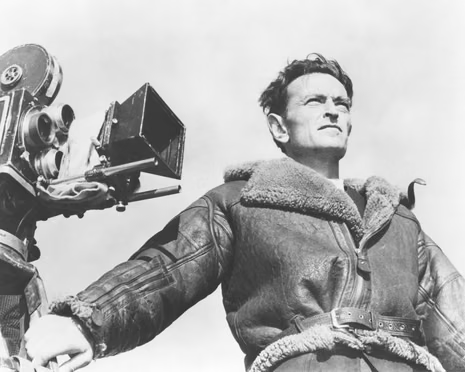
One of the fascinating dimensions of the movies made in the studio-system era is how the perceptions of those movies — and, in a strange way, the movies themselves — change over time. I went into “Maverick: The Epic Adventures of David Lean” eager to see a documentary about a director I thought of as the quintessence of lavishly impeccable middle-of-the-road Hollywood classicism. And it’s not like that perception is wrong.
But “Maverick,” which is full of singular stories, stunning film clips, and extraordinary insights from a panoply of filmmakers (Francis Ford Coppola and Alfonso Cuarón to Paul Greengrass and Celine Song, Wes Anderson and Nia DaCosta to Denis Villeneuve and Brady Corbet), is a movie that boxes open your cinematic mind about who David Lean was and what he achieved. Yes, he was a classicist (Pauline Kael once complained that even if Lean were depicting a film’s hero in blood up to his elbow, it would all be framed with exacting good taste). But “Maverick,” narrated by Cate Blanchett and directed with a fine blend of ardor and intelligence by Barnaby Thompson, shows you that Lean was also a radical filmmaker, perhaps the key inventor (along with Hitchcock) of modern Hollywood cinema. His images may have been exquisitely orchestrated (and in “Lawrence of Arabia,” they were awesome verging on overwhelming), but what gave life to those images was the spirit beneath them, which was romantic and unruly. Because that’s who David Lean was.
You’d expect the opening-montage fanfare of “Maverick” — that snazzy blitz of career highlights that artist docs tend to rely on these days to suck you in — to be devoted to Lean’s movies. From the start, though, the documentary is threaded with an explosive contradiction: that Lean’s aesthetic as a director was elegant and organized and very British in its polish, but that his personal life was a mess, full of fast-burning romances and broken promises. The revelation of “Maverick” is how the two sides of Lean — the classicist and the reckless romantic narcissist — worked together.
From the start, he was an outsider artist. Born in 1908, he grew up in the suburbs of London with a father who rejected him (to the day he died, his father never saw one of his films), and this left the young David out of sorts and none too successful. He was bad at school and didn’t fit in; he was awkward and alienated. But then he got hold of a still-picture camera, and as he began to take photographs, that process took over his identity. He was a fractured person who put the world together in the images he lived inside.
He decided early on that he wanted to work in film, and after talking his way onto British studio sets, he realized he loved the process, the magic toy-shop aspect of it all. He became a film editor, which he was brilliant at, working on the movies of Powell and Pressburger until, after a time, he became the most sought-after editor in Britain. But he was hungry to take the next step, and did after winning the attention of Noel Coward, the Oscar Wilde-spirited multi-hyphenate dandy who tapped him to co-direct “In Which We Serve.” That was a fine film, but Lean’s second collaboration with Coward, “Brief Encounter” (1945), was revolutionary.
For a long time, “Brief Encounter,” with its shy-talking leads and Rachmaninoff soundtrack, its vision of stiff upper lips kissing, was thought of as a middle-class British weeper‚ one of the most touching four-hankie love stories ever made. But if you watch it now, you see that while it’s certainly a sublime tearjerker, “Brief Encounter” is also a drama of sophisticated naturalism, which starts with the fact that it’s about an adulterous affair, which the film dares to portray as transcendent and also heartbreakingly fragile. This was 1945, when that sort of thing was not openly embraced. And it’s the forbidden rapture of it all that lends “Brief Encounter” its quality of lyrical realism. You see the same spirit at work in “Summertime” (perhaps Lean’s most moving film), the 1955 Hollywood romance in which Katharine Hepburn plays a lonely secretary who finds love (or thinks she does) during a solitary summer vacation in Venice. “Maverick” makes the perceptive case that Lean’s understanding of loneliness was the lifeblood of that movie.
From the outset, he was using movies to express who he was. We associate David Lean with the word “epic” (the opposite of “intimate”). But “Maverick” spins on the counterintuitive reality of what a personal filmmaker Lean was. By the time he made “Brief Encounter,” he had already married and divorced Isabel Lean, abandoning both her and the son they had together, and he was in the middle of his fraught marriage to Kay Walsh, an actress who would be the second of his six wives, with hundreds of flings in between and on the side. His divorces ultimately left him scrambling for stability and turned him into a kind of moneyed vagabond, living out of suitcases.
He was successful but rootless, and as “Maverick” goes on, and we hear the stories of how these relationships foundered and fell apart, something strange happens. Lean’s flawed love life starts out sounding typical enough, and then it comes to seem sordid and opportunistic and finally, in a strange way, it becomes borderline funny, because we hear excepts from the letters Lean would write, and he sounds just like the ardent geeks of “Brief Encounter,” though the truth is that he was a hound — a hound who needed to convince himself, in every case, that he was having the love of a lifetime. He was hawkishly handsome, with a purse-lipped grin, which in later years made him resemble a genteel English David Lynch. But his polite façade masked a driven, at times raging ego of a personality.
Lean’s romanticism, which was obsessive (that’s part of why it was fickle), was embedded in how he worked as a filmmaker. He was drawn to extremes, just as his characters were — the hellbent ethno sun-god adventurer T.E. Lawrence, and Alec Guinness’s fanatically honorable, driven-to-the-point-of-blindness Col. Nicholson in “The Bridge on the River Kwai,” which was the first of the productions Lean made that changed cinema. Shooting “The Bridge on the River Kwai,” Lean became almost like later Kubrick in the lavish scale of his control-freak perfectionism, and a bit like the Werner Herzog of “Fitzcarraldo” in how he built that bridge (the largest movie set ever constructed up until that time). In a sense, he built an entire war movie around a (deluded) romantic quest.
“Lawrence of Arabia” was his attempt to top the spectacle of “Kwai,” and it was so visually transfixing, placing the audience in the sensual center of the desert, that “Maverick” makes the case for it as the first modern epic, a movie that casts its shadow over the entire blockbuster age; it’s been a totem for Steven Spielberg. “Lawrence” was not an ordinary film shoot. As dominated by Lean, the studio-system filmmaker who took filmmaking out of the studio, it was closer in spirit to the kind of teetering-on-madness, life-becomes-art immersion that Coppola sought in “Apocalypse Now.” These are filmmakers who became wedded to the idea of going to hell and back.
If “Lawrence” was Lean’s artistic apex, “Maverick” then chronicles his decline, which you could argue (as the critics did) began with the overly padded “Doctor Zhivago,” the first movie in which Lean’s lushly constructed style began to look a touch anachronistic. (But it was a smash hit.) That was followed by the overblown “Ryan’s Daughter,” which triggered one of the oddest events I’ve ever heard about within the world of film criticism. In 1971, after “Ryan’s Daughter” opened to scathing reviews, Lean was invited to a meeting of the National Society of Film Critics, and for two hours he sat there as critics like Pauline Kael and Richard Schickel excoriated him for having made this turkey. I’ve never heard another story of a director being “summoned” to a critics’ meeting — let alone so that he could sit there and be chastised. Lean was so devastated (we see a clip of him recalling the event) that he didn’t make another film for 14 years.
He came back, of course, with “A Passage to India,” which was one of the great comebacks — because Lean fashioned it in a lean version of his grand style, as if no time had passed, and what that meant in 1984 is that he wound up beating Merchant-Ivory at their own game. “Maverick” is an enthralling celebration of a director who was one of the visionaries of movies. I realized, watching clips of the two Dickens films Lean directed during the ’40s (“Great Expectations” and “Oliver Twist”), that the reason I’d never fully appreciated how original and movie-forward they were is that their influence had been so thoroughly absorbed into the language of cinema. Yet the current that runs through Lean’s films (he only directed 17 of them) is an indelible feeling of romantic fervor leading to loss. That was the story of his life, which he made larger-than-life.
Leave a Reply