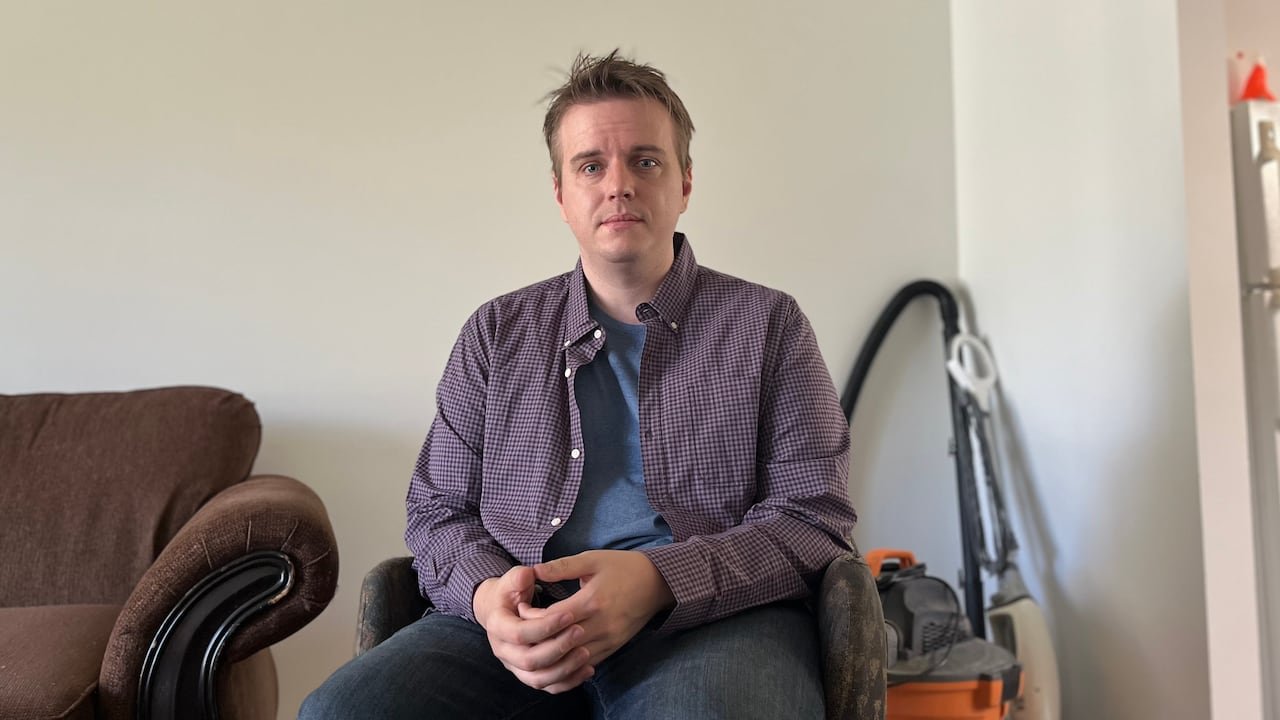
Since he was a child, Tomas Ponzilius wanted to be a lawyer, a father and a disability rights advocate.
But these days, he spends most of his time in bed in his home in Winnipeg, before the chronic pain he lives with causes him to pass out, he says.
He’s made two previous requests to get out-of-province treatment, but both were denied, leaving him considering exploring medically assisted dying.
“I don’t want to die, but I’m being tortured every single day,” the 33-year-old said. “This isn’t a life.”
Ponzilius has Ehlers-Danlos syndrome, a rare genetic condition that affects connective tissues in the body. It makes the collagen in his body weaker and causes cervical instability, or instability at the part of the spine holding up the head.
Because of this, he experiences vision and breathing problems, along with extreme pain in his neck.
Ponzilius said he’s run out of pain medication because he can’t afford it and it’s not covered by the province, and is cutting back on other treatments for the pain that cost $700 per month.

Ponzilius lives with vision and breathing problems, along with extreme pain in his neck due to Ehlers-Danlos syndrome. (Alicia Wang/CBC)
He’s asking Manitoba Health to approve his request to go to the U.S. for a cervical fusion, a surgical procedure that would stabilize his neck. It would cost about $200,000, but getting it would be “everything,” he said.
He acknowledges the cost sounds high, but estimates the social supports he’s forced to rely on because he’s in too much pain to cost $50,000 per year.
“Our government might say, ‘Well, we need to save money,’” he said. “Actually, your position is that we can cost our system.”
‘Left with no pathway’
In July, his neurosurgeon submitted a letter to the province’s out-of-province referral program.
It states that the “rarity and complexity” of Ponzilius’s condition means the required surgical expertise for the procedure, and the specialized rehabilitation services he’d need, are not available within Manitoba.
His request was rejected, with the province saying it needed more proof there wasn’t sufficient care in Manitoba.
Ponzilius is currently waiting for Manitoba Health to decide on his appeal.
In the meantime, living with the disease makes it feel like “every single day I wake up, I roll a 20-sided die. I roll too low, I’m dead,” Ponzilius said. “You can’t wait with this.”
CBC asked the health minister for a response on Ponzilius’s case, but a spokesperson said the province can’t comment while it’s before the appeals board.
Though Ponzilius was born with Ehlers-Danlos, he was only diagnosed last year, by an American doctor. For most of his life, doctors here couldn’t explain his dislocating shoulders and chronic pain, he said.
I wanted a childhood.… I wanted my 20s. I could still save my 30s.Tomas Ponzilius
He’s had several procedures done in Manitoba in an attempt to stabilize his shoulders. The results were meant to last years, but the first lasted five months, the second just two or three weeks.
“It is not that we don’t have excellent care in Manitoba, but this is a service gap,” Ponzilius said. “We just don’t have capacity, frankly, in Manitoba and we’re left with no pathway.”
Referred to U.S. clinic
Ponzilius was first rejected for out-of-province care last year, when he was referred to see Jan Dommerholt, who owns a Maryland clinic recognized by the non-profit Ehlers-Danlos Society for providing specialized care.
Instead, Manitoba Health told him to go to the GoodHope Ehlers-Danlos Syndrome Clinic in Ontario, one of a few clinics in Canada that specializes in the condition.
In a statement emailed to CBC in response to questions about Ehlers-Danlos in Manitoba, a provincial spokesperson said “established referral pathways are available” to clinics in Canada if Manitoba lacks the specialized care a patient might need.
But the Ontario clinic told Ponzilius it isn’t accepting out-of-province patients.
Ponzilius says Manitoba Health should’ve known that. The same information came up in a separate application for out-of-province coverage from a woman with Ehlers-Danlos he spoke with when she applied. She successfully appealed the province’s initial denial of out-of-province care in 2024.
Ponzilius paid for his visit to the Maryland clinic out of pocket.

Jan Dommerholt owns Bethesda Physiocare, which provides specialized Ehlers-Danlos syndrome care. He says he doesn’t know of any surgeons in Canada who are qualified to perform the procedure Ponzilius would need. (Submitted by Jan Dommerholt)
Dommerholt said when he saw Ponzilius, he recommended he see a Maryland neurosurgeon who specializes in Ehlers-Danlos to perform the cervical fusion.
That procedure can normally be done by any neurosurgeon, but Ehlers-Danlos can make the tissues of the body far weaker.
“If the surgeon goes in and tries to fix things and there’s nothing to even do stitches in because the tissues are too loose … what are you going to do?” said Dommerholt.
In its statement, the province said there are neurosurgeons in Manitoba who are trained to “assess and manage complex spinal conditions,” including Ehlers-Danlos syndrome.
Ponzilius has sent multiple letters to the minister of health asking who those people are, but hasn’t got a response.
Dommerholt said only a handful surgeons worldwide are qualified, and none are in Canada.
Lost faith in system
That’s also what the non-profit EDS Canada Foundation says.
Tammy Stadt, the foundation’s resources director, says the province’s request for more proof that Ponzilius can’t get the care he needs in Manitoba places an unfair burden on him.
“Exhausting other access to care in Canada is very challenging, because a lot of specialists will not take referrals from other provinces,” she said.
In denying his request, Manitoba Health told Ponzilius he hadn’t proven the care he needs is “not adequately available in Manitoba or elsewhere in Canada.”
But Stadt said while a procedure may be performed in-province, that doesn’t mean it’s being done with the right expertise.
In the meantime, Ponzilius is waiting for Manitoba Health to decide on his appeal. He thinks it will succeed, citing the 2024 precedent, but says he’s lost faith in the system.
If he’d had the right interventions, he feels his life could have been different.
“I wanted a childhood… I wanted my 20s,” he said.
“I could still save my 30s.”
Leave a Reply