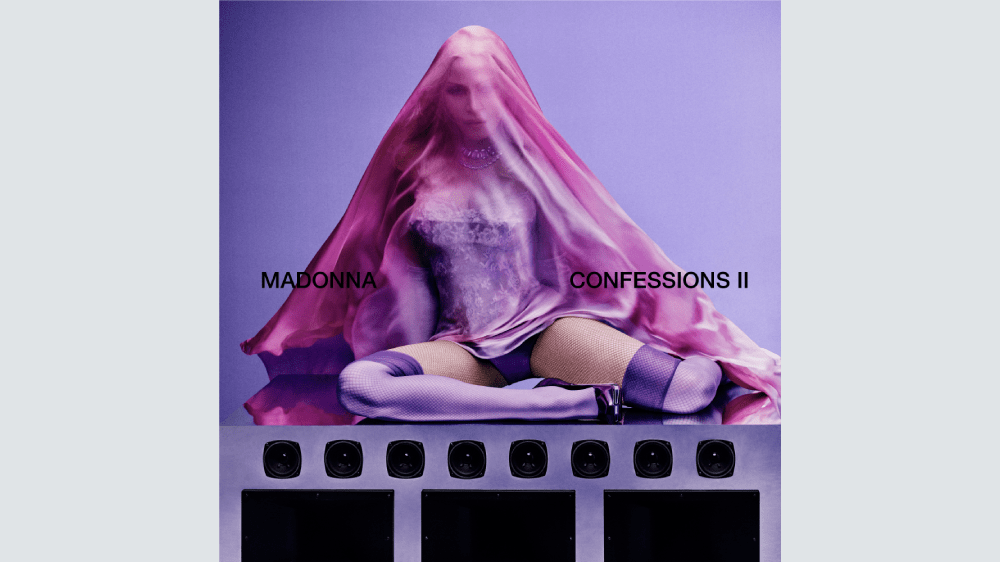
“Sometimes I like to just hide in the shadows,” mutters Madonna at the start of “I Feel So Free,” the opening track on her 15th album “Confessions II.” “Create a new persona. A different identity. I can be whoever I want to be.” As hard as it may be to picture Madonna hiding in the shadows of anything, that’s the thrill of any new album from her: guessing which version we’ll be getting. Will it be a cowgirl kicking up dust this time? A pop eccentric? A spiritually reborn idealist with a penchant for chanting and sitars?
Madonna made it clear at the start of the promotional cycle for “Confessions II” that her first album in seven years would be a return to the dance floor, a sequel to her seismic 2005 album “Confessions on a Dance Floor” that, by all counts, was the last time she conceived a project with such a fully realized scope. And it’s an approach that’s paid off: “Confessions II,” a 16-track album mainly produced by Madonna and producer Stuart Price, who sat at the helm of “Confessions on a Dance Floor,” is easily the best album that Madonna has made in two decades, a palpable record that celebrates the thrill of the dance floor while embracing its mystique.
“Confessions II” is an album where form meets function, assembled as a continuous DJ mix much like the original iteration of “Confessions on a Dance Floor.” (That version, added back to streaming last year, is part and parcel the most arresting Madonna record this century.) It allows for a continuous flow state to tell a full story, one of dance floor abandon, of reveling in the anonymity of a dimly lit room and the space it creates for reinvention. At the start of many tracks, Madonna whispers of the freedom that the cloak of darkness provides; she materializes it, quite literally, in the video for “Bring Your Love” featuring Sabrina Carpenter, soaring above a crowd of bodies like an otherworldly specter.
But on “Confessions II,” Madonna comes across as a central grounding force in a way that she hadn’t on “Rebel Heart” and “Madame X,” albums that either chased trends too closely or eschewed them entirely. “Confessions II” has a heartbeat and sonic identity, rooted in dance music but pulling from its vast palette, whether it’s Detroit house on “Bring Your Love” or dark techno on “Everything.” It’s a welcome reprieve for any Madonna fan looking for focus in one of her later-era albums, and much of the credit goes to Price, whose production here is vibrant and considered. There’s nothing that approximates “Hung Up” or “Get Together,” songs that married dance with pop in such resonant ways that they’ve transcended decades. Instead, Price opts for slow builds and gratifying payoffs, creating a tension that sustains the momentum of the record without getting lost in the details.
There are moments of immediacy where Madonna most flourishes. “Danceteria” is the album’s centerpiece, a Gen X mating call that harkens back to the halcyon days of New York City nightlife. Here, she revisits the haunt she frequented at the start of her career, reminiscing about passing off her demo tape of “Everybody” to DJ Mark Kamins and rubbing elbows with everyone from Nile Rodgers and Basquiat to David Byrne, Crazy Legs and the B-52s. She delivers it with a deadpan rap approach, much like the spoken-word segment on “Vogue.” (If anything, Madonna will be self-referential, either figuratively or literally).
An album sequel, by some counts, can be an attempted reclamation of past glory, a way to harness the goodwill of a great record and replicate it for legacy’s sake. To its credit, “Confessions II” does a commendable job of evoking the spirit of its predecessor without parroting it. Where the first album adapted ’70s disco and ’80s house to contemporary pop, this project feels free of those constraints, or at least indifferent to them. Yes, there are hooks aplenty — single “Love Sensation” hits on something that feels truly tangible — yet songs like “Good for the Soul” and “Love Without Words” favor vibe and aesthetic, blending into one another in service of the greater vision.
That does, admittedly, become its own detriment as the record stretches into the latter half. On the whole, “Confessions II” is arresting and propulsive, yet begins to feel homogenized by the end of its second act, when she teams with Martin Garrix for the big tent anthem “Bizarre” and throbbing “School.” By that point, the BPM has barely wavered and it’s 3 a.m. on the dance floor, the lights threatening to flicker on. Madonna could have cut it here — perhaps should have — yet she pivots off of platitudes about love and the liberation of dancing to explore more personal territory, a mode that Madonna fans know all too well and have come to savor as the closest approximation to Mother they can get.
It’s in these tracks that she faces the comedown after the ecstasy and grapples with the heaviness of reality. “Fragile,” a downbeat UK garage tune, is a touching homage to her late brother, Christopher Ciccone, whose tell-all memoir in 2008 created a rift that wasn’t patched until he was on his deathbed. “Late last night I was fast asleep, you came to me in a dream,” she sings. “You said, ‘Don’t forget about me, don’t forget to be happy’ / So I hope you found a higher ground.” She doesn’t reserve the same grace for “Betrayal,” a smoky, Erik Satie-sampling rebuke of what appears to be her stepmother Joan Ciccone, who died in 2024: “You couldn’t see your fall from grace, so take the hammer, hit the nail / You’ll never take my mother’s place.”
Perhaps most poignant is her duet with her daughter Lourdes “Lola” Leon on “The Test,” where fences are actually mended. Madonna references “Little Star,” the lullaby dedicated to Leon on 1998’s “Ray of Light,” by reckoning with how her own fame may have been a burden. “I tried to put you on a pedestal,” sings Madonna. “I didn’t think of how it could disturb or how it hurt / I wish I knew the pain I’ve caused.” Leon, who co-wrote the song, demurs: “I trace the line of what you have sewn / Keep my own design / Make it a landscape, make it alive.”
Tonally, these songs may have been better suited for a standalone EP or a deluxe edition. But that would have left “L.E.S.,” the album’s fitting closer, in the lurch. Over spare guitars, Madonna retraces the days of traipsing about the Lower East Side when the rent was overdue. She sings of being infatuated with a guy who had a “Marlon Brando face” and bleach-blonde dirty roots. Much like the lot of “Confessions II,” it’s a reminder that while the old Madonna may be long gone, Madonna is still here, reigning over the dance floor as though a second hasn’t ticked by.
Leave a Reply