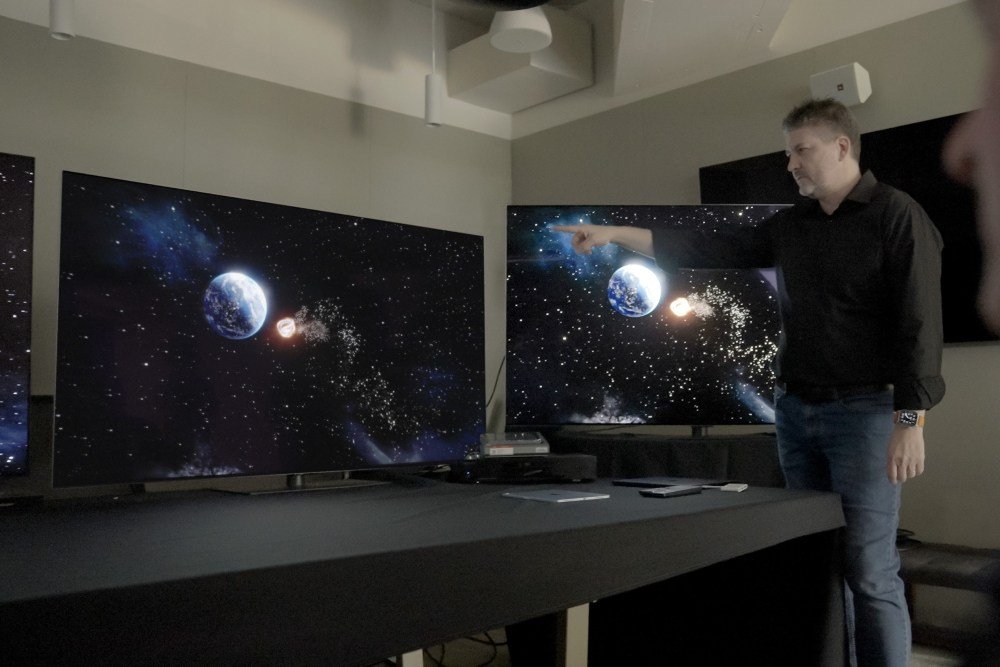
Last May, LG OLED TV visited Picture Shop, a post-production company based in Los Angeles. As a long-standing partner for Hollywood technicians, the company was there to showcase the 2026 LG OLED evo AI G6 TV. The event drew a distinguished group of industry professionals, including veteran color scientist Joshua Pines, whose credits include “Blade Runner” (1982), “Starship Troopers” (1997), “Saving Private Ryan” (1998), “Gravity” (2013), “The Revenant” (2016) and “Old” (2021). Also in attendance were cinematographer Joanna Coelho and colorist Tony D’Amore from the award-winning TV series “The Pitt.”
The G6’s new technology takes every aspect of picture quality to a whole new level. The first thing the experts experienced was LG’s next-generation picture quality technology called Hyper Radiant Color Technology. With Brightness Booster Ultra, which delivers up to 3.9 times the brightness, it expresses Perfect Black* and Perfect Color*** under any light and in any environment, while the α (Alpha) 11 AI processor Gen3 faithfully preserves even the most intricate details of the video. “The picture quality technology presented by the G6 precisely meets what the entire Hollywood post-production industry has long been demanding,” said Pines.
The G6 display which reduces light reflection and delivers flawless, reflection-free picture quality in any lighting conditions — whether bright or dim — also received an extremely positive response from experts on set.
“I think it’s extremely important to have a non-reflective TV to see the color contrast in ‘The Pitt,’” Coelho said. “It’s created by the subtle differences between the ceiling lights, white walls and dark surgical gowns; if light reflects off the screen, that entire intention is lost.” She noted that the G6 screen was impressive for faithfully reproducing the intended visuals while reducing reflections. The G6’s image quality has recently been objectively validated by a global certification body, which awarded it the “Reflection-Free Premium” certification****.
What Hollywood Veterans Say About the LG OLED G6*
From the moments when an image gradually reveals itself within the shadows, much of cinematic impact is born in darkness. The first thing creators look for on a TV is not brightness, but the depth of black and the details that come to life within it. However, if the screen reflects bright light or the colors are even slightly off, the creator’s intent is completely lost. To better understand how the G6 preserves immersion in the home, we spoke with colorist Tony D’Amore, cinematographer Joanna Coelho and veteran color scientist Joshua Pines about how the G6’s color reproduction and reflection-free screen help maintain immersion in the living room.
What do filmmakers consider the most important element on TV screens?
Joshua Pines: The most important element is shadow detail. Every colorist and cinematographer point to the screen and say, “Look at that black.” For professionals in the field, it is the gradation expressed through true blacks and the preservation of shadow detail without artifacts that matters most.

Joshua Pines, Photo credit: Ha Jin-kyung
How do you think that aspect has been improved in the G6?
Pines: Internal video processing has been upgraded from a 10-bit to a 12-bit pipeline. In works like “The Revenant,” which feature vast landscapes and subtle gradations in the sky, even the slightest banding is immediately noticeable to cinematographers. The G6 I tested today showed no banding or noise. For filmmakers like me, this is truly significant.
What role does black play on a show like “The Pitt,” which was shot primarily on bright sets?
Tony D’Amore: “The Pitt” is shot under such strong ceiling lighting that, if the blacks aren’t firmly anchored, bright scenes, especially in the trauma care areas, start to wash out. The Alpha 11 AI Processor Gen3 holds the image together with greater stability than ever before. The same applies to “Fargo.” The contrast between bright snowfields and deep shadows has always pushed displays to their limits, but on the G6, viewers can finally see the deep, rich blacks that the filmmakers originally intended.
How does increased screen brightness affect your work?
D’Amore: The brighter the TV, the wider the dynamic range becomes, and colors that were previously invisible come to life. The peak brightness achieved by the G6 reveals both the subtlest shadows and the brightest highlights simultaneously. Usually, you have to compromise on one or the other, but with this TV, I ended up making the fewest compromises I’ve ever experienced during color grading.
Tony D’Amore, Photo credit: Ha Jin-kyung
How has the Alpha 11 AI processor Gen3 changed color grading?
D’Amore: In the past, I had to deliberately lower the saturation to prevent banding in deep colors. Now, I feel confident that I can push the colors even further. Highlight details are more vivid and color bleeding is minimized. The saturation and richness of the images viewed through the Alpha 11 AI processor were the best I’ve ever seen.
Do you think the audience’s viewing environment also affects shooting decisions?
Joanna Coelho: When I frame a shot, I think all the time about how the audience is going to experience it in the environment they’re watching. I think it’s extremely important, because what we put on screen has so many details on the contrast and tone. “The Pitt” was filmed on a set with a lot of lighting and when I checked the footage on the on-set monitor, that light sometimes distracted me. I wanted viewers watching in a similar environment to be able to immerse themselves without being distracted.
Joanna Coelho, Photo credit: Ha Jin-kyung
How does the G6’s reflection-free screen in bright environments enhance viewer immersion?
Coelho: It’s crucial that the TV produces accurate tones without any glare. The G6 maintains deep blacks while rendering highlights at just the right level. Since that kind of contrast is only possible on a glossy display, not a matte one, I personally prefer glossy displays.
Is it possible for the colors set in the grading room to be faithfully preserved when viewed in the living room?
Pines: LG has worked closely with engineers to elevate the TV’s image processing to a level that stands up to comparison with studio reference monitors. As a result, the colors we see in the grading room are faithfully reproduced for viewers in their living rooms. For this reason, I support the Filmmaker Mode. It’s important that the picture adjusts to the brightness of the viewing environment, allowing viewers to see the colors and tones exactly as the creator intended.
*Brightness may vary based on model, screen size and market region. Peak brightness is up to 3.9X brighter than conventional OLED at a 3% window, based on internal measurements. Up to 3.9X Brighter applies to OLED W6 models and OLED G6 models (except 97-inch).
**LG OLED display is verified by UL for delivering black levels ≤0.24nit up to 500lux, based on IDMS Section 11.5 Ring light reflect measurement.
***LG OLED display is verified by UL for Perfect Color measured to IDMS 11.5 Ring-light Reflection standards. LG OLED display is certified by Intertek for 100% Color Fidelity measured to CIE DE2000 with 125 color patterns. Display Color Gamut Volume (CGV) is equivalent or exceeds the CGV of the DCI-P3 color space as verified independently by Intertek.
****LG OLED display is certified by Intertek for Reflection free measured to IDMS 11.2.2 sampling-sphere implementation. Reflectance is measured as the Specular Component Included (SCI) value at 550nm, independently tested by Intertek.
***** Sponsored by LG, this content was originally produced as an advertorial by Variety &Cine21 for the OLED Meets Hollywood Roadshow series. This interview was conducted in connection with participation in the Hollywood Roadshow event in Los Angeles (LG OLED evo AI G6 Showcase), and participants featured in this content were provided with products. The statements and opinions expressed by the talent in this contents are personal and do not represent the views of the studio.
Leave a Reply