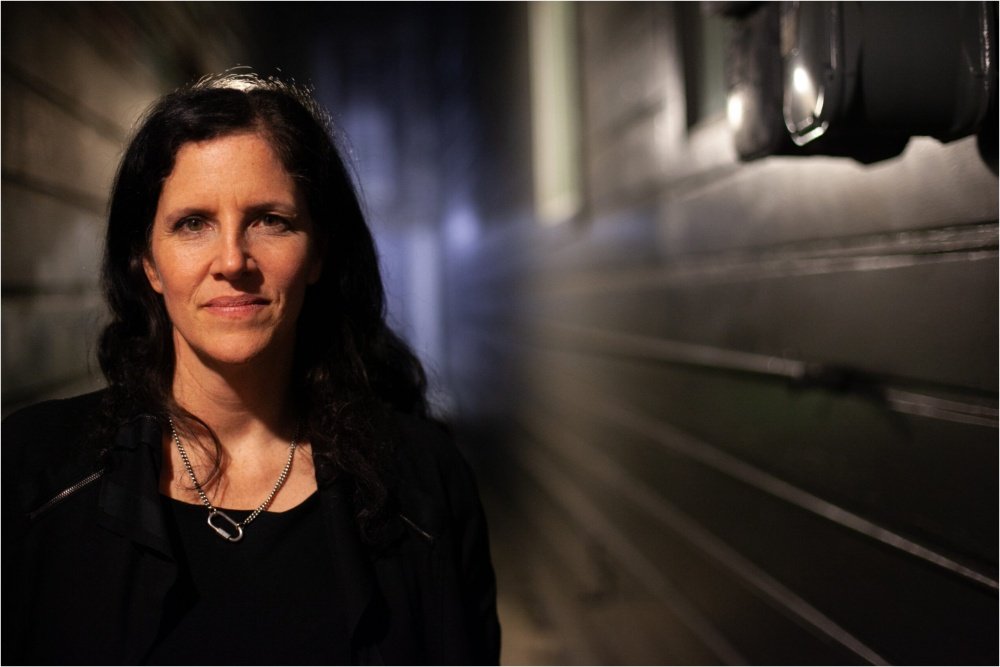
Opening the industry section of Swiss doc festival Visions du Réel, with her latest Netflix-produced feature “Cover-Up” serving as the festival’s opening film, Oscar-winning filmmaker Laura Poitras pointed to a documentary sector that is not only under pressure but increasingly mobilized – including around opposition to the Paramount-Warner Bros. Discovery deal.
Citing an open letter signed by more than 1,000 industry professionals, she said: “There’s recently been a letter calling to block the merger – I know behind the scenes a lot of documentary filmmakers were involved in that, there’s that kind of engagement.”
More broadly, she described a sector defined as much by solidarity as by strain, noting, “It’s no secret that this is a really dire time in the documentary landscape, if we’re talking about funding and distribution, but I also think it’s a time documentary filmmakers are actually showing up for each other and doing risk-taking work that is filling gaps where some of our institutions are failing us.”
Signed by directors including Alex Gibney and Davis Guggenheim, alongside Hollywood figures such as Mark Ruffalo, Kristen Stewart and Jane Fonda, the letter has drawn significant backing across the industry.
The question of funding surfaced sharply following a clip from “My Country, My Country,” the first of Poitras’ 9/11 trilogy, set in Iraq, which was backed by U.S. public television. Asked whether such a project on the current war in Iran could still be financed today, the answer was a clear ‘No.’
“Our public funding is now being completely decimated. The Corporation for Public Broadcasting, ITVS – one of the organizations that have been key in supporting first-time filmmakers – to lose that is completely devastating, both for funding and for distribution,” she said, referring to a U.S Congress vote last summer to defund the Corporation for Public Broadcasting, which led to the shutdown of key grant programs, reducing support for independent and politically engaged films.
Even beyond public support, she suggested, the space for politically sensitive work has narrowed across the board: “It’s going to be hard if you’re trying to go to a corporation,” she said, before adding that pitching such material to major platforms also has its limits. “I haven’t tried, but I think it’s going to be hard for a filmmaker to go to Netflix or HBO and say, ‘I want to make a film about the U.S. government’s regime change strategies in Venezuela and Iran.’”
Much of the focus of the conversation centered on Poitras’ long-standing interest in power and surveillance. Recalling the origins of her Oscar-winning film “Citizenfour,” about U.S. national security whistleblower Edward Snowden, she described trying to address a subject that, at the time, struggled to register with the public.
“I was very interested in how to make a film about [state] surveillance in a society that didn’t really seem to give a shit about surveillance.” Around 2010, she added, “people were in love with the internet, their phones, Facebook,” even as she felt, “Wow, this feels really scary and dangerous,” referring to the “long relationship between state power and surveillance.”
Acknowledging that it was “a very hard film to make – very hard to translate into cinematic language because it’s abstract,” Poitras turned directly to the audience: “How many people are worried about being surveilled?” she asked, before following with, “How many of you have engaged in political protests?,” drawing a direct line between fear of surveillance and political action.
Addressing Snowden’s exile to Moscow in 2013, Poitras was keen to underline what she described as a “full-throated effort” by the U.S. to prevent him from being granted asylum in Europe. “His passport was rescinded. He was trying to go someplace else. And he did try to get asylum in every European country. And every European country was pressured by the United States not to give him asylum,” she said.
While Poitras declined to discuss current projects, she returned repeatedly to what she described as a recurrent political pattern in U.S. political history – one that underpins “Cover-Up” – which she describes as “cycles of power and cycles of impunity”: “You have exposure of wrongdoing followed by denials and cover-ups, and ultimately impunity – nobody’s held accountable.”
In a Q&A with the industry audience, Poitras closed by defending freedom of expression at a time of increasing pressure on U.S. institutions. “I fully believe that we have the right to freedom of expression – and to use it,” she said, criticizing universities for “capitulating to pressure” and, in particular, their “silencing” of student protests over the situation in Gaza and Palestine. Calling the situation “shameful,” she added that the response must be to “use these rights that we have to resist and talk about the world that we live in.”
VdR-Industry runs alongside Visions du Réel in Nyon, Switzerland until April 22.
Leave a Reply