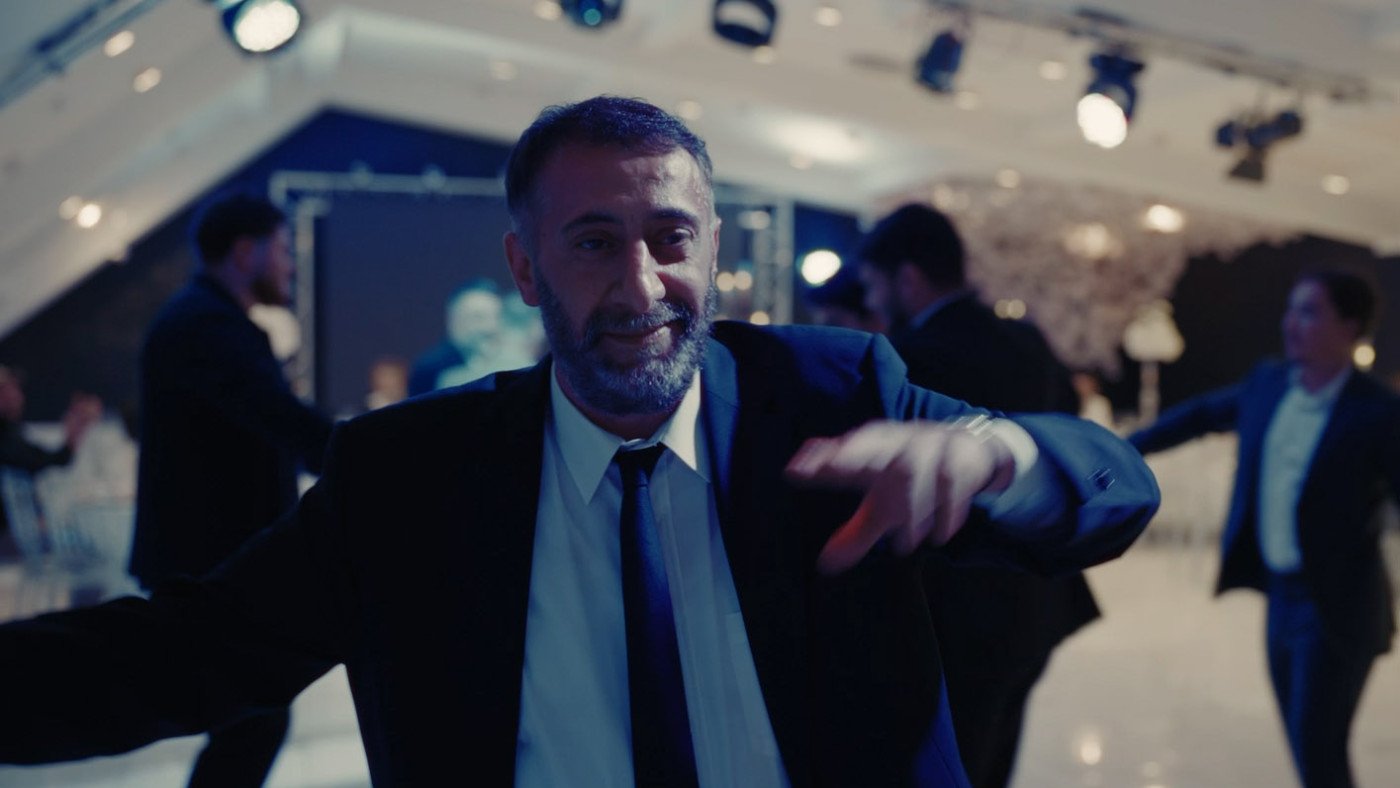
Kida Khodr Ramadan needs no introduction in Germany. And now, the popular star is ready to take the international film festival circuit!
The autodidact Ramadan has made a name for himself as an actor, director and screenwriter, winning several awards for his portrayal of Ali “Toni” Hamady, the head of a Berlin drug cartel, in the German drama series 4 Blocks, which has also been discovered by an ever-increasing international audience in the streaming age. He has further made a splash with the likes of Asbestos, a drama series about a soccer player whose dreams of going professional are shattered when he is framed by his uncle for a crime. Speaking of shattered: The series did just that to the record for the best start ever of a series on public broadcaster ARD’s ARD Mediathek streaming service.
He followed up that success with another ARD hit, namely two seasons of Testo, in which he starred while also co-writing and co-directing. The show follows five prisoners who rob a bank while on free access. When a security guard is accidentally killed, they are forced to take hostages, and the situation quickly escalates.
Ramadan also directed the movie Haltlos, starring Lilith Stangenberg as a woman experiencing a crisis and deciding to give up her newborn baby for adoption. The film earned rave reviews for its intensity. The creative further wrote, directed and starred in Égalité, the psychogram of a family father. He also handled all those jobs on the TV movie In Berlin Wächst Kein Orangenbaum, which can be translated as No Orange Trees Grow in Berlin. In it, he plays Nabil, who is released from prison after 15 years due to terminal cancer and finds out that he has a daughter, to whom he wants to leave his share of the loot from the robbery that put him behind bars.
In short, Ramadan has accomplished and won pretty much everything there is to accomplish and win in Germany.
Now, he is bringing his ability to slip into complex characters to the family drama Hijamat, written and directed by none other than Nader Saeivar (The Witness) and produced and edited by none other than Jafar Panahi. Yes, that is the creative duo that co-wrote Cannes 2025 Palme d’Or winner It Was Just An Accident, which was nominated for two Oscars. The film will be taking the spotlight with its world premiere at one of the oldest film festivals in the world when it debuts at the 60th edition of the Karlovy Vary International Film Festival (KVIFF) on Wednesday, July 8, in the Czech festival‘s Crystal Globe main competition.
In Hijamat, Ramadan portrays Murad, who is shaken to the core and struggles to protect his younger brother Kerem, played by Jael Cem Ilhan, when he learns that Kerem is gay. Long-buried secrets threaten to tear his deeply religious Muslim family and their life in Berlin apart as he finds himself subjected to pressures from all sides, including from his father, who has close ties to the local imam. Nicolette Krebitz, Aziz Capkurt, Moritz Bleibtreu and Nastassja Kinski also star in the ensemble cast.

Ramadan, born in Lebanon before his family moved to Germany when he was a young kid, took time out of his busy schedule to share with THR how he approached his lead role in Hijamat, working with the celebrated film auteurs behind it, the challenge of preparing for the film while serving a prison sentence, why acting is all about honesty, and why Hijamat is a story about freedom.
How did you approach and “become” Murad in Hijamat?
Do you know the Austrian director Marvin Kren? In 4 Blocks, he at some point made a robot out of my character, Toni Hamady. And I remembered that and felt that this was a very similar role.
Murad fights a lot for the family and takes on so much just so that everything fits. But he never even thinks about himself. And he doesn’t see that he has a disease. Actually, it’s not a disease; it’s a co-dependency. And he has ADHD.
Could you tap into your personal experience as a loving family man to slip into the character Murad?
The motto for me in this role was honesty and authenticity. I have family and children myself. And I have siblings. And film is about honesty and authenticity. If you’re not honest in a film, then it doesn’t work – at least for me.
I don’t know why, but watching you, this felt like a very physical role, even though Murad doesn’t run marathons or have big fights. What do you think?
I wanted to get into this role and not have a lot of dialogue. I focused on expressing a lot through the eyes, body and this honesty.
Well, you managed to touch me. I thought to myself repeatedly, while watching Hijamat: Please, somebody give Murad a hug or something!
You know, I’ve been waiting for a hug since I was a kid. But the hug is there for me when I have a good screenplay and a great director. And that was the case here. I had a great director and a great screenplay. I’m an actor, I’m a juggler, and we go into different roles. Here, we had a director who really brought great emotion to the set.
When you have a director who honestly thanks you after every take, and you say thank you back, that is not common. I’ve rarely had that in Germany, where things are more technical. There was love and that human element in the communication, and that’s art for me.

Did you know Nader Saeivar before Hijamat, and how did you get cast for the role?
No, I was asked to do the role and waited two years.
But in those two years, I was in prison for a year. I thought a lot about it in prison and if I could shoot this movie at all. I get a lot of requests, but I really wanted to play this role because it totally grabbed me.
I really want to thank producer Said Nur Akkuş for all his trust and for bringing me to this wonderful project and giving me the chance to work with the amazing Nader Saeivar.
You served an open prison sentence in Germany for repeatedly driving without a license. Under this set-up, you could serve time in a low-security facility and can get permission to work during the day and return at night. Can you share a bit about how this affected the communication with the Hijamat team and your preparation?
In my one year in prison, I had direct contact with the director and everyone. I’m very grateful for that. That was a matter of trust for me. I had to prepare in prison and then get into the role. Actually, the first days of shooting took place when I was still in prison.
I also quickly got my driver’s license while I was in prison, because I have a lot of car ride scenes in the film, and I didn’t want to be doubled. I hate doubles. If someone can be my double, it’s another Kida Khodr Ramadan.
Since we discussed prison, I want to ask you about someone who is supposed to go to prison, again, in Iran. Did you know Jafar Panahi‘s films well before agreeing to do Hijamat?
Yes, I’ve seen them. He always does great stuff. They told me that Panahi is a producer on this and will cut the film.
Everyone asked me if I wasn’t afraid to be edited by Panahi. But why should I be afraid? I’m ready. When I’m in costume and mask, I’m prepared for the project. Filmmaking is sometimes like love and war. You have to get through it. You have to trust your body, and you have to trust your soul. You have to be present and in the moment – whether the editor is Hans-Peter or Panahi. I’m happy to be a participant in a great movie written by Nader, who trusted me, and edited by Panahi.
Nader was my captain, and we focused on bringing this ship home. It’s nice when you can just focus on that and dive into the role.
My director fled from his country because he wasn’t allowed to live there without being afraid for his family. It’s all so paradoxical.
Was being directed by Nader different from your past experiences?
The most important thing was to understand the system of an Iranian director and how he works. In the German system, it is very different, and you play differently. I noticed that timing was very important for the film. Timing was extremely important. We had a lot of one-takes, so you just have to be there and be ready.

I actually ate better and slept better during the production. It is very important with such a film that you are in good shape mentally. You need this energy. Otherwise, it’s disrespectful to the audience if you don’t show what you can do.
Tell me bit about the great cast you have around you in Hijamat. Were you familiar with Jael before, for example? I had never seen him before. And then you have such stars as Moritz Bleibtreu and Nastassja Kinski…
No, I didn’t know Jael, but he did his job so well. For me, it was really important that we all pull together, and I think that’s why it worked.
Nastassja Kinski is a friend of mine. I asked Nader about her, and he said I should bring her in, and I did right away. She’s a legend. We all look up to Nastassja. And then I brought in Moritz.
And I was so very grateful, very grateful indeed, that I had such a great partner in the film in Nicolette Krebitz. She gave me the security in my role. She was a very important point for me.
Religion plays a key but different role for the various characters in Hijamat, but it doesn’t feel like a film about religion. What role do you see religion playing in the film?
Some people will likely confuse it for a religious film. For me, it’s a film about freedom. It has nothing to do with nationality or religion, but with people wanting to be free. And that was the theme for me. Freedom. A person wants to be free, but he has his limits. And sometimes you have to cross those limits.
I don’t want to keep you any longer, given all your work and other commitments. What can you share with me about projects that you are currently working on or preparing for?
I have been doing a lot of directing, but now I want to work more as an actor again. I am preparing for the lead role of Göz by Nuran David Calis, [a contemporary reimagining of Johann Wolfgang von Goethe’s Götz von Berlichingen].
And then I will shoot [a satire about a village thrown into disarray by the arrival of extraterrestrials] with the twins who did the series Die Discounter. I will play the main character in this film from Bruno Alexander and Emil and Oskar Belton. The film is called Aliens Over Meck-Pomm.
Leave a Reply