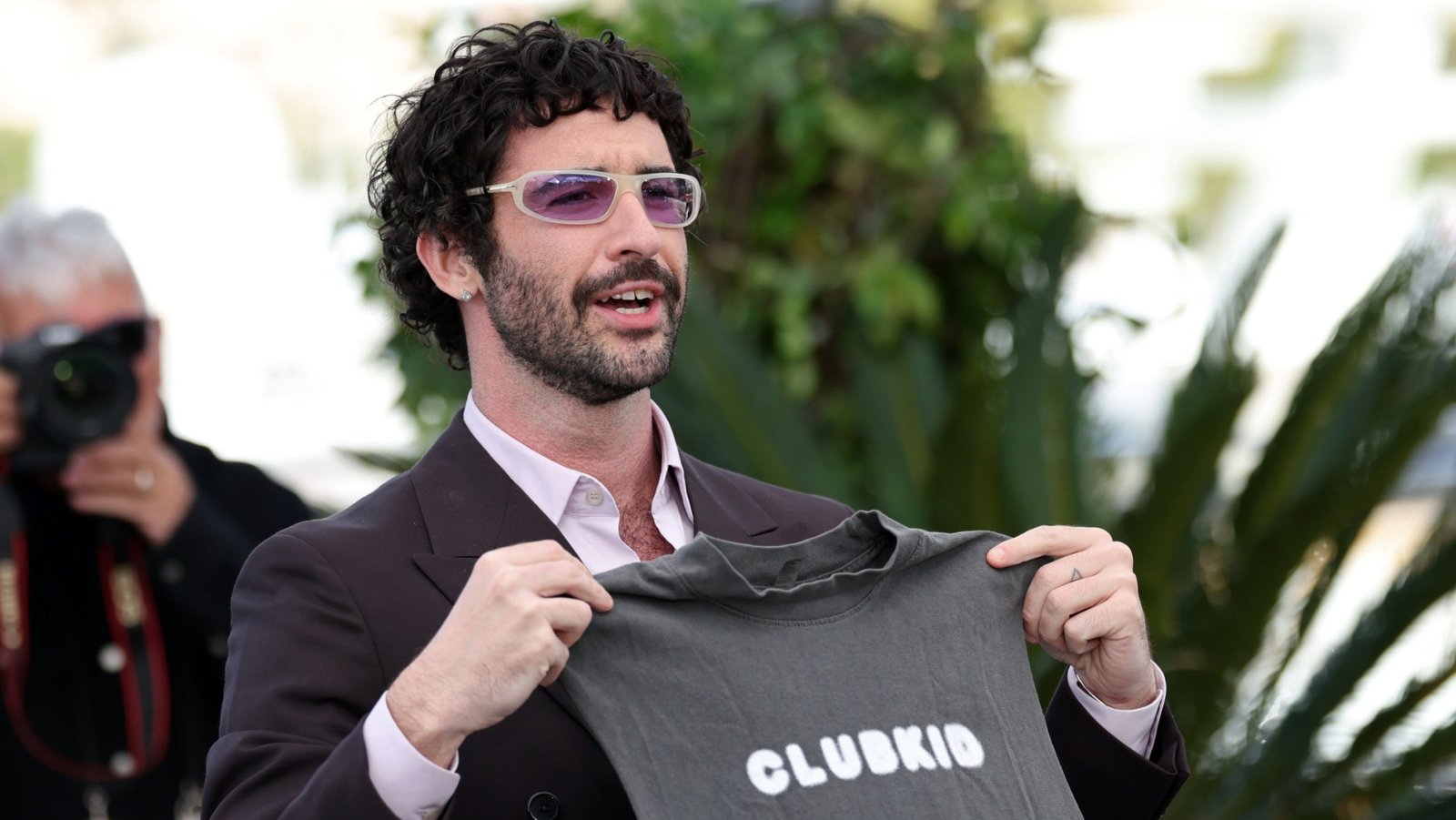
When the lights went up after the Cannes premiere of Jordan Firstman’s Club Kid, the writer-director scooped up his 14-year-old co-star Reggie Absolom in his arms and started a chant in his honor. He knew he had a winner.
A few days and nights of a bidding war later, he was proved right. A24 laid down eight figures for world rights to Firstman’s debut feature — outmaneuvering Focus Features, Searchlight, Netflix and Mubi to land this year’s Cannes success story. For a market that had been crying out for a genuine breakout, the reported $17 million worldwide deal was the shot of adrenaline everyone needed.
Club Kid, which premiered in Un Certain Regard, stars Firstman as a gay, drug-addled party promoter who has spent a decade on the dance floors and in the darkrooms with no particular plan for the future — until the son he never knew he had shows up on his doorstep. Warm, funny and genuinely touching, but with plenty of edge, the film sparked the kind of competitive feeding frenzy that used to be a regular feature of the Marché. This year, it was the exception.
The other marquee deal came courtesy of Amazon, which inked the biggest package sale of the market, picking up most international rights to Pumping Black, a new psychological thriller from Fresh director Mimi Cave, set in the cutthroat world of competitive cycling and starring Jonathan Bailey and Natalie Portman. Two eight-figure deals to close the Cannes Film Market. On paper, a strong finish. In practice, a pair of bright lights in what was otherwise a pretty dim room.
There was business being done in Cannes. The hallways of the Palais des Festivals were busy enough and there were plenty of packages on offer — though most got announced late, leaving buyers griping they barely had time to read scripts, much less make offers. Much of the real dealmaking will happen post-Cannes, after international buyers go home and crunch the numbers. Which is another way of saying the market didn’t really close — it just adjourned.
That’s symptomatic of something deeper. The independent film industry is in transition, and nobody has quite figured out what it’s transitioning into.
The old model — the one that sustained the indie ecosystem for decades — is visibly fraying. At its center was the pay-one television window: a predictable, lucrative revenue stream that allowed distributors to take risks on pre-sales, backing films before a frame was shot based on talent and a promising pitch. Streaming platforms, negotiating their own deals on their own terms, have largely killed that window. What’s left for independent distributors is a landscape stripped of the financial cushions that once made risk-taking viable.
“Buyers are very specific about what they want and how much risk they are willing to take,” says Matt Brodlie of Upgrade Productions. Deals for projects above a certain budget level, or without a clear and obvious path to commercial success, are taking a lot longer to close.
For producers, says David Garrett of Mr. Smith Entertainment, who has been navigating these markets for decades, that means “relying more on equity financing and soft money to get movies financed.” The result is a buyer’s market without enough buyers — or at least without buyers willing to commit large sums up front. Films that would once have sparked competitive bidding are screening to polite attention and noncommittal follow-up meetings.
But here’s the thing about a vacuum: something always fills it. And this year at Cannes, you can see the outlines of what that something might be — not one model, but several.
One answer, increasingly convincing, to the challenge of independent film distribution is community. Watermelon Pictures, the Chicago-based company co-founded by brothers Badie and Hamza Ali, which focuses primarily on films about the Palestinian and Arab experience and has built its entire operation around the idea that a deeply engaged, underserved audience is a more reliable foundation than any pre-sale agreement. The distributor deploys WhatsApp groups, local community leaders, and social media influencers to drive audiences to cinemas, with remarkable results: Three of its Palestinian-focused films — Palestine 36, All That’s Left of You, and The Voice of Hind Rajib, made the Oscar shortlist for best international feature, with The Voice of Hind Rajib scoring a nomination.
A faith-based variant of the same logic has produced even more dramatic results. Faith-based distributor Angel Studios (King of Kings, The Sound of Freedom) has been scaling rapidly across Europe, Latin America, and Asia. The Chosen, the multi-season drama about the life of Jesus, fully financed by the Christian nonprofit Come and See Foundation, has grossed more than $120 million worldwide through theatrical releases of its episodes.
“We are really a fan-based production company,” says Mark Sourian, president of production at 5&2 Studios, which produces The Chosen. “In the 21st century, if you are not in direct connection with your audience, if you are just letting your film ‘speak for itself,’ you are going to lose control of the conversation.” 5&2 Studios were in Cannes promoting their first stand-alone feature, The Chosen: The Crucifixion, which Amazon MGM is releasing next spring.
That lesson of going direct to fans is one that has been absorbed by a generation of online creators now moving into features with their audiences already in tow. As Club Kid‘s Firstman (who started on Instagram) and horror filmmaker Mark Edward Fischbach (aka Markiplier), a YouTube influencer whose self-distributed Iron Lung has grossed more than $50 million worldwide, have both demonstrated. Firstman’s social media fluency wasn’t incidental to A24’s interest in Club Kid, it was part of the package.
Then there’s the re-release model, less flashy but quietly significant. Warner Bros.’ new Clockwork label presented a restored The Devils in Cannes Classics and Cineverse screened a new 20tth Anniversary, 4K version of Guillermo del Toro’s Pan’s Labyrinth ahead of theatrical runs for the films this fall. Del Toro himself made the case simply: “The future of theatrical is a mixture of reissues and new movies. You put Road Warrior out on a big screen, I’m there. You put The Devils, I’m there.”
None of these models is a clean replacement for what the indie industry has lost. But taken together, they suggest the audience for independent film hasn’t gone anywhere. It’s just waiting to be reached in new ways — whether that’s a church network, a WhatsApp group, or a comment section on YouTube. The dealmaking machinery of Cannes may be sputtering. The people willing to reinvent it are already here.
Leave a Reply