There are two key moments in Steven Soderbergh’s “John Lennon: The Last Interview” that really capture John Lennon — at his most captivating and humane, and also at his most messianically annoying. (As a Beatles believer since I was a little kid, I’ve never written the word annoying in a sentence with a Beatle before. But there’s a first time for everything.)
The first moment comes early on, when Lennon is talking about the song “(Just Like) Starting Over.” “The Last Interview,” as its title states, presents the very last media conversation that John Lennon ever had — and, chillingly, the interview took place on the day he was murdered, Dec. 8, 1980. A few hours before that earth-shaking tragedy, John and Yoko sat down inside their apartment in the Dakota to talk to a small crew from the radio station KFRC in San Francisco. It was the one radio interview Lennon had agreed to give in conjunction with “Double Fantasy,” the comeback album that had been released three weeks beforehand. (Just before the interview started, John and Yoko were upstairs in their apartment doing what became the iconic Annie Leibovitz photo session for Rolling Stone.)
“(Just Like) Starting Over” is about John and Yoko, after coming out the other side of some stormy years, celebrating the renaissance of their hard-won, long-term, stronger-than-ever love story. The song’s tone is upbeat, though tethered to a slightly rueful awareness of everything they’ve gone through (“It’s been so long since we took the time,/No one’s to blame, I know time flies so quickly”). The song celebrates coming back together.
Lennon, however, declares that the song has a larger meaning. He talks about the separation between men and women that had emerged in the culture, going back to the rise of third-wave feminism in the early ’70s; he felt that this gulf was now winding down. So in “Starting Over,” Lennon explains that he intended the song’s message of reconciliation to apply to men and women in general. It’s about time, he says, that they started to get back together. That’s an arresting thought, and a touching one. It shows you how instinctively Lennon could take in the big picture and reflect it back to us.
But the second key moment in the interview, while just as revealing of who Lennon was, is more…problematic. “Double Fantasy” was Lennon’s first album in five years, marking the end of the break he’d taken starting in 1975, when he and Yoko’s son Sean was born. At that point, he became what he called a “househusband” (a novel term back then), putting his guitar on the shelf to devote himself to raising Sean. At the time, this was kind of a revolutionary idea; it marked the dawn of an age when men would start to be thought of as domestic nurturers in a way they hadn’t been before. Lennon, as in so many things, was on the cusp of a movement, but he had never spoken about it much. In “The Last Interview,” he talks about what his experience as a househusband was like.
He’d get up early and fix Sean some breakfast (nothing with sugar!). We hear that and think: Yep, sounds like a good way to start the day. He’d make sure that Sean watched “Sesame Street” rather than commercial television. And then, at some point in the morning, the nanny would take Sean out, and the two of them would spend the rest of the day doing whatever they were doing. I have to confess that I heard this last bit and didn’t know whether to laugh or choke. For here is John Lennon setting himself up as a new kind of hands-on daddy. He took five years off from making music to do it. But after all that, his kid was still raised by the help. On the one hand, this marks Lennon, for all his forward-looking rhetoric, as a man with one foot stuck in an older era (which is no crime). And I’m not suggesting that there’s anything wrong with having a nanny. What I’m saying is that if John was going to let his nanny spend most of the day with Sean, then maybe he shouldn’t be lecturing the rest of us about the virtues of househusbandry.
I raise the issue only because John, in “The Last Interview,” comes off as just about the happiest he has ever been. But he’s so high on the life he’s leading that he’s also at his most messianic. And a little of that goes a long way. There’s a side of Lennon that was a born cynic with an acid tongue, who would use it to cut through every piety he came across. But there’s another side of Lennon that was almost the sentimental counter- reaction to his own cynicism. I’m talking about the side that wrote “Imagine,” and that inspired him to treat his marriage to Yoko as an ongoing piece of instructional performance art. That’s the Lennon who’s on full effusive display in “The Last Interview.” I could have used a bit more of the acid cynicism.
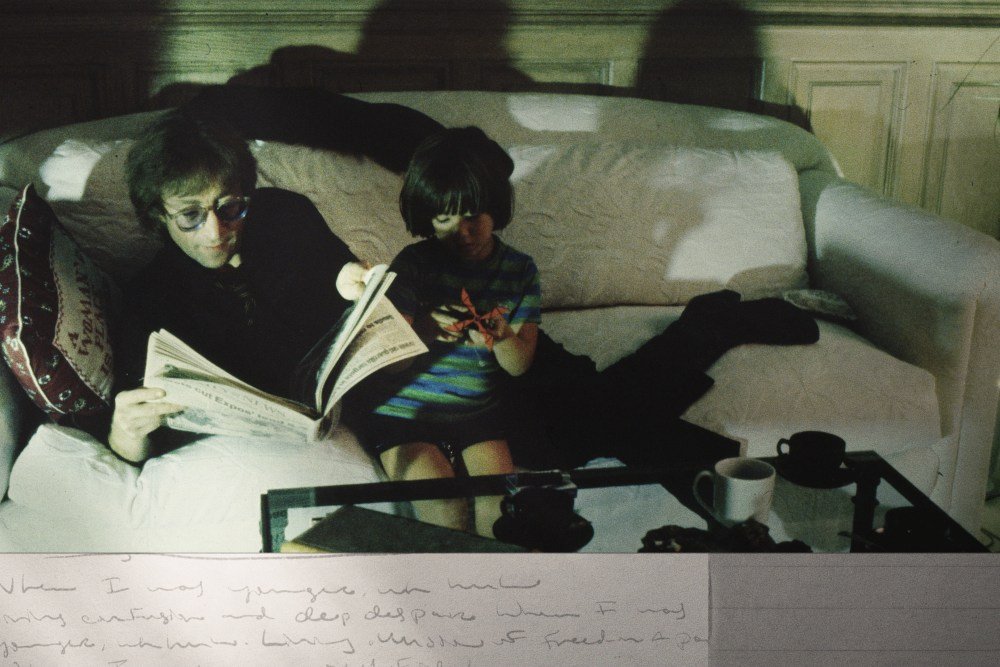
I’m not trying to make light of “The Last Interview” — I’m just to describe what the movie is like, despite the haunting circumstances that surround it. That Lennon was killed just hours after he said all this stuff is a wrenching reality to behold; it lends the movie an inescapable poignance. And Soderbergh has done an ace job of illustrating “The Last Interview” by turning it into a dreamy archival collage, accompanying John’s words (and Yoko’s too) with hundreds of photographs I had never seen before. (He also uses a handful of fantasy images created by AI; if they’d been devised with older technology, no one would care, and no one should care now.) You really get a candid sense of Lennon at home, and occasionally with the Beatles. (You also see how miserable he was during the Lost Weekend period.) The needle drops, which include Lennon songs and Beatles songs, are impeccable and irresistible. I especially dug the exquisite use of “Love” over the closing credits.
Yet part of it is that Soderbergh is doing all he can to make this interview more momentous than it actually was. One of the conditions of the interview was that John wouldn’t be asked to talk about the Beatles or “the past.” That’s quite a restriction! I get that he didn’t want to rehash old stories, but what that means is that “The Last Interview” actually presents one of the first of a new breed of promotional interview. Lennon is such a commanding personality that he goes off on tangents anyway (I dug hearing him talk about how much he loved disco), but his tone of relentless bonhomie can be a bit much; on some level he’s marketing his happiness to sell the album. I have to say that I preferred the let-it-rip Lennon showcased in the famous Jann Wenner interview known as “Lennon Remembers,” and when it comes to Lennon documentaries, “The Last Interview” isn’t nearly as revelatory as Kevin Macdonald’s recent “One to One: John & Yoko,” which caught the complex tumult of the couple’s first two years in New York.
That said, in “The Last Interview” John Lennon has a message — to himself, and to us — that was almost a sequel to the Beatles’ message of love. It was a message about women, and about how the time had come for a new kind of equality that turned on something deeper than power. For Lennon, that was the new square one. And what’s bittersweet about “The Last Interview” is that it actually gives you a concrete vision of where John Lennon would have been heading had he not been felled by a madman’s bullet. He talks about wanting to perform live again, about his desire to give concerts with the kind of musicians he’s made “Double Fantasy” with. Lennon was 40 when he died; he’d been out of sorts for much of the first half of the ’70s, and largely out of view for the second half (though he was an avid New Yorker). “The Last Interview” reveals that he was revving up to rejoin. Watching the movie, you realize he’d only just begun.
Leave a Reply