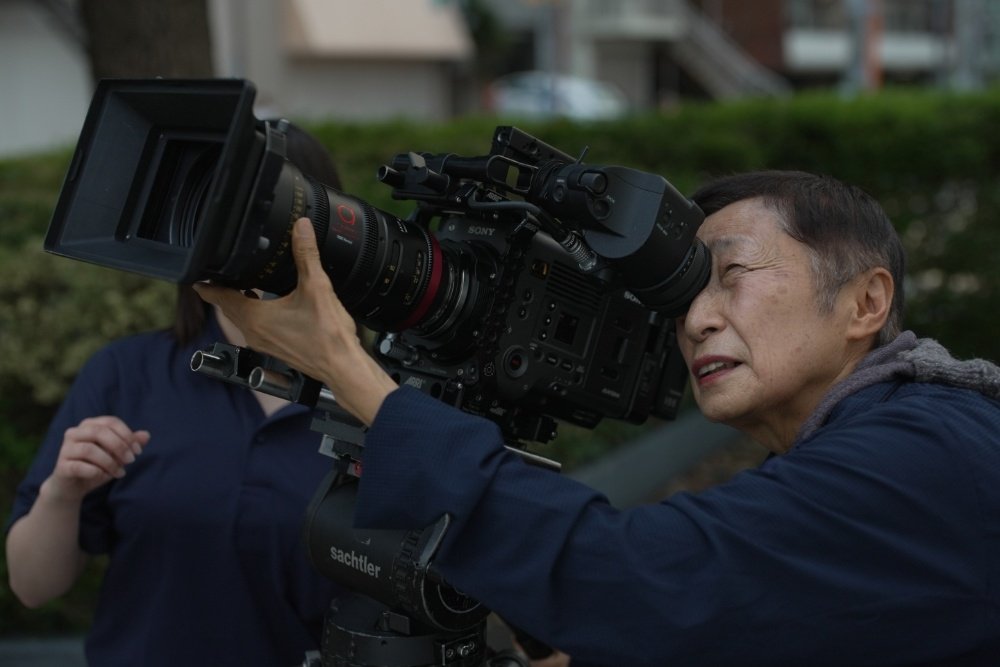
Ashizawa Akiko, a veteran of more than 70 features and one of the most accomplished cinematographers in the history of Japanese cinema, delivered a wide-ranging masterclass at the Cannes Film Festival, tracing her career from an unlikely entry into the industry through features spanning horror, comedy, drama and historical epic. The session preceded her receipt of the Pierre Angénieux Tribute.
The event opened with Ashizawa describing an upbringing entirely removed from cinema – until, as a student at Aoyama Gakuin University in Tokyo, she encountered the films of Jean-Luc Godard. Early ambitions to direct dissolved when she saw the 8mm work of fellow student Morita Yoshimitsu. “He’s really talented and I can’t win over him, so I decided to find another way – that’s why I took the path for the cinematographer,” she said.
Breaking into the industry in the early 1970s required finding a side door. With no female camera assistants in the Japanese film industry, Ashizawa found her opening through cinematographer Ito Hideo – known for shooting Oshima Nagisa’s “In the Realm of the Senses” – who agreed to take her on as an assistant. The lesson Ito imparted proved foundational. “Whether it’s a big-budget job or a small job like just taking photos for a panel, there is no doubt that you should pour all your energy into it,” she said, noting she still passes that principle on to her own assistants.
With the film industry still largely closed to women, Ashizawa moved into TV commercials in the 1980s – a newer field less entrenched in the male hierarchy – before returning to features in the 1990s.
Her breakthrough into sustained international recognition came in 2005 when she began working with Kurosawa Kiyoshi, Japan’s foremost practitioner of atmospheric unease. She told the audience she pitched herself for the collaboration after hearing Kurosawa was searching for someone who could shoot overcast skies and gloomy weather – the inverse of what she described as most Japanese directors’ preference for bright, sunny conditions. Eight features followed, among them “Tokyo Sonata,” which won the Jury Prize in Un Certain Regard at Cannes 2008, and “Journey to the Shore,” which took the section’s directing prize in 2015.
Ashizawa also screened a clip from “Chronicle of My Mother,” directed by Harada Masato, and paid tribute to Harada, who died at the end of last year without realizing his ambition to visit Cannes. She offered a frank account of their working relationship – marked by persistent on-set disagreements over camera angles that she would sometimes quietly correct when Harada’s attention was elsewhere – before acknowledging that the friction produced one of her finest results. “Even if things don’t go well on set, a good movie can still be made,” she said. “On the other hand, even if the set is fun, a movie might not turn out well.” The film won Ashizawa the 2012 Mainichi Film Award for Best Cinematography.
“Journey to the Shore” prompted one of the session’s more revealing technical discussions. Shooting during the analog-to-digital transition, Ashizawa said she rejected the then-prevalent “film-like” trend in favor of exploiting what digital could do on its own terms. She pushed Sony cameras beyond the manufacturer’s recommended ceiling – shooting at ISO 3200 or 4000 rather than the manual’s limit of 1600 – and built custom LUTs designed to preserve, rather than eliminate, the digital noise most cinematographers worked to suppress. Lenses were vintage Kowa CinemaScope glass more than 50 years old, which she found matched unexpectedly well with modern digital sensors. The entire film was shot on three lenses.
Her broader philosophy toward digital technology emerged as a consistent thread. “If you think you can do anything later, it means you can’t do anything at the moment,” she said, describing a preference for committing fully to tone and image during pre-production rather than deferring to the color suite.
Ashizawa also produced several bell peppers at the podium – purchased at a local market the previous day – to illustrate her preferred method for camera testing. “Rather than placing a chart, shooting like this makes it much easier to understand the state of the light naturally,” she said. “Coming to Cannes this time, I confirmed that bell peppers have the same color all over the world, so I think I will continue to use these vegetables for camera tests instead of charts.” She joked that when testing is complete, the vegetables can be turned into a salad.
Discussion of her recent work with Indonesian director Edwin – their second collaboration after “Vengeance Is Mine, All Others Pay Cash,” which won the Golden Leopard at Locarno in 2021 – illustrated the adjustments required when working across cultural contexts. On “Sleep No More,” a horror film that premiered at the Berlinale this year, Ashizawa said she found that Indonesian and Japanese conceptions of fear diverged markedly: the former physical and tactile, the latter more conceptual and psychological. “The director also modified his approach, and I think it turned out to be a work that can be understood by people all over the world,” she said.
On the question of how the industry has shifted for women since she entered it, Ashizawa was direct. “It has changed dramatically,” she said, citing the growth in female cinematographers and assistants and pointing to Toho Studio’s addition of a daycare facility as evidence of structural change.
Closing the session, she expressed a desire to shoot her first Korean production – “I haven’t worked with our neighbor South Korea yet, so I’d like to do that if there’s an opportunity” – before returning to first principles. “In this chaotic and dark world, I hope that cinema can serve as a ray of light to brighten the world,” she said.
French actress Irene Jacob, who worked with Ashizawa on Fukada Koji’s “Sayonara,” attended the masterclass. Ashizawa is the second female cinematographer to receive the Pierre Angénieux Tribute, following Agnès Godard in 2021.
Leave a Reply