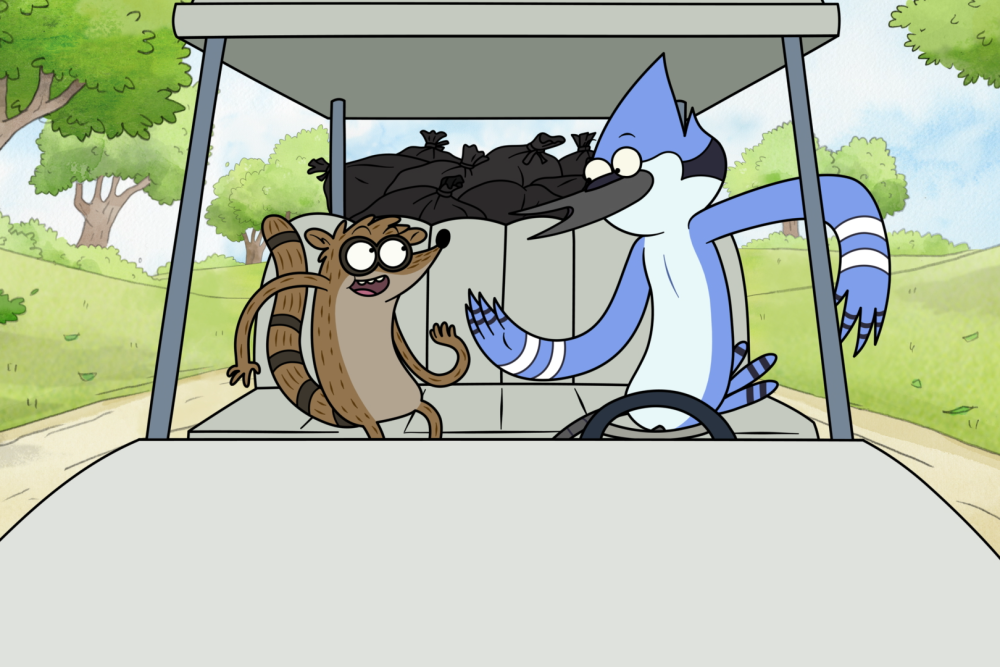
In the “Regular Show” pilot, a mild-mannered blue jay named Mordecai and his scrappy raccoon counterpart Rigby swipe a magical synthesizer from a wizard while he’s peeing in a bush. The instrument, which they name “The Power,” can grant the 20-something-year-olds any wish, as long as they articulate their desires through an improvised song and dance routine. Shenanigans ensue, but it isn’t long until their fun is threatened by the prying eye of Skips, their much more responsible co-worker at the local park. In an attempt to shoo him away, they crank “The Power” up to the max. They sing in unison, “Using ‘The Power’ in your face / Sending you back to your place / Don’t look at our crotches while we synchronize our watches!” It’s their most inspired arrangement yet, but right as they are about to send Skips to his “room,” they flub their lyrics and accidentally send him to “the moon.”
This episode debuted on Sept. 6, 2010. I was nine years old, and it was the funniest thing I’d ever seen.
“When I think back on those days, I’m like, ‘How did they greenlight it?’” says J.G. Quintel, series creator and the voice of Mordecai. “Some of the stuff we were doing was so weird, but it was making us laugh.”
“Regular Show” became one of the most successful series in Cartoon Network’s history. Running for 244 episodes across eight seasons from 2010 to 2017, “Regular Show” chronicled the hijinks of Mordecai and Rigby, two college-age slackers whose pursuits of video games, grilled cheese and time off from work inexplicably descend into intensely surreal, and often life-threatening, emergencies. It was nominated for six Emmys during its time on air and picked up a win in 2012 for outstanding short-format animated program.
And now, after nine years away, Quintel is bringing “Regular Show” back to TV with “The Lost Tapes,” a mysterious reboot that drops viewers back into the world of the Cartoon Network classic. Along with Quintel, original cast members William Salyers, Sam Marin, Mark Hamill, Minty Lewis and Janie Haddad Tompkins are all set to return. Quintel remains tight-lipped about how exactly he’s reviving “Regular Show” after tightly wrapping up the original run, but he ensures that “everybody’s questions” will be answered when “The Lost Tapes” premieres May 11 with a half-hour special. The first 10 episodes will air on Cartoon Network and will be available to stream on HBO Max in June. 30 additional episodes are scheduled for later release.
Weeks before the premiere, Quintel sat down with Variety to discuss Cartoon Network’s golden age, pushing “Regular Shows” TV-PG rating to the limit and what fans, both old and new, can expect from “The Lost Tapes.”
What was it like working at Cartoon Network during, what I think is considered in retrospect, the golden age of the channel?
I remember feeling like the vibe was that Cartoon Network was one of the more creative studios compared to the other ones, and they were able to take bigger swings, bigger risks, and they had all creator-driven shows. I got to work on ”Camp Lazlo” and see what that was like, and then I moved on to “[The Marvelous Misadventures of] Flapjack”, which was Thurop van Orman’s show. We met at CalArts in a screenwriting class. When we got to pitch that show, and he got it off the ground, and we started making stuff, they were very creator-focused. Whatever we thought was funny and was making us laugh, we would try to push it through, and they would have notes and things, but overall, it was very supportive of the creative team and the artists.
And then around the second season of that, there was an executive changeover. I remember that’s when [former chief content officer] Rob Sorcher came in, and he was looking to push Cartoon Network to be a little bit older. And they made the Cartoonstitute, and they were doing shorts, and that’s when I ended up making the “Regular Show” short. I had sent him my film “2 in the AM PM,” which I had made my senior year at CalArts, and I was like, “I want to make something like this” — the vibe of it, like the intensity of the surreal nature of the show, and how that could be pushed. After pitching the show and getting it greenlit, and after making the pilot, they didn’t really have any notes. Then the first couple of episodes, we were just making it for ourselves. Again, they didn’t really have notes, and they were saying, “We want to do TV-PG stuff, and we want it to be pushed a little bit further.” That whole first season let us go to town and just do our thing.
You first drew Pops, Benson and Mordicai in college. Was the idea for “Regular Show” also in your back pocket when you started pitching?
No. The reason that I put all those characters back together was that it takes a long time to find new characters. Having spent a year on each of those films, it felt like, “Oh, I really like those character designs, and I want to use them again.” They had done well at school, like, people were laughing at the screenings, and so I was like, “These characters work. I want to put them together.” Then I needed to round out the cast, because it wasn’t enough. Adding Skips, Muscle Man, High Five Ghost, that was just pouring through my sketchbooks and finding things that I thought were funny, and trying to piece them together until it felt like, “Oh yeah. This feels like the crew.”
That was one of the only big notes that Rob Sorcher had on that initial, early pitch. “Regular Show,” conceptually, was going to be about these guys working at a zoo, but in the zoo, it was going to be humans instead of animals, and they were the animals. And he was like, “You don’t need that.” And I was like, “Huh, I guess you’re right.” And so it was like, “Well, I’ll just make them work at a park.” They’re just doing kind of mundane, everyday chores that we all get, whether we’re kids or adults, like working in a first job or whatever, and I think everybody can relate to being like, “I don’t feel like doing that right now.” It made it really easy to reset and make another episode each time.
What was it like going from a supporting role on your previous shows to creating, starring in and steering the ship of one of Cartoon Network’s most popular franchises?
When you’re working on someone else’s show, like “Flapjack,” I was the creative director on that, and my attitude working on any show up to that point was like, “Let’s just make it as good as it can be.” I had a lot of energy and was always trying to find ways to push stuff. For every episode, trying to be like, “Dude, we can have no bad episodes. Let’s just make them all good.”
So when “Regular Show” started, it was hard because it was my own thing, so I cared about it even more. I was really picky about everything and trying to find people who could match the tone and the sensibility, and watching what they would do with it, and being like, “Oh my God, that is hilarious. I never would have thought of that.” And then having other things come through where it’s like, “It’s not right. I know we could do better than that.” In this job, usually you’re the last round of notes, and if you want to change it, you just have to do it. You don’t get paid extra or anything. You’re always pushing yourself to make sure the episodes are good and that you think they’re super funny, which gets harder and harder down the line. Because you’re like, “We already did that episode. I know that we can be funnier than this. We’ve done ones that were like, crazy funny.”
And the added intensity of the ticking time clock, because once the show is greenlit, every week, you have to turn in the next one, and every week, and you’re checking, say, 20 episodes at a time, at different parts of the process. You really lean on your team. Once you find the group that really gets it, and they know what they’re doing, and they’re making stuff better than you even would make, it’s really fun.
Why do you think “Regular Show” resonated with audiences as well as it did?
When I was making student films, one of my favorite parts was going to the screenings and seeing whether or not people thought it was funny. If you get a big laugh, it feels good, especially after working so long. This is a similar thing, except you don’t really get to go out and watch people watch it, because it goes out to the world on television. But I’ve run into people who’ve seen it, and they like it, and they grew up with it. But running into people who weren’t born when it was on, or born afterwards, and they found it through streaming, and they still think it’s funny, has been wild. Once we ended the show, maybe eight years ago or so, it was like, “Oh, it’s over. Like, it’s done,” but I forgot that it’s still airing. And for some people, they’ve never even seen it or heard of it, and so when they find it, and it clicks, it’s really cool to think that it can hopefully be timeless.
We really tried to make something that would be funny, no matter when you find it. It wasn’t about pop culture events or something super topical. It was always just within that world and based on stuff that we were growing up doing as kids, or definitely stuff we were doing in college. I feel like they’re totally moments, no matter when you grew up, of you and your friends getting really excited about something, like being down to wait in line for some weird food thing, or a movie that you’re not supposed to see, or to finally get that video game that you wanted to play. I feel like that is exciting to everybody, because we’ve all been through that.
You really pushed the limits of your TV-PG rating on “Regular Show” with some of the language and allusions to adult themes. I remember many episodes where the guys were miraculously getting drunk off soda and hot wings. Was it difficult to push that stuff through?
We were all just trying to make ourselves laugh, and it was within the parameters of this TV-PG show. So, you know, they had to be drinking soda, they had to be eating hot wings. And if you get it, you get it. And if you don’t, maybe watch it again when you’re a little bit older. Usually, we’re the pickiest ones about the episodes, and we would totally get episodes all the way up to an outline and then shelve it and be like, “Nah, it’s not good enough.” But the story I tell the most is about “Eggcellent.” We initially wanted it to be about Rigby trying to eat this 12-egg omelet to win a hat, but then he just barfs, and the barf comes to life and, like, trains him to do the challenge so he can win. And they were like, “You can’t have barf come to life.” We’re like, “Dude, it’s gonna be funny.” And finally, after a long time of pushing on it, we were like, “Well, what if it wasn’t barf? And what if Rigby goes into a coma, because he’s allergic, so then Mordicai promises to win it for him?” It ended up being way better, and we won an Emmy for that episode.
I remember back in the day, we were two or three seasons in of doing this type of stuff and getting it in, and it’d be on TV, and then eventually, I think the show got some calls to the point they were like, “We need you guys to tone it down and take some of that stuff out.” And we had to retroactively pull some of the language and some of the stuff they don’t let us get away with as much. But we have been able to lean back on what made us so popular. We’re like, “That’s part of what made it so cool.” I’m so excited for the new season, because I feel like we’ve got a lot of that vibe.
Were the calls from parents or the network?
I feel like it was parents, because if the executives were only getting good calls, they’d probably be like, “Keep doing it.” It was definitely getting the ratings, but I think as more and more people watched it, some more critical people maybe started to become aware of it, and they were like, “Hey, you can’t do that!”
How do you reflect on that original run, considering the current state of the entertainment industry?
We’ve talked about it a lot on the show. We brought back a lot of people from the original run, and we’ve all been on shows since then, and a lot of us didn’t realize what we had when we were on “Regular Show.” That first season was 12 episodes, which sounds more like what they would do today, and then the second season, they were like, “Do 28 more.” And after that, it was like 40. And they kept just banging out 40 after 40 after 40, and then do a movie, and then do 40 more. For a lot of us, we worked on that show for almost 10 years straight with small hiatuses where you knew you had something to come back to, which is really nice. Now it feels like everything is so truncated and short. “10 episodes, and then wait until it streams to see if it’s got numbers, and then we’ll call you back.” But usually, everybody’s already found other jobs, so you have to gear up a whole other crew and retrain them every time. But back then, we were just having a good time. Not that we took it for granted, but I don’t think we realized how rare it was to be on something that could have that kind of longevity.
Having it back, even this time around, we were kind of shocked that they, right out of the gate, [wanted] 40 episodes, because we’re not used to that. A lot of people on the show have never been on a show with that long a run. Then some people have not worked in person together, but we’re already just like the old days. We’re having artists pitch on the walls, and everybody’s together doing it. It’s super fun.
How did “The Lost Tapes” come about?
So a couple of years ago, I was in development here at WB, and [former VP of series] Lauren Martinez asked me if I wanted to think about bringing back “Regular Show.” I was like, “I don’t know,” because we really wrapped it up in the first run. It was complete, and it meant a lot to all of us. So I was like, “Well, I need to call Sean.” So I called up [writer/producer/storyboard artist] Sean Szeles, who was on the show the whole way through, and we had a bunch of meetings talking about it. Like, “What would we do with it? How would we bring it back? Do we even want to bring it back?”
We finally landed on an idea that we were really excited about that would get us back into it. So we pitched that to the network, and then they greenlit it for 40 episodes, and we were like, “Okay!” So then we started getting the crew back together, and it was like riding a bike. It’s really cool to come back to it after eight years, because I feel like we had really fresh eyes. Having not worked on it for so long, we had so many different experiences going out in all our different ways. So there were all these new ideas that we never would have come up with back then, if we had just kept going.
Why is now the right time for a “Regular Show” reboot?
I know a lot of studios are bringing back reboots, and that’s just part of the business. But, for us, after the pandemic, and going back out more and running into people, we realized how many people watched the show. I prefer to kind of recede into the darkness when it comes to being out in public. Animation is definitely for shy people. And people were coming up to me, and I was like, “What? How do you know my name?” Or I’d be ordering a burger, and the dude would be like, “Dude, are you J.G. Quintel? It’s free.” And, like I told you, meeting kids who weren’t even born when it came out, and they’re like, “It’s my favorite show ever.” So I was like, “Man, people really like it.”
It still clicks. To get the chance to bring it back, we still have so many stories to tell for people that maybe still are yet to be born that might find it and be like, “Oh, dude, this show is so good,” and then have the original run to watch as well. It’s really exciting, because I’m like, “Oh, if they haven’t seen it, they get to watch it for the first time.” That’s so cool.
Considering you wrapped up “Regular Show” so nicely the first time, how did you go about dropping us back in that world? Are you retconning the lore?
That was one thing we’re trying really hard to keep for people’s first watch because it’s one of those things with reboots, you’re like, “Are they gonna change the way it looks? Who’s gonna come back?” At the end of the first run, we had characters die, so it’s like, how do you bring it back? But the first episode is going to answer everybody’s questions about how we are bringing it back. It’s a really cool episode that’s like a half-hour special and a different structure than we’ve ever done in any episode. We had to pitch the network to be cool with it. It’s super cool to get you back into “Regular Show,” and then after that, it’ll just be so fun to watch the rest.
Will there be serialized storylines, or is “The Lost Tapes” a collection of classic, one-off episodes?
It’ll be important to have watched it all, and there will be a payoff. Watching it through to the end will be really satisfying.
I only got two episodes ahead of time, and both of them centered around Eileen and Margaret. Are the side characters going to have bigger roles in “The Lost Tapes”? Are there plans for new characters as well?
There’s going to be plenty of Mordecai and Rigby hijinks throughout, the classic stuff. But we wanted to take other characters that were off to the side in most of the series, and explore their backstory more. Beyond Margaret and Eileen, there are going to be other characters that get their own episodes here and there. And there’s going to be some new characters.
This interview was edited for clarity and length.
Leave a Reply