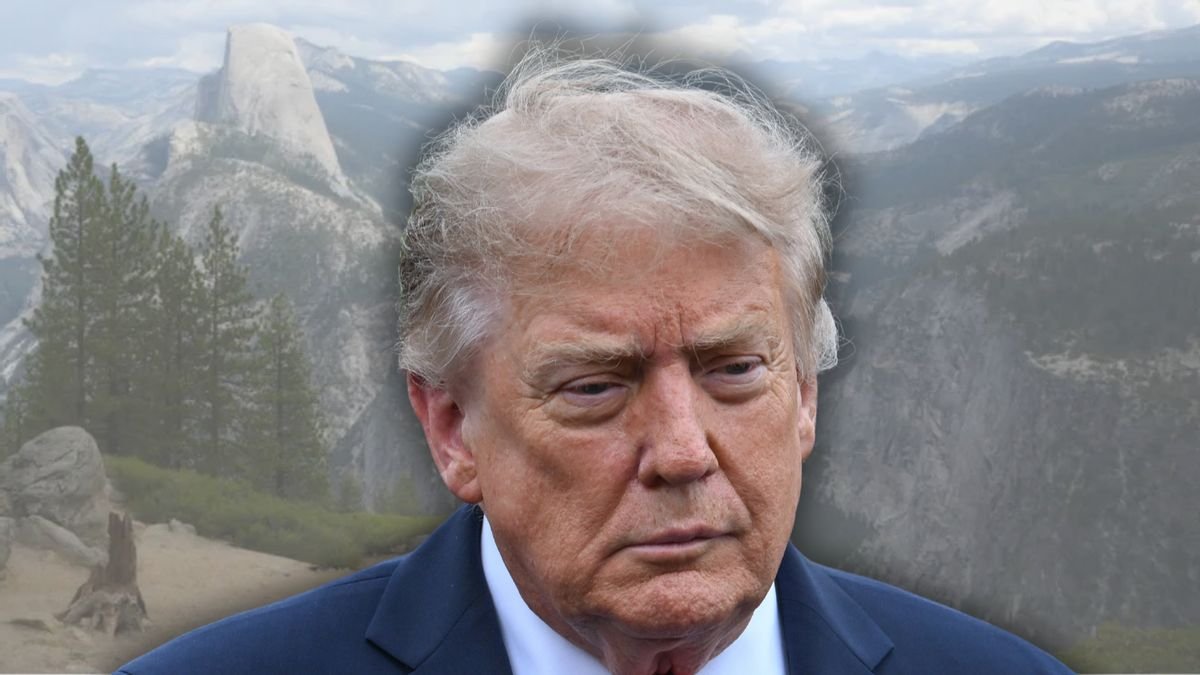
U.S. President Donald Trump’s administration is considering a deal that would give a piece of Yosemite National Park to a private developer.

- A rumor is circulating that U.S. President Donald Trump’s administration is pushing a deal that would give a piece of Yosemite National Park to a private developer. The claim stemmed from an August 2026 investigation by The Washington Sun (formerly NOTUS), which reported: “If the deal goes through, the Trump administration would be breaking with 150 years of American precedent at the birthplace of the national park system.”
- After the Sun released its story, other reputable news outlets such as The Washington Post and New York Times published their own reports. According to those articles, a Nevada-based real estate developer that currently owns property adjacent to Yosemite wants the land — a quarter-mile strip — to build a new road connecting its property to the national park.
- It’s true that, under Trump, the National Park Service is working with that developer, Kingsbarn Realty Capital, on an agreement that would give the company a part of Yosemite in exchange for an unidentified piece of land in California, based on Snopes’ review of federal records, court documents and statements from parties involved.
- What’s less clear is Trump officials’ level of influence on the project. The Sun based its reporting in part on interviews with anonymous sources who are “directly familiar with discussions” about the deal. At least one claimed leaders within Trump’s Interior Department were putting unusual pressure on the park service to make the land exchange happen. But due to their anonymity, Snopes was unable to track down those people to independently verify their accusations.
- A
spokesperson for the park system said claims that those conversations were happening in “secret” or under “political pressure” were untrue. Kingsbarn Realty Capital bought its land next to Yosemite in 2024, property records show. That land’s previous owner pushed a similar proposal to get the piece of Yosemite years earlier, though the park service and courts rejected it.
Under U.S. President Donald Trump’s administration, the National Park Service is working with a private developer on a land exchange deal that would give the company a strip of land in Yosemite National Park, according to Snopes’ review of federal records, court documents and statements from parties involved.
We began looking into the matter after seeing posts on social media sites that accused (archived) the administration of “quietly” working on the agreement, and numerous readers reaching out to us to investigate whether that was true. A Facebook page that advocates for protecting lands and monuments under the park service’s jurisdiction, Alt National Park Service, claimed:
The Trump administration is considering giving a private developer access to land inside Yosemite National Park so they can build a road to an 83-acre property they want to develop right outside the park. The National Park Service already rejected the same request years ago, and the previous owner even lost in federal court trying to force access through Yosemite. Now suddenly it’s back on the table.
Some members of Congress and conservation groups condemned the alleged project, accusing leaders of the Interior Department of breaking their promise to protect national parks. For example, in an interview with The Guardian, a spokesperson for Save Our Parks described the land exchange deal as part of a broader “push to sell off public lands and privatize America’s national parks” by Interior Secretary Doug Burgum.
The rumor about Yosemite stemmed from an August 2026 investigation by The Washington Sun, formerly NOTUS, which other reputable news outlets such as The Washington Post and The New York Times followed with their own reports.
According to those articles, a Nevada-based real estate developer that currently owns property adjacent to Yosemite wants the land — a quarter-mile strip inside the park’s western boundary — to build a new road connecting its property to the national forests.
“If the deal goes through, the Trump administration would be breaking with 150 years of American precedent at the birthplace of the national park system,” the Sun wrote. “The federal government has historically strived to expand the crown-jewel national parks, not give up land within them.”
Below, we lay out what’s true about the claim and the context surrounding the project:
Our investigation
According to evidence obtained by Snopes, it’s true that, under Trump, the park service is working with that private developer, Kingsbarn Realty Capital, on an agreement that would give the company a part of Yosemite in exchange for an unidentified piece of land in California.
What’s less clear is Trump officials’ level of influence on the project.
The Washington Sun based its reporting in part on interviews with anonymous sources who are “directly familiar with discussions” about the deal. At least one claimed leaders within Trump’s Interior Department were putting unusual pressure on the park service to make the land exchange happen.
Due to those sources’ anonymity, Snopes was unable to track them down and corroborate the Sun’s reporting. We rely on primary evidence for our fact-checking, which means we consider all other news outlets’ reporting questionable until we can confirm (or debunk) it ourselves, with our own sources.
In an email to Snopes, a
The White House declined to comment on the matter and directed us to
The quarter-mile strip of land in question
According to The Washington Post, the company is planning to build short-term rental accommodations for tourists on the land.
Meanwhile, according to The Washington Sun, the park service has been working with Trump officials to grant the strip of land inside Yosemite, adjacent to Kingsbarn’s property, to the real estate firm since spring 2025. That outlet reported:
The private developers own an 83-acre plot of land just outside the western boundaries of Yosemite, about five miles from one of the park’s defining ancient sequoia groves. Jeff Pori, the CEO of Kingsbarn, wants to build a short road connecting the property to one of Yosemite’s central thoroughfares. The new road would give the land exceptionally rare private access to a park that is otherwise almost entirely buffered by national forests.

(General Land Office Records (Bureau of Land Management), National Park Service and Snopes Illustration.)
Jeff Pori, chief executive of Kingsbarn, told the Post its property can be accessed only by an 11-mile road through neighboring Stanislaus National Forest right now, and that could be a safety issue in the winter.
Should the land exchange deal with the park service go through, the new road would connect Kingsbarn’s property to the park highway, he said. The Post reported:
Even once connected to the highway, the development would be a 45-minute-plus drive to Yosemite’s valley floor or any of the other major attractions of the park, he said. The development would be hidden by a berm and not visible from the highway.
Pori said in the interview that while the development has yet to be designed, “it would not be a private ‘compound for rich guys’ to live in, as some are trying to characterize it.”
As of this writing, it’s unclear where, precisely, the quarter-mile strip would fall within Yosemite.
The property’s history
Before Kingsbarn, developer Lewis Geyser owned the parcels adjacent to Yosemite (
To confirm the property’s ownership history,
Court documents from 2007 show Geyser’s company attempted to acquire the land inside Yosemite through legal means after talks with the the park service and Interior Department fell through.
That developer’s failed attempts should have ended the matter, members of the California Legislature wrote in a September 2026 letter addressed to Burgum. “The same underlying proposal has returned,” the letter read. “Not through the courts this time, but through a land exchange negotiated directly with officials in your Department.”
The developer’s strategy
Fast forward to 2026, and there is no indication that Kingsbarn has trie to secure the land through the legal system. Instead, it appears the company is working directly with federal officials on the proposed land swap.
Lanny Davis, an attorney representing Kingsbarn, said in an August statement (archived):
Over the last six months, Kingsbarn Realty Capital and I have been working directly and cooperating with National Park Service staff at Yosemite National Park in California to provide safe access from the Hazel Green property to the park entrance – which is supportive of environmental values, since it will reduce air pollution from the longer, less safe route. […] This land exchange mechanism is expressly provided for under federal law and will not reduce the land area of the park.
We wrote to Davis seeking more information, including whether the company is hoping to build anything beyond a road on the site and whether that thoroughfare would be accessible to the general public. We have not received a response.
It’s true federal law allows for land exchanges.
However, according to The Washington Post, the park service generally makes the deals only with congressional approval, “with possible limited exceptions for minor adjustments to park boundaries, so long as the ultimate goal is conservation.”
The spokesperson for the park service told us:
Any land exchange or access proposal involving National Park Service lands would be subject to all applicable federal laws, regulations and Departmental policies, including required environmental review and public notification processes. No final decisions have been made.
If a proposal advances, the Department will follow established procedures to ensure appropriate coordination, transparency and public involvement consistent with federal law. Anonymous speculation does not change those facts.
A 2026 budgeting proposal for the agency mentioned the project,
That budget document stated, “NPS does not have legal authority to grant an interest in land and therefore, has been working with the landowner on a land exchange.” It also said:
The Hazel Green Ranch is located outside Yosemite National Park and within the boundary of Stanislaus National Forest. In order to proceed with a planned commercial development, the landowner has requested an interest in land over federally owned property within the park boundary in order to connect their property with an NPS road called Big Oak Flat Road. The road, which is federally owned, provides access to the park and is a major route to Yosemite Valley.
Congressional opposition
As of this writing, it’s unclear whether the land exchange will happen.
Sens. Lisa Murkowski, an Alaska Republican, and Jeff Merkley, an Oregon Democrat — leaders of the Senate Appropriations Subcommittee, which oversees the Land and Water Conservation Fund — did not approve
In an email to Snopes, a spokesperson for Merkley said he objects to the Yosemite proposal.
Other lawmakers oppose the idea, too. U.S. Rep. Chellie Pingree, a Maine Democrat and ranking member of the House Appropriations subcommittee on interior, environment, and related agencies, wrote in a Sept. 10, 2026, letter to Burgum that the department has deemed the project a priority “to advance a private transaction rather than a public purpose.”
“The Land and Water Conservation Fund exists to safeguard land for the American people — not to serve as a federal concierge for a private landowner’s real estate ambitions,” she wrote.
On Sept. 15, 157 members of Congress signed another message to Burgum condemning the land exchange and asserting that “political leadership at DOI is pressuring career staff to approve the exchange.”
It’s possible the project could move forward, regardless of funding from the Land and Water Conservation Fund or congressional support.
“A land exchange does not necessarily require a congressional appropriation if the proponent agrees to cover all associated costs,” Interior Department spokesperson Elizabeth Peace told The Washington Post. “Depending on the appraised values of the properties involved, congressional notification or approval may be required before an exchange could be completed.”
Should the deal go through, environmental and conservation groups will likely challenge it in court.
Leave a Reply