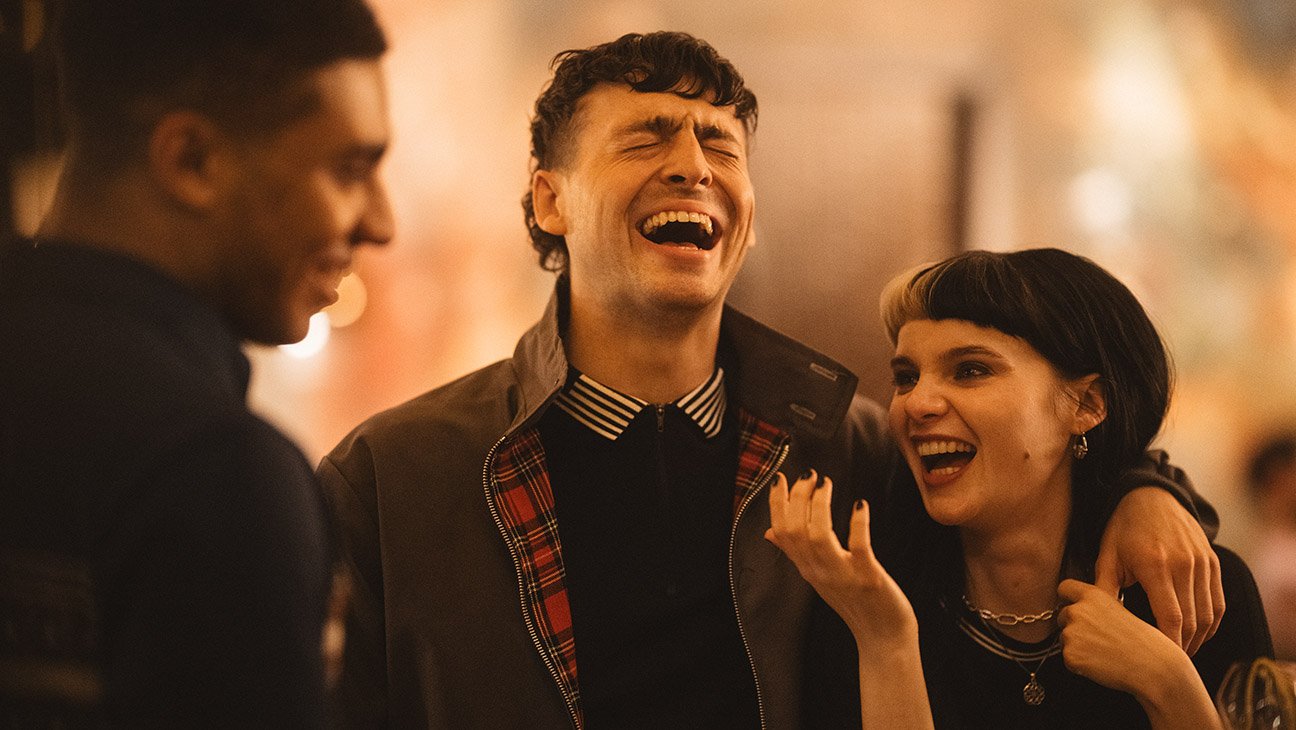
A textbook example of how good casting lifts all boats, I See Buildings Fall Like Lightning features five outstanding up-and-coming British and Irish millennial actors — Anthony Boyle, Joe Cole, Jay Lycurgo, Daryl McCormack and Lola Petticrew — at the helm of a strong ensemble alongside well-chosen supporting players and non-professionals. The core quintet play a gang of working-class friends who’ve known each other since high school but are now facing tough adult choices in economically depressed Birmingham, England. Their liquid, nervy, interlocking performances make this British director Clio Barnard’s best feature in a while, although it still doesn’t reach the high-water mark set by her haunting, innovative debut The Arbor.
Adapted by Enda Walsh (Die My Love, Small Things Like These) from a novel by Keiran Goddard, Buildings offers a hearty, quintessentially British-Irish café fry-up of gritty realism, class consciousness and masculine despair, all washed down with tannic, milky mugs of message-bearing melodrama in the tradition of Ken Loach. That sort of package usually plays well in Cannes, where this debuted in the Directors’ Fortnight strand, although the end result is ultimately a bit flat and underwhelming.
I See Buildings Fall Like Lightning
The Bottom Line
Beautifully acted but heavyhanded.
Venue: Cannes Film Festival (Directors’ Fortnight)
Cast: Anthony Boyle, Joe Cole, Jay Lycurgo, Daryl McCormack, Lola Petticrew, Tracey Green, Lucie Shorthouse, Skyla-Rose Steward, Elsie Mae Vitello-Minshull, Jackie Donald, Emma Bassett, Debbie Milner, Millie Brady
Screenwriter: Enda Walsh, based on the novel by Keiran Goddard
Director: Clio Barnard
1 hour 49 minutes
The poetically present-tense title refers to the spectacle of high-rise buildings from the mid-20th century being blown to smithereens that the characters here remember observing years ago in their old neighborhood. Indeed, back in the 1990s and 2000s, municipalities across the country were happily demolishing Brutalist eyesores made to house the poor. Authorities often dispensed empty promises that projects would be replaced with better structures, ones less vulnerable to crime, damp and black mold, and not flawed by the kind of dangerous cost-cutting construction that led to London’s Grenfell Tower burning down in 2017, killing 72 people. Just to underscore the point, throughout Barnard and editor Maya Maffioli splice in archive footage of imploding tower blocks collapsing into clouds of dust in which, according to Oli (Lycurgo), he could see the face of the devil himself. But given how often Oli was high on drugs in those days, such Satanic visions probably just meant it was a Tuesday.
True to form, the film opens with Oli getting stratospherically high on booze, cocaine and maybe some heroin at his own birthday party in The Castle, a local pub everyone has been going to for years. (Some of the background artists and characters with only a few lines are locals and staff from an actual Birmingham pub.) The party has reunited Oli with his four oldest friends from school days: longstanding couple Patrick (Boyle, from stage’s Harry Potter and the Cursed Child), a food courier with a bachelor’s degree, and Shiv (Petticrew, arguably best known for an indelible turn TV’s Say Nothing), a carer for her children and aged mother, who now have two young daughters (Skyla-Rose Steward and Elsie Mae Vitello-Minshull); aspiring developer and permanently simmering pot of rage Conor (McCormack, Wake Up Dead Man); and working-class hero made good Rian (Cole, Peaky Blinders and Skins), who went off to work in finance down in London and now makes more in a month than all the others put together do in a year.
The woozy, choppily edited party sequence, featuring lots of handheld, cellphone-style footage and glassy slow-motion interludes, clearly illustrates the camaraderie and profound affection between the five main characters, who tease and tickle one another like sportive, overgrown puppies. But underneath the smiles, hugs and wisecracks, fissures and fraught moments can be glimpsed, such as a sozzled Conor almost getting into a pointless barroom fight or Rian giving Patrick and Shiv the kind of look you see in a cat just before it knocks a glass vase off the table.
Goddard’s novel is broken up into a series of first-person interior monologues from each of the principles and covers a considerable span of time, and it’s clear Walsh and Barnard have struggled to keep that polyphonic symphony going in the film. The transitions here are sometimes jarring and lack finesse, creating a choppy rhythm as we jump around from character to character. We’re able to gauge how much time has passed by how far along the construction has come on the apartment complex Conor is supervising, seen rising floor by floor in time-lapse, mirroring the demolition footage elsewhere.
It turns out that Rian is partially bankrolling the project, a set of flats which will house either “yuppies” (or, as one old boozer calls them, “yippees”) or a younger generation of clients in need of state-subsidized housing like the protagonists’ parents. Patrick clearly is hoping for the latter, and he says as much in several inebriated speeches full of progressive political rhetoric. But his idealized vision of a past paradise of social cohesion that late-stage capitalism destroyed doesn’t reckon with the snakes that were always there in this imaginary Eden, including a personal betrayal that’s close to home and only comes slithering out in a moment of drunken weakness.
Boyle puts extra meat on Patrick’s bare bones with a soulful performance that meshes precisely with Petticrew’s turn as the slight-in-stature but formidably strong-willed Shiv. The two actors both hail from Northern Ireland but nail the tricky nasal tones of the “Brummie” accent, as do the rest of the main cast, none of whom are from the Midlands. It’s obvious that there was space created in the production process for the cast to build a sense of fraternal solidarity through improvisation and spontaneity on set, an ease that comes through in the way they interact via dance and touch. But that physicality has to do a lot of heavy lifting to persuade us that it’s plausible that these five very different people would still be pals at this stage in their lives.
Although they’re meant to be all roughly the same age, Conor and Oli look like they’re from different generations, even though the actors are only five years apart. That partly stems from the way McCormack projects the gravitational pull of a man grappling with forces and feelings far beyond his control, which prevent him from seeking help when everything starts to go south. All sweet-natured Oli needs to worry about, apart from getting over some major addictions, is how to make sure he’s got enough money to pay for dog food for his adorable mutt, Lulu. Rian is similarly hamstrung by inarticulacy and masculine angst, but his storyline feels the least convincing, as if fashioned only to prove money can’t buy happiness, even if Cole convincingly suggests unspoken depths.
Barnard has always coaxed layered, thoughtful performances from her cast and knows this kind of battered but unbowed community like the back of her hand. But the drama here feels too diagrammatic, foretelling a tragic fate from the first scene onward as everyone parties down like their lives depend on it. You just know that before the end credits roll one of them will have lost their raging battle with the dying of the light, and just as there will be hangovers in the morning, there will be a funeral wake in that very same pub.
Leave a Reply