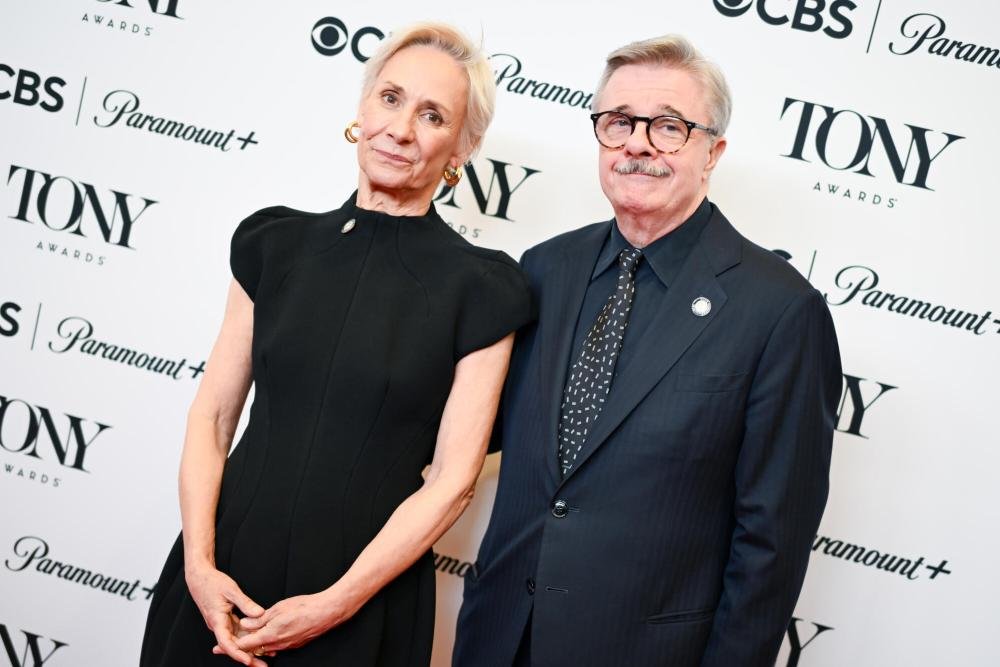
The best onstage production of Arthur Miller’s “Death of a Salesman” in a generation is also, conveniently, the one that settles two long-running perceptions of its two Tony-nominated thespians.
The first is about Nathan Lane — and, as it turns out, the 70-year-old veteran offers the clearest read on where he is in this career moment and what it means to finally be taken seriously as a dramatic performer. “I punched a hole in the box and got out,” he says of the comedy-and-musical typecasting others built around him. “There are people who will never let go of the fact that I had some success in musical theater or comedy. No matter what I do, whether it’s Hickey, Roy Cohn or Dominick Dunne in the Menendez miniseries, they’re never going to let me forget I made them laugh.”
For most of his career, Lane has been told — in both kind and unkind ways — that he is the funniest man in the building. He heard it through every comedy that made him a star, none louder than his Max Bialystock in “The Producers” in 2001.
He has spent much of the last quarter-century trying to prove there was more.
The evidence has been mounting: Theodore “Hickey” Hickman in Eugene O’Neill’s “The Iceman Cometh,” in Chicago in 2012 and at the Brooklyn Academy of Music in 2015; Roy Cohn in Tony Kushner’s Pulitzer Prize-winning “Angels in America” in 2018; and now Willy Loman, eight shows a week at the Winter Garden Theatre alongside an ensemble that includes Laurie Metcalf, Christopher Abbott and Ben Ahlers.mOnstage, the argument is over. This Willy is not a comedian reaching for gravity. It is a full, unsparing performance from an actor who has been capable of it the whole time and was rarely asked.
Lane has thought a lot about why it took so long.
“I just wanted to take on challenging, interesting roles and do a variety of things,” he tells Variety. “That’s certainly what I’ve been trying to do over the last 10 or 15 years, because I felt I had more to offer. I wondered if I could shift the perception a little, because some of the things I’d done in musical theater and comedy were very successful, and that’s how people tend to see you.”
He is not bitter and is, to no surprise, characteristically funny about it all.

Emilio Madrid
“But even while I was doing all those things, I was also doing the work of Terrence McNally, Simon Gray and Jon Robin Baitz, and ‘Waiting for Godot.’ I’d like to think I had a well-rounded diet as an actor.”
The emotional spine of his account relates to the late actor Brian Dennehy, his friend and mentor, who encouraged him toward Willy Loman before and after he played the role in the 1999 stage revival.
Lane’s nom is the latest in a notable pattern around the role, which has delivered five Tony-recognized portrayals in 50 years — George C. Scott (1976), Dennehy (1999), Philip Seymour Hoffman (2012), Wendell Pierce (2023) and now Lane. In that time, Loman has produced only one winner, Dennehy. Lane is battling the likes of John Lithgow from “Giant” and Mark Strong from “Oedipus” this season, and even as he’s an early favorite, he’s thinking of his friend, missing him dearly. “It’s very emotional just thinking about him,” Lane says of Dennehy. “He was such a great friend, and so supportive when we did ‘The Iceman Cometh.’ He had played that part in 1990 at the Goodman Theatre.”
Of course, Lane carries Dennehy, along with the late playwright Terrence McNally, into the role. He recalls that both men told him for years, “I can’t wait to see your Willy Loman someday.”
Now, sitting at the precipice of major recognition, which already includes three Tonys on his shelf at home, it never gets old.
“You become part of history,” he says. “And these giants whom I was lucky enough to work with — I know they would be thrilled to see the success of this production.”
“Death of a Salesman,” a radical reimagining of Arthur Miller’s look at capitalism’s corrosive influence, was the top play nominated at the Tonys, earning nine nominations. The show also marks the comeback of Scott Rudin, the superstar producer who retreated from Broadway following multiple allegations of bullying and abuse in 2021. Rudin not only produced “Salesman,” he also oversaw “Little Bear Ridge Road,” which earned a best play nomination.
Lane talks about the producer and the long path that led from “The Iceman Cometh” to this iteration of “Salesman.” According to Lane, Rudin controlled the rights to the O’Neill revival, which cleared the earlier “Iceman” stagings, and had the producer never giving up on mounting “Death of a Salesman” for him and director Joe Mantello.
Another major piece of the equation surrounds his co-star, Laurie Metcalf.
One of the most decorated stage actors of her generation, Metcalf approaches Linda Loman like an architect studying where the structure actually bears weight.
“Each one brings its own difficulties and mysteries. You never know what you’re going to uncover in any role you tackle,” she says. “This one has been a learning curve, figuring out how to be a true partner to Willy and not just someone cleaning the house. I also had to learn how protective she is of the family, especially of the boys and, of course, of Willy.”
Metcalf also appeared this season in “Little Bear Ridge Road,” the Sam Hunter piece nominated for best play. Working on two shows in the season can be daunting, which she was well aware of. “I had to be careful because I don’t want to burn out doing it,” Metcalf shares. “Back-to-back is more daunting than I thought it would be, honestly. A lot depends on the project. These were really daunting and complex.”
Many predicted she could become only the seventh performer to earn double acting nominations in a single Tony season alongside “Death of a Salesman.” The Tony gods had other plans. Still, it hardly dents her impeccable resumé. The 70-year-old, two-time Tony winner (“A Doll’s House, Part 2,” “Three Tall Women”) is one of the nine performers to earn Oscar, Emmy and Tony nominations in the same year — most recently in 2018 for “Lady Bird,” “Roseanne” and “Three Tall Women.”
Put this duo together in the same production, and their underestimation runs in opposite directions. Lane spent decades being seen as too funny to be taken seriously. Metcalf spent decades so consistently excellent that surprise was no longer part of the response. They both have changed their trajectories.
Leave a Reply