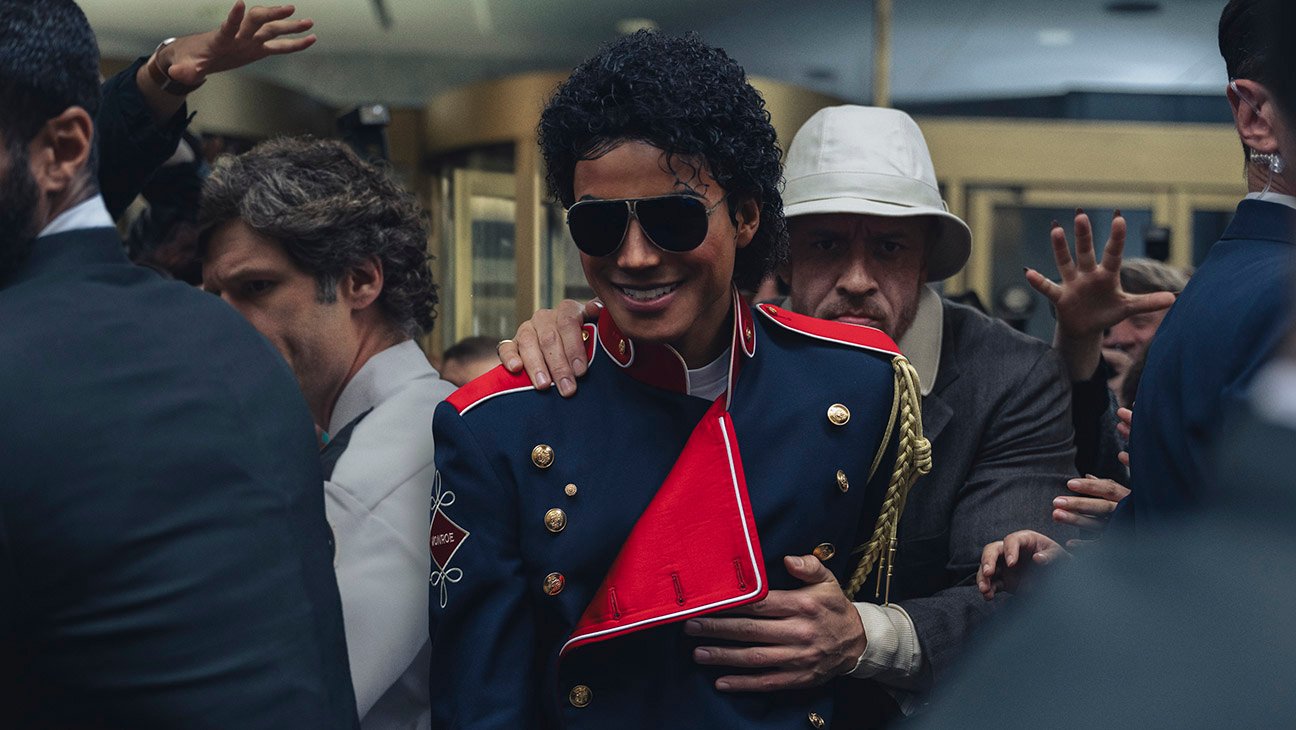
Jaafar Jackson’s portrayal of his uncle Michael Jackson in the eponymous Michael will assuredly be a talking point among the film’s viewers for months ahead, as the younger Jackson delivers an impressive, spot-on take on the King of Pop, from his look to his mannerisms, smile, dance moves — and yes — his voice.
Regarding the speaking voices, that’s all Jaafar and Juliano Valdi, who portrayed a 10-year-old, Jackson 5-era Michael in an equally convincing performance. But getting Jackson’s iconic singing vocals requires savvy sound editing, with the team blending Jaafar and Valdi’s live vocals that they performed on set with Michael’s original recordings.
The actors’ voices are heard in the singing performances when there isn’t a genuine Jackson recording, such as scenes where Jaafar scats in the studio while recording “Don’t Stop Til You Get Enough” or when Valdi does the initial takes of “I Want You Back.” Michael’s voice becomes more dominant when the pure recording is allowed to take over.
“We had the discussion a lot, could we have Jaafar and Juliano go to a studio and record those songs, and the answer was yes,” says Michael music supervisor John Warhurst. “They were capable of delivering those vocals. But then it becomes more an overall philosophy of when people go see the movie, do they want real Michael to be a part of this movie, or do they want it to just be 100 percent Giuliano and Jaafar? Every movie is different, but here we think people want Michael to be a part of it.”
Warhurst has worked on several of the most prominent music films of the past decade, including Bob Marley: One Love, Whitney Houston: I Wanna Dance With Somebody and Bohemian Rhapsody, the latter of which earned him an Oscar. Below, he breaks down the extensive process on how Michael handled the vocals.
Let’s start from the top. How did you guys actually do it?
I’ve worked on quite a few musical films over the years, there’s a few different ways you can approach the vocals. But the best way I’ve found is to approach it like a live musical. That entails the the actor going on set and performing the pieces themselves. Ignore how we’re going to put it together in post-production at this stage. When you use recordings, one of the first things you need is what I call the visual canvas. You can’t put an incredibly powerful voice on a face that doesn’t look like it’s projecting that kind of power. The actors need to learn the songs so that they can actually sing them with the same sort of energy and power as the original artist and then perform it.
Often with these scenes, we’re pretending that we’re in a recording studio, and that means we can actually record. The actor’s wearing headphones. We have a huge microphone in front of them. We should be able to shoot it exactly as if we were recording it for an album. The next important ingredient is as many live takes as you can get without music on it.
It’s more complicated when we do the stadium performances. It isn’t as much like a recording session. There’s more outside of the recording. You see Jaafar doing more of his own bits and pieces and ad libs. And when you’ve got a set that size, you need to really sort of vibe it up a lot. You want the ground to shake. You want everybody to feel it in the room, and it to be that sort of atmosphere.
It sounds like you’re essentially getting stems of their vocals.
Yeah, of their performance. Once we’ve got that right visual canvas and the recordings, when you get to post-production, we’ve got 15 to 20 takes of Jaafar or or Juliano and the one take of Michael with his recording. That’s where the blend comes into it. In that scene when Jaafar is performing as Michael recording “Don’t Stop ‘Til You Get Enough,” he does that scatting stuff. I call that “dialog.” We don’t have Michael doing that. That is Jaafar.
Or that scene of Juliano doing the opening lines of “I Want You Back” where Berry Gordy has to stop Michael and tell him he’s moving too much. If we used Michael on the first take, when we use him again on the final, it’d feel like a carbon copy. So the first time is just Juliano, then the second time when it’s meant to be getting closer we add in some Michael.
How long does the process take?
The process starts as soon as someone gets cast. Especially when it comes to singing, the one thing my ear always picks up on straight away is the strength of voice, in the strength of the vocal, and that’s not something you’re going to do in two or three weeks. You need a lot of vocal coaching.
And then there’s always back and forth in post production, it’s never version one of a movie. Everybody wants to try everything in every single different way possible. You’re constantly reworking. And then you get really happy with the vocal, and they say, “no, we’re going to re-edit this scene.”
How similar a process was it with Bohemian Rhapsody? I know the vocalist Marc Martel was very involved there to get Freddie’s vocals.
It was a very similar process [to get the visual canvas]. The difference with Freddie and Rami was that Freddie was a tenor, and Rami more of a baritone, he had a much deeper voice. That’s where Mark Martel came into it. We understood the differences, and he sounded like Freddie and we could get the vocal if we didn’t have an original recording that fit.
With Jaafar and Juliano, we did not need that. They were both so close. Jaafar is Michael’s nephew. Physically his voice is very close in range and sound to Michael’s, which made my job much easier. In post-production we had several conversations about whether we could just use Jaafar and Juliano or if we needed Michael. They were so close, they nailed it. We ended up deciding it made more sense to keep with Michael. It kept it more consistent across scenes.
If we’re to break down the DNA if you will, particularly with the final product, it sounds like it’s mainly Michael’s vocal, and then Jaafar and Juliano are the anchors to attach the vocal to.
I think of it as the other way around. It’s their performances, with Michael over the top of it.
And to be clear, there’s no AI?
No, I’m very much an audio purist. Once you have the best recording you possibly can, you do the fewest amount of steps away from that record. We apply like EQ, and then we apply compression, and then we apply reverb, and then we stretch it. Those AI tools are amazing but there are bits that are good and then all of a sudden it can sound chewed up.
Working with these actor vocals is obviously a lot more work than lip syncing. How much harder is it to let the actors just lip sync instead?
There is no one in the world who could do it so good, so tight that you wouldn’t detect something when you see it on the big screen. You would feel a slight discrepancy between the image and the sound. People also forget this when you’re on set, we’re not just doing this song once. We’re going all day, and that’s exhausting.
When Michael was on tour, he would go on set that night and sing the song once. We’re going to sing it 24 times for every different angle we could possibly shoot it from. We have to keep that intensity that you see on stage during that first take. When you lip sync, what tends to happen is that is the visual performance drops down as well. It tends to turn into a bit of a goldfish, where the face looks like they’re miming as well. You lose the visual part, and then it just doesn’t work.
Leave a Reply