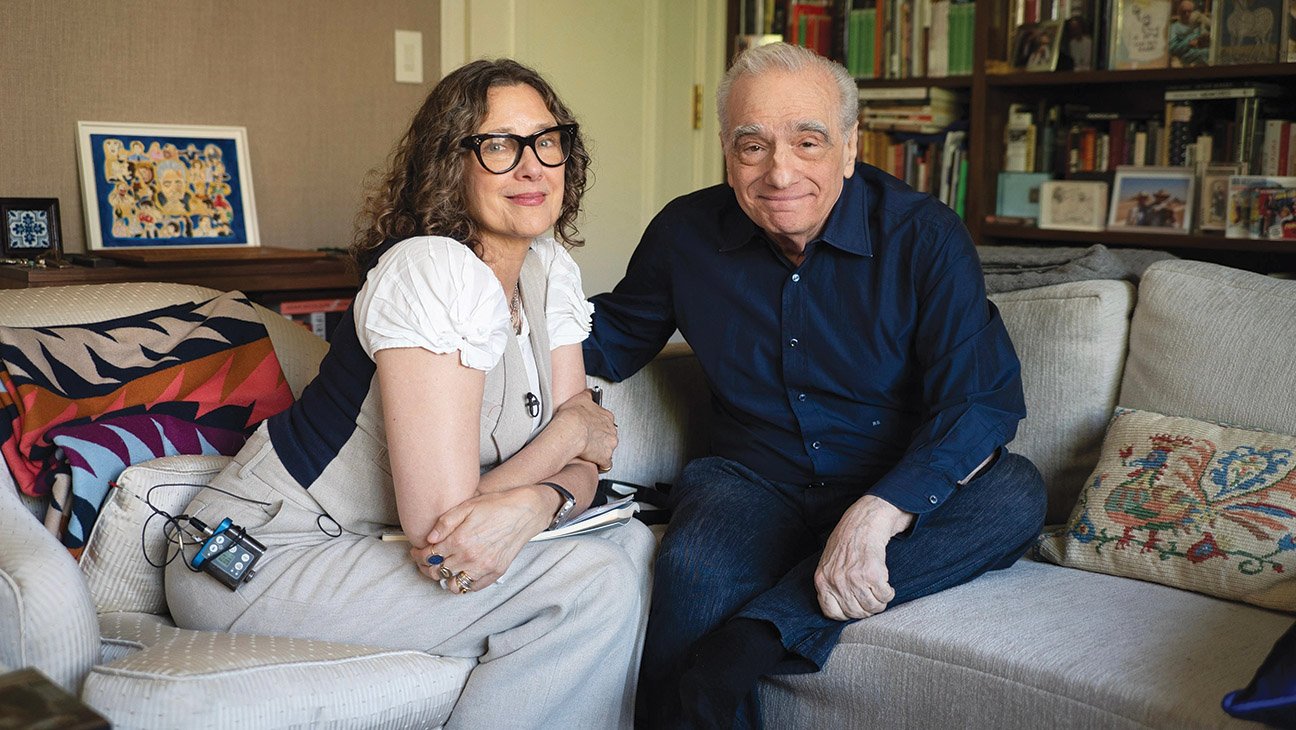
Rebecca Miller had been directing acclaimed movies for 30 years by the time she was tasked with making a documentary about one of the greatest directors of all time. The Connecticut native, best known for The Ballad of Jack and Rose and Maggie’s Plan, signed on to helm a five-part series about Martin Scorsese knowing they’d have to go deep together. They knew each other casually beforehand, with Miller’s husband, Daniel Day-Lewis, having starred in Scorsese’s The Age of Innocence and Gangs of New York, but as they settled in for hours upon hours of conversations — about Scorsese’s family life, his dark days earlier in his career, the legacy he hopes to leave — they developed a bond that’s evident in the finished Apple TV series. Mr. Scorsese shows its subject willing to go anywhere and everywhere, illuminating the fascinating overlap between his life and his art. THR recently spoke with Miller about the doc.
You use a split-screen format to parallel Martin Scorsese’s personal story with the content of his films. How did you land on that style and what did it reveal?
The split-screen idea came from me not wanting this to be “talking heads of older people talking about the past.” I want to see what they’re talking about. One of my favorites came quite late in the game when I was talking to David Bartner, the editor, and I was like, “Let’s do [Taxi Driver’s] Travis Bickell taking his gun out and then Reagan gets shot.” You see that sometimes art really does leap into life. Marty is such a personal filmmaker, but he managed to leap from the personal sphere into the cultural sphere, which is really unusual.
So much of Scorsese’s films are in the movie that it’s natural that some part of that style or that rhythm infected my film.
In getting to know Martin, did anything in his personality strike you particularly?
He’s the most self-honest person I know. He’s so honest to himself about himself, and that’s actually very rare. We tell ourselves a story to make ourselves feel better, and he’s ready to not feel better. He’s ready to just be honest with himself.
It must make for an interesting dynamic for an interview.
He also made a decision to share that quality with me, to a large degree, for whatever reason — whether it was timing, whatever chemistry of friendship that we created or had — he felt like this was the moment. He had avoided a big film like this for a long time. It’s not like I’m the first person who thought of doing this, but this was the moment for him. He figured, “If I’m going to do it, I’m going to do it.”
Even with the epic length of this movie, you can’t get to everything, and this never feels like a dry filmography — yet you cover enormous ground. How did you manage that?
Once I understood how linked his life and his art were — well, “linked” is the wrong word, it’s the same being. He said, “There’s temptations along the road.” I said, “You mean as an artist or a man?” He said, “There’s no difference.” It’s a dance: The two things are locked, the life is creating the art, and the art has created the life. They’re creating each other, and it’s one big tornado. There were certain ideas that I really wanted to get across. I wanted to talk about violence and Catholicism: How do these things coexist? In one being, what are those two things? There are moments where we have the split-screen three ways, and you see three characters who are all [Mean Streets’] Johnny Boy reflections in some way. We ended up covering, I think, 32 films. The only major feature that we don’t do is Hugo, and it’s only because it was immense and didn’t really have a corresponding personal movement that he talked about.

Scorsese (right) with his longtime collaborator Robert De Niro.
Courtesy of Apple TV+
You zero in on some core creative collaborators like Leonardo DiCaprio, who essentially grew up with Scorsese. What story did you want to tell there?
I knew that I wanted to talk to him, and luckily he was very much ready to do it. It’s still storytelling, even though it’s a documentary: How do you make someone want to hear this story, and how do you get to the emotional center of whatever it is that you’re doing? This was true both of Robert De Niro and Leonardo DiCaprio, actually: They gave much more than they seemed to give when you were there. We found so much in their interviews that was very emotional, that was very profound, but you had to dig in and figure out what to put it next to and figure out how to cut it. He would’ve been a genius anyway. He was born that way. But without all these people, he couldn’t have had this career. And that’s what’s really fascinating: They all meet each other.
Margot Robbie has a great anecdote about how willing he was to let her experiment on Wolf of Wall Street before she was the A-lister we know her as now. It speaks to his spirit as a director.
His appetite for risk is immense. Whereas 99.9 percent of directors would be scared shitless to hear the night before, “Oh yeah, let’s just try this other sequence where we break down the garage door and you destroy the car” — I mean, it’s so wild. It’s a kind of generosity, but it’s also a willingness to say, “I’ll risk everything.”
Scorsese editing film in an archival photo in Mr. Scorsese.
Courtesy of Apple TV+
How did you come out of this project as a filmmaker yourself?
I’ve written one screenplay since, and I hope I get to make that film. This gave me more courage to just stick to my guns and to not be afraid. I don’t think of myself as a very fearful person in the business, but the way that Marty uses influence, the way that he absorbs and metabolizes other people’s work, is so interesting to me. He makes it his own. It becomes part of his whole being, and it comes out as its own thing, but he’s very open to influence. Perhaps there’s a bit of that for me now. I had to watch so many films talking to him — it’s almost like I went to grad school. It really was an added layer of my own education working with him this way. The level of risk that he’s willing to take is really inspiring.
Which film of his was reframed most for you after digging into his career so thoroughly?
The Wolf of Wall Street, actually. As I studied it, I understood how great the film is. I appreciated it the first time as this amazing, entertaining sleight of hand, but now I see what he was doing and how linked it is to Goodfellas — in fact to his early work, his early films, with this careening freedom and anarchic pulse.
This story first appeared in a June stand-alone issue of The Hollywood Reporter magazine. To receive the magazine, click here to subscribe.
Leave a Reply