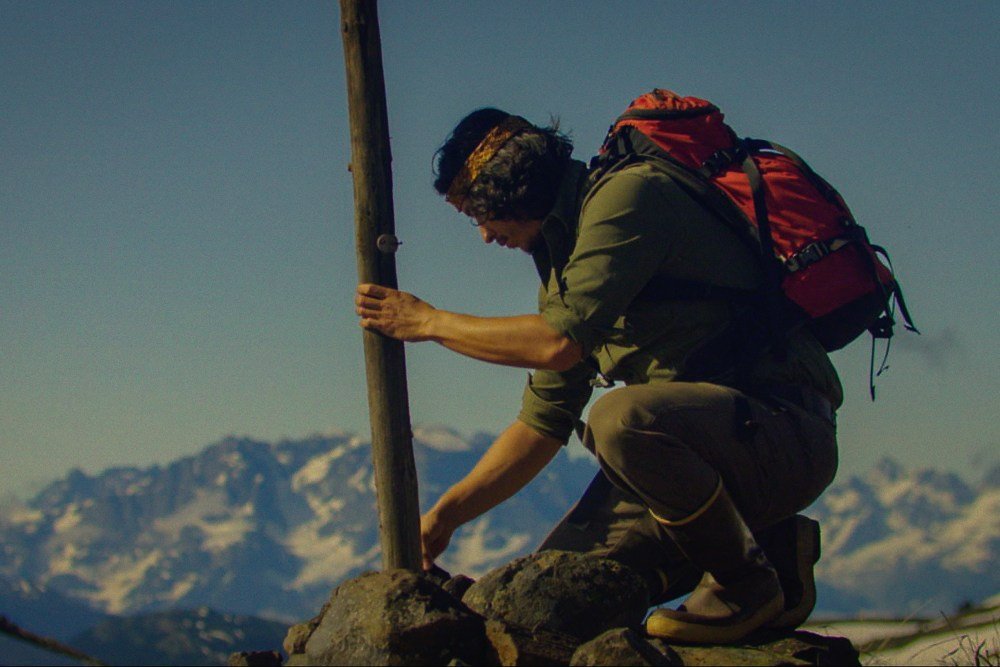
Indigenous director Banchi Hanuse’s “Ceremony” won the Audience Award at SXSW, a DGC Award at Hot Docs and the First Nations Award at the Sydney Film Festival — that success underlines her goals with the film. The film screens June 19 at the Bentonville Film Festival.
Hanuse spent 12 years with the story of her Nuxalk community — a community that has lived in the Pacific Northwest for millennia. As a resident of the Bella Coola Valley in British Columbia, she took on the responsibility of telling the story of her people through the disappearance of the ooligan in the Bella Coola River. It’s an essential part of their culture, as it not only provides food but also grease. And the way the grease is made provides family and community-wide bonds.
“A big part of the goal was to help heal, help heal the past, and also to help make us comfortable to return to the way we used to live,” she says. It’s “about the spirituality, and just being so connected to our lands and waters and nature, and just to live with peace and joy, and it’s almost the same message for the wider world, just that for all of us to survive, we need to live this way.”
The film centers on a pair of local Nuxalk biologists studying ways to bring the ooligan back, which is a way to get into the history of the Nuxalk community and its traditions. Nuxalk Radio’s co-founder Qwaxw serves as the touchstone throughout. (Hanuse is one of the station’s co-founders.) Nuxalk Radio “just felt like the easy and helpful way to let our community speak, because people come on the radio and feel comfortable to speak,” she says.
“It was made for the Nuxalk community, and I really wanted it to be a piece of healing, to contribute to our healing and contribute to empowering the community. So I had that in the back of my mind,” Hanuse says, adding, “and just making it entertaining for them.”
Her visuals are beautiful, almost meditative in gently focusing on the stunning natural beauty of the river, mountain ranges and forests of the valley. And animation is used to convey ideas and tells stories of the past as well.
“I really wanted a way to help bring the viewer into our ancient way of living, a lot of us believe that for us to truly heal, for the world to truly heal, we need to return to the way we used to live when everyone had the ability to communicate with the critters, with with the supernatural, with the undersea world, with the all with all the other worlds, and we’re just live spiritually and basically in harmony with our lands and waters,” she says. “I felt like animation would be the way to bring us into that world and to go into those little stories.” Animation was led by Indigenous artist Jay White, with Hanuse’s neice, Anuximana Jade Hanuse, creating the Nuxalk designs and artwork.
The film also uncovers documentation of how the white settlers, with the implicit accord of the Canadian government, murdered thousands of Nuxalk in 1862 with the smallpox virus and colonized the land.
Hanuse uses footage of the smallpox survivors in the film that is over 100 years old, underscoring the devastation but also their strength. “I felt like the whole sequence was personally challenging to deal with, just because I knew this story forever, but to really sit down with it and just be like, holy smokes, this is crazy,” she says.
“My community wanted this story told, and so I started working on it without really understanding what it needed to be, and every year I was like, ‘It’ll get done, it’ll be done,’ but it just kind of felt more and more challenging — all these obstacles were being put on my path — and it really felt, which I learned at the end, that it wasn’t going to happen until I learned about our ancestors, and almost like experienced the pain that they went through, if that makes any sense at all.”
“I had to go through my own kind of healing journey to be able to learn how to tell the story,” she continues. “And I guess in the way our community needed. Believe me, I prayed every year, my community prayed for me, everyone was praying for me, and it just wasn’t until like this 12th year that I was like, oh, it’s finally going to be complete.
“That’s part of why I called it ‘Ceremony,’ because it was like almost a ceremonial thing to accomplish,” she says.
Leave a Reply