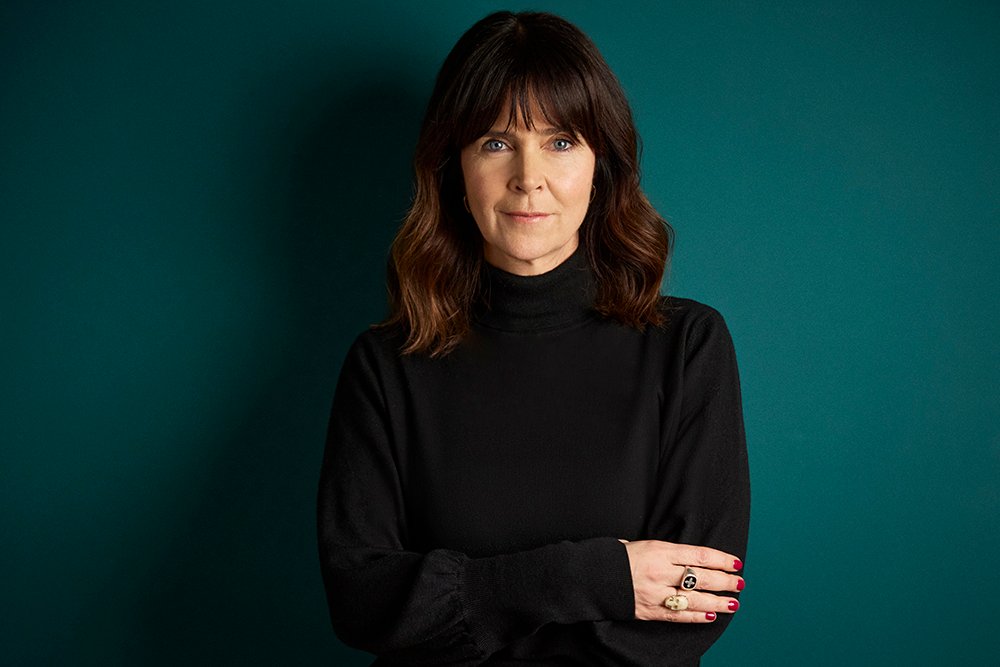
Liza Marshall recently discovered that she was the only person who bid for the rights to “Hamnet.”
This was back in October 2019, after the producer had been sent Maggie O’Farrell’s novel a good five months before publication. A voracious reader, Marshall got through the book in no time. “And I just fell in love with it as a piece of writing,” she says. Of course, O’Farrell’s agent was leading her to believe others had fallen in love with it just as much, but a month ago he let slip that Marshall’s had been the solitary offer.
More than six years on from making the bid, the decision feels like an automatic slam-dunk.
“Hamnet” the book — telling a fictional account of the real-life relationship between William Shakespeare and Agnes Hathaway and their grief over the tragic loss of their eldest son from the plague — became a literary sensation in 2020, winning numerous prizes for O’Farrell and selling more than 2 million copies worldwide.
“Hamnet” the film adaptation — distributed by Focus, directed by Chloe Zhao and starring Jessie Buckley and Paul Mescal alongside Emily Watson, Joe Alwyn and Jacobi Jupe — has grown into an awards season juggernaught since premiering in Telluride and is now a box office smash hit. It recently surpassed $90 million globally, while at last Sunday’s BAFTA awards — which it went into having broken the record for nominations for a feature directed by a woman — it won outstanding British film and leading actress for Buckley. In just over two weeks it enters the Oscars with eight nominations, including best film.
But, as Marshall admits, adapting the book for the big screen was far from straightforward when she first read it.
“It was a book set in the 1580s, about the death of a child that’s very internalized — it didn’t seem like an easy route to getting made,” she says, speaking shortly after “Hamnet” returned to the top of the U.K. box office. “But it’s just so beautifully written and I was just completely captivated by it. And I always go with my gut.”
That instinct is something that’s come to define Marshall, a quiet, modest force in British film and TV for many years who is only now — as lead producer of “Hamnet” — getting her deserved due as a true tastemaker of excellence.
She’s speaking from the breezy West London offices of her company Hera Pictures. It’s a decent shlep from city’s usual creative hub of Soho but, as she notes, a short walk from her home (and coincidentally, given the theme of her most recent hit, overlooking a vast graveyard).
Hera was set up by Marshall in 2017 after stints as the co-founder of Archery Pictures (where she produced “Riviera”), setting up and running Scott Free London for Ridley Scott (“A Life in the Day,” “Taboo”) and five years as head of drama at Channel 4 (where she greenlit top titles such as “Top Boy” and the “Red Riding” film trilogy).
Named after the wife of Greek god king Zeus — “a female name that felt up there,” she says (while noting that her husband, the actor Mark Strong, was not part of the decision) — Hera was borne out of Marshall’s desire not just to “be my own boss,” but to make work that “felt authored and distinctive.” And it’s since slowly emerged as one of the U.K.’s most distinctive independent production outfits.

Liza Marshall and Maggie O’Farrell at the 83rd Annual Golden Globes.
Penske Media via Getty Images
On a wall behind Marshall is a poster featuring Julianne Moore and Nicholas Galitzine in Elizabethan era splendor for the raunchy Sky/Starz period series “Mary & George,” which aired in 2024. Directed by Olivier Hermanus, the historical drama about English royal peeress Mary Villiers and ruthless queer social climbers was another “go with your gut” moment for Marshall.
“There’s not much written about her in history, but Mary essentially went from being a nobody with no property or money to being the closest woman to James I by basically pimping out her really hot second son,” she says. “It’s such an extraordinary story, but when I started talking about it, everyone was like, ‘Well,that’s never going to get made.”’
It took five years, but Marshall did get “Mary & George” made (and it currently boasts a 94% rating on Rotten Tomatoes).
On the wall to her left is a poster for another long-haul development, the gripping 2023 survival film “The End We Start From,” in which Jodie Comer navigates an environmentally apocalyptic Britain with her newborn baby. Based on Megan Hunter’s novel, optioned in 2017 along Benedict Cumberbatch’s company SunnyMarch, it would mark Hera’s first feature. “It’s this beautiful, poetry prose book that I just completely fell in love with… again!” says Marshall. “But that took six years to get made, because it’s essentially a film about motherhood in extremis.”
There’s a clear literary-focused throughline that runs through Hera’s output, unsurprising given Marshall’s appetite (“I’m just constantly reading books,” she says). And this includes last year’s “What it Feels Like for a Girl,” the widely-praised coming-of-age BBC drama series based on the autobiography by transgender author and campaigner Paris Lees.
But Marshall says that even from Hera’s very first production — the Sky series “Temple,” based on the hit Norwegian drama “Valkyrien” and starring husband Strong as a surgeon running an illegal clinic in a disused underground station — she’s wanted “everything to feel different and be a unique take on the world.”
And Marshall has managed to achieve this through not just her own deliberate, authored stewardship of each project, but alongside the growing pool of creative collaborators she’s amassed along the way.
She had actually worked with Neal Street Production’s Pippa Harris on TV in the 1990s, so when the producer came knocking about the rights to “Hamnet” (once O’Farrell’s book had become a hit), it felt like the perfect fit. Harris, alongside her Neal Street partner Sam Mendes, had the connection through “1917” to Steven Spielberg at Amblin, who then took it to Focus. Suddenly, “Hamnet” was a $30 million production, with a team of creatives largely handpicked by Marshall. Zhao was her first choice as director, having loved “The Rider” and her unique shots of nature, but also wanting both a woman behind the camera and someone not from the U.K. who didn’t have “such a reverential attitude to Shakespeare” and could see the story through Agnes’ point of view.
At Telluride in 2022, Zhao — who apparently had been looking for a project about a “witchy woman” — met with both Mescal (there with “Aftersun” and sporting a somewhat Shakespearean hooped earring) and Buckley (in town for “Women Talking”). “It was all just serendipity,” says Marshall.
While there was perhaps a splash of serendipity in pulling the pieces together, there’s no question that one of the year’s most unexpected cinematic success stories began following that first spark in October 2019 as Marshall read O’Farrell’s words. In the U.K., “Hamnet” is the highest grossing film of all the BAFTA best film nominees — surpassing “One Battle After Another,” “Marty Supreme” and “Sinners.” And it’s a result driven by a younger audience (including Marshall’s eldest son, now at university).
“People are hearing that they have to go to the cinema and watch it with a group of people to experience that emotion altogether,” she says. “So it’s a bit of a phenomenon.”
“Mary & George”
Courtesy of Starz
Next up for Hera — which thanks to its growing slate is now expanding its small team — actually isn’t a novel Marshall fell in love with long before it hit the shelves. But it does reunite her with some former collaborators.
Based on a short story by Steven Soderbergh, “The Return of Stanley Atwell” is a mystery thriller set in 1959 and was brought to Marshall by its writer-director Brian Welsh, the lead director on “What It Feels Like for a Girl” (who Marshall hired off the back of his 2019 indie hit “Beats”). For the lead role, a presumed dead heir to a Lord’s title and fortune who unexpectedly returns to the family estate, she turned to “Mary and George’s” pimped-out “hot” son, Galitzine. Further casting is due for announcement soon, with the film set to start production later this year.
And then, just over the horizon, there is a project straight out of the Hera handbook, underscoring Marshall’s deep-rooted connection with authors. Off the back of the success of “Hamnet,” she’s extended her partnership with O’Farrell by landing the rights to her next novel, “Land.”
Partially based on her own family history, the story follows a father and son as they traverse Ireland in 1865 in the aftermath of the Great Hunger. Not due out until June, the book has already generated huge buzz, with the demand for tickets to the book tour in the U.K. and U.S. “on a par with only Margaret Atwood in terms of authors selling out events,” says Marshall. Of course, while O’Farrell is a beloved force in her own right, having “Hamnet” continuing to dominate headlines has surely helped.
There will surely be no shortage of producers, directors, actors and distributors lining up to be a part of this project. “There’s a lot of interest in it,” Marshall acknowledges.
“But I’ve just finished reading it for the second time,” she says. “It’s such beautiful book and I’m just really excited to get going.”
Jessie Buckley stars as Agnes and Paul Mescal as William Shakespeare in ‘Hamnet’
Agata Grzybowska
The rise of Hera Pictures comes amid a challenging time for many independent producers, many of whom are dedicating years to projects only to find themselves squeezed out of the final financial equation due to an ever-shrinking pot of money. For Marshall, it’s the fact that she also makes TV that has helped keep her afloat. “You just can’t make a living making films in the U.K. — it’s really tough,” she says. “But I’ve always worked in TV and I really like the fast pace of it and to just tell stories completely differently. But films are like a passion, they take longer.”
But as many other British entities are now bringing on board the deep-pockets of major international partners to ensure longevity, Marshall says she wants to remain “fiercely independent” for the foreseeable.
“People have been asking me, but I quite like doing what I want and being really flexible,” she says. “And actually not having a distribution deal is really great, because when we take a project out to market we have multiple people bidding for it, which often puts us in a better financial position. So I think there’s an advantage to being completely independent, although it obviously comes with with risks.”
As “Land” starts to attract potential suitors, Marshall admits there are now, thanks to “Hamnet,” considerably more pre-publication novels coming through her letterbox than before. But she claims there’s now a lot of competition.
“Everyone’s looking for the perfect book — and it’s hard,” she says. “But you’ve just got to go with your gut. That’s all you can go on.”
Leave a Reply