Haitian filmmaker Samuel Suffren’s debut feature “Job 1:21,” unveiled in the Work-in-Progress section of Visions du Réel, Switzerland’s leading documentary film festival, is already gaining traction on the industry circuit, picking up one of the top prizes at the market forum.
The project denounces Haiti’s justice system through the story of a woman imprisoned for years without trial and later judged not by law, but by scripture.
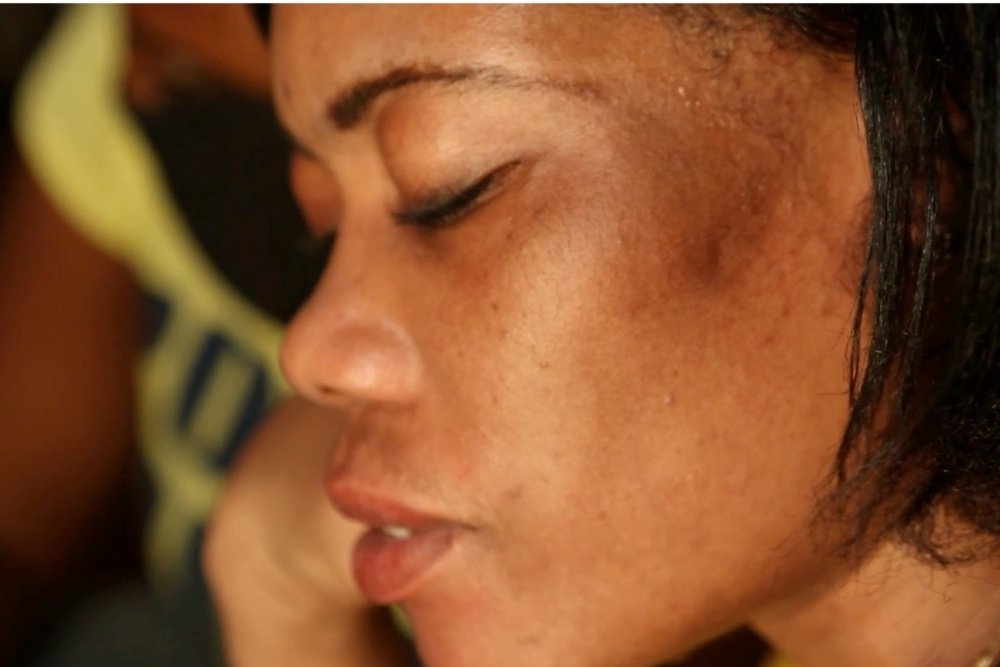
Shot between 2019 and 2021 in Port-au-Prince, the film follows a group of former female inmates who stage a play condemning the country’s prison system. At its center is Nathalie, who fights for the release of her sister Aline, held in prolonged pretrial detention – a widespread practice in Haiti.
Aline is unexpectedly freed during the COVID-19 pandemic, as authorities release detainees accused of minor offenses to free up the overpopulated jails. But her ordeal doesn’t end there. After five years in prison without trial, she is judged in absentia – in a sequence that gives the film its title.
“The main character is judged using a biblical text,” Suffren told Variety. “Instead of using the law, the judge uses the Bible: Job 1, verse 21. There is no legal text. Nothing – he judges based on that verse.”
In the scene, the ruling is delivered without any legal basis, ultimately accusing Aline of being a “loup-garou.” Rooted in a local myth about a child-killing, cannibalistic werewolf, it underscores the film’s depiction of a system where superstition, religion and unchecked authority meet. “The judgment becomes more theatrical than the play itself,” said Suffren.
The film unfolds against the backdrop of Haiti’s escalating crisis, where armed gangs have seized control of large parts of Port-au-Prince. Suffren left the country in 2024 after violence made it impossible to continue working. His filmmaking collective was forced to shut down, and his daily life became increasingly difficult. Recalling one incident, he said armed men stopped him at gunpoint while filming and warned him: “If it had been later, we would have killed you.” He left soon after, carrying the film with him on a hard drive.
Now based in France, Suffren describes his departure as a personal rupture rather than formal exile. “When you feel you no longer have a home, that’s when exile begins,” he said. “You can be in exile even in your own country.”
For producer Eugénie Michel-Villette, the project’s strength lies in both its immediacy and its construction. “We’re really in this shaken, chaotic reality of Haiti, with the force of direct cinema,” she said. “We quickly realized there was a film, a very strong, important one, because the women Samuel filmed are incredibly powerful, and so are their journeys.”
She also highlights the film’s central contrast: “There’s a parallel between a theater of former detainees and a kind of judicial ‘performance’: one fails to deliver justice, while the other becomes a form of catharsis that, in a way, saves these women.”
The feature marks a shift in style for Suffren, whose acclaimed short film trilogy – “Agwe,” “Des Rêves en Bateau Bleu” (“Dreams Like Paper Boats”) and “Coeur Bleu” (“Blue Heart”) – premiered at Locarno, Sundance and Cannes’ Directors’ Fortnight respectively. Here, he moves toward a more direct, observational form while retaining a strong visual signature.
Most of “Job 1:21” is already shot, with footage now effectively archival as several locations seen in the film – including the prison and theater spaces – no longer exist. The project is currently seeking partners for post-production.
Additional sound work still needs to be done, notably to capture the singing voice of the central character. As Suffren cannot return to Haiti, the recordings will be handled locally by a longtime collaborator.
Les Films du Bilboquet, which produces the project, is also enjoying a strong showing at Visions du Réel, with titles including Hassen Ferhani’s “Alea Jacarandas” picking up the Burning Lights Competition Award, while Elsa Amiel’s “Dentro” received the Interreligious Award.
The outfit is also heading to Cannes with Marie Clémentine Dusabejambo’s “Ben’imana” (Un Certain Regard) and Mahsa Karampour’s “Dans la gueule de l’ogre” (ACID).
Visions du Réel runs in Nyon, Switzerland until April 26.
Leave a Reply