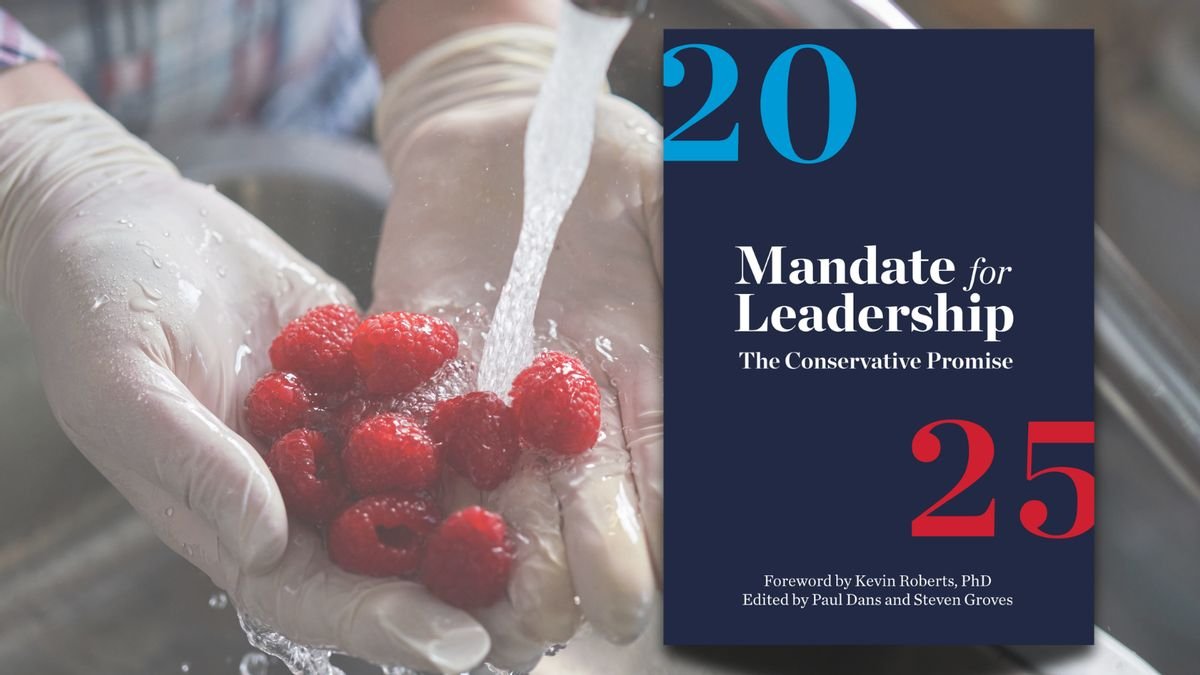
- Cyclospora, E. coli and salmonella outbreaks from contaminated food across the U.S. made news headlines in summer 2026. The illnesses led to produce recalls and a widespread fear among people about what they should eat.
- Meanwhile, posts appeared on social media suggesting that Project 2025 — a road map for running the country by the conservative think tank The Heritage Foundation — proposed changes to the food system that caused the wave of illnesses.
- According to the posts, Project 2025 called for “cutting safety nets” and “slashing regulations and restrictions on food production” that would make food less safe to eat. The posts implied President Donald Trump’s administration followed the alleged recommendations and that they affected foods that caused the latest illnesses, such as iceberg lettuce, frozen blueberries, jalapeños and eggs.
- The claim was an exaggeration of facts, relying on a subjective interpretation of the roughly 1,000-page document at the heart of Project 2025.
The document proposes an overhaul of the federal government, touching on issues ranging from immigration to climate change to abortion. Compared to other topics, the document contains very few ideas for changing the country’s food system. - The document proposes changing regulations on three specific products — baby formula, red meat and poultry and genetically modified foods — and makes a vague recommendation to limit the role of the Department of Agriculture, an agency in charge of food safety and oversight.
- However, at no point does the document explicitly call for
loosening food safety rules on a grand scale, nor outline budget and staffing cuts for the USDA or Food and Drug Administration, another food regulator. It also does not mention foods linked to the recent outbreaks of foodborne illness. - Project 2025 aside, the Trump administration has made sweeping changes to the USDA and FDA in its purported attempt to eliminate unnecessary government spending. The departments have faced budget cuts and eliminated thousands of jobs related to food safety.
A White House spokesperson told us “FDA inspectors and other critical frontline personnel” at the USDA and Centers for Disease Control and Prevention, which traces foodborne illnesses, were not affected by those staffing reductions. Reporting by reputable journalists at ProPublica and other news outlets refuted that claim.
Searching for a reason behind the contaminated food, some people pointed to Project 2025, a sweeping proposal to overhaul the federal government released by the conservative think tank The Heritage Foundation.
Other posts alleged more specifics, asserting a specific chapter of the roughly 1,000-page document at the center of Project 2025 (“Chapter 13”) outlined ways to create “food insecurity by cutting safety nets and slashing regulations and restrictions on food production.”
Snopes has done much reporting on Project 2025, including a report on the close ties between its authors and U.S. President Donald Trump’s administration. The administration’s decisions have often mirrored ideas in the Project 2025 document, which touches on everything from immigration to abortion to climate change.
The claim linking Project 2025 to foodborne illnesses implied the following:
- Project 2025 called for slashing food safety regulations and/or oversight.
- The Trump administration followed those recommendations.
- Those changes led to the recent outbreaks of foodborne illness.
To investigate, we reviewed the Project 2025 document, looking for passages that allegedly recommend cuts to “safety nets” or regulations that could make food less safe to eat. We also reached out to the Heritage Foundation and federal agencies in charge of food safety and regulations, the Department of Agriculture and Food and Drug Administration, and are waiting for replies.
Specifically, Project 2025 calls for changing regulations on three products — baby formula, red meat and poultry and genetically modified foods
At no point does the document explicitly call for loosening food safety rules on a grand scale, nor outline budget and staffing cuts for the USDA or FDA. It also does not mention iceberg lettuce, jalapeño peppers, frozen blueberries or other foods that caused the wave of foodborne illnesses.
As a result of the ambiguity and unknowns, Snopes did not rate the veracity of the claim.
When asked if Project 2025 impacted the administration’s thinking on food safety regulations, a White House spokesperson said Trump had “nothing to do with Project 2025.”
Project 2025 aside, the Trump administration has made sweeping changes to the USDA and FDA in its purported attempt to eliminate unnecessary government spending. The departments have faced budget cuts and eliminated thousands of jobs related to food safety.
Snopes asked the White House for its response to the claim that those changes created conditions for the wave of foodborne illnesses. The White House spokesperson said “FDA inspectors and other critical frontline personnel” at the USDA and Centers for Disease Control and Prevention, which traces foodborne illnesses, were not affected by the staffing reductions.
Reporting by reputable journalists at ProPublica and other news outlets refuted that claim.
What Project 2025 says
Project 2025 dedicates an entire chapter to the USDA, and it includes recommendations outside of the agency’s work overseeing the country’s food supply chain. For example, the chapter suggests more restrictions on people’s access to SNAP food assistance and
It paints broad strokes while recommending changes to food regulations, proposing that the USDA “remove obstacles imposed on American farmers and individuals across the food supply chain” (Page 293).
As far as specifics, the document calls for changing regulations on baby formula that “unnecessarily delay” manufacturing and sales in an attempt to combat shortages (Page 302). The document says that change should be considered a priority.
A second detailed recommendation pertains to
Project 2025 calls for a new law to allow state-inspected facilities to sell
Finally, Project 2025 recommends removing “obstacles for agricultural biotechnology,” an obfuscated way to say it supports the production of genetically engineered foods.
In 2016, Congress passed a law requiring all genetically engineered food to be labeled as such so consumers know what they’re eating.
Project 2025 argues that that legislation was “just a means to try to provide a negative connotation to GE food.” The document encourages the USDA to “embrace”
While the Trump administration
We examined other chapters
Some social media posts pointed to “Chapter 13” of the Project 2025 document in their claims about food production, though that section is about the Environmental Protection Agency — not food or farming. It
Next, we considered a chapter dedicated to the Department of Health and Human Services, which oversees the FDA.
While that chapter discusses the FDA for several pages, it makes no mention of the FDA’s authority as a food regulator.
Almost two full pages discuss abortion medication. Other sections propose increasing people’s access to generic drugs; allowing the
We also investigated the document’s proposed changes to the CDC.
Those passages are fully dedicated to the COVID-19 pandemic and abortion policies and do not reference the agency’s work to track foodborne illnesses.
USDA, FDA changes under Trump
The Trump administration
According to the Office of Personnel Management, the USDA has lost
The Trump administration has also changed how agencies in charge of food safety can implement new rules.
For example, Trump issued an executive order early in his second term that requires such agencies to repeal 10 existing regulations when they wish to implement a new one. (It’s unclear how this executive order is enforced, and to what extent it has been enforced.)
Snopes previously reported on this decision by the FDA in an article exploring connections between the Trump administration and Taylor Farms, a lettuce producer linked to the ongoing cyclosporiasis outbreak.
Consumer protection groups like Consumer Reports and the Center for Science in the Public Interest have criticized the
“When the FDA is unable to inspect, people die.”
Leave a Reply