An actual avalanche happens in the background of an early scene in “Fjord,” as snow gathers and masses and tumbles down a hill behind the school in a small, close-knit Norwegian village, eventually stalling before it becomes any kind of disaster. Later in the film, another happens in the same spot, this time breaking closer to the schoolhouse in a misty white burst, but no one is fazed: Protocol is followed, everyone heads inside, and the day proceeds as planned. Nature is no big deal in Cristian Mungiu‘s superb new drama of systemic order and individual disarray, which takes in the sprawling waters and monochrome mountainscapes of the region with a placidly appreciative eye. It’s human nature, concentrated and scrutinized and made ugly amid this splendor, that causes all the alarm.
The sixth feature from the Romanian writer-director — and the fifth to premiere in competition at Cannes, 19 years after “4 Months, 3 Weeks and 2 Days” landed the Palme d’Or — is his first to be set and shot outside his home country, with an international cast intelligently fronted by Sebastian Stan (in a rare onscreen reminder of his Romanian roots) and Norway’s Renate Reinsve. Many a great world cinema auteur has come unstuck when venturing farther afield, but in Mungiu’s case, the journey makes perfect sense: So much of his work has been preoccupied with globalization, migration and cultural divides between eastern and western Europe that “Fjord” feels immediately of a piece with his searching, bristling oeuvre, despite its crisp new setting.
If we’re well accustomed to seeing Mungiu unpicking the corrupt workings of various Romanian institutions — from church to state, healthcare to education — “Fjord” presents his keen anti-authoritarian eye with a new challenge: finding the moral wrinkles and manifold ambiguities in the ostensibly more orderly, progressive systems governing Norway, made all the more difficult to determine by the troubling, sometimes unreadable actions of outsider characters who fall afoul of social norms, and perhaps the law too. As a small-town case of possible child abuse is blown up into an international cause célèbre protesting perceived religious persecution, Mungiu’s typically intricate, immaculate script repeatedly steers the viewer away from any firm conclusion or confident judgment on the many, many matters at hand.
Following several serene establishing shots of the rippling titular inlet, set to the austere instrumental strains of “Amazing Grace,” Mungiu’s first interior scene places us on the back foot straight away — opening without context on a strangely solemn domestic tableau, as teenagers Elia (Vanessa Ceban) and Emmanuel (Jonathan Ciprian Breazu) embrace their parents, Mihai (Stan) and Lisbet (Reinsve), with a dutiful stiffness that speaks more of instruction than spontaneous affection. “You need to learn to admit when you’re wrong,” says Mihai, quietly but not softly admonishing them for some apparent, unidentified misdemeanor. If a lesson has just been learned, it doesn’t look like a fun one.
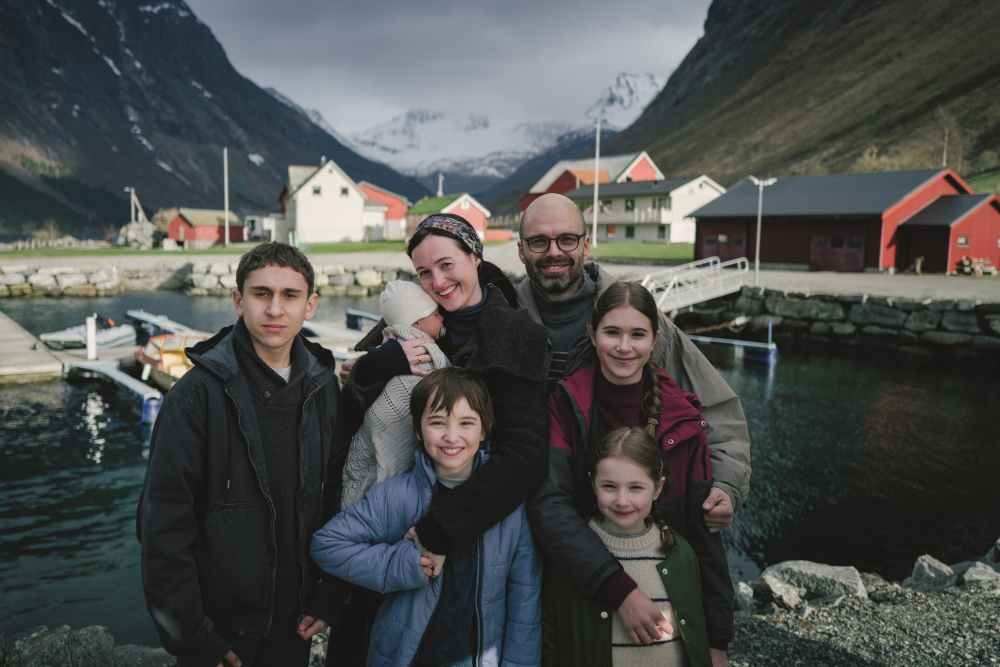
Meet the Gheorghiu family, recently relocated from Mihai’s homeland in Romania to Lisbet’s native Norway following the death of his parents, in the interests of giving their five children a safer, gentler, more domestically centered way of life. The small village they’ve chosen as their home is wholesome and welcoming, and everyone there knows everyone’s business: Their next-door neighbor Mats (Markus Scarth Tønseth) is a friendly family man who also happens to be the principal at the kids’ inclusive new school, while Mihai’s new job — an IT position for which he’s severely over-qualified, but these are the sacrifices you make to live in a Nordic paradise — is connected to his place in the church.
That church, by the way, is of the sternly Evangelical variety, and the Gheorghius take it very seriously indeed. Daily prayers and Bible study sessions are strictly regimented for the children; cellphones, computer games and secular music, among many other things, are verboten. Though the locals are generally accepting and open-minded, the family’s pious conservatism does mark them as other in a society where agnostic liberalism is the status quo: From early on, the children have to be cautioned by their teachers against any kind of religious expression at school. Still, that difference doesn’t stop Elia from forming a fast, close friendship with Mats’ similarly aged stepdaughter Noora (Henrikke Lund-Olsen) — an intense bond that the chilly Mihai, who isn’t shy to voice and teach his conviction that a family can only begin with a man and a woman, regards somewhat askance.
When Elia turns up in gym class with bruises on her body — a day after a domestic altercation with Lisbet that Mungiu also depicts in interrupted fashion — her teachers are concerned, and quick to act. Child services are notified, and Elia and Emmanuel questioned: When they admit that their parents will often dole out “a slap to the butt” as punishment, they and their siblings are swiftly placed in protective care, as required by Norwegian law. Blindsided by this sudden turn of events, their parents don’t deny the accusations, but do get tangled up in semantics: While Mihai doesn’t see “slapping” as equivalent to “hitting,” the authorities see no difference.
This is just the first point of contention in a minefield of cultural barriers, letter-of-the-law distinctions, personal prejudices and perhaps some plain mistruth here and there. It’s never made precisely clear just how severely, or how knowingly, Mihai and Lisbet have harmed their children, while both Stan’s and Reinsve’s measured, tightly clenched performances are courageously dour in affect, inviting no easy sympathy from viewers, whatever their degree of culpability. As this community scandal grows, mutates and eventually reaches the judiciary — not to mention the court of social media, thanks to Mihai’s highly emotive YouTube videos calling for global solidarity from fellow Evangelicals — the stakes shift: In certain lines of questioning from the prosecution, the Gheorghius’ personal beliefs seem to be on trial as much as their parenting.
These multiple, variously sized arcs of dramatic tension, political consciousness and philosophical inquiry are ingeniously disentangled — before again being densely intermeshed — by Mungiu and editor Mircea Olteanu to form a kind of Rohrschach procedural thriller in which the roles of protagonist and antagonist, victim and aggressor, are very much up for discussion. “Fjord” often darts around the perspectives of the most innocent party here, the Gheorghiu children, to symphonically conduct the verbal and ideological warfare of the elder parties who claim to be acting in their best interests. The two-and-a-half-hour result is riveting, acted with careworn nuance down the line by an excellent ensemble, yawing this way and that in terms of narrative and emotional momentum, even as we sense early on that no clear, cathartic resolution will ever be forthcoming.
It’s shot, like Mungiu’s last two features “R.M.N.” and “Graduation,” in coolly ravishing widescreen by the gifted DP Tudor Vladimir Panduru, in tones of sleety, silvery blue that scarcely warm up as this saga spreads across seasons: Action is layered in the film’s deep, expansive frames to an extent that demands our intent, undivided gaze, to catch the incidental conversation playing out in the middle distance, the nervy surveillance off to one side, or another avalanche building in the background to nobody’s great concern. Everything is happening at all times in “Fjord,” as befits a film sharply attuned to the world’s ever-expanding possibilities for movement, misunderstanding and conflict — a great many of them playing out in one pretty, postcard-scaled Norwegian settlement, lapped by snow and water, with the opaque impurity of ice.
Leave a Reply