SPOILER ALERT: This story contains spoilers for “In God We Trust,” the Season 3 finale of “Euphoria,” now streaming on HBO Max.
“It’s always chess for Bishop.”
That’s an apt metaphor from Darrell Britt-Gibson describing his character’s fatal betrayal of his boss Alamo Brown (Adewale Akinnuoye-Agbaje) in the bloody series finale of “Euphoria.”
In the culmination of Sam Levinson’s HBO drama, Alamo kills Rue (Zendaya), an employee who has secretly been working as a DEA informant, by giving her painkillers laced with fentanyl. Ali (Colman Domingo), her mentor and sobriety sponsor, heads to Alamo’s strip club to avenge Rue’s death, and the two engage in an old-fashioned duel.
Breaking cowboy rules, Alamo points his gun at Ali before the designated time and attempts to shoot, but the weapon does not fire. It’s revealed that Bishop, Alamo’s mysterious and monotone right-hand man, has removed the bullets, essentially sentencing Alamo to death. Ali kills the sex- and drug-trafficking tycoon with three shotgun blasts to the chest.
It’s a bold move from Bishop, a mellow henchman who hints at the twist earlier in the episode — once, when he tells Maddy about his pet poodle, “I like to surprise people,” and again when he stares at the snake that’s housed at the strip club. Britt-Gibson tells Variety the morning after the finale that Bishop’s betrayal is not just a power move — it’s rooted in Alamo’s treatment of Rue.
“Bishop didn’t agree with a lot of what Alamo did, but it was a job for him,” he says. “I think what Alamo did to Rue was the final straw for Bishop.”
Did you watch the finale last night?
I did. I got an opportunity to watch it in Brooklyn with a room full of fans, and it was incredible. There’s nothing like watching something that has this impact and this type of feeling with a group of people who are totally invested in the show. It was an incredible moment.
What was it like seeing live reactions from the fans?
It was surreal, because I knew what happened, and I had an expectation about how a group of people would collectively react to it. My expectation was surpassed, because there’s no way to account for every single emotion that’s going to be felt. It’s how I wish everyone could have experienced it. I wish the entire world could have watched it together at the same time.
The way you play Bishop is fascinating. How was he described to you or written on the page, and what did you bring to him?
It wasn’t really described to me in any way, and that the beauty of it. Sam saw an audition of mine for another part, and he wanted to craft Bishop around what I brought to it. Sam is so amazing in that way — he’s a “best idea wins” type of creator. I had this idea of a character who moves more like a samurai in a world of cowboys. Somebody who you can’t really figure out until it’s time to figure him out.
I had ideas about these beads and the way he moved, and Sam was like, “I love it, let’s do that.” Early on in the process, he saw my auditions and wanted to build the character around what I presented. Then he wrote this beautifully intricate, nuanced and layered character.
Did you originally audition for Alamo?
Yeah, and I was too young for it, but he was like, “I need this guy in my show.”
I read that Marshawn Lynch also auditioned for that part.
He did. I think the entire crew did, Asante [Blackk, who plays Kidd] as well. Sam just knows. He’s one of these creators who sees something and knows what he wants to do with it.
Colman Domingo, speaking with Variety, said he wondered if Bishop is on the autism spectrum. Does that resonate with you?
Yeah, it did. I don’t think Black people get to play that enough. I don’t like the way that people who are on the spectrum are spoken about. There are a lot of people in my life and my family who are on the spectrum, and they are the most beautiful, deep, soulful people. I thought, “If I get to do this and play him like that, I want to be able to do it justice and make it thoughtful and layered.” That was something I inherently thought about. I wanted to give it that care.
What is Bishop’s relationship to animals? Obviously, he kills Laurie’s bird, but he also has this pet poodle named Snowflake.
He loves animals. In that scene at the poker table, when Alamo says, “Bishop killed that bird,” Bishop says, “I didn’t want to, but I had to.” And Bishop doesn’t know how to lie. So when Laurie says to him, “You like animals?” he looks at her and deadpans, “I love them.” This is the truth. The killing of Paladin was a job he had to do, but he didn’t want to do that at all. He’s probably more connected to animals than people.
Why does the show introduce Snowflake in the final episode?
I think it speaks to the idea that Bishop is like an onion — every time you see him, there’s another layer being peeled back. It’s like, “Wait, what? He has a dog now?”

Why does Bishop betray Alamo?
Bishop didn’t agree with a lot of what Alamo did, but it was a job for him. I think what Alamo did to Rue was the final straw for Bishop. He’s also having that conversation with Maddy in the car. Rue was a bridge too far, and he’s like, “I promise I’m not going to let you get to Maddy.”
That’s interesting because it doesn’t seem like Bishop cares that much about Rue, at least in the way he behaves toward her.
There are a million different ways to look at it, from a character standpoint. It plays like he doesn’t care, but if you look deep enough, there are moments of Bishop being like a big brother who is hard on her. You know those figures in your life who are like, “Don’t hang out with those people. Those are not good people. You shouldn’t be here.” The way Sam wrote it is up to interpretation. He gives it space for it to be seen however people want to see it.
Do you think Bishop’s betrayal is spontaneous, or had he been waiting for an opportunity to dethrone him for a while?
He’s been waiting. He’s so calculated. It’s chess. It’s always chess for Bishop.
Hence the name.
Exactly.
I have to ask about the multicolored coat Bishop wears in the finale. It reminded me of the story of Joseph, and how the coat of many colors is a biblical symbol of betrayal and being chosen by God. Is that something you discussed on set?
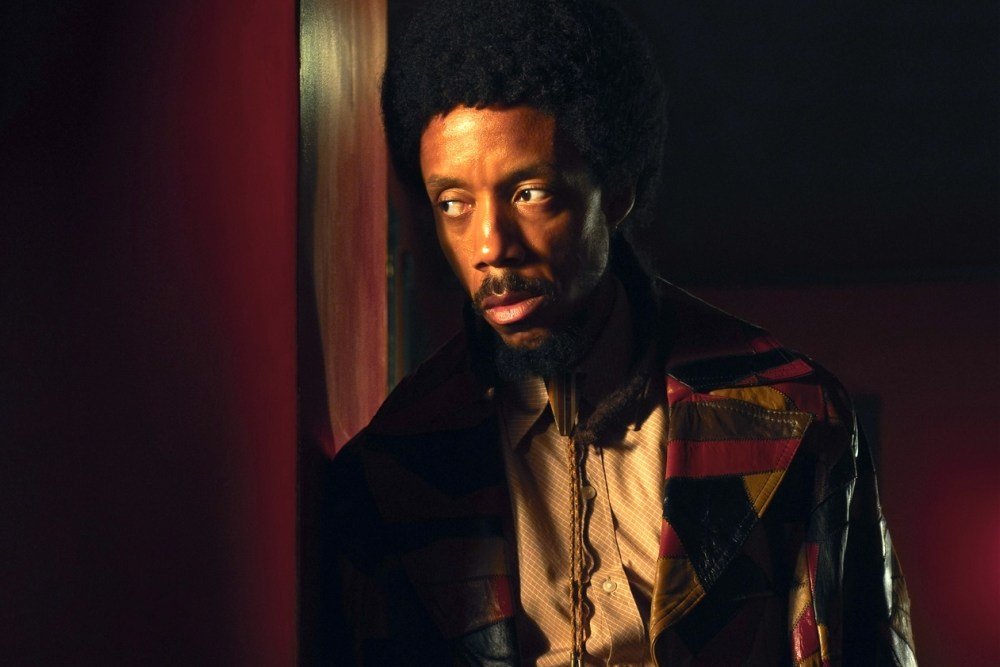
No, no. That’s just Natasha [Newman-Thomas], our incredible costume designer. Every episode I had these incredible coats, and when I walked into the trailer for the finale, I was like, “Oh Natasha, you went crazy with this.” Bishop had worn a lot of solid colors, and in the last episode he’s wearing this patchwork jacket with cracked colors. It represents the multi-dimentionality of the character, and the idea that the color is starting to shine through.
There’s a lot of religious symbolism in the show. I was wondering about how Bishop flashes his rosary beads at Kidd, signaling to put his gun down. What’s the story behind that?
Some people picked up on it, some people didn’t, but I carry those beads in every single scene in the show. It was something I brought to Sam. I personally have prayer beads, and I thought it’d be fascinating to have this character who lives in this dark world [of crime] but carries these prayer beads.
I also spoke to Adewale about the finale, and he said Alamo might be scared of Bishop because he seems to truly enjoy the act of killing. What do you think about that?
Yes, but also no. I don’t believe Bishop genuinely enjoys killing. It’s like what we talked about before. That scene where he is about to saw up the bouncer [with a chainsaw] and he’s asked, “How are you today?” he says, “I’ve been better.” That’s a very specific thing to say, as opposed to “I’m good” or “I’m great.” Having to kill this man isn’t something he wants to do, but he’s detached from emotion. He’s like a psychopath, but he’s also not. It’s why I love the character so much.
Was there anything you shot that didn’t make the final cut?
I can’t remember everything, but it wasn’t like there was some murder that nobody saw. Nothing like that. But there were little pieces of dialogue. He speaks about the beads in one scene in Laurie’s house. I think Wayne [Toby Wallace] looks at the beads and says, “What are those, a Muslim thing?” And Bishop looks at him and says, “It’s a me thing.”
Where do you think Bishop comes from? How did he come to work for Alamo?
Sam told me the idea for Bishop’s backstory, which is so incredible, but I don’t even want to say it. I want to let the world make their own opinions.
This interview has been edited and condensed.
Leave a Reply