At the steady rate of two or three movies a year (shorts and features combined), Romanian director Radu Jude has become one of the most prolific auteurs of our time.
That doesn’t always mean quality over quantity. See, for instance, last year’s overstuffed Dracula, which was bested by the other film he somehow shot at the same time, the minimalist drama Kontinental ’25. Indeed, not all Jude movies are created equal, though even when they’ve been made too quickly, they’re always brimming with sociopolitical critiques, stylistic innovations and the director’s acerbic sense of humor.
Diary of a Chambermaid
The Bottom Line
A century-old story gets a relevant update.
Venue: Cannes Film Festival (Directors’ Fortnight)
Cast: Ana Dumitrascu, Vincent Macaigne, Mélanie Thierry, Marie Rivière, Louen Bouteiller, Arnaud Baudoin, Ilinca Manolache
Director, screenwriter: Radu Jude
1 hour 34 minutes
Diary of a Chambermaid (Le Journal d’une femme de chambre), which marks Jude’s first feature in French, contains all of the above, as well as a clever meta-structure that provides a running commentary on its famous source material. “A variation on the novel,” is how an opening title card explains this umpteenth take on the controversial (in its day) book by Octave Mirbeau, which was previously adapted to the screen by heavyweights Jean Renoir and Luis Buñuel, then most recently by Benoît Jacquot.
Like Buñuel, with whom he shares certain affinities as a filmmaker, Jude sets his movie in the present and takes plenty of liberties with the original text, throwing much of the novel’s plot out the window. But he still manages to capture its essence, transforming the tale of an exploited 19th-century maid into one about a Romanian immigrant working as a nanny for two passive-aggressive French intellectuals.
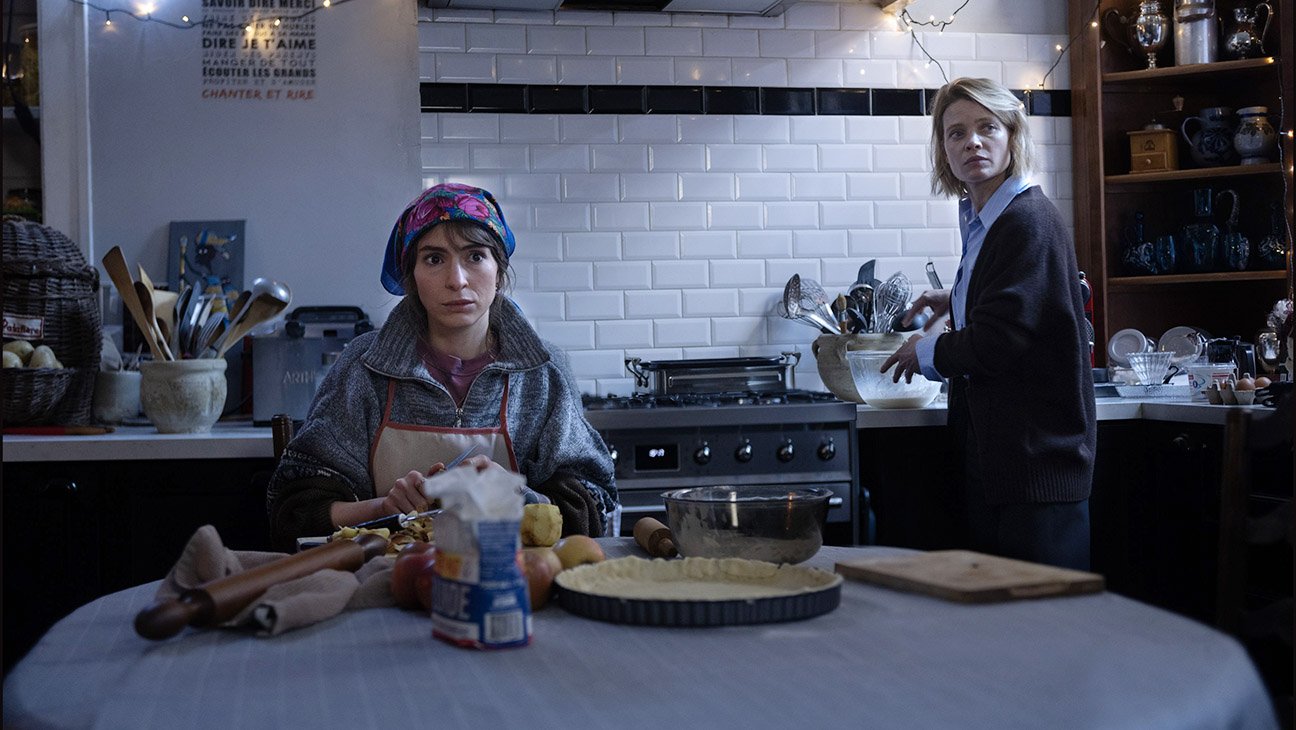
Set in the picturesque southwestern city of Bordeaux — whose past as a slave-trading hub Jude doesn’t shy away from — the film chronicles several months in the life of Gianina (the excellent Ana Dumitrascu), who’s employed as an au pair for bourgeois-bohemians Pierre (Vincent Macaigne) and Marguerite (Mélanie Thierry, also at the fest with competition entry A Woman’s Life).
Tasked with cooking, cleaning and picking their somewhat bratty son, Louen (Louen Bouteiller), up from school, Gianina slaves away in France so she can send money back to Romania, where her young daughter, Maria (Sofia Dragoman), remains with her grandmother (Liliana Ghita) in the countryside.
It’s a story you see taking place in many major western cities nowadays, where wealthy couples pay immigrants for childcare, while those very same immigrants often have their own children back in their homelands. Jude uses this set-up to update Mirbeau’s scathing look at class hierarchies and modern-day slavery, highlighting how the cycle of exploitation remains unbroken over a hundred years later.
The director doubles-down on his adaptation by having Gianina also perform in a theatrical version of Diary of a Chambermaid that’s staged by another Romanian (played by Jude regular Ilinca Manolache) and co-stars a fellow foreigner (Arnaud Baudoin). The rehearsal scenes for that production can be somewhat trying and over-the-top — what would a Jude movie be without at least one hyper-simulated orgasm? — but they provide a nice mirror to the rest of the plot, no matter how exaggerated the play is.
The film’s best sequences involve Gianina dealing with Pierre and Marguerite, a pair of well-meaning bobos who can’t help ordering her around half the time. Macaigne’s improv skills are on fine display in several hilarious pieces of dialogue that have him clumsily trying to get the nanny to do his bidding, while Thierry plays an icy college professor who acts both concerned about Gianina and completely self-involved.
Working once again with DP Marius Panduru, Jude stages these scenes in crisp, fixed medium-shots that get the best out of the performances. The rest of the film relies on phone footage taken by Gianina as she wanders Bordeaux and talks on Facetime with Maria, who misses her mother dearly and isn’t afraid to say so. As caustic as this version of Diary is, it’s also filled with an underlying sense of longing and melancholy, of being far from your loved ones in a country that isn’t always welcoming.
That sentiment hits its apex just before Christmas, during which Gianina was supposed to travel home and visit her daughter for the first time in months. But the sudden arrival of Louen’s grandmother (played by Eric Rohmer favorite Marie Rivière) winds up changing everyone’s agenda, revealing to what extent Gianina’s personal life matters little when it comes to her employers’ holiday plans.
The story’s rather uplifting resolution probably comes too swiftly and doesn’t exactly resolve all the problems Gianina is facing, but that tends to happen in Jude’s movies. He’s less interested in dramatic arcs or emotional crescendos than in exploring an idea from as many angles as possible — both thematically and cinematically, and always with a sizable dose of dark humor.
Here, he uses Mirbeau’s text as a springboard to lambast the current social order, wavering from the narrative to discuss subjects like Communism, Maoism and the fate of Romanian dictator Ceausescu (beheading is a recurring motif in the film). These may seem like digressions, yet everything is connected in a movie that never ditches its razor-sharp view of class exploitation. It may appear now in new forms and iterations, but even a century or so after the book came out, it’s still the same story.
Leave a Reply