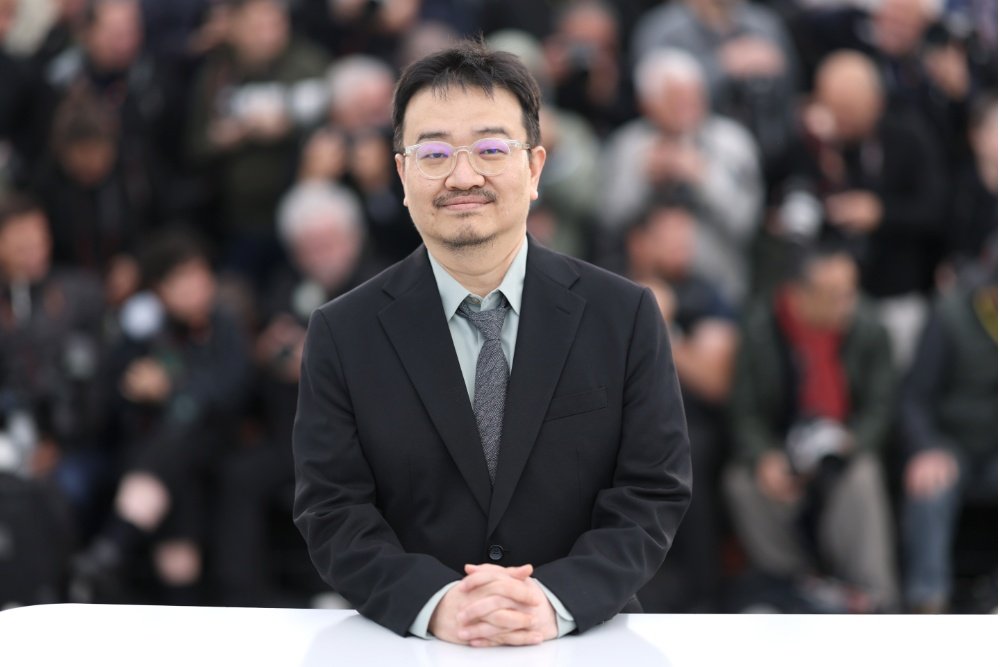
Yeon Sang-ho’s “Colony” premiered in the Midnight Screenings section at the Cannes Film Festival on Friday, marking the “Train to Busan” director’s return to the zombie genre. This time, he infuses it a distinctly contemporary twist that reflects anxieties about artificial intelligence, collective behavior and the erosion of human individuality.
“All along my works, I always tried to express the fear or the horror of today’s society,” Yeon tells Variety. “For me, the greatest fear is the high-speed communication exchange. It’s like a living organism and, in a way, it reduces our individualism, our individuality.”
That thematic concern drives “Colony,” which follows biotechnology professor Se-jeong, played by Gianna Jun, as she attends a conference that spirals into catastrophe when a rapidly mutating virus is unleashed. With authorities sealing off the entire facility, survivors find themselves trapped with an ever-growing threat that behaves less like traditional zombies and more like a networked intelligence.
For Yeon, the decision to revisit zombies wasn’t about retreading familiar ground but finding the right vessel for exploring modern anxieties. He points to George A. Romero’s enduring influence, noting that “Night of the Living Dead” and subsequent zombie films remain beloved because Romero was able to express the potential fear of his time through the undead.
“When you see the history of those zombie movies, actually zombies represent the fear of that time, so it’s really, really relevant,” Yeon says. “And zombies, even in my movies, they are called zombies because it’s not a definition, but it’s because they represent the potential fear of our time.”
That fear, in 2026, centers on how rapid information exchange and artificial intelligence are reshaping human thought into something collective and homogenized. “In a way, it’s like a living organism,” Yeon observes, “and it reduces our individualism, our individuality.”
The filmmaker’s research into viral colonies and group organisms revealed a fascinating parallel to human society. “Each colony or each group, each virus — we can just assume that there’s only one specificity — but actually, even if they appear to be the same, themselves they create a mutant,” he explains. “Because if they are all the same, if something happens to this particular organism or this virus, it’s a weak point because this weakness can lead to complete extinction.”
That biological imperative toward diversity informs Yeon’s broader philosophy about protecting minority voices within collective structures. “I think the human society can learn a lot about this because actually, it’s also for us very important to protect the minority in front of the universality.”
Yeon’s concerns about collective behavior extend directly to artificial intelligence itself. “We have to look into what are the specificities of AI,” he says. “Of course, it’s an artificial intelligence and it’s the sum of all that is universal. So when we speak about universality, it also embraces errors or bugs which is, in a way, the point of view of the minority which is completely buried in it.”
For Yeon, AI’s ability to rapidly find and synthesize universal opinions creates a fundamental problem: it eliminates the mutations and minority perspectives that biological systems — and human societies — need to survive. “AI is appropriate for creating universal opinions, but it has limitations in creating mutations, which are characteristics of living organisms — minority opinions,” he explains.
“Train to Busan” trapped its characters in the horizontal space of a speeding train, but “Colony” unfolds vertically within a sealed high-rise building. The shift isn’t merely spatial but symbolic, representing what Yeon sees as the precariousness of human civilization itself.
“When you have vertical action, it also expresses that the civilization made by humans can also go back very quickly to the primitive, to the savageness that we all knew before,” he says. The verticality also plays with audience expectations about escape and survival. “Humans think that you better go up, upwards to survive, but actually in the movie, you know that it doesn’t really help to go on the top.”
The setting also allowed Yeon to explore a dimension absent from “Train to Busan” — the perspective of those outside who view containment as necessary. “There are people outside who want people inside to be completely locked down, isolated,” he notes. “That is the biggest difference compared to ‘Train to Busan’.”
It’s an approach informed by the global experience of the COVID-19 pandemic. “We all experienced the coronavirus experience since then,” Yeon observes. “I think we all have a way of watching that completely changed because of that experience.”
In an era when visual effects can conjure virtually anything, Yeon made the deliberate choice to ground “Colony’s” horror in physical performance. He hired three teams of professional dancers to embody the infected, rejecting the notion that creatures sharing a collective consciousness should move identically.
“I’m not struggling to avoid any CGI, but here it was the case because we have actual real living organisms,” Yeon explains. “Of course, they have all the specificities of AI, those zombies, but those living organisms, I wanted them to be real.”
The metaphor he used with the dancers was telling: “Ten fingers of one hand playing a piano. So each of them, they are in one hand, so they are a body, but each of them have their specific role.” It’s a choreographic approach that mirrors the film’s thematic interest in how individuals function within collectives while maintaining distinct identities.

“Colony”
Showbox
Balancing blockbuster spectacle with philosophical inquiry comes naturally to Yeon, but he’s quick to credit the infrastructure created by Korea’s previous generation of filmmakers.
“I think everything is really due to the industry of South Korean cinema,” he says. “You see recently all those famous directors like Lee Chang-dong, Bong Joon Ho, Park Chan-wook — we really owe them a lot because they are the ones who made the basic frame of doing movies that are at the same time commercial but also very auteur.”
That framework, Yeon says, distinguishes Korean commercial cinema from other markets. “It’s like a really cornerstone — so we all try to not only make pure commercial films, but commercial films which also embrace auteur side. So that, I think, is one of the greatest strengths of Korean cinema.”
The international success of Korean genre filmmaking has opened new collaborative opportunities for Yeon. His Netflix thriller “Revelations” featured Alfonso Cuarón as producer, while his Netflix Japan series “Human Vapor,” directed by Katayama Shinzo, launches July 2. The series, inspired by a 1960s film and Okuda Hideo’s novel “Olympic Ransom,” allowed Yeon to work in unfamiliar cultural terrain.
“The subject takes place in a country that I don’t know, it’s not my usual surroundings, so it was great to collaborate on that project,” he says.
Yeon is completing post-production on “Paradise Lost,” a darker, more intimate project that extends themes from his 2025 film “The Ugly.” Inspired by low-budget works from Asian masters like Edward Yang and Kurosawa Kiyoshi, “Paradise Lost” tells the story of a mother who uses AI services to virtually resurrect her dead young son, only to have her actual son return nine years later.
“It’s a very dark movie and it’s really completely different to the big movies that I usually make,” Yeon says. “But I don’t want to focus on only one kind of movie; I really want to have a parallel, to make both independent low-budget movies and also all those commercial movies together.”
Looking further ahead, Yeon hints at an international project that will take him outside Korean-language cinema entirely, though he’s staying tight-lipped on details.
For now, his focus remains on “Colony’s” Cannes debut, where he and his cast — including Jun, Koo Kyo-hwan, Ji Chang-wook, Shin Hyun-been, and Kim Shin-rock — walked the red carpet Friday night. It’s a moment that encapsulates how far Korean genre cinema has traveled on the global stage, and how filmmakers like Yeon continue to find fresh resonance in familiar forms.
“I think that I’m really lucky to be a director working today,” Yeon reflects, comparing the current debates about streaming platforms, AI, and cinema’s identity to the artistic ferment that followed Marcel Duchamp’s Dadaism. “All those debates actually enriched art at that time. So I think today it’s the same for cinema because of the platforms, because of the quest of identity, everything enriches cinema today.”
Leave a Reply