Category: News

  • FBI Director Kash Patel sues Atlantic for ‘false’ reporting on drinking

    FBI Director Kash Patel sues Atlantic for ‘false’ reporting on drinking

    FBI Director ⁠Kash Patel has filed a defamation lawsuit against The Atlantic and its reporter, Sarah Fitzpatrick, following the publication of an article on Friday alleging the director had a drinking problem that could pose a threat to United States national security.

    The Atlantic said it stood by its reporting and would vigorously defend against the “meritless lawsuit” that was filed on Monday.

    The magazine’s story, initially titled “Kash Patel’s Erratic Behavior Could ⁠Cost Him His Job,” cited more than two dozen anonymous sources expressing concern about Patel’s “conspicuous inebriation and unexplained absences” that “alarmed officials at the FBI and the Department of Justice”.

    The article, which The Atlantic subsequently titled “The FBI Director Is MIA” in its online version, reported that during Patel’s tenure, the FBI had to reschedule ⁠early meetings “as a result of his alcohol-fueled nights” and that Patel “is often away or unreachable, delaying time-sensitive decisions needed to advance investigations”.

    In The Atlantic’s story, the White House, the Department of Justice and Patel denied the allegations. The article included a statement from the FBI attributed to Patel, “Print it, all false, I’ll see you in court—bring your checkbook.”

    Patel, in the lawsuit filed in the District Court in Washington, denied the allegations of his behaviour and criticised the magazine for relying on anonymous sources. Fitzpatrick wrote that she interviewed more than two dozen people and granted them anonymity to “discuss sensitive information and private conversations”.

    “Defendants cannot evade responsibility for their malicious lies by hiding behind sham sources,” the lawsuit said.

    “We stand ‌by our reporting on Kash Patel, and we will vigorously defend The Atlantic and our journalists against this meritless lawsuit,” the magazine said in a statement.

    Reuters could not independently establish the accuracy of the article or why the publication changed the title.

    Patel’s complaint says that while The Atlantic is free to criticise the leadership of the FBI, “they crossed the legal line” by publishing an article “replete with false and obviously fabricated allegations designed to destroy Director Patel’s reputation and drive him from office”.

    The lawsuit, filed in the US District Court for the District of Columbia, seeks $250m in damages.

    The lawsuit alleges The Atlantic ignored the FBI’s denials and did not respond to a Friday letter from Patel’s lawyer Jesse Binnall to senior editors and the Atlantic’s legal department ⁠asking for more time to refute the 19 allegations the reporter told the FBI’s press office she would be ⁠publishing.

    “It is among the strongest possible evidence of actual malice,” it said.

    “The Atlantic’s story is a lie,” Patel said in an interview with Reuters. “They were given the truth before they published, and they chose to print falsehoods anyway.”

    Acting with ‘actual malice’

    The letter, which Reuters has seen, was sent shortly before 4pm (20:00 GMT) on Friday, and The Atlantic published the story at 6:20pm (22:20 GMT), according to the complaint. Reuters could not determine whether or how The Atlantic responded to Binnall’s request.

    The lawsuit alleges the publication acted with “actual malice”, a legal standard that requires public figures such as Patel to show the publisher knowingly printed ⁠false information or recklessly ignored doubts about its accuracy.

    “Defendants’ conscious decision to ignore the detailed, specific, and substantive refutations in the Pre-Publication Letter, and their refusal to give a reasonable amount of time for the FBI and Director Patel to ⁠respond, is among the strongest possible evidence of actual malice,” the lawsuit says.

    Binnall is a prominent Republican ⁠attorney who has represented US President Donald Trump in numerous civil cases, including one brought by US Capitol Police officers over his role in riots in Washington, DC on January 6, 2020. Binnall has represented Trump’s eldest son, Donald Trump Jr., as well as former national security adviser Mike Flynn, and ran Trump’s challenge to Nevada’s 2020 election results.

    The lawsuit is the latest instance of a Trump administration figure suing a media outlet. A judge ‌dismissed a lawsuit brought by Trump against CNN for describing election denialism as “the big lie”. Judges have also dismissed Trump’s lawsuits against the New York Times and the Wall Street Journal. Trump has refiled his lawsuit against the New York Times and may refile against the Wall Street Journal.

    He has also secured some settlements. ABC News agreed ‌to settle ‌a case for $15m plus $1m in legal fees. Paramount Global agreed to pay $16m to settle a dispute over what the Trump administration called “deceptive editing” of a CBS News interview with his opponent in the 2024 election, Kamala Harris.

  • Gunman kills Canadian woman, injures six at Mexico’s Teotihuacan pyramids

    Gunman kills Canadian woman, injures six at Mexico’s Teotihuacan pyramids

    President Claudia Sheinbaum says she instructed authorities to ‘thoroughly investigate’ incident outside Mexico City.

    A gunman has fatally shot ⁠a Canadian woman and injured six ⁠others at Mexico’s Teotihuacan pyramids, a ‌popular tourist and archaeological site outside of Mexico City, authorities say.

    The perpetrator later died of a self-inflicted gunshot wound on Monday, local officials said. The State of Mexico said four of the injured ⁠victims were shot and two others suffered from falls.

    Recommended Stories

    list of 3 itemsend of list

    “Care is being provided to the people who were affected, and the presence of elements from the state Secretariat of Security will be maintained,” Governor Delfina Gomez Alvarez wrote on X.

    Mexico’s President Claudia Sheinbaum said she is closely monitoring the situation, and her government is in contact with the Canadian embassy.

    “I have instructed the Security Cabinet to thoroughly investigate these events and provide all necessary support,” Sheinbaum wrote on X.

    “Personnel from the Secretariat of the Interior and Culture are already heading to the site to provide assistance and accompaniment, along with local authorities.”

    The pre-Hispanic ⁠city was one ⁠of the most important cultural centres in Mesoamerica.

    The incident comes less than two months from the start of the FIFA World Cup, which Mexico will co-host with the United States and Canada.

    Concerns over the security situation in Mexico came to the forefront in February after violence erupted across parts of the country, following the killing of Nemesio Oseguera Cervantes, leader of the Jalisco New Generation Cartel, also known as “El Mencho”.

  • These are difficult times for the world, so what will Pakistan do?

    These are difficult times for the world, so what will Pakistan do?

    The recent statements by US President Donald Trump and the shuttle diplomacy carried out by senior Pakistani military and government leaders in regional capitals have raised hopes of ending the US-Israel war with Iran through negotiations. This could initially take the form of a “framework agreement” between the United States and Iran to lay the groundwork for a final deal.

    Speaking to reporters at the White House on Thursday, Trump struck an optimistic tone, saying the war was “about to end”, as “almost all” issues had been resolved. The remaining differences would be addressed in talks that he said would resume soon. He also said he might travel to Islamabad if a final agreement were signed there.

    Despite Trump’s tendency to make exaggerated statements, his remarks this time appeared to be backed by a series of intensive diplomatic activities in the region. The surprise visit by Pakistan’s army chief, Field Marshal Asim Munir, to Tehran for talks with Iranian officials—apparently to convey messages from Washington—suggested that the ground was being prepared for another round of negotiations between the US and Iran.

    The messages conveyed were intended to address differences between the two sides over the remaining issues, as well as to discuss efforts aimed at securing a ceasefire in Lebanon.

    At the same time, Pakistan’s Prime Minister Shehbaz Sharif embarked on a three-country tour—Saudi Arabia, Qatar, and Turkiye—to brief their leaders on the latest developments in the talks aimed at ending the war.

    This also indicates that diplomatic activity was in full swing in preparation for another round of direct talks between Washington and Tehran.

    With the ceasefire among the US, Israel, and Iran holding since April 8, the announcement of a 10-day truce between Lebanon and Israel has boosted optimism and was widely seen as a step towards a peace agreement between Washington and Tehran.

    Iran welcomed the truce, which received global backing. Iranian Foreign Ministry spokesperson Esmaeil Baghaei said Tehran views the truce as part of a broader understanding with Washington reached during talks mediated by Pakistan.

    In fact, controversy arose shortly after the ceasefire between the US and Iran was announced, when Iran and Pakistan said it included a truce in Lebanon as part of a broader regional ceasefire, but Trump denied that.

    This required talks among Israel, the US, and Lebanon, which culminated in the ceasefire in Lebanon. In response, Iran announced it would allow all commercial ships to pass through the Strait of Hormuz for the remainder of the temporary truce period—before matters became somewhat complicated.

    All of this came after negotiations held between the US and Iran in Islamabad on April 12.

    These were the highest-level direct talks between them in more than four decades, during which there were no diplomatic relations between the two countries. The dispatch by both sides of high-level delegations indicated their seriousness about finding a way out of the conflict.

    Many international media outlets rushed to declare that the talks were inconclusive and ended in failure, as if an agreement on such thorny issues could be reached within just a few hours.

    In reality, the Islamabad talks were neither a major achievement nor a failure; the two delegations returned to their capitals to consult with their leaderships in a generally positive atmosphere, and neither side said the talks had collapsed.

    The diplomatic option remained on the table for both sides, keeping the door open to the possibility of continuing negotiations. Diplomatic engagement continued through Pakistan, which stepped up its efforts to persuade the two parties to show flexibility and maintain back-channel communications in order to narrow the gaps in their positions.

    The Islamabad talks revealed how far apart the two sides’ positions were, as reflected in the 15-point plan put forward by the US and the 10-point proposal presented by Iran.

    Tehran’s core demands included guarantees that there would be no future American or Israeli attacks on Iran and its regional allies, the lifting of sanctions, the unfreezing of assets, international recognition of its right to uranium enrichment, and the continuation of its control over the Strait of Hormuz.

    The US’s demands included strict Iranian commitments not to pursue nuclear weapons, insistence that Tehran carry out no enrichment, removing Iran’s stockpile of highly enriched uranium from the country, and the reopening of the Strait of Hormuz.

    When the talks ended, the US side claimed that Iran had not responded to its nuclear concerns, while Iran asserted that the American negotiators had made unrealistic demands.

    But both sides acknowledged that progress had been made, despite key issues remaining unresolved, including the future status of the Strait of Hormuz. The US proposed sharing the revenue from customs fees for the strait, but Iran rejected the idea.

    Subsequent indirect contacts sought to address contentious points on the nuclear issue and the strategic waterway, as Pakistani mediators urged both sides to be more flexible.

    These issues are expected to dominate the talks in a second round if it is held, as Pakistani mediators have privately said they made progress on the “contentious issues”, although Iranian officials have expressed a more cautious stance.

    The main difference that must be resolved concerns the nuclear issue: the US proposes that Iran carry out no uranium enrichment for 20 years, which it believes would ensure that Tehran does not pursue a nuclear weapons programme.

    Iran has repeatedly stressed that it will not build a nuclear bomb, but that it has the right to enrichment for peaceful purposes under the Nuclear Non-Proliferation Treaty, to which it is a party. Mohammad Eslami, head of the Atomic Energy Organization of Iran, has stated that the talks must recognise Iran’s rights, interests, and dignity if they are to bear fruit.

    The question is whether the US would agree to enrichment at less than three percent —far below weapons-grade levels—for five years, as Iran reportedly offered.

    As for the other issue related to removing nuclear material, it can likely be addressed through Tehran’s offer to dilute the concentration of its 400kg stockpile of highly enriched uranium to the lowest possible level inside Iran, while granting the International Atomic Energy Agency full access to verify it.

    Iran wants all sanctions lifted, but it will not agree to take its stockpiles out of the country. When Trump recently claimed that Iran had accepted the US demand, Iran’s Foreign Ministry spokesperson quickly denied it, saying: “Enriched uranium will not be transferred anywhere.”

    The question remains open as to whether the next round of talks will be able to break the deadlock over the nuclear issues and the Strait of Hormuz. The stakes are high for both sides, which appear to want a way out of the war, but obstacles remain, and Israel could still play a spoiling role and stand in the way of any achievement that might be made. These are difficult hours casting a shadow over the world.

    A version of this article was originally published in Arabic by Al Jazeera Arabic

    The views expressed in this article are the author’s own and do not necessarily reflect Al Jazeera’s editorial stance.

  • Woman charged in US with trafficking arms to Sudan for Iranian government

    Woman charged in US with trafficking arms to Sudan for Iranian government

    US accuses Iranian citizen of brokering arms deals, including for drones and ammunition, with Sudan’s Ministry of Defence.

    An Iranian national has been arrested at Los Angeles International Airport for allegedly trafficking arms to Sudan on behalf of Tehran, the US Department of Justice says.

    Shamim Mafi, 44, was arrested and “charged with … brokering the sale of drones, bombs, bomb fuses, and millions of rounds of ammunition manufactured by Iran and sold to Sudan”, the department said in a post on X on Monday.

    Recommended Stories

    list of 3 itemsend of list

    US Attorney Bill Essayli wrote in an earlier X post that Mafi lived in the Los Angeles suburb of Woodland Hills and “is an Iranian national who became a lawful permanent resident of the United States in 2016”.

    Mafi was arrested on Saturday and faces a maximum sentence of 20 years in federal prison if convicted.

    Essayli’s post was accompanied by images of a woman presumed to be Mafi surrounded by federal agents at the airport, a large drone on a tarmac, a woman’s ID image and bundles of cash.

    The United Nations recently warned that Sudan is at risk of slipping into “full-scale famine and collapse” as the war between its army and the paramilitary Rapid Support Forces (RSF) has entered its fourth year.

    A criminal complaint dated March 12 alleged that Mafi and an unnamed coconspirator operated a company in Oman called Atlas International Business, through which weapons and ammunition were trafficked. The company received more than $7m in payments in 2025.

    Separately, Mafi and the coconspirator brokered the sale of 55,000 bomb fuses to the Sudanese Ministry of Defence, according to court documents.

    “In connection with the transaction, Mafi submitted a letter of intent to Iran’s Islamic Revolutionary Guard Corps (‘IRGC’) to purchase the bomb fuses for Sudan,” the complaint said.

    Mafi is scheduled to appear in US District Court in Los Angeles on Monday. If convicted, she could face up to 20 years in prison.

    Denise Brown, head of the United Nations in Sudan, told the AFP news agency on Thursday that Sudan is facing the world’s largest humanitarian crisis and weapons from outside sources deserve part of the blame.

    The UN has repeatedly called on foreign powers to stop fuelling the war but has not accused specific states.

    On one side, the Sudanese army has been backed by Egypt and Saudi Arabia and deployed Turkish- and Iranian-made drones.

    However, most of the blame has been pointed at the United Arab Emirates, which denies evidence that it has funnelled arms to the RSF, which has been accused of genocide.

  • US launches tariff refund system as thousands of importers line up

    US launches tariff refund system as thousands of importers line up

    More than 330,000 importers paid up to $166bn in tariffs on 53 million shipments ​of imported goods.

    The refund system set up to allow companies to recover illegally collected tariffs from the United States government has gone live as thousands of companies rushed to file claims.

    “So far, so good” – though the system is a little glitchy, said Jay Foreman, CEO of toymaker Basic Fun, which had a team in its “war room” at its headquarters in Boca Raton, Florida, ready to start filing when the system went live at 8am US Eastern time (12:00 GMT) on Monday.

    Recommended Stories

    list of 4 itemsend of list

    Foreman said the system didn’t crash as some had feared it might under the onslaught of attempted submissions – but rather would sometimes not allow an upload and force them to retry. The company has over 500 files it needs to upload to the system, although the system permits these to be uploaded in batches.

    “However, if you load too many or the system is too busy, it will kick them back,” Foreman said in an email about how the process was working in the early moments. “We’ve got over 50 percent of our invoices loaded so far. We are hoping in the next few hours to have them all loaded. I’m very happy we got this process started early.”

    Companies contacted by the Reuters news agency in recent days expressed concerns about the durability of the new system, created by US Customs and Border Protection (CBP) in response to a court order that it prepare to return up to $166bn to importers.

    The US Supreme Court in February struck down the tariffs that President Donald Trump pursued under a law meant for use in national emergencies, handing the Republican president a stinging defeat.

    In court filings, customs officials said as of April 9, some 56,497 importers had completed the necessary steps to receive electronic refunds, an amount totalling $127bn, or more than three-quarters of the total eligible to be refunded. More than 330,000 importers paid the tariffs at issue on 53 million shipments of imported goods.

    Companies must submit declarations listing the goods on which they collectively put billions of dollars towards the import taxes the court subsequently struck down. If CBP approves a claim, it will take 60-90 days for a refund to be issued, the agency said.

    The government expects to process refunds in phases, however, focusing first on more recent tariff payments. Any number of technical factors and procedural issues could delay an importer’s application, so any reimbursements that businesses plan to make to customers would likely have to trickle down slowly.

    It is unclear whether getting a refund claim into the portal as soon as possible will impact how quickly it’s processed, but many companies decided to not take the risk of waiting.

    A CBP spokesman said on Friday that the agency created a system that will “efficiently process refunds, pursuant to court order, for importers and brokers who paid” the duties.

    This is the latest twist in a drawn-out battle over emergency tariffs collected over the past year as Trump seeks to restructure US trade relations. The constantly shifting tariffs roiled global business as companies rushed to move supply chains to avoid them as well as figure out who would ultimately pay the taxes.

  • ‘Israel never talked me into the war with Iran,’ Trump says

    ‘Israel never talked me into the war with Iran,’ Trump says

    United States President Donald Trump has denied being dragged into war with Iran by Israel as he faces increasing criticism over the conflict, including from segments of his own base.

    “Israel never talked me into the war with Iran, the results of Oct. 7th, added to my lifelong opinion that IRAN CAN NEVER HAVE A NUCLEAR WEAPON, did,” Trump wrote in a social media post on Monday.

    Recommended Stories

    list of 3 itemsend of list

    There is no public evidence linking Iran directly to Hamas’s October 7, 2023, attacks against Israel. Trump’s own intelligence chief, Tulsi Gabbard, also testified to Congress in March that Iran is not building a nuclear weapon.

    Over the eight months before the war on Iran, Trump had been saying repeatedly that the US air strikes on the country in June had “obliterated” its nuclear programme.

    Many of Trump’s critics have argued that Iran did not pose an imminent threat to the US and the war only advances the interests of Israel at the expense of the safety and prosperity of Americans.

    Iran responded to the initial US-Israeli strikes of the war – which killed Supreme Leader Ali Khamenei, other top officials and hundreds of civilians on February 28 – by blocking the Strait of Hormuz, sending oil prices soaring.

    In the US, energy costs have skyrocketed, fuelling inflation. The price of 1 gallon (3.8 litres) of petrol has remained more than $4, up from less than $3 before the war, more than a week after a ceasefire between Washington and Tehran came into effect.

    A recent poll by NBC News suggested that two-thirds of Americans disapprove of Trump’s handling of the war.

    With dissatisfaction growing, many of the president’s critics have pointed to Israel as the real power behind the war, portraying Trump as a weak leader following Israeli Prime Minister Benjamin Netanyahu.

    “He entered a war – got pulled into it by Bibi Netanyahu. Let’s be clear about that – entered a war that the American people do not want,” Kamala Harris, Trump’s 2024 Democratic opponent, said last week.

    Harris served as vice president in President Joe Biden’s administration, which provided diplomatic and military support for Israel’s genocidal war on Gaza for 15 months.

    During the 2024 campaign, Trump presented himself as the “peace” candidate, promising to end wars that were started under previous administrations.

    Trump’s National Security Strategy, released last year, also said Washington would pivot its foreign policy and military resources from the Middle East to the Western Hemisphere.

    But Netanyahu, who has visited Trump in the US six times in one year, has continued to push for a hard line against Iran. The most vocal supporters of the war in Washington have also been Israel’s closest allies.

    On Monday, Trump renewed his attacks on the mainstream media for its coverage of the war with Iran.

    “I watch and read the FAKE NEWS Pundits and Polls in total disbelief. 90% of what they say are lies and made-up stories, and the polls are rigged, much as the 2020 Presidential Election was rigged,” the US president wrote, referring to the election he lost to Biden.

    He also touted his policies in Venezuela, where the country has remained stable and become more friendly to Washington since US forces abducted President Nicolas Maduro in January.

    In Iran, however, the US-Israeli strikes led to the closure of the Strait of Hormuz and sustained Iranian attacks across the Gulf for nearly six weeks.

    The conflict is now paused, and further talks between US and Iranian officials could take place in Pakistan this week. But both sides have threatened to renew the fighting if a deal is not reached. The two-week ceasefire is due to expire on Wednesday.

    “Just like the results in Venezuela, which the media doesn’t like talking about, the results in Iran will be amazing – And if Iran’s new leaders (Regime Change!) are smart, Iran can have a great and prosperous future!” Trump posted.

  • Cloud over US-Iran talks: What are the key sticking points?

    Cloud over US-Iran talks: What are the key sticking points?

    United States President Donald Trump has claimed a second round of negotiations with Iran will take place in Pakistan on Tuesday as mediators try to revive negotiations before the end of an ongoing yet fragile two-week ceasefire.

    The announcement on Sunday came alongside a sharp escalation in rhetoric. Trump warned that Iran must agree to a deal “one way or another – the nice way or the hard way” and threatened to target key infrastructure if negotiations fail. He also renewed his threat of striking “bridges and power plants”, which experts said could amount to war crimes under international law.

    Recommended Stories

    list of 3 itemsend of list

    Iran, however, has so far denied it will participate in the talks, accusing the US of “armed piracy” after US forces struck and seized an Iran-linked tanker on Sunday, further heightening tensions between the longtime adversaries.

    What has the US said?

    On Sunday, Trump announced that US negotiators would travel to the Pakistani capital, Islamabad, on Monday for talks aimed at ending the US-Israel war on Iran.

    In a social media post, the president did not say which officials would be sent to the talks. Last weekend’s first round of talks, at which Vice President JD Vance led the US delegation, ended without a deal.

    Trump accused Iran of violating their two-week ceasefire, which is due to expire on Wednesday, by opening fire on Saturday in the Strait of Hormuz. The US president threatened to destroy civilian infrastructure in Iran if it doesn’t accept the terms of the deal being offered by the US.

    “We’re offering a very fair and reasonable deal, and I hope they take it because, if they don’t, the United States is going to knock out every single power plant, and every single bridge, in Iran,” Trump wrote on his Truth Social platform.

    In a further escalation, Trump said an Iranian-flagged ship called the Touska was “stopped” by US forces in the Gulf of Oman “by blowing a hole in the engine room”. He said it was trying to get past the US naval blockade of Iranian ports.

    US forces boarded the ship and took physical control of the vessel.

    How has Iran responded?

    Iran’s Khatam al-Anbiya military headquarters confirmed the US attack on the Iranian-flagged tanker and said it would “respond soon”.

    Then, Iran’s Tasnim News Agency reported that Iranian forces had sent drones in the direction of US military ships.

    Ebrahim Azizi, the head of the Iranian parliament’s National Security Committee, told Al Jazeera that Iran’s actions during talks with the US are strictly guided by national interests and security.

    When asked if Tehran intends to participate in the talks in Islamabad, he said, “Iran acts based on national interests.”

    “We see the current negotiations as a continuation of the battlefield, and we see nothing other than the battlefield in this,” he said. “If it yields achievements that sustain those of the battlefield, then the negotiation arena is also an opportunity for us … but not if the Americans intend to turn this into a field of excessive demands based on their bullying approach.”

    What are the key points of friction now?

    Since the start of the war on February 28, a number of new sticking points have emerged – alongside old challenges:

    Strait of Hormuz

    A central dispute is over the Strait of Hormuz, a critical global shipping route linking the Gulf to the Arabian Sea. One-fifth of the world’s oil and liquefied natural gas (LNG) supplies were shipped through the strait before the war began.

    Iran insists on sovereignty over the waterway, which lies within the territorial waters of Iran and Oman and does not fall into international waters, and stated that only “nonhostile” ships could pass. It has also floated the idea of levying tolls while Washington demands full freedom of navigation.

    After the war began, Iran in effect closed the strait by forbidding transits, attacking ships and reportedly laying sea mines. Shipping traffic has since dropped by 95 percent.

    A week ago, the US implemented a blockade of its own. Its Navy has been blocking Iranian ports to pressure Tehran to reopen the vital waterway, adding another obstacle to the talks.

    According to Rob Geist Pinfold, a lecturer in international security at King’s College London, Trump’s stance on the strait has shifted during the conflict and remains unclear.

    “We’ve had Trump say that he would be open to jointly controlling the Strait of Hormuz with Iran, where both sides collect a toll for shipping,” Geist Pinfold noted, calling this “completely different to the demands of the US on paper but also the demands of the US’s regional allies like the Gulf states and Israel, … who would regard any deal that entrenches Iranian control of the Strait of Hormuz … as a stab in the back”.

    “This isn’t just between the US and Iran. It’s about the US having to keep its regional allies on side,” Geist Pinfold told Al Jazeera.

    INTERACTIVE - Alternative route throughthe Strait of Hormuz - APRIL 14, 2026-1776162674

    Enriched uranium

    Another core issue is Iran’s nuclear programme, particularly its stock of enriched uranium.

    The US and Israel are pushing for zero uranium enrichment and have accused Iran of working towards building a nuclear weapon while providing no evidence for their claims.

    Iran has insisted its enrichment effort is for civilian purposes only. It is a signatory to the 1970 Treaty on the Non-Proliferation of Nuclear Weapons (NPT).

    In 2015, the US was a signatory to the Joint Comprehensive Plan of Action (JCPOA) under then-US President Barack Obama. In that agreement, Iran pledged to limit its uranium enrichment to 3.67 per cent, which is substantially below weapons grade, and to comply with inspections by the International Atomic Energy Agency (IAEA) to insure it wasn’t developing nuclear weapons. In return, international sanctions on Iran were lifted.

    However, in 2018, during his first term, Trump withdrew the US from the JCPOA despite the IAEA saying Iran had complied with the agreement up to that point.

    In March 2025, Tulsi Gabbard, the US director of national intelligence, testified to Congress that the US “continues to assess that Iran is not building a nuclear weapon”.

    A month later, the IAEA estimated that Iran had 440kg (970lb) of 60-percent enriched uranium. While that is also below weapons grade, it is a short jump to achieve the 90-percent purity needed for atomic weapons production.

    On Sunday, in strongly worded comments, Iranian President Masoud Pezeshkian said Trump had no justification to ⁠⁠”deprive” Iran of its nuclear ⁠⁠rights.

    Maryam Jamshidi, a law professor at the University of Colorado in Boulder, said Iran’s position on enrichment is based on Article IV of the NPT, “which recognises that all state parties [to the treaty] have the inalienable right to research, develop and use nuclear energy for peaceful purposes”.

    “In demanding that Iran have no enrichment, the United States is denying Iran its rights under this treaty,” she told Al Jazeera.

    “In insisting that its right to enrichment be preserved, Iran is expressing a reasonable desire to be treated the same as any other state under international law.”

    Lebanon

    Two days after the first US-Israeli strikes on Tehran on February 28, in which Supreme Leader Ali Khamanei was killed, the Iran-backed Hezbollah group in Lebanon began firing rockets and drones into northern Israel, and Israel struck back, launching an invasion into southern Lebanon.

    Iran is adamant that its ceasefire with the US extends to Lebanon and is demanding Israel end its offensive against its ally Hezbollah and its invasion of Lebanon.

    After initially denying the two-week ceasefire included Lebanon, Israel accepted a 10-day truce starting on Thursday night after direct Israel-Lebanon talks. However, that ceasefire is also teetering on collapse amid renewed hostilities.

    On Monday, the Israeli military claimed that it struck a loaded launch system in the Kfarkela area of southern Lebanon overnight while Hezbollah claimed responsibility for multiple explosions that it said hit a convoy of eight Israeli armoured vehicles, also in southern Lebanon.

    Hezbollah is Tehran’s most powerful ally in the region and a central part of its “axis of resistance”, a network of armed groups across the Middle East aligned with Iran against Israel. The network also includes Yemen’s Houthis and a collection of armed groups in Iraq.

    Which of the US demands have changed during the conflict?

    Ballistic missiles

    Before the US-Israeli war on Iran, Tehran had always insisted negotiations be exclusively focused on Iran’s nuclear programme.

    US demands, however, have extended beyond the nuclear file. Before the war, Washington and Israel demanded severe restrictions on Iran’s ballistic missile programme. Iran has said its ability to maintain its missile capabilities is non-negotiable.

    On February 25, US Secretary of State Marco Rubio warned that Iran’s refusal to discuss its missile programme was a “big problem”.

    Yet, since the two-week ceasefire was announced on April 8 and the Pakistan-brokered negotiations began, the US has not made any mention of Iran’s ballistic missiles, which have been a major feature in Iran’s retaliation against US and Israeli forces.

    A change in Iran’s government

    The US and Israel have also made no secret of their desire for a change in Iran’s government. Asked two weeks before the war began if he wished for a toppling of the government in Tehran, Trump said: “Seems like that would be the best thing that could happen.”

    After the killing of Khamenei and multiple other senior Iranian leaders, Trump claimed the US-Israel war had in effect brought about “regime change”, claiming key leadership layers were “decimated”.

    Experts, however, disputed Trump’s assertions, saying the government was very much intact, if not stronger.

    Salar Mohandesi, a professor at Bowdoin College in Maine, argued that despite US claims, what is happening in Iran does not meet any serious definition of “regime change”.

    “The fundamental structures of the Islamic Republic are intact, and the new leaders are regime loyalists who are arguably more hardline than their assassinated predecessors,” he told Al Jazeera.

    Mohandesi said the war has arguably strengthened the Islamic Revolutionary Guard Corps (IRGC), something that is an “acceleration of an existing” trend and does not necessarily amount to regime change, “certainly not in the way Trump means it”.

    “Trump’s declaration that he has succeeded in ‘regime change’ is just a rhetorical move to try to claim victory where none exists,” he added.

    Ending support for proxy groups

    Three days before the war began during his State of the Union address to the US Congress, Trump accused Iran and “its murderous proxies” of spreading “nothing but terrorism and death and hate”.

    The US and Israel have long demanded Iran stop supporting its nonstate allies – primarily Hezbollah in Lebanon, the Houthis in Yemen and a number of groups in Iraq.

    Tehran to date has refused to enter into any dialogue about limiting its support for these armed groups.

    But on Friday, Trump claimed Iran had agreed to almost all of the US demands, including support for its proxies.

    A statement by Iran’s Ministry of Foreign Affairs rejected that any such agreement was in place, saying: “The Americans talk excessively and create noise around the situation. Do not be misled!”

    Can the divide be bridged?

    On Sunday, Iran’s top negotiator and speaker of its parliament, Mohammad Bagher Ghalibaf, acknowledged that while “conclusions” had been reached on some issues, “we are far from a final agreement.”

    Analyst Geist Pinfold told Al Jazeera that deep divisions between the US and Iran make a comprehensive deal unlikely in the near term despite some openings created by Trump’s shifting positions.

    “The primary complication that would mean a deal is less likely but also one of the potential curveballs that would make a deal more likely is the Trump administration’s equivocations regarding what its red lines actually are,” he said.

    “At the moment, the gaps look insurmountable,” Geist Pinfold added, noting that “the best-case scenario would be the extension of the ceasefire rather than the actual deal.”

    The US-Iran talks face major structural obstacles despite growing speculation about a negotiated end to the current crisis, according to Bowdoin College’s Mohandesi.

    “Donald Trump feels that he needs to somehow convert this disastrous defeat into some sort of win,” he noted, adding: “It’s unclear what that would look like at the negotiating table.”

    On the Iranian side, Mohandesi sees little room for compromise on the core strategic issues. “Iran will absolutely not abandon its missile programme. It will not stop supporting its allies in the region, and it will almost certainly not agree to zero enrichment,” he said.

    The academic questioned whether even a restoration of maritime traffic would constitute meaningful success for Washington. Even if Trump “were to somehow convince Iran to return the Strait of Hormuz to the pre-war status quo, it’s unclear how that would be a major win since the strait was open before he started the war”, Mohandesi said.

  • ‘Technofascism’: Critics accuse Palantir of pushing AI war doctrine

    ‘Technofascism’: Critics accuse Palantir of pushing AI war doctrine

    Palantir CEO Alexander Karp’s book The Technological Republic advocates for Western ‘hard power … built on software’.

    A book coauthored by a cofounder of Palantir, a leading defence and intelligence software firm in the United States, has prompted outcry from detractors who say it lays out a “manifesto” for the weaponisation of artificial intelligence by the US and its allies.

    Palantir, which has multibillion-dollar contracts with multiple US government agencies, including the US Army, and partnerships with the Israeli military, recently summarised the key arguments of The Technological Republic – written by the company’s chief executive, Alexander Karp, and Nicholas W Zamiska, the head of its corporate affairs – in a post on X.

    Recommended Stories

    list of 3 itemsend of list

    The book argues that leading US tech firms have a “moral debt” to the United States, which needs “hard power” fuelled by cutting-edge software to maintain global dominance.

    “If a US Marine asks for a better rifle, we should build it; and the same goes for software,” Palantir wrote in the summary of the book.

    It also contends that future deterrence will be based on AI, not nuclear power, and that US adversaries will not hesitate to build AI weapons. “The question is not whether AI weapons will be built; it is who will build them and for what purpose,” the company said in its summary.

    The framing drew sharp criticism from academics and commentators.

    Mark Coeckelbergh, a Belgian philosopher of technology who teaches at the University of Vienna, described the message as an “example of technofascism”.

    Greek economist and former Finance Minister Yanis Varoufakis said Palantir had effectively signalled a willingness “to add to nuclear Armageddon the AI-driven threat to humanity’s existence”.

    “AI-powered killer robots are coming,” wrote Varoufakis on X.

    ‘Destructive clash-of-civilisations crusade’

    Palantir’s summary of the book also argues the US and its Western partners should resist “a vacant and hollow pluralism”, claiming “some cultures have produced vital advances; others remain dysfunctional”.

    Entrepreneur and geopolitical commentator Arnaud Bertrand said the message reveals a dangerous “ideological agenda”.

    “They’re effectively saying ‘our tools aren’t meant to serve your foreign policy. They’re meant to enforce ours,” said Bertrand in a post on X.

    Bertrand also pointed to the book’s argument that “the postwar neutering of Germany and Japan must be undone”, an allusion to the two states’ historically restrained defence postures resulting from the second world war.

    He said Palantir’s motivation to “overturn the security architecture of two continents” is both commercial and ideological.

    “A remilitarised Germany and Japan are massive new defense-software markets,” said Bertrand. “But the more troubling answer is that [it] fits into the ideological project the rest of the manifesto lays out – a civilisational contest requires a consolidated Western bloc, and pacifist members are a liability in such a contest.”

    On top of its ties to the US government, Palantir contracts with numerous foreign government agencies, including Israel’s military, to which it has provided technology during Israel’s genocidal war on Gaza.

    In a statement to Al Jazeera earlier this year, Palantir UK reiterated the company’s support for Israel, and the country’s broader alliance with “the West”.

    Bertrand said: “Every government still running Palantir software in its intelligence, security, or public-service infrastructure needs to start ripping it out, now!”

    “Lest they want to be embarked on the delusional and deeply destructive clash-of-civilizations crusade Palantir has now openly committed itself to.”

  • Second round in Islamabad: Who are the main US-Iran negotiators?

    Second round in Islamabad: Who are the main US-Iran negotiators?

    Fresh talks between the US and Iran are uncertain. But these are the key figures who have driven negotiations so far.

    Negotiators from the United States are expected to arrive in Pakistan’s capital, Islamabad, for a second round of talks with Iran aimed at extending a two-week ceasefire that is set to expire on Wednesday.

    The diplomatic efforts are unfolding amid sharp military escalation, hours after the US Navy intercepted and captured the Touska, a 294m (965 feet) long Iranian-flagged container ship in the Gulf of Oman.

    The negotiations follow a period of heightened rhetoric, with US President Donald Trump threatening to destroy Iran and wipe out power plants and civilian infrastructure if a deal is not reached. Tehran has labelled the ship’s seizure “piracy” and has expressed uncertainty regarding its participation in the sessions while the naval blockade remains.

    The current diplomatic track predates the outbreak of the US-Israel war on Iran, which began on February 28. While some figures at the table led indirect talks before the conflict, another key Iranian negotiator has been permanently silenced.

    The absent negotiator

    Just weeks before the war broke out, Ali Larijani, the secretary of Iran’s Supreme National Security Council, was engaged in indirect negotiations with Washington, mediated by Oman. Born in 1958, Larijani was widely viewed as the pragmatic face of the Iranian establishment. A mathematician and philosopher who wrote his university thesis on Immanuel Kant, he served as the country’s chief nuclear negotiator and was a bridge between the security apparatus and the political establishment. He was killed in an Israeli air attack in early March, removing one of Tehran’s most experienced strategic minds from the current diplomatic equation.

    The US delegation

    • JD Vance: The 41-year-old US vice president has been tapped to lead the American delegation, having previously led the first round of talks in Islamabad on April 11. Born in August 1984, Vance is a former Marine and Yale Law School graduate who served in Iraq before entering politics. Once a fierce critic of US President Donald Trump, he has evolved into a staunch loyalist known for his unwavering support for Israel and his advocacy for an “America First” foreign policy.
    • Jared Kushner: Trump’s 45-year-old son-in-law currently holds no official government title but remains a highly influential, unofficial player in US foreign policy. Kushner, who built his wealth in real estate, co-led indirect negotiations with Iran in Oman early in 2026, just before the conflict erupted. He previously served as a senior adviser in the White House, where he was a primary architect of the Abraham Accords and recently participated in ceasefire negotiations for Gaza.
    • Steve Witkoff: The 69-year-old US Special Envoy to the Middle East is a New York real estate investor and a long-time golfing companion of Trump. Witkoff partnered with Kushner to spearhead the pre-war backchannel talks with Tehran, giving him crucial prior experience with the Iranian delegation. He has been described by Trump as an “unrelenting voice for peace”.

    The Iranian delegation

    • Mohammad Bagher Ghalibaf: Iran’s 64-year-old parliament speaker led Tehran’s team during the first round of talks and is a conservative political heavyweight. Born in August 1961, Ghalibaf has a deep military and security background, having served as the commander of the Islamic Revolutionary Guard Corps Air Force, national police chief and mayor of Tehran.
    • Abbas Araghchi: Iran’s 63-year-old foreign minister is a veteran pragmatist and academic holding a doctorate from the United Kingdom’s University of Kent. Born in December 1962, Araghchi is best known as the chief negotiator who successfully navigated the complex technical talks leading to the 2015 landmark nuclear deal. He has served under both reformist and conservative administrations, establishing a reputation as one of Tehran’s most skilled diplomats.

    As the Wednesday deadline nears, the prospect of a lasting agreement remains deeply uncertain. Millions of people, in the Gulf and beyond, are watching how the talks play out. They also fear the escalation that could follow if Iran and the US do not reach a peace deal, and how the prospects of a prolonged conflict directly impacts their daily lives.

  • US captures Iranian ship Touska amid mediation efforts: All we know

    US captures Iranian ship Touska amid mediation efforts: All we know

    The United States military seized an Iranian container ship near the Gulf in the early hours of Monday, sending tensions spiralling hours before Washington is due to send negotiators to Pakistan for talks aimed at ending their war.

    The US Central Command (CENTCOM) and President Donald Trump claimed the Touska was hit after it refused to follow US orders to withdraw from its planned passage through the Strait of Hormuz. The US has been imposing a naval blockade since last Monday

    Iran has responded by describing the attack and hijack as an act of “piracy”, and threatened retribution. On Monday, hours after the attack and capture, Iran said it had no plans to send its negotiators for talks with the US in Islamabad.

    This is the first non-military Iranian ship that US forces are known to have hit during the current war, and the first Iranian cargo vessel that the American military has captured since the start of its week-long naval blockade.

    Here’s what we know about the capture of the ship, and why it matters:

    What happened?

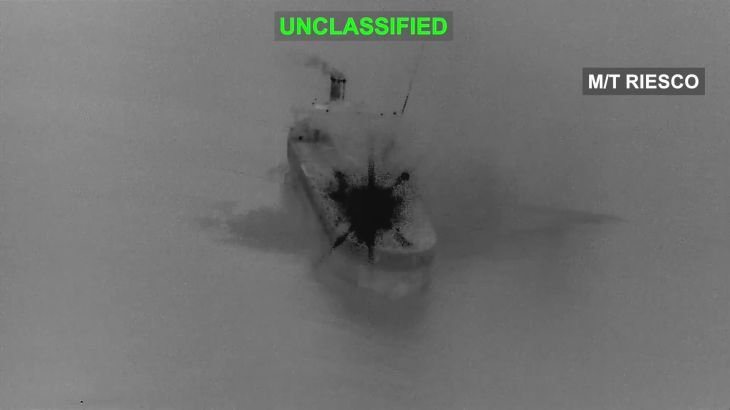
    A little after midnight in Iran, CENTCOM announced that its guided-missile destroyer, the USS Spruance, had fired its 5-inch (127 mm) MK 45 gun at the ship’s engine room and disabled it.

    According to the US military, the Touska was attempting to cross from the Arabian Sea through the Strait of Hormuz and was headed to the Iranian port of Bandar Abbas.

    Since April 13, the US military has enforced a naval blockade on the Strait of Hormuz, in response to Iran blocking the passage of most vessels through the narrow waterway — except ships belonging to nations that have struck deals with Tehran.

    Under its blockade, the US military is barring any ships belonging to Iran, or travelling to or from Iranian ports, from passing through the strait. In effect, this is blocking Iran’s own ships from exporting the country’s oil to other countries: According to Al Jazeera’s calculations, Iran earned nearly $5 billion in revenue from the export of oil in the month leading up to the US blockade.

    According to the CENTCOM, “American forces issued multiple warnings and informed the Iranian-flagged vessel [the Touska] it was in violation of the US blockade”.

    “After Touska’s crew failed to comply with repeated warnings over a six-hour period, Spruance directed the vessel to evacuate its engine room,” the CENTCOM statement said, before the American destroyer fired at the Iranian ship.

    Subsequently, US Marines from the 31st Marine Expeditionary Unit clambered onto the Touska, and captured the ship. In a grainy video released by CENTCOM, US troops can be seen flying from the USS Tripoli on helicopters, then using ropes to climb down to the Touska.

    What do we know about the Touska?

    The container ship flies under the Iranian flag. It is 294m (965 feet) long – only a little shorter than the US aircraft carrier USS Abraham Lincoln at 332.8m (1092 feet) long.

    The Touska is 32.25m (105.8 feet) wide.

    The vessel and its owners have been under sanctions issued by the US Treasury Department and the US Office of Foreign Assets Control. They are accused of helping Iran break sanctions.

    It is unclear what the Touska was carrying. Donald Trump posted on Truth Social that American troops are “seeing what’s on board”.

    What has Iran said about the ship capture?

    Early on Monday morning, Iran called the capture of the Touska an act of “piracy”.

    Hours later, Iranian Foreign Ministry Spokesperson Esmaeil Baghaei told reporters that Tehran had no plans to send its negotiators to Islamabad for a round of talks that Pakistan is trying to host as early as Tuesday. The US has said that its negotiators, Steve Witkoff and Jared Kushner, are going to Islamabad on Monday for talks.

    Baghaei accused the US of “violating the ceasefire” that has largely held between the US and Iran since April 9.

    “Iran does not trust Washington,” he said. Asked about the US negotiators expected to travel to Islamabad, the Iranian foreign ministry spokesperson said: “There are indications from the American side that there is no seriousness on the side of the US to walk down the path of diplomacy”.

    Separately, the Iranian military has said that it will hit back against the US for the ship’s seizure.

    “We warn that the armed ⁠forces of the Islamic ⁠Republic of Iran will ⁠soon respond and retaliate against this armed piracy by ‌the US military,” said a spokesperson for Khatam al-Anbiya, Iran’s joint military command.