UN Security Council draft resolution demanding Iran end its attacks on Gulf nations was cosponsored by 135 countries.
The United Nations Security Council adopted a draft resolution condemning Iran’s attacks on Gulf countries and Jordan, demanding that Tehran immediately halt hostilities.
Thirteen of the 15 members of the UNSC voted on Wednesday in favour of the resolution sponsored by the Gulf Cooperation Council (GCC) and cosponsored by an extraordinary 135 other UN member states.
Recommended Stories
list of 4 itemsend of list
No countries voted against the draft.
“It was overwhelming. It was 13 votes on the Council in favour, two abstentions,” Al Jazeera’s Gabriel Elizondo said, reporting from UN headquarters in New York.
“Both China and Russia abstained but notably decided not to use their veto power to block this resolution, probably because it got a lot of support, not only in the Security Council but with other member states – 135 other countries cosponsored this resolution that has now been adopted,” Elizondo said.
“We believe that this is the largest number of countries ever to cosponsor a Security Council draft resolution,” he said.
The resolution condemns Iran’s attacks, demands an immediate halt to hostilities, and deplores Tehran’s targeting of infrastructure such as ports and energy facilities in the Gulf region.
“The resolution is very clear; it is now part of international law. The question becomes, will Iran abide by it? We will find out in the coming hours and days,” Elizondo said.
‘Profound regret’
After the vote, Iran’s UN Ambassador Amir-Saeid Iravani addressed the Council, expressing his “profound regret” at the adoption of the resolution.
“This is a deeply regrettable day for the Security Council and for the international community. Today’s adoption is a serious setback to the Council’s credibility and leaves a lasting stain on its record,” Iravani said.
“Today’s action represents a blatant misuse of the Security Council mandate,” he said, blasting the United States for its “barbaric war against the Iranian people” and for starting the conflict, including killing Iran’s Supreme Leader Ali Khamenei.
“This resolution is a manifest injustice against my country, the main victim of a clear act of aggression. It distorts the realities on the ground and deliberately ignores the root causes of the current crisis,” Iravani said, accusing the US and Israel of being behind the resolution.
Iravani also said more than 1,348 civilians have been killed and more than 17,000 injured since the US and Israel launched their attack on February 28, including the “massacre of 170 schoolgirls in Minab”.
More than 19,000 civilian sites, including residential homes and hospitals, have also been damaged, he added.
Addressing the council, Russia’s ambassador to the UN, Vassily Nebenzia, said his country abstained from the vote on the draft resolution “because it was extremely unbalanced” and would not fulfil the purpose “of meeting international peace and security”.
“We regret the situation that Middle Eastern countries find themselves in. Moreover, we think it unacceptable to strike civilian infrastructure of Arab states in the Gulf,” Nebenzia said.
China’s ambassador to the UN Zhang Jun told the council that the conflict had “neither legitimacy nor legal basis” and the US and Israel must cease their attacks to prevent further deterioration of the regional situation.
The UNSC also voted, but failed to pass, a draft resolution put forward by Moscow on Wednesday that called on all sides to cease military action in the Middle East.
The 2026 edition of the FIFA World Cup kicks off in three months, but what was set to be one of the most straightforward editions to organise in the tournament’s history appears to be growing more complicated by the day.
The Israeli-United States war on Iran has created massive uncertainty across the globe, and FIFA’s showpiece event is already feeling the ramifications along with policy and political issues that were already rumbling in the Americas.
Recommended Stories
list of 4 itemsend of list
Al Jazeera Sport takes a look at the five issues the competition – cohosted by the US, Mexico and Canada – must resolve before the first match on June 11 between Mexico and South Africa.
Will Iran participate at FIFA World Cup 2026 in US?
Iran’s sports minister said on Wednesday that the country cannot participate in the FIFA World Cup after the US killed its supreme leader.
Ayatollah Ali Khamenei was assassinated on the first day of the US-Israel war, and all of its national football team’s World Cup group games are to be played in US cities.
The US and Israeli attacks began on February 28. So far, 1,255 people have been killed in Iran and more than 12,000 wounded.
Iran has hit back with strikes on Israel, US military bases in neighbouring Middle East states and infrastructure in the region.
“Considering that this corrupt regime [the US] has assassinated our leader, under no circumstances can we participate in the World Cup,” Sports Minister Ahmad Donyamali told state television.
The US flag flies near a football stadium at the Kino Sports Complex in Tucson, Arizona, where the Iranian national team is scheduled to practise for the World Cup [Rebecca Noble/Reuters]
Is the US willing to host Iran at World Cup in time of war?
US President Donald Trump would “welcome” Iran’s participation in the World Cup, according to FIFA President Gianni Infantino.
Before Iran’s announcement, Infantino took to Instagram on Wednesday to state that despite the war in the Middle East, Trump had reiterated his stance on Iran’s involvement during a meeting between the pair to discuss the upcoming tournament.
As the draw stands, the US and Iran could come head-to-head at the tournament if they both finish second in their respective groups. A July 3 elimination match in Dallas would be the outcome.
Meanwhile, if the US themselves refused to host the Iranian team, then FIFA could remove them as a World Cup host – a fate the Indonesia already befell.
As hosts of the men’s Under-20 World Cup three years ago, Indonesia refused to welcome Israel. FIFA dropped the tournament host just weeks before the scheduled first game and moved that competition to Argentina.
What is the latest on Iraq’s qualifications playoff match?
Iraq are facing major logistical issues as a result of the war before their March 31 qualifier for the World Cup.
The winner of Iraq’s intercontinental playoff against either Suriname or Bolivia will advance to the 2026 edition, but Iraqi airspace is closed until April 1 due to the war, and the squad is predominantly made up of players from the domestic league.
With the squad struggling to fully gather for the match, the head coach of the national team, Graham Arnold, asked FIFA on Monday to delay his team’s qualifier.
The match is due to be played in Monterrey, Mexico, and the host country issued some visas to Iraq’s players at their embassy in Qatar on March 8.
In a further complication, Mexico does not have an embassy in Iraq for the remaining players.
Mexico has issued an assurance to Iraq that it will “provide all necessary assistance in documenting the members of the Iraqi national team”.
Mexico violence raises questions over it hosting World Cup games
While the US and the rest of the world face complications related to the war on Iran, Mexico is facing its own internal issues.
A wave of violence was triggered in the country on February 23 after the killing of a drug lord who led one of the most powerful Mexican criminal organisations.
Gunmen torched cars and blocked highways in more than half a dozen states in the immediate aftermath of news of his killing.
The first match of the World Cup is being staged in Mexico City with a second on the same day in Guadalajara, which was rocked by last month’s violence.
Mexican officials thereafter sought to assure FIFA authorities and potential travellers that the tournament would be safe.
On Friday, President Claudia Sheinbaum said Mexico would deploy as many as 100,000 members of its security forces during the competition, assuring football fans that there was “no risk” in coming to the country.
Former Brazilian football player Jose Roberto Gama de Oliveira shakes hands with Mexican President Claudia Sheinbaum during the FIFA World Cup trophy tour [Reuters]
What are the FIFA World Cup 2026 ticketing issues?
Nearly 2 million tickets were sold in the first two sales phases for the 2026 edition, and demand was so intense that tickets were oversubscribed more than 30 times.
The most expensive tickets for the opening game are being advertised at almost $900 while for the final, that figure is more than $8,000
Tickets in general cost at least $200 for matches involving leading nations. The cheapest tickets for the final cost $2,000 and the best seats $8,680.
Then there is FIFA’s official resale site, where one category three seat for the final in New Jersey on July 19 was being advertised for an eye-watering $143,750, more than 41 times its original face value of $3,450.
Crude oil prices fall sharply as energy markets remain on tenterhooks over effective closure of the Strait of Hormuz.
Published On 11 Mar 202611 Mar 2026
Share
Oil prices are seeing dramatic swings as traders struggle to make sense of mixed messages about the impact of the United States and Israel’s war on Iran.
Brent crude, the international benchmark, on Tuesday plunged 17 percent to fall below $80 a barrel, then rebounded to near $90 after US Secretary of Energy Chris Wright posted on the X platform – but then quickly deleted – a claim that the US Navy had escorted an oil tanker through the Strait of Hormuz.
Recommended Stories
list of 4 itemsend of list
White House Press Secretary Karoline Leavitt later told reporters that there had been no armed escort through the strait, which has been effectively closed to shipping in the region due to Iranian threats.
Oil prices fell sharply again early on Wednesday after The Wall Street Journal reported that the International Energy Agency was considering the largest release of oil reserves in its history to help keep global supplies stable.
Brent crude futures were hovering below $85 a barrel as of 02:00 GMT following the news.
After rising as much as 50 percent to nearly $120 a barrel before falling, oil prices still remain about 17 percent higher than they were before the US and Israel launched joint strikes on Iran on February 28.
Global energy markets have been on tenterhooks amid the near halt of traffic through the Strait of Hormuz, through which about one-fifth of the global oil supply transits, as well as attacks on energy facilities across the Middle East.
The effective closure of the waterway has forced Saudi Arabia, the United Arab Emirates, Kuwait and Iraq to cut oil production amid a growing stock of barrels with nowhere to go and depleting storage capacity.
A cargo ship sails off the coast of the city of Fujairah, the UAE, on February 25, 2026 [Giuseppe Cacace/AFP]
Threat of Iranian sea mines
A sustained rise in oil prices would have serious knock-on effects for the global economy, pushing up the cost of everyday goods and dragging down growth.
According to an analysis by the International Monetary Fund, every 10 percent rise in oil prices corresponds with a 0.4 percent rise in inflation and a 0.15 percent reduction in economic growth.
US petroleum prices have risen about 17 percent since the start of the war, while authorities in South Korea, Thailand, Bangladesh and Pakistan have introduced measures such as price caps and rationing to keep costs down.
US President Donald Trump has repeatedly stated that the US Navy could be deployed to keep the strait open “if necessary”.
Some analysts have cast doubt on the feasibility of such plans due to the massive backlog of ships in the region and the threat of drone and missile attacks from nearby Iranian shores.
The US military said on Tuesday that it had attacked 16 Iranian mine-laying vessels near the strait after Trump had earlier warned Tehran against placing mines in the waterway.
Trump and administration officials have also given conflicting accounts of how long the war might last, exacerbating unease in energy markets.
On Tuesday, Trump said he expected the war to be over “very soon”, but he also said that US attacks on Iran would not stop “until the enemy is totally and decisively defeated”, and US forces had still not “won enough”.
“Analysts talk about geopolitical risk constantly, but most of the time, it remains hypothetical. What we saw this week was the market briefly treating that risk as real and repricing supply disruption in earnest,” Chad Norville, president of industry publication Rigzone, told Al Jazeera.
“At the same time, escorting a single tanker does not materially change the supply equation when well over a hundred vessels typically move through the strait each day. What the market is really trying to determine is whether the overall flow of oil can revert to normal operations,” Norville said.
Miami Heat player’s historic night is second behind the famous Wilt Chamberlain who scored 100 points back in 1962.
Published On 11 Mar 202611 Mar 2026
Share
Bam Adebayo produced the second-highest single-game scoring total in NBA history, putting up 83 points as hosts Miami Heat beat the Washington Wizards 150-129 on Tuesday night.
The 28-year-old centre scored 31 points in the first quarter en route to passing Kobe Bryant (81 points in 2006) for second place on the single-game list. Wilt Chamberlain’s 100-point outing has stood as the record since March 2, 1962.
Recommended Stories
list of 2 itemsend of list
Adebayo set Heat records for the highest-scoring game and the highest-scoring quarter. The old club mark for a game was 61 points, set in 2014 by LeBron James. Adebayo’s previous career best was 41 on January 23, 2021, against the Brooklyn Nets.
In 42 minutes on Tuesday, Adebayo shot 20-for-43 from the floor, 7-for-22 from 3-point range and 36-for-43 at the free-throw line. He also grabbed nine rebounds.
Abebayo set NBA single-game records for most free throws made and most free-throw attempts. Chamberlain and Adrian Dantley were the prior record-holders for made foul shots, with 28 each. Dwight Howard had the old mark for attempts of 39, which he reached twice.
The Heat earned their sixth straight win, matching their longest streak of the season. They improved to 22-11 at home.
Adebayo’s heroics were needed because Miami was without three of its top four scorers due to injuries: Tyler Herro (quadriceps), Norman Powell (groin) and Andrew Wiggins (toe). The Heat were also without Kel’el Ware (shoulder) and Nikola Jovic (back).
Washington has lost nine straight games, five short of its longest skid of the season. Alex Sarr led the Wizards with 28 points.
Wizards star Trae Young sat out due to injury management related to his right knee.
Adebayo shot 20-for-43 from the field in the history-making performance [Megan Briggs /Getty Images via AFP]
Adebayo, in his blistering-hot first quarter, shot 10-for-16 on field-goal attempts, 5-for-8 on 3-point tries and 6-of-7 on free-throw attempts.
Miami, which led 40-29 after the first quarter, stretched its advantage to 19 points in the second. However, the Wizards closed relatively well, going into halftime trailing 76-62.
Adebayo had 43 points in the first half, another Heat record. His first half came on 13-of-24 shooting overall, 5-of-11 success from beyond the arc and 12-of-14 accuracy at the free-throw line.
His shooting overshadowed Sarr, who had 23 points at halftime.
Adebayo scored 19 points in the third, giving Miami a 113-97 lead by the end of the quarter. He dunked with 22.2 seconds left in the third, giving him 62 points and breaking James’s record.
In the fourth quarter, with the victory assured, Miami kept Adebayo in the game, passing the ball to him on every possession as he hunted for records. His last two points came from the foul line with 1:16 to go as he surpassed Bryant.
Adebayo, right, celebrates with his Miami Heat teammates at Kaseya Center after the game [Megan Briggs/Getty Images via AFP]
A new report has expressed alarm at what it describes as backsliding press freedoms across the Americas, with the United States seeing the steepest decline.
The Inter American Press Association (IAPA) released its latest press freedom index on Tuesday, ranking last year as the lowest point for freedom of expression since the report began in 2020.
Recommended Stories
list of 3 itemsend of list
Researchers found that the Americas have experienced a “dramatic deterioration” in unrestricted speech, according to the report.
“This is one of the worst years for journalism in the region, marked by murders, arbitrary arrests, exile, and rampant impunity in countries such as Mexico, Honduras, Ecuador, Nicaragua, El Salvador, Guatemala, Colombia, Cuba, and Venezuela,” the report said.
It added that enhanced restrictions on free speech have occurred in countries of various ideological persuasions, whether right-wing or left-wing.
The US, however, was singled out as an area of “alarming decline”. In a ranking of 23 countries across the hemisphere, the US dropped from fourth place to 11th, indicating that journalists operate with increased restrictions.
Changes under President Donald Trump, who returned to office last year, were cited as a primary factor.
“Even though journalistic practice in the United States remains protected by the Constitution and laws, last year’s events saw the erosion of safeguards,” the report explained.
Trump, it said, had contributed to the “stigmatisation of critical journalism”. The report also pointed to developments like cuts to public media funding and the closure of Voice of America, a government-funded broadcaster, as detriments to the free press.
In total, the report tallied 170 attacks against journalists in the US last year, and it cited interactions with federal immigration agents as an area of concern.
The report also noted that Nicaragua and Venezuela continue to rank as “without freedom of expression”.
In Venezuela’s case, for instance, it cited the closure of more than 400 radio stations and the detention of 25 journalists in the wake of the controversial 2024 presidential election.
On a scale of 100, the report ranked press freedom in the country at 7.02. It remains in last place on the report’s list of 23 countries.
El Salvador also dropped in the index’s latest evaluation, now in 21st position on the press freedom list, just ahead of Nicaragua and Venezuela.
In an accompanying statement, Sergio Arauz, the president of the Association of Journalists of El Salvador (APES), denounced what he called the “escalating repression” under the government of President Nayib Bukele.
Arauz noted that 50 Salvadoran journalists had been pushed into exile in the last year amid a campaign of harassment by the government.
“There are no possibilities of practicing journalism fully without facing consequences when there is an Executive branch with virtually unlimited powers and no effective legal oversight,” said Arauz.
Since 2022, Bukele and his government have placed the country under a state of emergency that suspended key civil liberties and granted wide latitude to state security forces, in the name of addressing crime.
Tuesday’s report pointed to the state of emergency as a factor in undermining free speech, and also cited El Salvador’s new Foreign Agents Law, which gives the government the power to dissolve organisations that receive funding from abroad.
El Salvador is one of eight nations categorised in the index as “high restriction”, along with Ecuador, Bolivia, Honduras, Peru, Mexico, Haiti and Cuba.
The Dominican Republic, Chile, Canada and Brazil were ranked among the highest for protecting press freedoms.
For the first time since Russia’s 2022 invasion of Ukraine, the price of oil skyrocketed past $100 per barrel this week, driven by ongoing energy uncertainty after the United States and Israel’s war on Iran began on February 28.
About 20 percent of the world’s oil comes from the Gulf region, and most of it is shipped on massive tankers through the Strait of Hormuz. This narrow waterway, located between Iran and Oman, is only 21 nautical miles (39km) wide at its narrowest point.
More than 20 million barrels transit through the strait per day, which is one-fifth of global petroleum consumption and accounts for one-quarter of all oil traded by sea.
(Al Jazeera)
According to the US Energy Information Administration (EIA), more than three-quarters of the world’s oil supply (79.8 million barrels per day) travels by sea, funnelled through a handful of critical chokepoints with no easy transit alternatives.
Why are oil prices surging?
Since the Iran war began, marine traffic through the Strait of Hormuz has nearly ground to a halt. Attacks on vessels and interference with navigation equipment have pushed most operators to anchor their ships at the waterway’s edge rather than risk the crossing.
Without the flow of this oil, global supply chains are severely disrupted. With a limited supply and rising demand, prices are likely to increase, putting pressure on consumers and businesses.
While prices briefly dipped on Monday after US President Donald Trump said, “The war is very complete, pretty much,” analysts warned that high prices could persist if no agreement is reached between Washington, Tel Aviv and Tehran to stop the war.
“It’s all about risk,” Ismayil Jabiyev, supply chain analyst at CarbonChain, told Al Jazeera.
“Think about the Strait of Hormuz and cheap drones. It’s not a physical blockage – Iran hasn’t built a wall across the sea. Cheap drones will always pose a risk, even if all the launch sites are destroyed because hidden drone launches could continue for months. As long as hostilities continue, the disruption is likely to persist. I don’t see any real progress or resolution on the horizon,” Jabiyev added.
Which countries rely most on Middle Eastern oil?
About 89 percent of the oil that flows through the Strait of Hormuz is bound for Asian markets with China, India, Japan and South Korea the top buyers.
If traffic remains restricted, Gulf exporters will be forced to seek alternative routes, but options are limited with Saudi Aramco’s East-West Crude Oil Pipeline and the United Arab Emirates’s Abu Dhabi Crude Oil Pipeline (Habshan-Fujairah pipeline) offering a capacity of about 4.7 million barrels per day (bpd).
The Saudi pipeline runs from eastern oilfields to the port of Yanbu on the Red Sea, one of the few arteries that bypasses the strait entirely. However, of the 7.2 million bpd that Saudi Arabia exported in February, 6.38 million bpd relied on passage through the strait, according to Kpler, a global trade data and analytics firm.
(Al Jazeera)
Gavekal Research, an independent macroeconomic research firm, estimated that Gulf exporters, including Iran, could reroute at most an additional 3.5 million bpd to terminals outside the strait. But as long as the bulk of tanker traffic remains suspended, the world would still be facing a sudden supply shortfall of about 15 million bpd.
“I’m somewhat sceptical about those alternatives. Yes, the East-West pipeline and the Fujairah pipeline exist, but capacity-wise, they don’t come close to the main route.” Jabiyev told Al Jazeera.
“There’s also the Kirkuk-Ceyhan pipeline from Iraq’s northern provinces to Turkiye, but that’s limited to northern field production. The major Iraqi output comes from the southern fields, so again, it’s a partial replacement, not a full one.”
What is the highest oil price ever recorded?
Oil prices rose to their highest levels during the global financial crisis. On July 11, 2008, Brent crude, the European benchmark, hit $147.50 per barrel while West Texas intermediate crude, the US benchmark, hit a peak of $147.27. That spike was driven by a mix of a weakening US dollar and a massive influx of speculative money rather than a physical disruption to supply.
Throughout history, there have been a handful of energy market shocks when oil supplies were actually threatened, most notably the 1973 oil embargo, the Iran-Iraq War in the 1980s, the 1990-1991 Gulf War, the 2003 US-led invasion of Iraq and the 2022 Russian invasion of Ukraine.
(Al Jazeera)
“I think the Gulf War of 1990-91 is the most instructive comparison. Iraq and Kuwait together represented two major producers, and the disruption was serious and prolonged – lasting roughly half a year or more, even though the military phase was fairly brief,” Jabiyev told Al Jazeera.
“The world experienced high crude oil prices for an extended period and eventually faced some economic slowdown as a result. That makes it most analogous to our current situation: a likely long-term disruption, sustained high prices and a meaningful risk of economic slowdown. The key variable, as in 1990, was how quickly the affected countries could restore their production infrastructure and bring supply back online.”
How does crude oil become petrol?
Crude oil is a yellowish-black fossil fuel pumped from the ground and refined into fuels like petrol, diesel and jet fuel. The refining process also produces numerous household items.
Oil is graded by thickness and sulphur content. Light, sweet crude is low in sulphur and easy to refine and thus more valuable. After extraction, crude oil is sent to refineries where heat separates it into products. Lighter fuels form at lower temperatures while heavier products, such as asphalt, require much higher heat.
A barrel contains 159 litres, or 42 gallons, of crude oil. Once refined, a barrel typically produces about 73 litres, or 19.35 gallons, of petrol to power cars and trucks.
(Al Jazeera)
What products are made from oil and gas?
Oil and gas are used for far more than just fuel. They are raw materials for thousands of everyday products.
Plastics, including water bottles, food packaging, phone casings and medical syringes, are all derived from crude oil.
Crude oil is also the hidden ingredient in synthetic fabrics, such as polyester, nylon and acrylic, which is in everything from sportswear to carpets. It also underpins the cosmetics industry in products that include petroleum jelly, lipsticks and concealers.
Household items also rely on oil-based ingredients with laundry detergents, dishwashing liquids and paints all derived from petroleum products.
The global food supply is essentially built on natural gas in the form of fertilisers, used to enhance crop yields and ensure that food production can meet demand.
(Al Jazeera)
How high oil costs drive up the price of food
Oil prices and food prices move in lockstep with energy prices affecting every stage of the food supply chain from the fertilisers used in the fields to the trucks that carry food from the fields to supermarket shelves.
Rising oil prices directly affect shipping and the cost of transportation.
“The lifeblood of the global economy is transport,” economist David McWilliams told Al Jazeera. “It’s getting stuff from A to B. It’s a logistics problem, a supply chain problem, and ultimately, transportation is the energy of the global economy.”
Fears of stagflation – rising inflation and rising unemployment, which major oil shocks have historically summoned – are rising. Economists pointed to the crises of 1973, 1978 and 2008 as evidence that every significant spike in oil prices has been followed, in some form, by a global recession.
In lower-income countries, where populations spend a far greater share of their income on food and import large quantities of grain and fertiliser, rising oil prices could rapidly translate into food shortages.
United States President Donald Trump has said he is “thinking about taking over” the Strait of Hormuz so that it remains open. The strait links the Gulf to the Gulf of Oman. It is the only route to the open ocean for oil producers in the Gulf.
The war in Iran entered its 11th day on Tuesday, as attacks continue on Iran as well as on Israel and US assets in the Middle East, including in Bahrain, Kuwait, the United Arab Emirates and Saudi Arabia.
The war has sent oil prices soaring. As well as attacking US military assets and infrastructure in Middle East countries in retaliation against the US-Israeli campaign, Iran has threatened to attack ships traversing through the Strait of Hormuz, putting the route at severe risk for about one-fifth of the world’s oil supply.
Why has the price of oil soared?
One major reason is the closure of the Strait of Hormuz.
Ebrahim Jabari, a senior adviser to the commander-in-chief of Iran’s Revolutionary Guard Corps (IRGC), said on March 2: “The strait is closed. If anyone tries to pass, the heroes of the Revolutionary Guard and the regular navy will set those ships ablaze.
“We will also attack oil pipelines and will not allow a single drop of oil to leave the region. Oil price will reach $200 in the coming days,” Jabari wrote in a post on the IRGC’s Telegram channel.
As a result, oil prices had shot up by more than 30 percent by Sunday, when the international benchmark Brent crude at one point topped $119 a barrel. The price of crude has since seen a decline, but remains above the price it was before the war began on February 28. On Tuesday, it was hovering around $93 a barrel.
(Al Jazeera)
Placing further pressure on fuel prices, Qatar’s state-run energy firm and the world’s largest producer of LNG, QatarEnergy, halted LNG production last week following Iranian attacks on its operational facilities in Ras Laffan and Mesaieed in Qatar.
Saudi Arabia shut down operations at the Ras Tanura plant, its largest domestic oil refinery, which is operated by Saudi Aramco, after a fire broke out at the facility, which officials said was caused by debris from the interception of two Iranian drones.
Iranian officials have publicly denied attacking QatarEnergy or Aramco.
The volatility in energy markets caused by the war on Iran will worsen over time, members of the industry have warned.
“There would be catastrophic consequences for the world’s oil markets, and the longer the disruption goes on, the more drastic the consequences for the global economy,” Aramco CEO Amin Nasser told reporters on Tuesday.
(Al Jazeera)
What has Trump said about the Strait of Hormuz?
During an interview with CBS News on Monday, Trump said he was “thinking about taking over” the Strait of Hormuz to ensure it remains open.
Trump also threatened to increase attacks on Iran if it disrupts the flow of oil in the Hormuz Strait.
“If Iran does anything that stops the flow of Oil within the Strait of Hormuz, they will be hit by the United States of America TWENTY TIMES HARDER than they have been hit thus far,” Trump said during a news conference in Florida on Monday.
“I will not allow a terrorist regime to hold the world hostage and attempt to stop the globe’s oil supply. And if Iran does anything to do that, they’ll get hit at a much, much harder level.”
Trump also said he expects the war to be over in a short amount of time.
Earlier on Monday, Trump told Republicans at his golf club in Doral, Florida: “We took a little excursion because we felt we had to do that to get rid of some people. We’ve already won in many ways, but we haven’t won enough.”
Earlier, Trump said that the war, which began on February 28, could last “four to five weeks” and that the US military had the “capability to go far longer than that”.
Can the US occupy the Strait of Hormuz?
During his CBS interview, Trump did not explain what the US plans for “taking over” the Strait would be. Technically, the US cannot “occupy” the strait, however.
Alexander Freeman, a partner in the shipping team at UK-based law firm Hill Dickinson, said: “The United States has no jurisdiction over the Strait of Hormuz, which are not international waters under UNCLOS [the United Nations Convention on the Law of the Sea]. Without the consent of Iran and Oman – whose sovereign territorial waters cover the Strait – the US taking over the Strait would likely amount to an incursion on Iran and Oman’s jurisdiction – even where it is aimed to protect the safe passage of vessels.”
In the absence of a ceasefire and the reopening of the strait, however, it is possible that ships could be escorted through the strait by US or international navies.
During an interview last week, Trump said the US Navy would escort ships in the waterway “if necessary… as soon as possible”.
In Florida, on Monday, Trump reiterated this, saying: “We’ll perhaps go alongside them for protection.”
Speaking in Cyprus on Monday, French President Emmanuel Macron said France and its allies are also preparing a “purely defensive” mission to escort vessels through the Strait of Hormuz once the “most intense phase” of the US-Israeli war on Iran ends.
Macron did not provide further details, but he said the “purely escort mission” must be prepared by both European and non-European countries.
How has Iran responded, and what is its strategy?
Iranian leaders have not shown any signs of backing down over the war or the closure of the Strait of Hormuz.
The country’s Foreign Minister Abbas Araghchi said on Tuesday that Iran would keep fighting for as long as necessary.
In an interview with CNN, Kamal Kharazi, foreign policy adviser to the office of the supreme leader, ruled out diplomacy and said the war would continue.
“I don’t see any room for diplomacy any more. Because Donald Trump had been deceiving others and not keeping with his promises, and we experienced this in two times of negotiations – that while we were engaged in negotiation, they struck us,” Kharazi said.
He suggested that Gulf and other countries need to place economic pressure on the US and Israel to end the war in Iran for diplomacy to be back on the table.
Rob Geist Pinfold, a lecturer in international security at King’s College London, told Al Jazeera that Iran has been engaging in a “completely different approach to war fighting” than in the past, when it seemed to opt for slow and steady escalation.
Pinfold said Iran’s claim that it is attacking only US assets in the Gulf “has to be taken with far more than a pinch of salt”. Iran’s targets are primarily large-scale infrastructure and civilian ones, he added.
“What they’re doing now is trying to unleash as much chaos as possible to destabilise the region and global markets, hurt the economy, hurt the GCC states, in order that the US will at some point decide that this conflict is no longer worth its while any more and will push for a ceasefire.”
What could happen next?
Scott Lucas, a professor of US and international politics at University College Dublin, told Al Jazeera that if the domestic situation worsens for Trump, there may be an opening for the Gulf states to ask for a pullback.
Lucas added that this would be “especially true” if there is another surge in the price of oil in the coming days.
With the US mid-term elections approaching in November, the domestic pressure on the Trump administration to halt the war on Iran could build up.
For the first time since Russia’s 2022 invasion of Ukraine, the price of oil skyrocketed past $100 per barrel this week, driven by ongoing energy uncertainty after the United States and Israel’s war on Iran began on February 28.
About 20 percent of the world’s oil comes from the Gulf region, and most of it is shipped on massive tankers through the Strait of Hormuz. This narrow waterway, located between Iran and Oman, is only 21 nautical miles (39km) wide at its narrowest point.
More than 20 million barrels transit through the strait per day, which is one-fifth of global petroleum consumption and accounts for one-quarter of all oil traded by sea.
(Al Jazeera)
According to the US Energy Information Administration (EIA), more than three-quarters of the world’s oil supply (79.8 million barrels per day) travels by sea, funnelled through a handful of critical chokepoints with no easy transit alternatives.
Why are oil prices surging?
Since the Iran war began, marine traffic through the Strait of Hormuz has nearly ground to a halt. Attacks on vessels and interference with navigation equipment have pushed most operators to anchor their ships at the waterway’s edge rather than risk the crossing.
Without the flow of this oil, global supply chains are severely disrupted. With a limited supply and rising demand, prices are likely to increase, putting pressure on consumers and businesses.
While prices briefly dipped on Monday after US President Donald Trump said, “The war is very complete, pretty much,” analysts warned that high prices could persist if no agreement is reached between Washington, Tel Aviv and Tehran to stop the war.
“It’s all about risk,” Ismayil Jabiyev, supply chain analyst at CarbonChain, told Al Jazeera.
“Think about the Strait of Hormuz and cheap drones. It’s not a physical blockage – Iran hasn’t built a wall across the sea. Cheap drones will always pose a risk, even if all the launch sites are destroyed because hidden drone launches could continue for months. As long as hostilities continue, the disruption is likely to persist. I don’t see any real progress or resolution on the horizon,” Jabiyev added.
Which countries rely most on Middle Eastern oil?
About 89 percent of the oil that flows through the Strait of Hormuz is bound for Asian markets with China, India, Japan and South Korea the top buyers.
If traffic remains restricted, Gulf exporters will be forced to seek alternative routes, but options are limited with Saudi Aramco’s East-West Crude Oil Pipeline and the United Arab Emirates’s Abu Dhabi Crude Oil Pipeline (Habshan-Fujairah pipeline) offering a capacity of about 4.7 million barrels per day (bpd).
The Saudi pipeline runs from eastern oilfields to the port of Yanbu on the Red Sea, one of the few arteries that bypasses the strait entirely. However, of the 7.2 million bpd that Saudi Arabia exported in February, 6.38 million bpd relied on passage through the strait, according to Kpler, a global trade data and analytics firm.
Gavekal Research, an independent macroeconomic research firm, estimated that Gulf exporters, including Iran, could reroute at most an additional 3.5 million bpd to terminals outside the strait. But as long as the bulk of tanker traffic remains suspended, the world would still be facing a sudden supply shortfall of about 15 million bpd.
“I’m somewhat sceptical about those alternatives. Yes, the East-West pipeline and the Fujairah pipeline exist, but capacity-wise, they don’t come close to the main route.” Jabiyev told Al Jazeera.
“There’s also the Kirkuk-Ceyhan pipeline from Iraq’s northern provinces to Turkiye, but that’s limited to northern field production. The major Iraqi output comes from the southern fields, so again, it’s a partial replacement, not a full one.”
What is the highest oil price ever recorded?
Oil prices rose to their highest levels during the global financial crisis. On July 11, 2008, Brent crude, the European benchmark, hit $147.50 per barrel while West Texas intermediate crude, the US benchmark, hit a peak of $147.27. That spike was driven by a mix of a weakening US dollar and a massive influx of speculative money rather than a physical disruption to supply.
Throughout history, there have been a handful of energy market shocks when oil supplies were actually threatened, most notably the 1973 oil embargo, the Iran-Iraq War in the 1980s, the 1990-1991 Gulf War, the 2003 US-led invasion of Iraq and the 2022 Russian invasion of Ukraine.
(Al Jazeera)
“I think the Gulf War of 1990-91 is the most instructive comparison. Iraq and Kuwait together represented two major producers, and the disruption was serious and prolonged – lasting roughly half a year or more, even though the military phase was fairly brief,” Jabiyev told Al Jazeera.
“The world experienced high crude oil prices for an extended period and eventually faced some economic slowdown as a result. That makes it most analogous to our current situation: a likely long-term disruption, sustained high prices and a meaningful risk of economic slowdown. The key variable, as in 1990, was how quickly the affected countries could restore their production infrastructure and bring supply back online.”
How does crude oil become petrol?
Crude oil is a yellowish-black fossil fuel pumped from the ground and refined into fuels like petrol, diesel and jet fuel. The refining process also produces numerous household items.
Oil is graded by thickness and sulphur content. Light, sweet crude is low in sulphur and easy to refine and thus more valuable. After extraction, crude oil is sent to refineries where heat separates it into products. Lighter fuels form at lower temperatures while heavier products, such as asphalt, require much higher heat.
A barrel contains 159 litres, or 42 gallons, of crude oil. Once refined, a barrel typically produces about 73 litres, or 19.35 gallons, of petrol to power cars and trucks.
(Al Jazeera)
What products are made from oil and gas?
Oil and gas are used for far more than just fuel. They are raw materials for thousands of everyday products.
Plastics, including water bottles, food packaging, phone casings and medical syringes, are all derived from crude oil.
Crude oil is also the hidden ingredient in synthetic fabrics, such as polyester, nylon and acrylic, which is in everything from sportswear to carpets. It also underpins the cosmetics industry in products that include petroleum jelly, lipsticks and concealers.
Household items also rely on oil-based ingredients with laundry detergents, dishwashing liquids and paints all derived from petroleum products.
The global food supply is essentially built on natural gas in the form of fertilisers, used to enhance crop yields and ensure that food production can meet demand.
(Al Jazeera)
How high oil costs drive up the price of food
Oil prices and food prices move in lockstep with energy prices affecting every stage of the food supply chain from the fertilisers used in the fields to the trucks that carry food from the fields to supermarket shelves.
Rising oil prices directly affect shipping and the cost of transportation.
“The lifeblood of the global economy is transport,” economist David McWilliams told Al Jazeera. “It’s getting stuff from A to B. It’s a logistics problem, a supply chain problem, and ultimately, transportation is the energy of the global economy.”
Fears of stagflation – rising inflation and rising unemployment, which major oil shocks have historically summoned – are rising. Economists pointed to the crises of 1973, 1978 and 2008 as evidence that every significant spike in oil prices has been followed, in some form, by a global recession.
In lower-income countries, where populations spend a far greater share of their income on food and import large quantities of grain and fertiliser, rising oil prices could rapidly translate into food shortages.
US prosecutors say Turkish assistance in negotiating ceasefire and release of captives in Gaza contributed to settlement.
Published On 10 Mar 202610 Mar 2026
Share
The United States has tentatively agreed to drop a criminal case accusing Turkiye’s state-run Halkbank of participating in a multibillion-dollar scheme to evade sanctions against Iran.
In a document filed with the US District Court for the Southern District of New York on Monday, prosecutors said resolving the case would be in the “best interests” of the US government, a move that would end a years-long prosecution that has strained relations between Washington and Ankara.
Recommended Stories
list of 4 itemsend of list
Prosecutors said “unique and extraordinary national security and foreign policy considerations” contributed to the settlement, including Turkiye’s assistance in securing October’s ceasefire deal between Israel and Hamas and the release of Israeli captives held in Gaza.
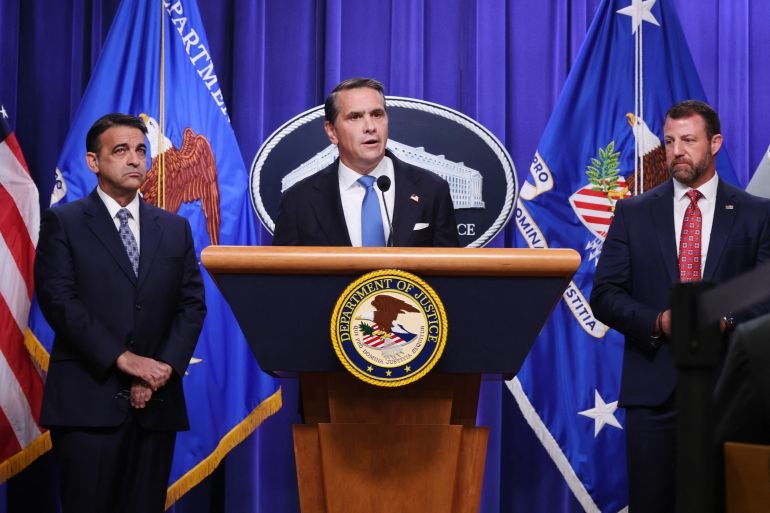
“This unique and substantial public interest in supporting the release of the hostages weighed heavily in the government’s assessment of the appropriate resolution of this case,” the US Department of Justice said in the filing.
Halkbank will engage a mutually agreed-upon third party to review the lender’s sanctions and anti-money laundering compliance as part of the deal, the Justice Department said.
The bank will also refrain from “conducting or facilitating” any transactions with the Iranian government, Iranian people or Iranian entities that involve US people or financial institutions during the period of the agreement, according to prosecutors.
“This agreement by Halkbank furthers the United States’ compelling interests in combating terrorist financing and financial support for the Government of Iran,” prosecutors said.
Halkbank, which has its headquarters in Istanbul, said it had not admitted to criminal wrongdoing and would not pay any penalties under the settlement, which requires the sign-off of a judge.
“This development is expected to positively impact our bank’s financial structure by expanding its foreign funding opportunities, correspondent network, and access to international markets,” the bank said in a statement posted on its website.
Halkbank’s Istanbul-listed shares on Monday rose 10 percent.
Turkiye had vigorously protested against the US case, with President Recep Tayyip Erdogan calling the original 2019 indictment “ugly” and “unlawful”.
US prosecutors had accused Halkbank of secretly transferring $20bn in Iranian funds in violation of Washington’s sanctions on Tehran.
Halkbank, which denied wrongdoing, had argued that it was protected from prosecution by sovereign immunity, taking its case all the way to the US Supreme Court, which rejected the lender’s appeal in October.
The US president repeats claims that Cuba is ready to negotiate as it faces a spiralling energy and economic crisis.
Published On 10 Mar 202610 Mar 2026
Share
United States President Donald Trump has signalled that his administration is still pursuing a government overthrow in Cuba even as the US-Israeli war on Iran enters its second week.
Trump said on Monday that the US Department of State is still focused on Cuba, where plans by the White House may or may not include “a friendly takeover” of the island, according to the Reuters news agency.
Recommended Stories
list of 4 itemsend of list
US Secretary of State Marco Rubio is “dealing” with Cuba, the president told reporters in Florida.
“He’s dealing [with it], and it may be a friendly takeover, it may not be a friendly takeover. Wouldn’t really matter because they’re really down to … as they say, fumes. They have no energy, they have no money,” Trump said.
“They are going to make either a deal or we’ll do it just as easy, anyway,” he said.
Cuba has been grappling with an energy crisis since January, when US forces abducted Venezuelan President Nicolas Maduro and halted fuel exports from Caracas to Havana, cutting the country off from one of its few allies and a key source of oil for the Cuban economy.
White House officials have suggested that Cuba is facing an economic collapse and that its government is ready to negotiate with Washington.
Trump has said on multiple occasions that Cuba’s government is ready to “fall” and that its leaders want to “make a deal” with Washington, according to NBC News.
Cuba has denied reports of high-level talks, according to Reuters, but it has not “outright” denied US media reports of “informal talks” between Raul Guillermo Rodriguez Castro, the grandson of former Cuban President Raul Castro, and US officials.
Cuba has been in the crosshairs of the US for decades, but Trump is the first US president since the Cold War to openly discuss and pursue a government change in Havana.
Trump’s attacks on Venezuela and Cuba are in line with his revival of the “Monroe Doctrine”, a 19th-century policy that states the Western Hemisphere should be solely under the sway of the US and no other foreign power.
Trump first raised the notion of a “friendly takeover” of Cuba in February.