A cat memecoin on Solana has paid its holders nearly $3 million worth of zcash as a rally in both tokens turned an unusual reward mechanism into a substantial payout.
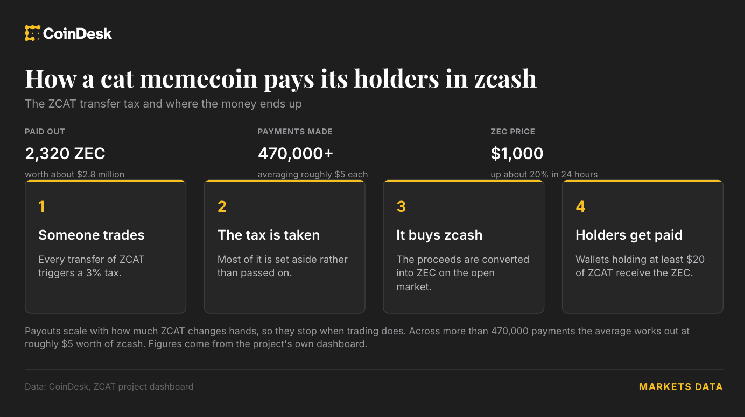
Anonymous Cat, or ZCAT, charges a 3% tax whenever the token is transferred. Most of that money is converted into zcash ($ZEC) and distributed to wallets holding at least $20 worth of ZCAT, according to the project’s dashboard.
Because $ZEC prices have recently surged, rewards paid to CAT holders have gone through the roof. About 2,320 $ZEC, worth roughly $2.8 million as of Monday morning in Asia, has been distributed across more than 470,000 payouts, the data show.
Note that the $ZEC rewards come from other people buying, selling, and transferring ZCAT, not from a business or investment that produces income. So if trading dries up, the payouts will be vastly reduced.
$ZEC has gained more than 2,300% over the past year and passed $1,200 late Sunday amid renewed demand for privacy-focused cryptocurrencies. Zcash allows users to hide details, including the sender, receiver, and amount of a transaction — making it the most direct way to bet on the privacy sector returning as a key narrative among crypto traders.
Router Protocol, a cross-chain infrastructure project backed by Coinbase, announced it will completely cease operations by September 30. The project team stated that attempts to commercialize their products, secure a sustainable position in the highly competitive blockchain bridging sector, or find a buyer had been unsuccessful.
Router Protocol announced its decision to shut down after more than four years of development via a statement on X. The team stated that they had spent the last year conducting commercialization, licensing, and acquisition talks, but were unable to create a model that would allow them to continue operations.
The company stated that key issues include the shift of capital from the crypto market towards the AI sector and the decrease in asset transfer fees between blockchains. It also noted a decline in demand for router services as activity becomes more concentrated on fewer networks and standardized infrastructures.
As part of its closing strategy, Router plans to permanently burn 303,333,198 ROUTE tokens held in its treasury. This amount represents approximately 30% of the total supply of about 1 billion tokens. The project will also work with centralized exchanges to end support for ROUTE.
Router announced that no new ROUTE programs will be launched and that it will remain independent of any market or liquidity pools created after the delisting process. However, the team will open-source some components so that developers can use the work done over the past four years.
Router had raised $4.1 million in funding in 2021 from investors such as Coinbase Ventures and Polygon. The project, which launched its own Layer 1 network, Router Chain, in July 2024, decided to shut down this network in September 2025 due to infrastructure costs, security risks, and validator inflation.
The team also revealed that two security incidents occurred in 2025, and in one of them, 80% of the lost value was recovered.
Ethereum founder Vitalik Buterin has countered assessments that long-term advancements in artificial intelligence and security technologies could compromise Bitcoin’s security system, leading to a price drop of more than 50% in $BTC. Buterin stated that the Bitcoin network’s fundamental security mechanisms are significantly resilient to such threats.
According to Buterin, potential attacks on Bitcoin’s network layer can be addressed by updating client software and mining pools. Therefore, the network’s current structure is not expected to become completely vulnerable to technological advancements.
Ethereum founder Buterin also stated that the likelihood of Bitcoin’s hash function or Proof-of-Work (PoW) mechanism being seriously compromised is extremely low. He noted that these systems form the basis of Bitcoin’s security model and argued that these mechanisms will continue to play a crucial role in protecting the network in the future.
Buterin specifically stated that he did not agree with the view that artificial intelligence could significantly weaken Bitcoin’s security, leading to a more than 50% drop in the $BTC price over the next two years.
The recent rapid advancements in artificial intelligence have sparked debate about their potential impact on the security of cryptocurrency networks, with some assessments suggesting that advanced AI systems could pose risks to cryptographic security mechanisms.
However, Buterin’s statements suggest that it is unlikely these risks will reach a level that threatens Bitcoin’s fundamental security structure in the short term. According to him, while software and infrastructure updates can be made to counter potential attacks, the complete failure of Bitcoin’s hash function and PoW system is considered highly improbable.
FOMO Cracks Top 5 US Finance Charts, Passes Kalshi and Cash App
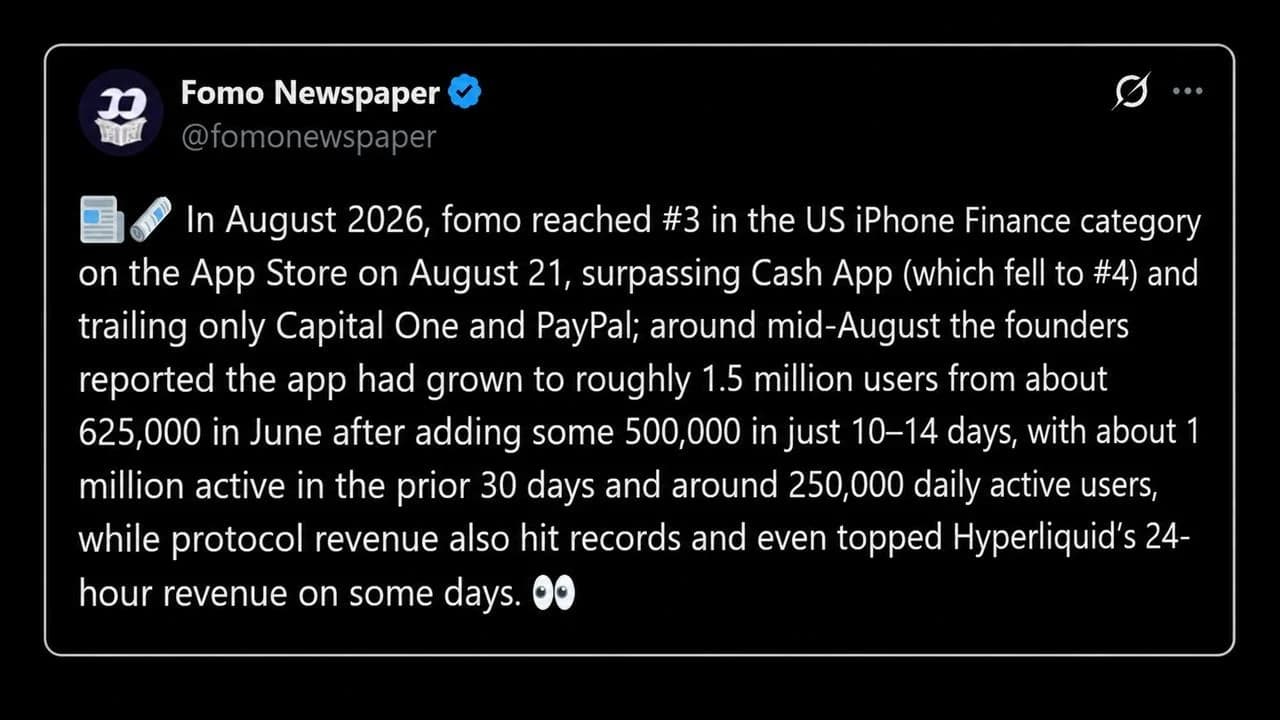
Fomo, the social crypto trading app built for Robinhood Chain and other networks, has climbed into the top five U.S. finance apps on Apple’s App Store…
Editor’s comment:
While it may be the epitome of extractiveness and a PVP-style arena, it looks like Fomo has found product market fit in the memecoin/social trading space. This is something that several other well funded companies failed to achieve in the past. Whether the money from the fomo arena flows out to raise other boats remains to be seen.
Grayscale Sees Crypto Opportunity as Stock Concentration Soars
Grayscale says record U.S. household equity exposure and demanding stock valuations strengthen the case for crypto diversification.
Editor’s comment:
While a “rotation” from equities into crypto has been predicted many times and failed to come true, it’s worth noting that there has been a significant decoupling of Bitcoin from the Nasdaq. It could perhaps be the beginning of a longer trend.
CLARITY Act Odds Stay Buried as Senate Showdown Closes In
As August comes to a close, the CLARITY Act is barreling toward a critical Sept. 15 Senate test with prediction marketplace odds flashing serious doubt…
Editor’s comment:We’re at the stage of the cycle where bad news has little effect on BTC, and good news sends price flying. With the failure of CLARITY likely mostly priced in and accepted by most, it may not even move the needle on Bitcoin, but a surprise passing on September 15th could be a significant catalyst.
153 Million Driver’s License Leak Sparks Explosive KYC Backlash
This week, the crypto community is discussing how cybersecurity experts from Krebs on Security’s researcher and journalist Brian Krebs, have discovered…
Editor’s comment:As if the privacy narrative couldn’t get any stronger, half the country’s drivers licenses are now for sale on the dark web. As this news emerges, ZEC is in price discovery, currently up 87% in the last 30 days.
US Operation Economic Outcast Targets Global Financial Lifelines
Operation Economic Outcast is preparing to expand its banking offensive, with Treasury Secretary Scott Bessent saying the U.S. plans to sanction another bank.
Editor’s comment:Sanctions, seizing, freezing… Take your pick. All of it is increasing and all of it strengthens the selling point for Bitcoin and crypto assets. While we don’t want to live in a world where these things happen more frequently, crypto bulls stand to benefit.
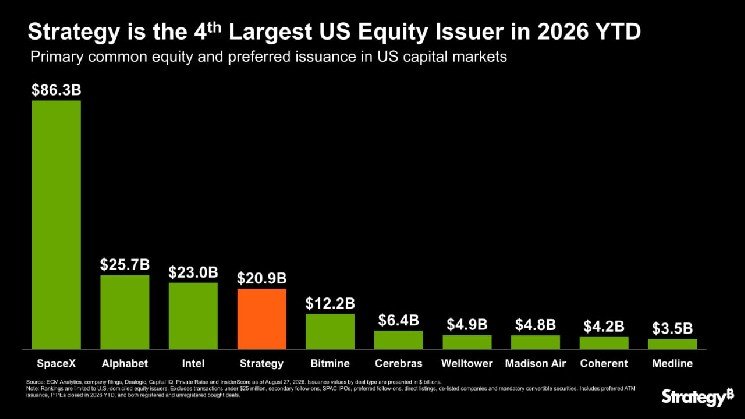
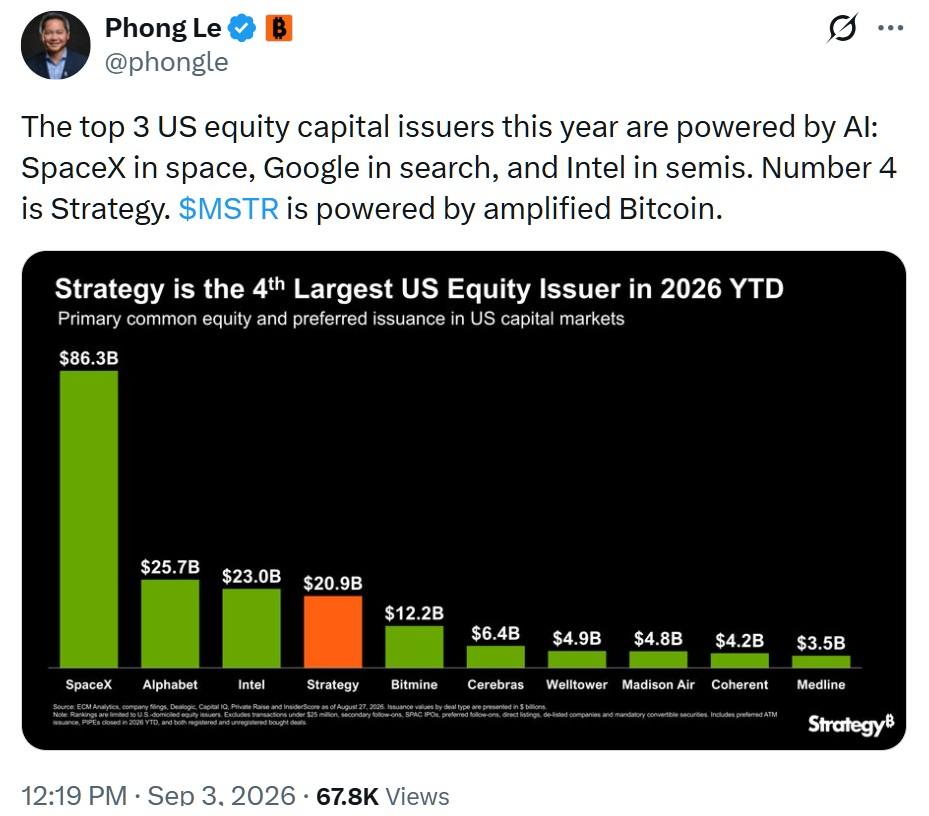
Strategy Inc. (Nasdaq: MSTR) joined some of America’s largest technology companies near the top of the equity capital market after issuing $20.9 billion this year, according to a chart CEO Phong Le posted Sept. 3 on X. The ranking reinforces the company’s goal of using bitcoin, digital credit, and equity to expand its balance sheet. The graphic cited ECM Analytics, Dealogic, Capital IQ, and company filings among its sources.
Le’s chart placed SpaceX first at $86.3 billion, Alphabet, Google’s parent company, second at $25.7 billion, and Intel third at $23 billion. SpaceX separately reported that its June initial public offering generated about $85.7 billion in net proceeds after underwriting commissions and offering costs, accounting for nearly all of its charted total.
How Strategy Raised and Used the Capital
Strategy’s position reflects repeated sales of MSTR common shares and several preferred stocks rather than one large offering. Its latest Form 8-K filed with the Securities and Exchange Commission showed $602.8 million in net MSTR proceeds from Aug. 24 through Aug. 30, demonstrating how its at-the-market program raises capital in smaller installments.
The company put $369.7 million of the Aug. 24-30 proceeds into bitcoin, $151.8 million into repurchases of Stretch preferred stock, $50.7 million into Stretch dividends, and $30.0 million into its dollar liquidity account. It ended that period with $5.10 billion in its dollar reserve and $1.61 billion in additional cash.
Those weekly proceeds illustrate the company’s broader practice of issuing securities when management considers market conditions favorable. Strategy’s Digital Credit Capital Framework allows management to shift between issuance and repurchases while maintaining a dollar reserve for preferred dividends and debt interest and preserving bitcoin as its primary treasury asset.
The $20.9 billion figure combines primary common equity and preferred issuance, according to the chart Le posted. Strategy now offers MSTR and five preferred securities tied to one corporate capital structure, although none gives shareholders direct ownership of its bitcoin. Their dividend terms, seniority, conversion rights, and exposure to the company’s finances differ.
Bitcoin Strategy Creates Opportunity and Risk
Equity issuance has supplied cash for bitcoin purchases, dividends, liquidity, and preferred-stock repurchases, giving Strategy several ways to manage its balance sheet. The model also exposes shareholders to dilution and financing costs as the company faces an MSCI index eligibility test that could affect its place in widely tracked global benchmarks. MSCI’s consultation closes Sept. 30, with a decision expected by Oct. 16.
Strategy’s scale distinguishes it from companies that allocate only a small portion of their reserves to cryptocurrency. A bitcoin corporate treasury can finance purchases with stock, debt, preferred shares, or operating cash, with each route creating different obligations. Strategy held 845,050 $BTC as of Aug. 30 after buying 4,603 $BTC with proceeds from common-stock sales during the preceding week.
Algorand has announced a significant achievement, surpassing 1 million post-quantum transactions on its mainnet. This milestone underscores Algorand’s position as a leader in blockchain security, particularly in addressing growing concerns around quantum computing threats. The news, highlighted in a tweet by Algorand, positions the network uniquely in the competitive landscape of Layer 1 blockchains, paving the way for future innovations.
The Key Development
The broader crypto market displays mixed signals as Algorand’s announcement coincides with ongoing trader interest in security-focused projects. While specific price movements remain unreported, the achievement of over 1 million post-quantum transactions signals a growing confidence in Algorand’s technology. This could potentially lead to increased whale activity and larger wallet movements as investors look for secure options in the evolving digital landscape. The tweet from Algorand, which gained notable engagement, further solidifies their commitment to quantum resistance, a crucial factor for future-proofing blockchain technologies.
Algorand is a blockchain network known for its focus on scalability and security, particularly through its innovative consensus mechanism. The recent surge in post-quantum transactions highlights the network’s ability to handle sophisticated cryptographic needs as the industry prepares for potential shifts due to quantum computing advancements. As a leader in blockchain technology, Algorand’s efforts reflect its commitment to maintaining robust security in an increasingly complex digital environment.
What Traders Are Watching Next
Traders are keenly observing how this milestone may influence Algorand’s market dynamics. With the crypto space increasingly focused on security, movements from large wallets could become more pronounced as confidence in post-quantum capabilities grows. The implications of this achievement might also prompt other networks to enhance their security measures, further shaping competitive positioning in the market.
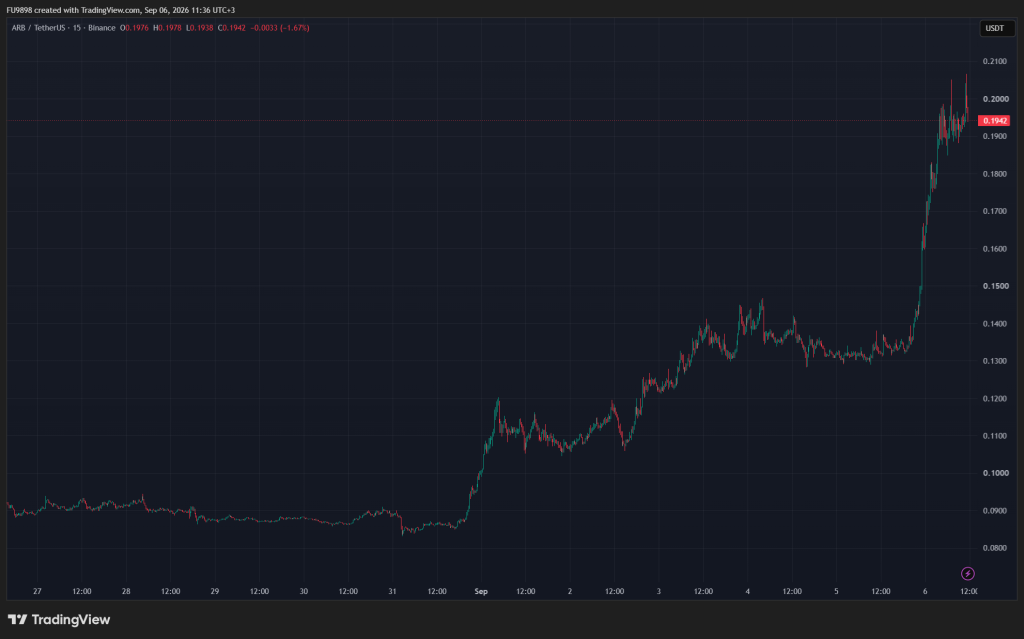
Arbitrum ($ARB) experienced one of the most remarkable price increases in the cryptocurrency market today. Ranked as the 53rd largest cryptocurrency by market capitalization, $ARB rose approximately 49% in the last 24 hours, reaching $0.1972. While the increase exceeded 50% at some points during the day, $ARB still remains approximately 92% below its all-time high of $2.40 recorded on January 12, 2024.
A chart with 15-minute candles showing the recent rise in $ARB price.
One of the main catalysts behind the sharp rise in $ARB is the rapid growth of Robinhood Chain, built on Robinhood’s $ARB technology. Robinhood Chain, an Ethereum Layer 2 network that launched its mainnet on July 1, 2026, uses the Arbitrum Orbit infrastructure. Under the Arbitrum Expansion Program, $ARB-based chains operating outside of Arbitrum One and Nova contribute 10% of their net protocol revenue to the Arbitrum ecosystem. According to Arbitrum Foundation data, in July, the first month of Robinhood Chain’s operation, the $360,000 in licensing revenue generated from this program constituted 35% of Arbitrum DAO’s monthly revenue.
The recent extraordinary acceleration in activity on Robinhood Chain has further increased the importance of this revenue model for Arbitrum. Daily transaction fees on the network surged to millions of dollars in early September, surpassing the Ethereum mainnet and Coinbase’s Base network on some days. Record levels were also seen in Robinhood Chain’s decentralized exchange trading volume, with the network’s 24-hour DEX volume reaching billions of dollars, increasing investor interest in the $ARB ecosystem.
One of Robinhood Chain’s prominent use cases is its “Stock Tokens” product. Issued by Robinhood Assets Limited, these tokens track the economic performance of US stocks such as NVIDIA, Apple, and Alphabet. While not providing users with direct legal ownership of company shares, the products are offered in numerous countries outside the US.
The economic model between Arbitrum and Robinhood also sparked a notable debate on social media between the founders of Solana and Arbitrum. Anatoly Yakovenko, co-founder of Solana, argued that Robinhood Chain’s 10% revenue share paid to the Arbitrum ecosystem was enough to cover approximately four times the transaction fees on Solana, suggesting that if Robinhood chose Solana, it could offer users significantly lower, even subsidized, transaction costs.
Steven Goldfeder, co-founder of Offchain Labs and $ARB, responded to Yakovenko, stating that Robinhood retains approximately 90% of the gas revenue on the $ARB infrastructure, while it does not receive any revenue from basic network transaction fees on Solana. Goldfeder added that by choosing Arbitrum, Robinhood has opted to “become a homeowner instead of a tenant.”
In $ARB’s revenue sharing model, 8% of the 10% share is allocated to the Arbitrum DAO treasury, managed by $ARB holders, and 2% is dedicated to ecosystem development. Therefore, continued growth in transaction volume and network revenue on Robinhood Chain, while not directly distributed to $ARB token holders, is seen as a significant factor strengthening Arbitrum DAO’s revenue and ecosystem economy.
Polish Sejm Fails to Overturn Presidential Veto On Crypto-Asset Market Act
Poland is facing a battle regarding cryptocurrency regulation amid a national scandal involving the demise of Zondacrypto, the largest local cryptocurrency exchange.
Prime Minister Donald Tusk called last month for a revision of the Crypto-Asset Market Act, which President Karol Nawrocki vetoed three times, after he warned the public about the act’s effects on Poles’ freedom and stability. At the time, he stressed that, given the circumstances, he could “no longer imagine that President Nawrocki, Chairman Kaczyński, and former Prime Minister Morawiecki would reject this problem with such incredible lightness.”
On Thursday, pushed by Tusk, the Sejm added the issue to its working agenda, allowing limited discussion, according to official reports. A vote followed on Friday, where the initiative failed to get the needed support for overturning Nawrocki’s veto, managing only to reach 241 of the 266 votes needed.
The motion marks the third time that the Sejm has failed to overturn the presidential veto on this crypto law, meaning Polish crypto operators still face a difficult task complying with the Markets in Crypto Assets (MiCA) framework, registering their activities in other jurisdictions before operating.
The failed initiative follows a corruption probe that involves government officials connected with Zondacrypto, a national exchange that stole up to $94 million in customer funds. Polish Olympic Committee President Radosław Piesiewicz was detained in connection with this investigation.
Tusk blasted Nawrocki’s party representatives, accusing them of colluding with Zondacrypto and turning Przemysław Kral, Zondacrypto’s former CEO, into a local celebrity.
“In a sense, those who opened the door to the man behind Zonda Crypto—that is, you—very specifically: you, who brought him into the mainstream; who made Zondacrypto the de facto owner of the Polish Olympic Committee,” he declared while addressing the Sejm.
“Zondacrypto infiltrated the Polish state—it infiltrated the Polish state for a long time and without hindrance—because leading politicians from your party guided this company and its owners to the very highest echelons of power,” Tusk concluded.