South Korea-based cryptocurrency exchange Bithumb has listed CP, the native token of Cluster Protocol. According to the exchange’s announcement, CP trading began today at 09:30.
The listing is significant in terms of increasing accessibility for the CP token to investors in South Korea, as well as trading volume and liquidity. Bithumb users can now trade CP through the platform following the listing.
Upbit, one of South Korea’s leading cryptocurrency exchanges, has also started offering trading support for Cluster Protocol (CP). The exchange launched CP trading with KRW, $BTC, and $USDT trading pairs today at 08:30.
Upbit’s offering of three different trading pairs expands access to the CP token for different investor groups. The KRW pair allows direct trading via the South Korean won, while the $BTC and $USDT pairs facilitate access to the token for cryptocurrency investors.
The simultaneous listing of CP on Bithumb and Upbit is a noteworthy development in terms of the token’s visibility and liquidity in the South Korean market. CP’s trading volume and price performance will be closely monitored in the coming period.
R3E Network has resolved all 11 findings from a systematic audit of neox-rs, the Rust-based Neo X full-node client, including four classified at P1 severity. Separately, R3E shipped a security-focused release for the Neo Decompiler, hardening its parsing, output sanitisation, and release pipeline.
Both releases reflect a security-first development approach across R3E’s Neo tooling, with neox-rs v2.5.2 targeting consensus and cryptographic correctness while the decompiler update addresses input handling and supply-chain integrity.
neox-rs v2.5.2: audit remediation
The v2.5.2 release closes all findings from a Sept. 5 audit review, with fixes spanning consensus, Anti-MEV transaction handling, and cryptographic operations. The client, built on Paradigm’s Reth framework, was first released in July as the first alternative full-node client for Neo X and reached its first stable release shortly after.
Among the P1-severity fixes, the dBFT ChangeView tally has been aligned with the nspcc-dbft v0.3.2 reference implementation. The previous tally logic contained a duplicate detection issue that could affect view-change progression. The fix introduces cumulative per-request tallying and restores the recovery path for future views with cumulative contribution rules.
A second P1 fix addresses Anti-MEV reconstruction pool admission. The pool now uses parent-state per-sender tracking for nonce and cost validation, matching the behavior of the Geth reference client. This ensures that enveloped transactions entering the reconstruction pool are validated against consistent state rather than potentially stale sender data.
The third P1 finding concerns PKCS#7 decryption handling. neox-rs now implements a Pkcs7Strict hardfork with an optional neoXPkcs7StrictBlock genesis field for versioned activation. The release introduces dual-mode decryption: strict mode enforces RFC 5652 compliance, while legacy mode preserves pre-fork replay compatibility. A corresponding Geth patch is included in the release with SHA-256 verification.
Validator safety and test coverage
Beyond the audit findings, the release introduces a durable validator signing-duty journal stored in neox-dbft-duties.jsonl. The journal is fsync-backed and restart-safe, providing equivocation protection by refusing to sign a different payload for the same duty after a restart. Torn crash recovery uses hash-shape validation to ensure journal integrity.
The release also adds reconstruction retry with exponential backoff and an offline envelope census scanner for historical PKCS#7 validation.
All 418 tests in the Neo X Rust suite pass with zero failures. Five cross-implementation test suites validate compatibility against Geth reference client vectors covering threshold encryption, decryption, padding, reshare, and ciphertext admission. The release maintains strict clippy compliance and nightly rustfmt formatting.
Binaries are available for Linux x86_64, Linux aarch64, and macOS Apple Silicon. The client supports Neo X MainNet (chain ID 47763) and T4 TestNet (chain ID 12227332).
Neo Decompiler v0.14.0
The Neo Decompiler, which converts NEF bytecode and manifest metadata into readable C# source, received a security-audited release across three separately versioned deliverables: the Rust crate at v0.14.0, the JavaScript package at v2.1.0, and the web package at v0.14.0.
Jimmy Liao, R3E Network founder, described the update:
“NEF + manifest -> readable C#. This update fixes Rust branch/loop analysis, preserves JS call order & side effects, and hardens parsing. 103/103 pinned devpack contracts compile with Roslyn.”
CALLT and method-token hardening
The release caps NEF method-token arity at the Neo VM stack limit of 2048, preventing oversize inputs from causing unexpected behavior. Unresolved method-token calls now receive deterministic index-derived labels, and same-named method tokens are resolved by token index rather than method name. Restricted or hostile token names are no longer used as executable identifiers in decompiled output.
Argument rendering for CALLT expressions has been corrected to preserve evaluation order and side effects. High-level and C# rendering paths no longer substitute placeholders for missing values.
Output sanitisation and pipeline hardening
All generated source and CLI output now escapes control characters, bidirectional formatting characters, and line separators. Schema input, diagnostics, and error counts are capped, and oversize files are rejected before buffer allocation.
The release pipeline itself has been hardened. GitHub Actions revisions are pinned, packaging and publishing jobs are separated with SHA-256 verification between stages, and npm archive creation uses fail-closed scripts. Ambiguous tar encodings and unsafe archive layouts are rejected during packaging.
Additional improvements include corrected immediate dominator computation for deep merge cases in SSA construction, aligned WebAssembly report shapes with the TypeScript API, and a new Criterion benchmark suite for deterministic performance tracking.
The release notes can be found at the links below: https://github.com/r3e-network/neox-rs/releases/tag/neox-v2.5.2 https://github.com/r3e-network/neo-decompiler/releases/tag/v0.14.0
Worldcoin [$WLD] rallied by more than 13% in the past 24 hours, doubling its weekly profits to over 26%. The altcoin has been, on average, bullish over the past 30 days, with gains exceeding 50% as of press time.
The altcoin is surging amid renewed interest in AI despite a massive token unlock. Here are the bullish signals that outweighed the unlock’s selling pressure:
Why is Worldcoin rallying?
Renewed interest in AI was evident not only in Worldcoin but also in Near Protocol [NEAR], Bittensor [TAO], Injective [INJ], and Internet Computer [ICP]. They all recorded double-digit gains from a similar time scale.
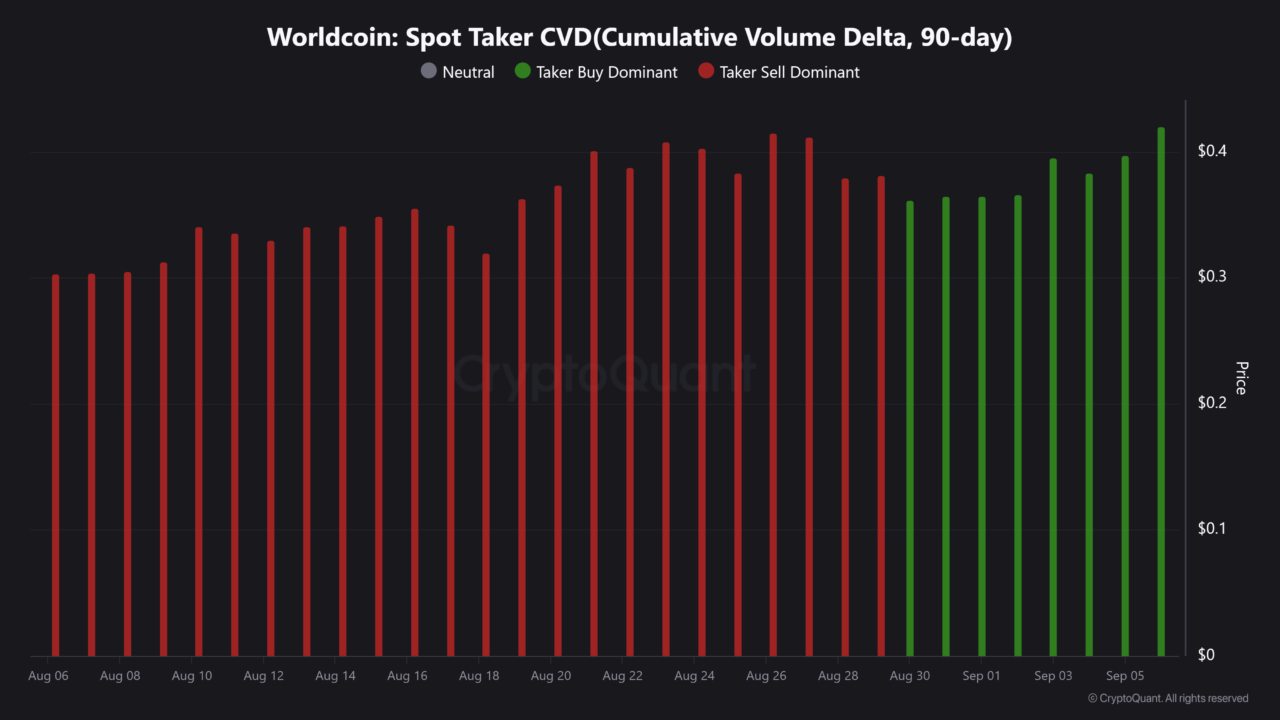
The buying activity was evident in the reading of the Spot Taker CVD of the past three months. This metric had flipped green in the last two days of August, indicating buyer dominance.
Source: CryptoQuant
Additionally, the Long/Short Ratios on Binance and OKX were all above 1.70. The Top Trader Long/Short ratios for accounts and positions are 1.93 and 2.11, indicating large players were invested.
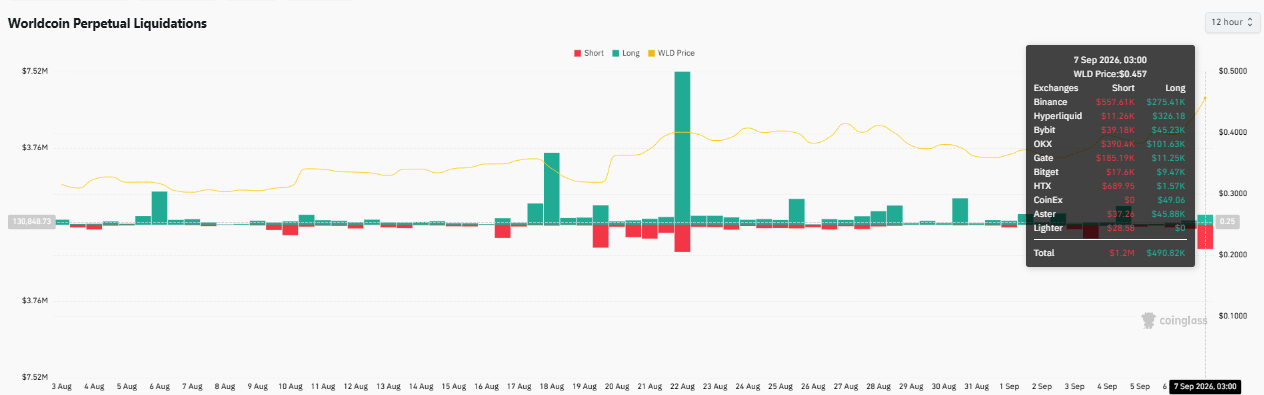
As a result, this buying volume forced a spike in liquidation of leveraged shorts, wiping out more than $1.20 million in 12 hours. Such activity accelerated the rally. On the other hand, only $490K in long orders was liquidated.
Source: CoinGlass
$WLD price breaks out—Is a market structure shift unfolding?
Apart from leveraged buying and short liquidations pushing $WLD higher, its technical outlook was also aligned.
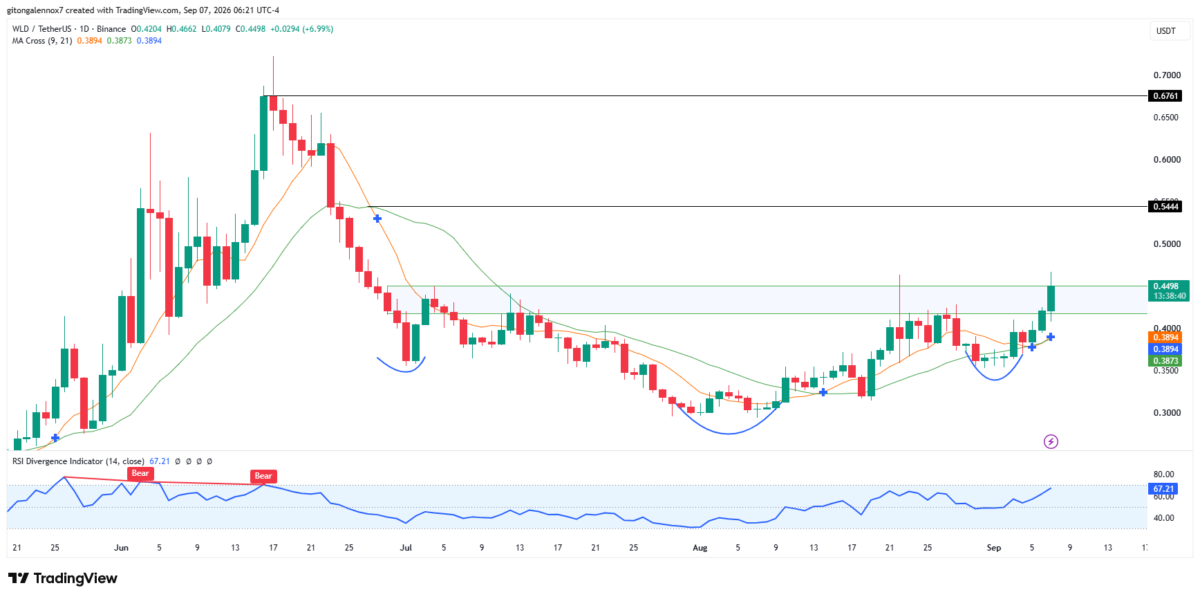
The altcoin broke above the $0.41-$0.45 zone, which is the most recent lower high. It was also the neckline of an inverted head-and-shoulders pattern. The breakout hinted at a potentially shifting market structure.
Therefore, $WLD’s bullish target areas would be $0.55 and above the true close at $0.67. But that would only happen if bulls could keep the altcoin above the supply zone, which closes at $0.45.
Source: $WLD/USDT on TradingView
However, the RSI divergence was still having a bear signal even though its reading at 67 was above the neutral level. The reading indicated the selling pressure was yet to be exhausted.
Why could this rally be a dead cat bounce?
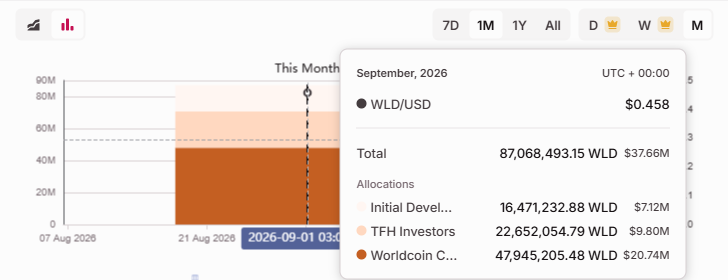
The selling pressure still exists after the scheduled unlock of 69 million $WLD tokens on the 7th of September, valued at $28 million. This amount is only a fraction of 87 million tokens set for September.
This selling pressure puts the rally at risk.
Source: Tokenomist
On top of that, the market structure was yet to be confirmed, as the price was ranging around $0.45.
Final Summary
Worldcoin surges by more than 13% amid AI coins’ awakening, buying activity, and short liquidations.
$WLD’s bulls attempt to break past $0.45, which would confirm a bullish market structure shift on the daily chart.
Traders scanning the order books got a surprise when Abraxas Capital bought 13,000 $ETH, valued at $32.39 million, to hedge its substantial short position of 141,180 $ETH, worth $353.27 million. This strategic move, highlighted by CryptoTwitter commentator @lookonchain, demonstrates a significant shift in trading tactics within the Ethereum market, suggesting that traders may be preparing for increased volatility ahead.
Breaking It Down
Ethereum commands a significant portion of the tokenized commodity market, currently holding 65.7% of the total market. Despite this dominance, recent shifts in trader sentiment indicate a growing uncertainty regarding its future ranking among cryptocurrencies. The latest purchase by Abraxas Capital signals that institutional players are actively adjusting their strategies in response to market dynamics, potentially foreshadowing increased volatility in Ethereum’s price action.
Key Details
Abraxas Capital bought 13,000 $ETH for $32.39 million. The firm is hedging against a short position of 141,180 $ETH worth $353.27 million. This transaction occurred on Hyperliquid, indicating active trading strategy adjustments. The purchase reflects broader trends in Ethereum trading as market sentiment shifts. This move may influence other institutional traders’ strategies moving forward.
The Numbers
The broader crypto market exhibits mixed signals, with Ethereum’s price remaining stable despite fluctuations in sentiment. The recent acquisition by Abraxas Capital suggests that there may be underlying factors influencing trader behavior. As the market continues to react to external pressures, Ethereum’s current trading volume remains low, indicating a cautious approach among market participants. Despite this, the ongoing adjustments by institutions like Abraxas Capital could lead to shifts in momentum in the near future.
Ethereum is a leading platform for smart contracts and decentralized applications, making it a critical player in the crypto ecosystem. The trading decisions of firms like Abraxas Capital highlight the competitive nature of the market and the need for strategic hedging to manage risks effectively.
What Traders Are Watching Next
Traders are advised to monitor Ethereum’s price action closely, particularly as institutional interest continues to evolve. The recent purchase by Abraxas Capital may foreshadow increased volatility as traders reassess their positions. Key levels to watch include support and resistance zones that could dictate future price movements as the market reacts to ongoing shifts in sentiment and strategy.
The crypto market is volatile, and predictions are subject to change.
A Mexican national could spend up to two decades in prison after pleading guilty to laundering $4 million worth of drug trafficking proceeds via crypto.
The U.S. Department of Justice (DOJ) says Carlos Erick Vazquez Gonzalez, 48, earned $40,000 by working with various “money brokers” who had him collect drug profits earned in cities throughout the country.
Gonzalez ended up securing $4 million worth of the drug profits in a crypto wallet. He quickly moved the digital assets to obscure their origins, then sold the crypto for US dollars in Mexico.
The DOJ says Gonzalez then returned the cash to a “money broker” who arranged the pickup of drug proceeds in the US.
The Mexican national’s sentencing is scheduled for December 17th. He faces a maximum penalty of 20 years in prison.
US regulators also claim Mexican drug cartels employ crypto for multiple purposes beyond money laundering. In 2024, the Financial Crimes Enforcement Network (FinCEN) said Mexican drug traffickers were using digital assets to purchase fentanyl precursor chemicals, pill presses, die molds and other manufacturing equipment from Chinese companies.
The cartels reportedly rely on Bitcoin (BTC), Ethereum (ETH), the top stablecoin USDT and the privacy coin Monero (XMR), among other crypto assets.
FinCEN is an agency at the U.S. Department of the Treasury that polices money laundering and terrorism financing.
Bitcoin has processed 893,391 transactions in one day, its fourth-highest daily total on record and a reading above the 99th percentile of its historical range.
Bitcoin transaction count enters its historical top four
Galaxy Research reported the milestone in a Sept. 7 post on X, placing the latest total among the most active days since Bitcoin began operating in 2009.
“Yesterday was the 4th largest daily transaction count in Bitcoin’s history,” the firm said.
At 893,391, the count also exceeded 99% of all daily readings recorded by the network, according to Galaxy’s data. The research firm did not identify a single event, application, or group of users responsible for the increase.
Yesterday was the 4th largest daily transaction count in Bitcoin’s history. The daily transaction count of 893,391 is above the 99th percentile of its historical range. pic.twitter.com/ROm8TYgXwK
— Galaxy Research (@glxyresearch) September 7, 2026
YCharts recorded the same total and showed that daily transactions had risen from 723,854, representing an increase of about 23.4% in 24 hours. Compared with 441,035 transactions on the corresponding day a year earlier, activity had climbed by approximately 102.6%.
The increase extends a recovery that was already visible earlier in 2026. Data based on Blockchair showed that Bitcoin processed 862,979 transactions on June 23, which ranked as the third-highest daily total at the time.
June’s average reached 651,655 transactions per day, up 90% from the 342,866 average reported for June 2025. Bitcoin’s median daily count had fallen to 417,151 during 2025, an 18% drop from the 508,934 median registered in 2024.
Earlier Blockchair figures placed April 23, 2024, at 927,010 transactions and Sept. 8, 2024, at 910,083. Galaxy’s updated fourth-place ranking for the 893,391 reading indicates that another session has since entered the top three.
Small Bitcoin transfers have driven much of the increase
Research from CryptoQuant has linked much of Bitcoin’s 2026 transaction growth to small transfers rather than a matching rise in the value moved across the network.
Transfers below 0.01 $BTC accounted for about 80% of Bitcoin transactions in 2026, according to data cited by CoinMarketCap in August. Their share stood near 44% in 2023, meaning low-value transfers have nearly doubled their portion of the network’s daily activity.
CryptoQuant head of research Julio Moreno said the economic value carried by the transactions remained small compared with their share of the total count. While the data shows that more transfers are reaching the blockchain, it does not establish that a similar increase has occurred in payment value, investment demand, or unique users.
A July crypto.news examination of transaction-count limitations also found that raw totals can provide an incomplete picture when fees are low. Cheap transactions allow automated systems, applications, or a small number of users to generate substantial activity without moving a comparable amount of capital.
Bitcoin transactions can also contain several inputs and outputs. A sender may pay more than one recipient in a single transaction, while exchanges and custodians may combine withdrawals through batching. Users can also move funds between addresses under their own control, so a transaction does not necessarily represent a payment between two separate people.
Lightning Network payments are settled away from Bitcoin’s base layer until participants close or rebalance their channels. As a result, the 893,391 figure covers confirmed on-chain transactions rather than every payment made using Bitcoin-linked infrastructure.
Network data shows volume and addresses moving differently
Blockchain.com’s dashboard paired the 893,000 transaction reading with approximately 415,000 active addresses, down 10.7% from the previous period. The difference shows that transaction totals and address activity can move in opposite directions because one address may participate in several transfers.
Transferred value reached about $3.36 billion, an increase of 33.8%, while total network fees stood near $191,073, down 8.1%, according to the same dashboard. Fee revenue therefore declined even as the number of confirmed transactions increased.
BitInfoCharts separately showed an average transaction fee near 0.0000024 $BTC, worth about $0.19 at the recorded price, and a median transfer value of roughly $34.69. Its latest 24-hour window did not align exactly with the calendar-day period used by Galaxy, so the readings describe surrounding network conditions rather than the same fixed reporting period.
The relationship between high transaction volume and modest fees depends partly on the amount of block space consumed by each transfer. A transaction with many inputs can use more data than a simple payment, while exchanges can reduce their footprint by placing several customer withdrawals in one transaction.
Ordinals previously showed how a new type of activity could change Bitcoin’s transaction profile. During an earlier record in 2023, more than 307,000 Ordinals-related transactions were recorded in one day, according to Dune data cited at the time by Blockworks. Galaxy’s latest post did not attribute the September 2026 increase to Ordinals, Runes or another protocol.
U.S. investors face different on-chain and ETF exposure
For American investors, the importance of Bitcoin transaction activity depends on how they hold the asset. Buyers who use self-custody wallets create or receive on-chain transfers, while shareholders in U.S.-listed spot Bitcoin exchange-traded funds trade securities through brokerage accounts.
An earlier Bitcoin ETF explainer detailed how fund creations and redemptions differ from ordinary exchange purchases. Buying an ETF share does not directly create a Bitcoin transaction for each investor because authorized participants, fund sponsors and custodians handle the product’s underlying settlement process.
Daily blockchain totals cannot separate ETF-related custody movements from exchange withdrawals, individual payments, mining transfers, or wallet reorganizations. Transaction count also does not show whether a transfer represents buying or selling because the blockchain records movements between addresses rather than the purpose behind them.
Recent activity among older wallets provides another example of the distinction. A September report on older holdings cited K33 Research data showing that nearly 890,000 $BTC moved during a seven-day period in early August, the highest seven-day active supply reading of 2026. Bitcoin was trading within one of its narrowest 30-day ranges since 2023 at the time, separating the on-chain movement from a major price breakout.
U.S. tax rules also treat Bitcoin transactions according to their purpose instead of their appearance on the blockchain. The Internal Revenue Service states that moving digital assets between wallets or accounts owned by the same taxpayer is generally not a taxable event, while selling crypto, exchanging it for another asset, or using it to buy goods and services can produce a reportable gain or loss.
Chainalysis estimated in August that the United States accounted for $112.6 billion of potentially taxable on-chain crypto activity during 2025. Its research placed the worldwide total above $457 billion but estimated that transactions within the reach of international reporting rules represented only 14% of the activity identified.
Under IRS guidance, taxpayers must retain records showing the asset’s acquisition date, cost basis, disposal date, proceeds, and resulting gain or loss for taxable digital-asset transactions.
KuCoin recently raised alarms regarding the threat of 51% attacks in blockchain networks. This serious security concern arises when a single miner or mining pool gains control over the majority of a network’s hashrate, risking the integrity of transactions. If successful, such attacks can lead to double-spending and a breakdown of trust within the network. For further details, refer to KuCoin’s tweet.
The Key Development
Traders scanning the order books got a surprise when KuCoin highlighted the risks associated with 51% attacks. Such attacks could allow a miner to manipulate transaction history, raising concerns about the reliability of affected networks. The broader crypto market is already exhibiting mixed signals, making this warning particularly timely. Ensuring network resilience against such threats will be crucial for maintaining investor confidence in blockchain technology.
The Essentials
KuCoin’s alert emphasizes the risks of 51% attacks prevalent in blockchain networks. The potential for a single miner to control majority hashrate poses severe security threats. Without proper safeguards, networks are vulnerable to transaction manipulation and double-spending. The tweet signifies the importance of community awareness in safeguarding blockchain integrity. As the crypto landscape evolves, maintaining robust security measures is essential.
Market Pulse
The crypto market currently reflects varying momentum, with some assets showing resilience while others struggle. KuCoin’s warning about 51% attacks adds another layer of complexity for traders navigating this landscape. While there are no immediate price changes to report, the implications of such security risks could influence market sentiment in the coming days.
KuCoin is a prominent cryptocurrency exchange known for its wide range of trading options and services. Given the increasing reliance on blockchain technology, the exchange’s jurisdiction extends to ensuring user security and promoting awareness of potential risks. The emergence of threats like the 51% attack underscores the critical need for vigilance in the crypto space.
What Comes Next
What traders should watch next includes the reactions from major mining pools and blockchain networks in response to KuCoin’s warning. Analysts suggest monitoring hashrate distributions across networks to gauge vulnerability levels. If larger mining pools do not adopt protective measures, we may see increased scrutiny from regulators concerned about the integrity of blockchain operations. Overall, heightened awareness could lead to more robust security protocols, which traders will be keen to observe.
This article is for informational purposes only and should not be considered as financial advice.
Bitcoin $BTC$79,394.02 may be a better hard asset than gold, according to a correlation study.
Both have been rising recently, just as concerns about the fiscal health of advanced-economy governments have come to dominate market sentiment, pushing bond yields, or market-implied borrowing costs, higher.
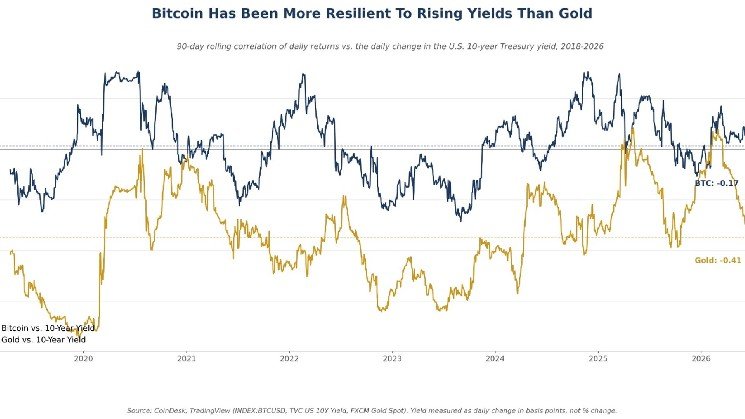
As of today, the 90-day correlation coefficient between $BTC and gold’s daily returns stands at 0.59, according to data from TradingView and CoinDesk. That’s the highest since 2020, when central banks and governments were printing truckloads of money to cushion the economy and markets during the pandemic.
While both are viewed as hard assets that stand to benefit from fiscal worries and the prospect of financial repression, bitcoin seems to have a slight edge.
The reason lies in its relationship with the U.S. 10-year Treasury yield, the benchmark borrowing cost that influences credit conditions across the economy (check Today’s Signal). An increasing bond yield is typically seen as a headwind for assets like gold and bitcoin, which just sit in investors’ portfolios without generating any new cash.
Bitcoin’s correlation with the 10-year yield is negligibly negative, and notably weaker than gold’s.
Britain’s Financial Conduct Authority (FCA) has held talks with trading platforms about potentially easing its ban on financial prediction markets for retail investors, according to a report by The Times.
Prediction markets let users take yes-or-no positions on the outcome of future events across various categories, including economics, sports, and weather. The FCA treats contracts linked to financial and certain weather events as binary options, whose sale to retail investors has been prohibited since 2019.
The regulator has weighed lifting the restriction as U.K. consumers increasingly access overseas platforms including market leaders Kalshi and Polymarket.
The FCA’s public position continues to support that restriction. Its latest perimeter report said the ban remained appropriate because of the speculative nature of the contracts and the risk of consumer harm, while leaving open the possibility of further work on access or clarification of the regulatory boundary.
Industry participants have been lobbying for a change, presenting officials with evidence that millions of Brits are using overseas prediction platforms, The Times reports. Some consumers bypass geographic restrictions using virtual private networks (VPNs), leaving them outside UK consumer protections.
Bitcoin has experienced sharp fluctuations in the past week. Having started September at around $78,000, $BTC surged above $82,000 during the week, reaching its highest level since May. However, it couldn’t maintain this level and fell back below $80,000.
As of today, with Bitcoin falling below $80,000, data shows that US spot Bitcoin ETFs have recorded net inflows for the third consecutive week. Spot Ethereum ETFs also extended their inflow streak to three weeks, signaling a recovery in institutional demand.
Positive Series in Spot Bitcoin and Ethereum ETFs!
According to SoSoValue data, US spot Bitcoin ETFs saw a net inflow of $986.9 million last week. This marks the third consecutive week of positive inflows into Bitcoin ETFs. The previous week, net inflows were $924.5 million.
BlackRock’s IBIT fund stood out in weekly inflows, with total net inflows reaching approximately $3.8 billion over the past three weeks. This period marks the strongest three-week inflow streak for Bitcoin ETFs in 2026.
Spot Ethereum ETFs also saw a net inflow of $218.4 million last week. This marks the third consecutive week of positive inflows into Ethereum ETFs.
ETFs continued their strong performance in August. Spot Bitcoin ETFs saw net inflows of $3.52 billion during the month, while spot Ethereum ETFs saw net inflows of $1.85 billion. This monthly inflow into Bitcoin ETFs was the strongest monthly performance since September 2025.
Bitcoin Prediction: $82,000-$85,000!
Speaking to The Block, Zeus Research analyst Dominic John stated that the bullish pattern in Bitcoin will remain valid if the $80,000 level is maintained.
At this point, the analyst predicted that $BTC’s uptrend would remain strong as long as it held above the $80,000 level, and that prices would gradually rise towards $82,000-$85,000. The analyst noted that the next significant upward move could depend on macroeconomic developments.
John noted that continued ETF inflows indicate that institutions are increasing their $BTC investments and that real spot demand is recovering.
The Biggest Risk for Bitcoin is Inflation!
Presto Research analyst Min Jung said the crypto market is starting to close the gap with other risky assets and that ETF inflows indicate a recovery in institutional demand.
However, Jung considers higher-than-expected US inflation data a significant risk that could dampen the upward trend in Bitcoin.